

No fees unless we win.
Get a free consultation
8 Reviews
5.0
★★★★★

Depo-Provera Lawsuit [2026 Update]

Depo-Provera Injections Linked to Meningioma Brain Tumors

The Depo-Provera lawsuit centers on claims that the birth control shot is linked to a significantly increased risk of developing meningioma brain tumors.

A 2024 study from the BMJ found that Depo-Provera users were at a 5.6x increased risk of developing brain tumors.

The Depo-Provera attorneys at Zoll & Kranz are actively reviewing claims and accepting new clients for the Depo-Provera litigation.

Depo-Provera Lawsuit

Do You Qualify for the Depo-Provera Brain Tumor Lawsuit?

Depo-Provera is an injectable birth control shot that uses medroxyprogesterone acetate to prevent pregnancy, typically given once every three months.

In recent years, published research and subsequent safety updates have raised questions about whether prolonged exposure to certain progestins, including medroxyprogesterone acetate, may be associated with an increased risk of meningioma, a tumor that forms in the tissues surrounding the brain and spinal cord.

Many people first learn something is wrong after severe headaches, vision changes, seizures, or other neurological symptoms lead to imaging and a brain tumor diagnosis.

As these concerns have gained attention, Depo-Provera cases have been brought in courts across the United States.

Most Depo-Provera lawsuits have been centralized in a federal Depo-Provera MDL to coordinate discovery, expert issues, and pretrial rulings across similar claims.

The core legal claims generally allege that manufacturers failed to provide adequate warnings about the meningioma risk and that patients and prescribers were not given clear information needed to weigh alternatives.

Through filing lawsuits, plaintiffs typically seek accountability and compensation tied to tumor-related harms, including diagnosis and treatment, lost income, and ongoing care.

These claims often focus on recovering medical expenses and other damages that can follow neurosurgical care, radiation, long-term monitoring, and the lasting effects a meningioma can impose on daily life.

If you or a loved one developed brain tumors after using Depo-Provera birth control shots, you may be eligible to file a Depo-Provera lawsuit and seek financial compensation.

Contact Zoll & Kranz today for a free consultation to find out if you qualify for a Depo-Provera lawsuit.

You can also use the chat feature on this page to get in touch with a Depo-Provera lawsuit attorney today.

Depo-Provera Lawsuit Overview

Depo-Provera is an injectable contraceptive that delivers a synthetic progestin intended to mimic the hormone progesterone.

In the United States, Depo-Provera and Depo SubQ Provera 104 are at the center of expanding pharmaceutical litigation focused on allegations that prolonged exposure may be linked to meningioma.

Many plaintiffs report that they were receiving Depo-Provera injections for years before learning they had a meningioma, often after headaches, vision changes, seizures, or other neurological symptoms prompted imaging.

The theory advanced in many complaints is that the use of Depo-Provera increases the risk of developing meningiomas, and that the drug’s progestin activity may contribute to tumor growth in susceptible patients.

These lawsuits typically frame the issue as a warning and patient-safety case rather than a dispute about whether the medication works as contraception.

As more cases have been filed, the federal judiciary centralized many of them into multidistrict litigation (MDL) to coordinate discovery and pretrial rulings across similar claims.

That centralized docket is designed to reduce duplicative proceedings while allowing each claimant to preserve an individual right to pursue damages based on personal medical history and outcomes.

Within that structure, the parties litigate what the science shows, what risks were known or reasonably knowable, and what the labeling communicated to prescribers and patients.

For many families, the lawsuits are also about accountability for the medical and financial disruption that can follow a meningioma diagnosis, treatment, and long-term monitoring.

Allegations commonly raised in these cases include:

  • Lawsuits allege the manufacturers failed to provide adequate warnings about meningioma risk associated with long-term use.
  • Plaintiffs claim the labeling and patient counseling materials did not plainly communicate that progestin exposure could be relevant to meningioma development and tumor growth.
  • Plaintiffs contend the companies did not act quickly enough to update warnings or risk information after emerging research and adverse event data.
  • Plaintiffs allege marketing and prescribing information understated clinically meaningful neurological risks for long-term users.
  • Plaintiffs claim safer contraceptive alternatives might have been chosen if complete risk information had been provided.
  • Plaintiffs allege the failure to warn contributed to delayed diagnosis and more invasive treatment for some patients.

The goal of this legal action is to secure compensation tied to the injuries and losses alleged to flow from meningioma, including treatment costs, lost income, and long-term effects.

The litigation also aims to test whether manufacturers met their duties to communicate known or knowable risks to prescribers and patients.

Like many MDL proceedings, the outcome can turn on expert evidence about causation, the adequacy of warnings, and whether the claimed mechanism of harm is supported by medical research.

How is Depo-Provera Use Linked to Brain Tumors?

Depo-Provera is a form of birth control injections that delivers depot medroxyprogesterone acetate (DMPA), a long-acting synthetic progestin.

The litigation focus is on meningioma, a typically non-malignant tumor that arises from the meninges, the tissue layers that surround the brain and spinal cord.

In epidemiology and neurosurgical literature, meningiomas are commonly described as the most frequent primary intracranial tumors, and they account for roughly 30% to 40% of primary central nervous system tumors.

That “most common” label matters in a lawsuit context because a common tumor can still be a severe diagnosis for an individual patient.

The baseline incidence is often cited around 9.5 cases per 100,000 people per year in general population estimates, with incidence increasing substantially with age.

When meningiomas become symptomatic, the symptoms can include chronic or worsening headaches, vision changes, hearing changes, seizures, and memory problems, and the presentation often depends on where the tumor is located.

BMJ Study Links Depo-Provera Use to Brain Tumor Risk

The study most frequently cited in public reporting and legal filings is a large French national case control analysis published in The BMJ.

The authors reported that prolonged use of certain progestogens was associated with increased risk of intracranial meningioma, including for injectable medroxyprogesterone acetate, and a related BMJ Group summary highlighted a 5.6-fold increased risk with prolonged use of the medroxyprogesterone acetate injection, with no increased risk observed for less than one year of use in that analysis.

This finding is frequently described in plain language as “women using Depo-Provera for over a year are about 5 times more likely to develop meningioma than non-users,” although the exact comparator group and exposure definitions vary by study design.

Researchers Have Considered the Link for Decades

The idea that hormones could matter in meningioma biology did not start with the current lawsuits.

Researchers were studying hormone receptor activity in meningiomas decades ago, including work in the early 1980s examining estrogen and progesterone binding sites in these tumors.

That long-running biologic context supports the plausibility argument plaintiffs rely on: if many meningiomas are hormone-responsive, then long-term exposure to a potent progestin could, in some patients, contribute to the development or growth of a tumor.

Depo-Provera Label Update: Brain Tumor Risk Added in December 2025

In December 2025, the FDA-approved U.S. label for Depo-Provera was updated to add explicit meningioma warning language, including directions to discontinue Depo-Provera if meningioma is diagnosed and to monitor for signs and symptoms.

For litigation, this matters because lawsuits are not only about whether an association exists, but also about whether the risk information was communicated in a way that allowed informed prescribing and informed consent before patients committed to long-term use.

Settlement Projections for Depo-Provera Claims

Depo-Provera lawyers estimate that, if this litigation reaches a settlement phase, individual payouts could fall in a broad range from around $100,000 to over $1 million.

These figures are not guarantees of compensation, and they should not be read as a promise that any claimant will receive a particular amount.

They are estimates drawn from how other mass tort and product liability cases involving dangerous drugs and serious, documented injuries have sometimes resolved when liability and causation evidence supported global negotiations.

The value of any Depo-Provera claim can vary sharply based on tumor type and location, whether surgery or radiation was required, long-term neurological effects, and how clearly medical records support causation and damages.

Awards or settlements, if they occur, can also depend on litigation factors like the strength of expert testimony, admissibility rulings, and the timing and content of warnings at issue.

Some claims may be worth less than $100,000, while others may exceed $1 million, particularly where treatment was extensive and the patient has lasting impairment.

Any settlement range discussion should be treated as a general reference point only, because outcomes are case-specific and no lawyer can ethically predict a result for an individual without reviewing the facts.

Who Qualifies to Sue Depo-Provera Manufacturers?

A person may have legal options if they were taking Depo-Provera as a birth control drug and were later diagnosed with a meningioma or another brain or spinal tumor.

Qualification usually starts with proof of use, including pharmacy records, medical charts showing injections, or other documentation confirming when and how long Depo-Provera was used.

Claim eligibility often turns on duration of exposure, timing of symptoms, and whether treating providers documented findings consistent with tumor development or growth after Depo-Provera use.

A confirmed diagnosis supported by imaging and specialist records is typically essential, along with evidence of treatment such as surgery, radiation, or ongoing monitoring.

Many claims also involve measurable damages, including medical bills, lost income, and lasting neurological effects that can be tied to the diagnosis and treatment course.

Potential claimants should act quickly because the statute of limitations can limit how long a person has to file, and the deadline may depend on when the tumor was discovered or when a reasonable person would have connected symptoms to Depo-Provera.

A lawyer can review records and explain legal options based on the facts, the filing deadlines that apply, and whether the case belongs in an MDL or another court.

Evidence for the Depo Shot Lawsuits

Strong evidence is the foundation of any Depo-Provera lawsuit.

Plaintiffs argue that Pfizer prioritized profits over patient safety by failing to conduct adequate studies on the long-term use of Depo-Provera, but those allegations must be supported by admissible proof in court.

To participate in the MDL, plaintiffs must provide clear documentation showing both their use of Depo-Provera and a confirmed diagnosis of a qualifying meningioma.

Courts require objective medical records, not personal recollection alone, to establish exposure and injury.

Without documented proof of injections and diagnosis, a claim will not move forward.

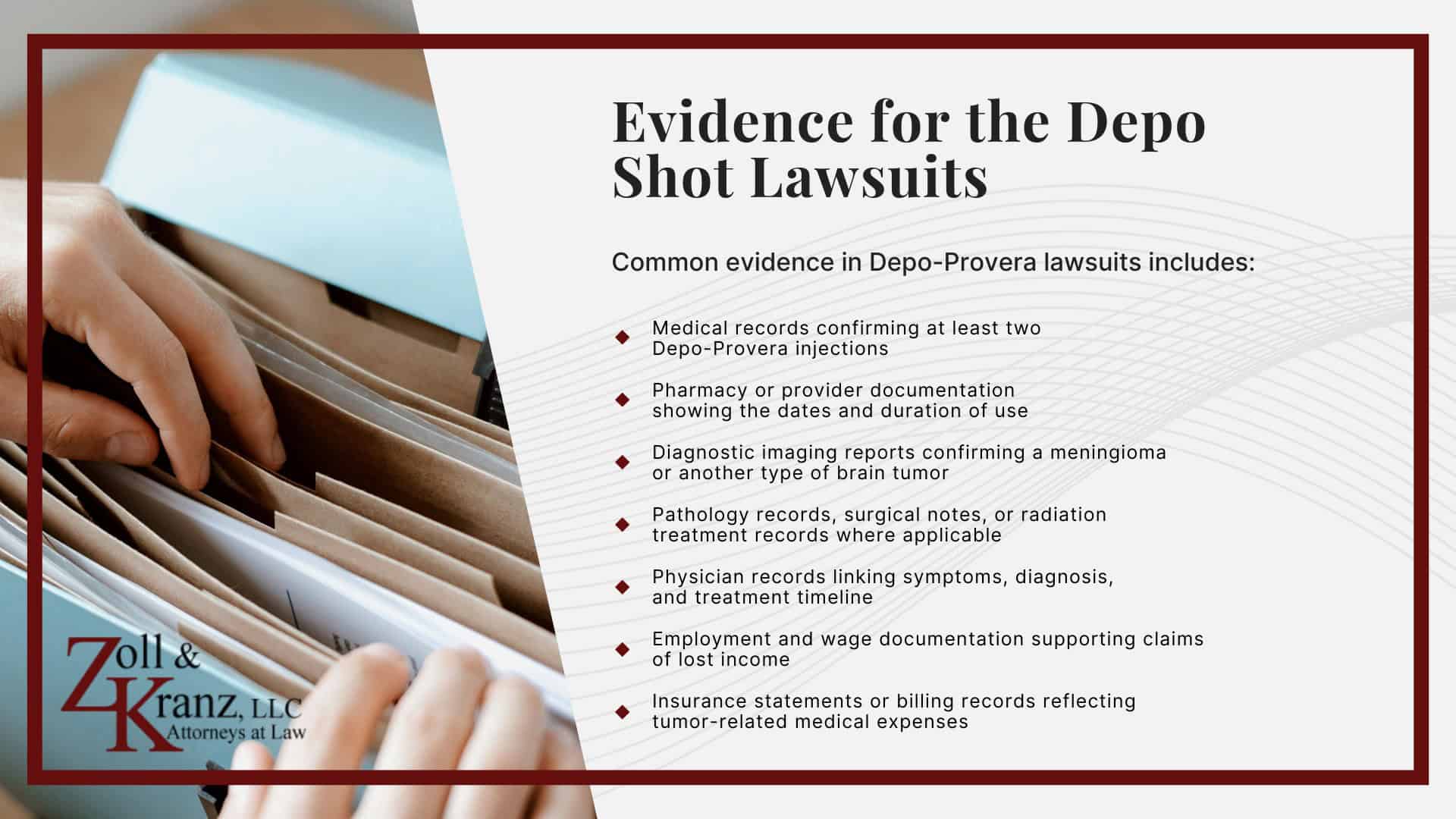
Common evidence in Depo-Provera lawsuits includes:

  • Medical records confirming at least two Depo-Provera injections
  • Pharmacy or provider documentation showing the dates and duration of use
  • Diagnostic imaging reports confirming a meningioma or another type of brain tumor
  • Pathology records, surgical notes, or radiation treatment records where applicable
  • Physician records linking symptoms, diagnosis, and treatment timeline
  • Employment and wage documentation supporting claims of lost income
  • Insurance statements or billing records reflecting tumor-related medical expenses

Potential Compensation in Depo Lawsuits

Damages refer to the financial and non-financial losses a person claims resulted from an injury.

In Depo-Provera lawsuits, plaintiffs allege that Pfizer failed to warn patients about the risk of brain tumors associated with this medication and that this failure led to avoidable harm.

Lawyers assess damages by reviewing medical records, employment history, billing statements, and expert evaluations to determine the full impact of a meningioma diagnosis.

Factors influencing potential settlement amounts often include the severity of the injury, total medical expenses, documented lost wages, and the degree of pain and suffering supported by the evidence.

Women who developed meningiomas after using Depo-Provera are advised to seek legal counsel to evaluate whether their documented losses support a viable claim under the allegations that Pfizer knew or should have known about the risks.

Damages that may be claimed in Depo-Provera lawsuits include:

  • Past and future medical expenses related to diagnosis, surgery, radiation, rehabilitation, and monitoring
  • Past and future lost wages or reduced earning capacity
  • Pain and suffering associated with neurological symptoms and treatment
  • Loss of enjoyment of life due to lasting cognitive or physical limitations
  • Out-of-pocket costs tied to travel, medication, or supportive care

Zoll & Kranz: Accepting New Clients for the Depo-Provera Lawsuit

If you were diagnosed with a meningioma or another brain tumor after taking Depo-Provera, you may have the right to pursue a claim.

These cases require documented proof of injections, diagnosis, and resulting losses, along with a careful review of filing deadlines and MDL procedures.

Our law firm is currently accepting new clients who believe their injuries may be connected to Depo-Provera use.

We will review your medical records, explain your legal options, and determine whether your case meets the criteria for inclusion in the ongoing litigation.

Contact Zoll & Kranz today to request a confidential case evaluation and learn whether you qualify to move forward with a Depo-Provera lawsuit.

You can also use the chat feature on this page to find out if you’re eligible to file a Depo-Provera lawsuit.

Frequently Asked Questions

Published by:
Share
Picture of Michelle L. Kranz
Michelle L. Kranz

Michelle is a founding partner of Zoll & Kranz, located in Toledo, Ohio. Michelle has been a plaintiff’s lawyer for the entirety of her practice – over 32 years. She devotes the majority of her time to complex consolidated litigation and class action including advocating for people injured by medical devices, prescription medications, or corporate negligence.

This article has been written and reviewed for legal accuracy and clarity by the team of writers and attorneys at Zoll & Kranz, LLC and is as accurate as possible. This content should not be taken as legal advice from an attorney. If you would like to learn more about our owner and experienced Ohio injury lawyer, Michelle L. Kranz, you can do so here.

Zoll & Kranz, LLC does everything possible to make sure the information in this article is up to date and accurate. If you need specific legal advice about your case, contact us. This article should not be taken as advice from an attorney.

Do you have a case?

A serious injury can have life-altering results.

Don’t settle for less than you deserve, speak with an award-winning personal injury lawyer today.

8 Reviews
5.0
★★★★★
Recovered damages
$35 Million+

Table of Contents

Practice Areas
About Zoll & Kranz, LLC

For over 37 years, Zoll & Kranz has been fighting for clients who have been the victims of the wrongful death of a loved one.

Do you believe you’re entitled to compensation?

Use our Instant Case Evaluator to find out in as little as 60 seconds!

Guides & Resources