A personal injury lawsuit is a civil claim filed by an injured person, called the plaintiff, against a person or entity alleged to have caused harm through negligence.
To establish liability in a personal injury case, the plaintiff must prove that the defendant was negligent and that this negligence caused the injury.
In Toledo, personal injury cases can stem from any negligent act that results in a severe injury, and motor vehicle accidents are often associated with these claims, but they are not the only type of case that qualifies.
Common examples include car accidents, truck accidents, slip-and-fall injuries, motorcycle injuries, bicycle injuries, dog bites, construction site injuries, and wrongful death claims when a family member is killed due to someone’s negligence.
Slip-and-fall injuries can occur when a property owner fails to maintain a safe environment for guests, and dog bite injuries can support a claim when an owner is negligent in controlling their pet.
Bicycle accidents can result in serious injuries because riders have little physical protection compared to occupants of motor vehicles, and construction site injuries are common due to hazardous work conditions and the equipment used.
These cases are built around a few core legal concepts:
- Negligence
- Liability
- Damages
- Burden of Proof
Negligence in Personal Injury Claims
Negligence is the legal theory most Ohio personal injury cases rely on, and it focuses on whether the defendant failed to act with reasonable care under the circumstances.
The plaintiff must show that the defendant owed a legal obligation to act safely, then identify what the defendant did, or failed to do, that violated that obligation.
The claim also requires proof that the defendant’s conduct actually caused the injury, meaning the harm would not have occurred without it.
Beyond that, the plaintiff must connect the injury to foreseeable consequences of the defendant’s behavior rather than a remote or unrelated event.
Finally, the case must include real, measurable losses, such as medical bills, lost income, or other documented harm.
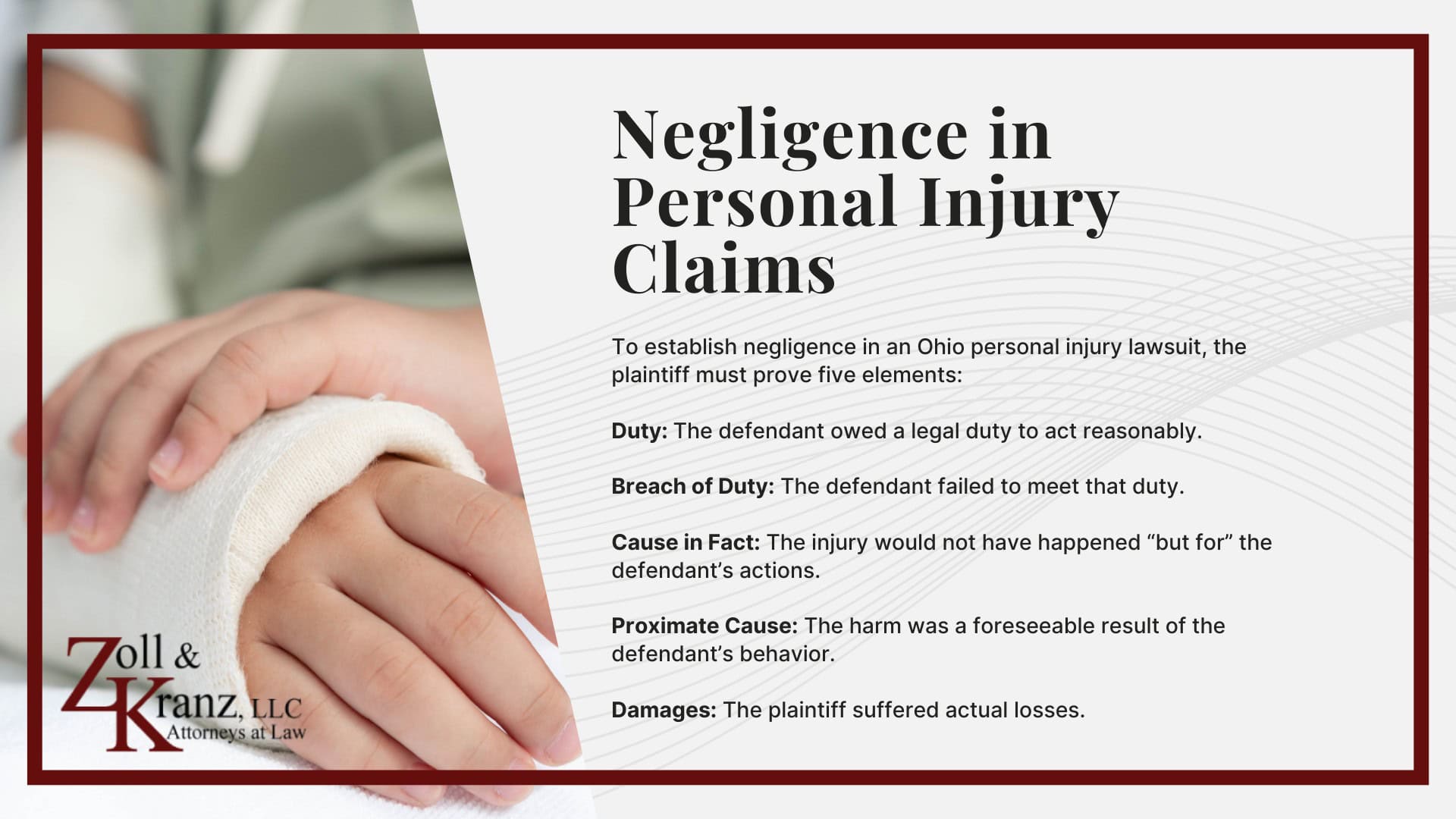
To establish negligence in an Ohio personal injury lawsuit, the plaintiff must prove five elements:
- Duty: The defendant owed a legal duty to act reasonably.
- Breach of Duty: The defendant failed to meet that duty.
- Cause in Fact: The injury would not have happened “but for” the defendant’s actions.
- Proximate Cause: The harm was a foreseeable result of the defendant’s behavior.
- Damages: The plaintiff suffered actual losses.
Ohio follows a 51% bar rule for shared fault, which affects the amount of damages a plaintiff can recover based on their percentage of fault.
Liability in Personal Injury Cases
Liability in a personal injury case means legal responsibility for the harm, and it determines whether the injured person can recover damages from the defendant.
It is established by showing that the defendant’s conduct, decision, or failure to act fell below the standard of reasonable care and caused the injury.
In many cases, liability turns on evidence such as crash reports, photographs, surveillance video, medical records, witness statements, and documentation of unsafe conditions.
Some claims involve more than one responsible party, such as a negligent driver and an employer acting within the scope of employment, or multiple companies connected to a dangerous worksite.
Ohio’s comparative fault rules can also affect liability, because compensation may be reduced based on the plaintiff’s share of fault, and recovery can be barred if the plaintiff is more than 50% at fault.
Liability can also extend beyond individuals to property owners, businesses, contractors, or manufacturers when their choices create hazards that lead to foreseeable injuries.
Personal Injury Damages
Damages are the losses an injured person can recover in a personal injury case, and they are usually divided into economic and non-economic categories.
Strong documentation, such as police reports, medical records, and witness statements, can make or break a claim because it shows what happened and how the injury changed the person’s life.
Economic damages in Ohio cover tangible losses without statutory caps, while non-economic damages are generally capped at the greater of $250,000 or three times economic damages, with a maximum of $350,000 per plaintiff in many cases.
Medical bills frequently make up a large portion of a settlement, especially when treatment is ongoing or involves specialists, imaging, surgery, and rehabilitation.
The two categories of damages in personal injury claims are:
- Economic damages: documented financial losses like medical bills, future medical care, lost wages, and other out-of-pocket costs.
- Non-economic damages: losses that are harder to measure, such as pain and suffering, typically tied to the severity and duration of symptoms and limitations.
To support economic damages, the claim needs documentation of every expense, including medical bills and proof of lost wages, not estimates or general statements.
Lost income can hit a household fast when an injury makes it impossible to work, and future earning loss can matter when recovery changes what the person can do long term.
Pain and suffering is often evaluated by the level of pain and disruption described in medical notes and reflected in day-to-day limitations.
A personal injury attorney can help gather records, frame the evidence in a way insurers and juries recognize, and seek compensation for pain and suffering, medical expenses, and lost wages.
Zoll & Kranz works to maximize every dollar tied to medical bills, lost income, and future needs, and many clients pay nothing unless there is a recovery because attorneys often work on a contingency fee basis.
What is the Burden of Proof for an Ohio Personal Injury Claim?
In an Ohio personal injury claim, the plaintiff generally has the burden of proof and must persuade the judge or jury by a preponderance of the evidence, meaning it is more likely than not that the defendant’s negligence caused the injury.
In practice, that standard is met when the evidence supporting the plaintiff’s version of events outweighs the defense evidence, even if only slightly.
The plaintiff must meet that standard on the core issues of the case, including duty, breach, causation, and damages.
Ohio law recognizes that some civil issues use higher standards than preponderance, such as “clear and convincing evidence,” which courts describe as more demanding than preponderance but less than “beyond a reasonable doubt.”
For most personal injury liability questions, though, the controlling burden remains the preponderance standard.