Building a strong personal injury case requires understanding the different forms of proof that collectively establish fault, injury, and financial loss.
Personal injury claims rarely rely on a single document or photograph. Instead, they are supported by multiple categories of information that work together to create a complete and credible record.
Each type of personal injury evidence serves a specific purpose, from demonstrating how an accident occurred to showing the full scope of physical, emotional, and economic harm.

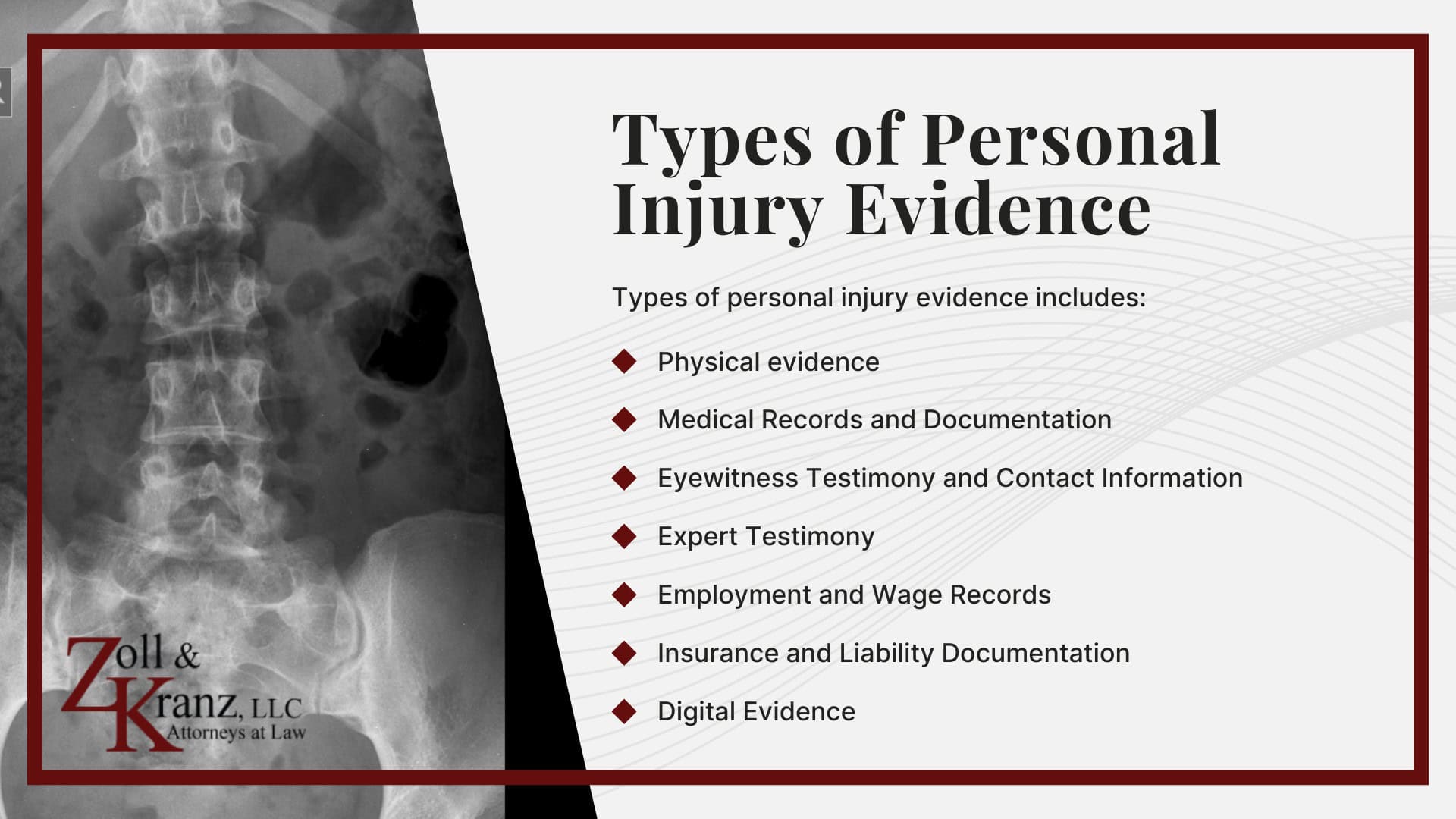
Types of personal injury evidence includes:
- Physical evidence
- Medical Records and Documentation
- Eyewitness Testimony and Contact Information
- Expert Testimony
- Employment and Wage Records
- Insurance and Liability Documentation
- Digital Evidence
Physical Evidence
Physical evidence is often the most immediate and compelling proof in a personal injury case because it captures conditions as they existed at the time of the incident.
Evidence gathered from the accident scene can help establish how an event occurred, whether safety hazards were present, and who may be legally responsible.
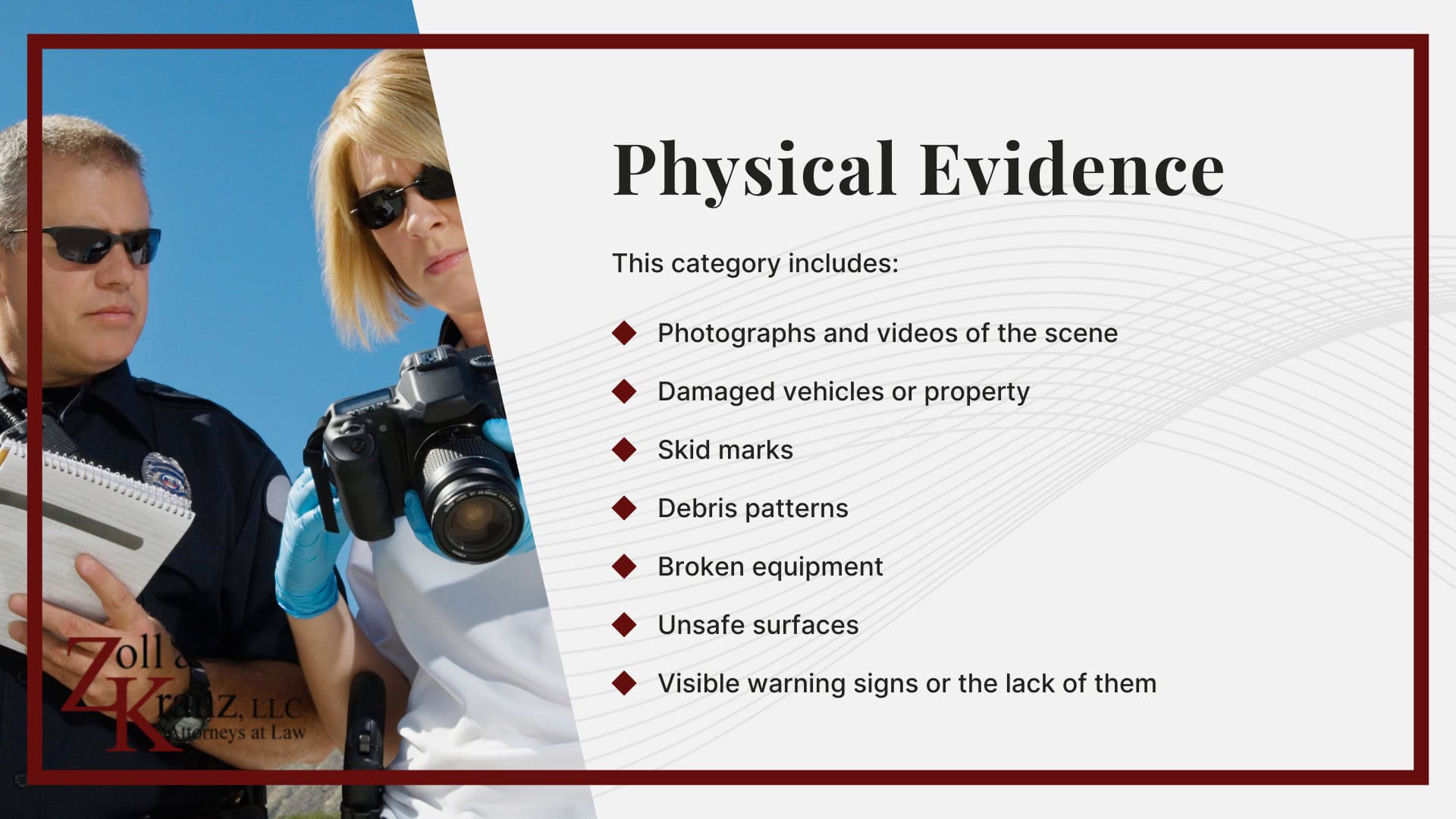
This category includes:
- Photographs and videos of the scene
- Damaged vehicles or property
- Skid marks
- Debris patterns
- Broken equipment
- Unsafe surfaces
- Visible warning signs or the lack of them
Why You Should Preserve Physical Evidence
Preserving physical evidence is especially important because conditions can change quickly.
Weather, cleanup efforts, repairs, or normal business operations may erase critical details within hours or days.
Promptly documenting the accident scene with clear, date-stamped photos and videos helps lock in details that may later be disputed.
In some cases, the damaged object itself (such as a defective product or vehicle component) may need to be preserved for inspection.
Physical evidence supports liability by showing what went wrong and causation by linking hazardous conditions to the injury.
Claimants should avoid altering or discarding items connected to the incident and should keep originals whenever possible.
Organizing photos, videos, visual evidence, and other materials chronologically and sharing them early with legal counsel allows the firm to assess the evidence before it is lost or challenged.
Medical Records and Documentation
Medical records are the primary evidence used to prove the existence, severity, and progression of injuries in a personal injury case.
These records create an objective timeline showing when injuries were diagnosed, what medical care was provided, and how a person’s condition evolved over time.
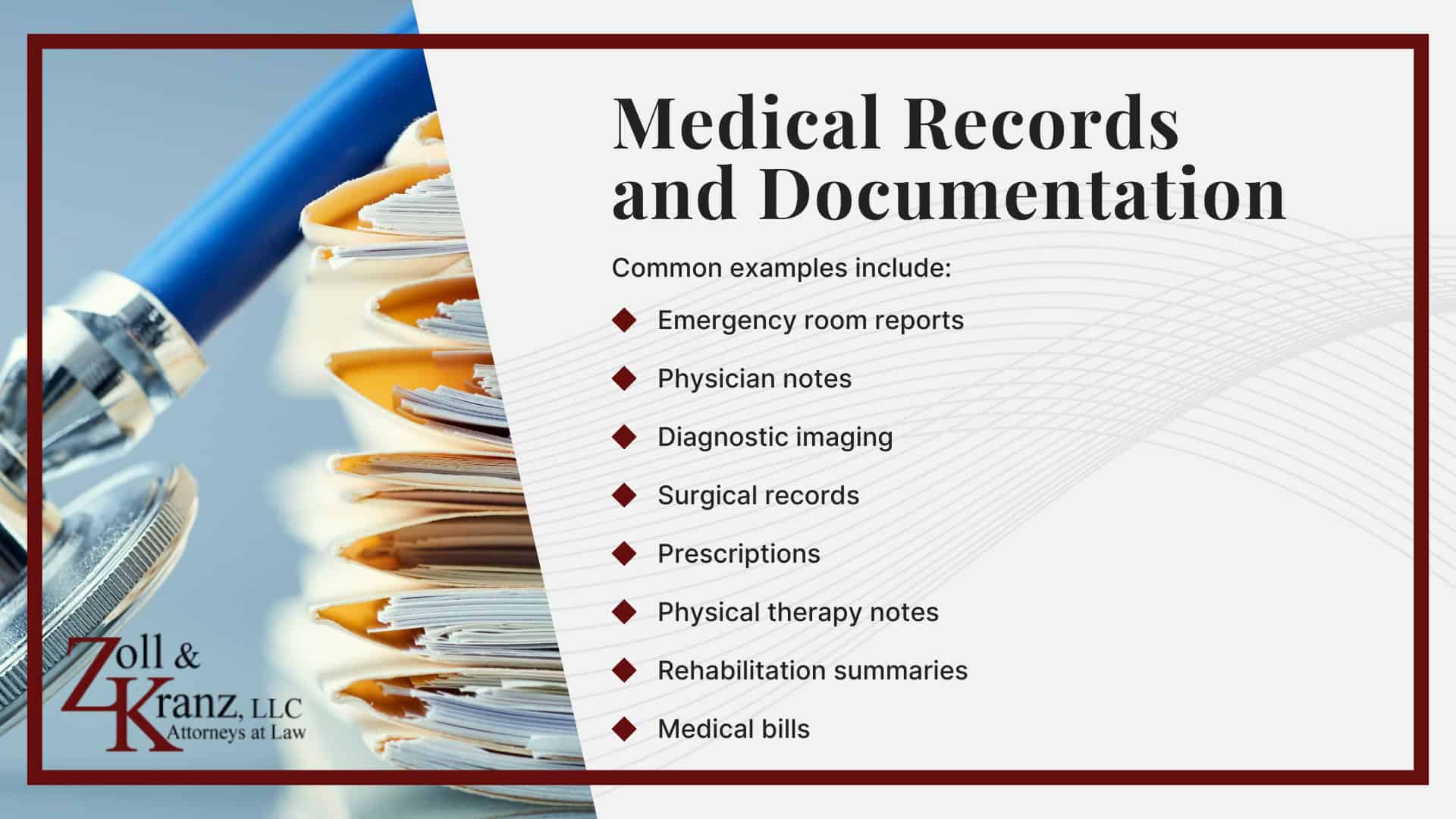
Common examples include:
- Emergency room reports
- Physician notes
- Diagnostic imaging
- Surgical records
- Prescriptions
- Physical therapy notes
- Rehabilitation summaries
- Medical bills
Consistent and timely treatment is critical.
Gaps in care or delayed treatment can raise questions about whether the injuries were caused by the accident or by another event.
Records generated by medical professionals help establish causation by linking the injuries directly to the incident and documenting symptoms as they were reported contemporaneously.
They also support damages by detailing ongoing limitations, future care needs, and recovery outlooks.
In addition to formal records, treatment plans and follow-up instructions demonstrate compliance and show how seriously an injured person addressed their condition.
Claimants should keep copies of all medical paperwork, bills, and appointment summaries, even when records are sent directly between providers and insurers.
Early communication with legal counsel ensures that all relevant records are requested, organized, and reviewed for completeness.
Comprehensive medical documentation strengthens negotiations, supports expert opinions, and provides the foundation for proving both current and long-term impacts of the injury.
Eyewitness Testimony and Contact Information
Witness statements can play a decisive role in personal injury cases, particularly when the facts of an accident are disputed.
Independent witnesses, or those with no personal or financial interest in the outcome, can provide firsthand accounts of what occurred before, during, and immediately after an incident.
Their observations often help clarify fault, confirm hazardous conditions, or contradict inaccurate versions of events presented later.
An example of the importance of witness testimony can be seen in a recent personal injury case in Los Angeles.
In a Lancaster train yard slip-and-fall case, a jury awarded a worker $58.35 million after he slipped on a wet surface and later developed chronic pain.
A key piece of evidence came from a senior safety manager, who confirmed the train had not dried for the required time and that lighting and safety conditions were poor.
That witness statement helped persuade jurors that unsafe conditions contributed to the accident.
Timing is critical.
Witness memories fade, and contact information can be lost if it is not gathered promptly.
Names, phone numbers, email addresses, and brief written or recorded statements should be preserved as soon as possible.
Even short observations, such as speed, traffic signals, weather conditions, or visible injuries, can become highly valuable later.
Experienced personal injury attorneys, like us, know how to evaluate witness credibility, follow up with formal statements, and integrate testimony into broader case strategy.
When combined with other evidence, witness testimony can strengthen liability arguments, support causation, and increase leverage during negotiations or litigation.
Expert Testimony
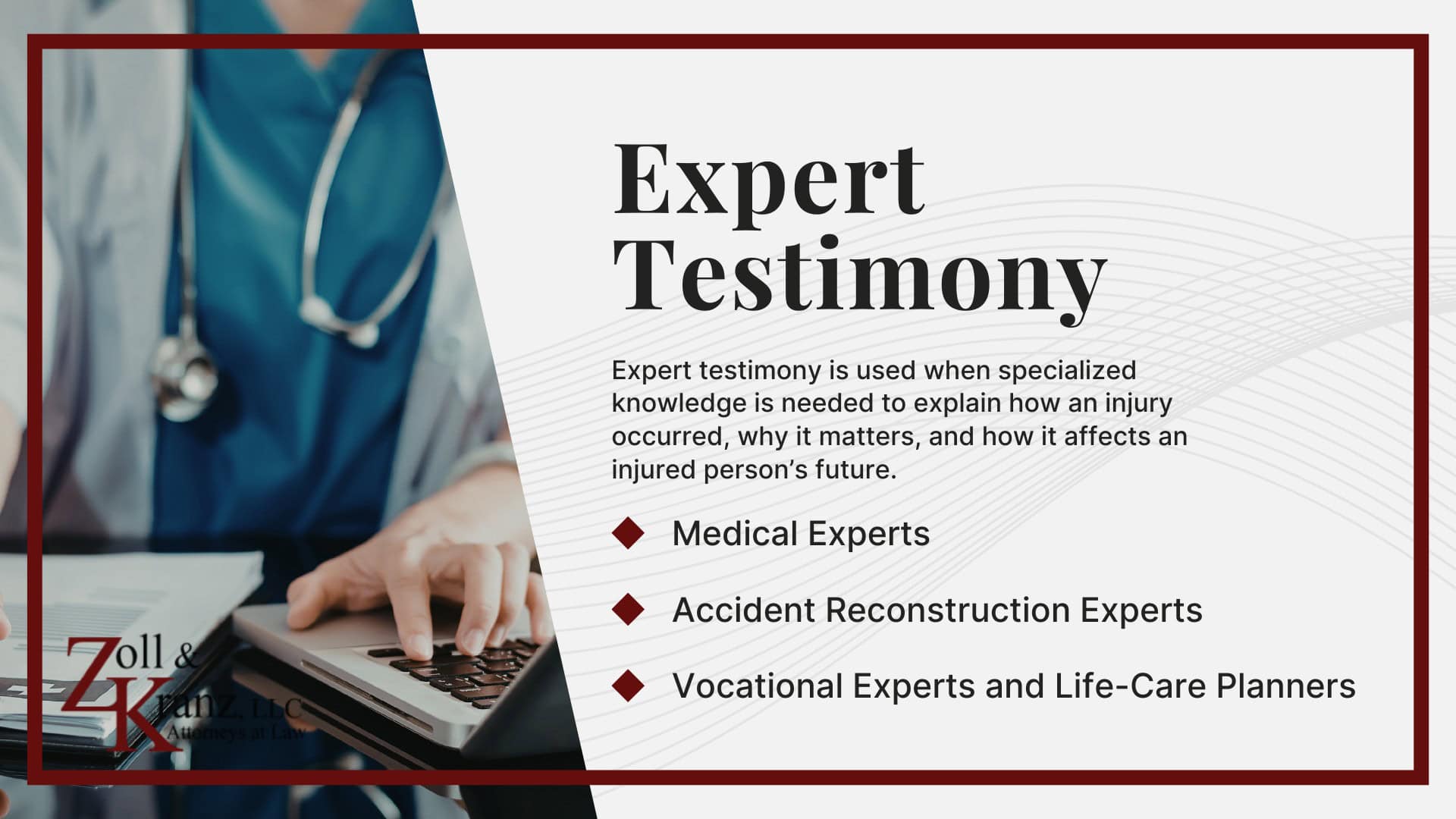
Expert testimony is used when specialized knowledge is needed to explain how an injury occurred, why it matters, and how it affects an injured person’s future.
Experts translate technical information into clear opinions that judges, juries, and even insurance companies can evaluate within the broader legal process.
Medical Experts
Medical experts explain diagnoses, causation, prognosis, and future care needs.
They rely on clinical experience, testing, and treatment history to connect the accident to specific injuries and to explain whether symptoms are temporary or permanent.
Their testimony often bridges gaps that basic accident reports or treatment notes cannot address.
They can provide guidance on how medical expenses will likely accrue over the patient’s lifetime
Accident Reconstruction Experts
These experts analyze physical evidence, scene data, vehicle damage, and accident reports to explain how an incident happened.
Using physics, engineering principles, and scene measurements, they help establish liability and counter arguments that an accident was unavoidable or caused by another factor.
Vocational Experts and Life-Care Planners
When injuries affect the ability to work or live independently, vocational experts assess employability and earning capacity, while life-care planners project long-term medical and support needs.
Their opinions are critical for proving future damages beyond immediate medical bills.
Why Expert Testimony Matters
A key fact to note: courts generally require expert testimony when medical causation or future damages are beyond “common knowledge,” a principle established under the Daubert standard used in Ohio and federal courts.
Well-qualified experts can significantly influence settlement value and trial outcomes by providing credible, defensible opinions grounded in evidence.
Employment and Wage Records
Employment and wage records are crucial evidence when a personal injury claim involves income loss or reduced earning capacity.
These documents help translate physical injuries into concrete financial damages by showing how an injury disrupted the ability to work.
Without clear wage documentation, proving economic loss becomes significantly more difficult.
What Employment Records Show
These materials establish pre-injury earnings, work schedules, and job responsibilities.
An employment record may include:
- Pay stubs
- W-2 forms
- Tax returns
- Job descriptions
- Attendance logs
- Employer verification letters
Together, these materials establish pre-injury earnings, work schedules, and job responsibilities.
This information is essential for calculating lost wages resulting from missed work, reduced hours, or job modifications following an accident.
Linking Injuries to Income Loss
To recover wage-related damages, claimants must show that time away from work was medically necessary.
This is why it is important to seek medical attention promptly and follow treatment recommendations.
Medical documentation combined with employer records creates a clear link between the injury and the inability to work, reducing opportunities for insurers to dispute the claim.
Ongoing and Future Wage Loss
In more serious cases, injuries may limit long-term earning capacity.
Employment and wage records allow attorneys and experts to assess career trajectory, advancement potential, and future income losses.
Organized, complete records strengthen negotiations and provide clarity if the case proceeds to litigation.
Claimants should retain copies of all employment-related documents and communicate any work disruptions early, ensuring these records are preserved and properly incorporated into the case.
Insurance and Liability Documentation
Insurance and liability documentation provide the formal, third-party records that often shape the direction of most personal injury cases.
These materials help establish how an incident was officially recorded, who may bear responsibility, and whether safety rules or policies were followed.
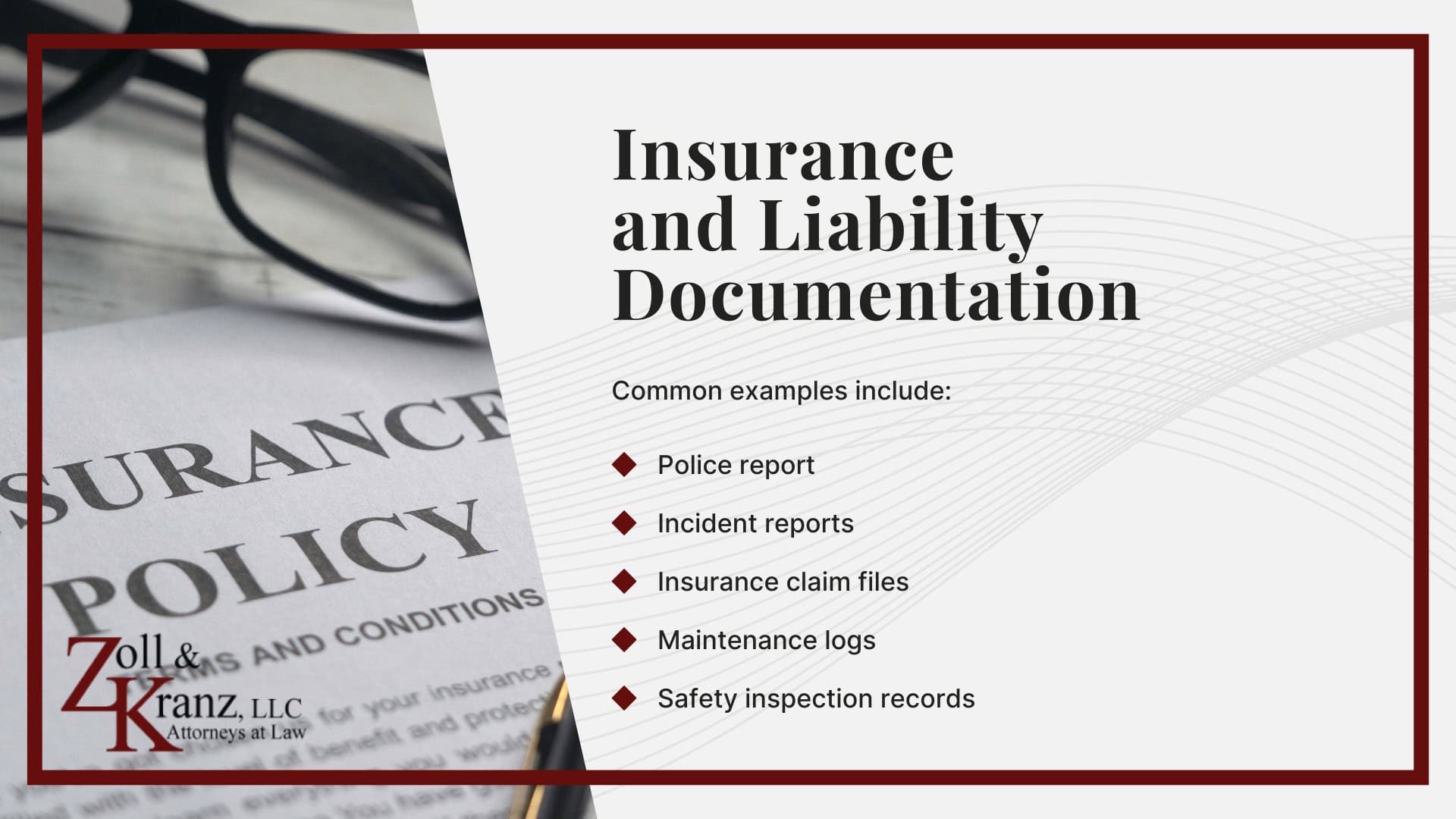
Common examples include:
- Police report
- Incident reports
- Insurance claim files
- Maintenance logs
- Safety inspection records
A police report frequently serves as a starting point for liability analysis.
While it may not determine fault conclusively, it documents the parties involved, witness information, roadway or property conditions, and any citations issued at the scene.
Incident reports created by businesses or property owners can further reveal internal acknowledgments of hazards, policy violations, or prior complaints.
Maintenance and inspection records are especially important in premises liability and workplace cases.
These documents may show whether a dangerous condition was known, ignored, or improperly addressed.
In personal injury law, such records can support arguments that an accident was preventable and that the responsible party failed to meet a duty of care.
Because insurers and defendants often rely heavily on these documents, reviewing them early allows attorneys to identify inconsistencies and challenge inaccurate or incomplete narratives before they harden into the official version of events.
Digital Evidence
Digital evidence has become increasingly important in modern personal injury litigation, often making all the difference in how a claim is evaluated, negotiated, or resolved.
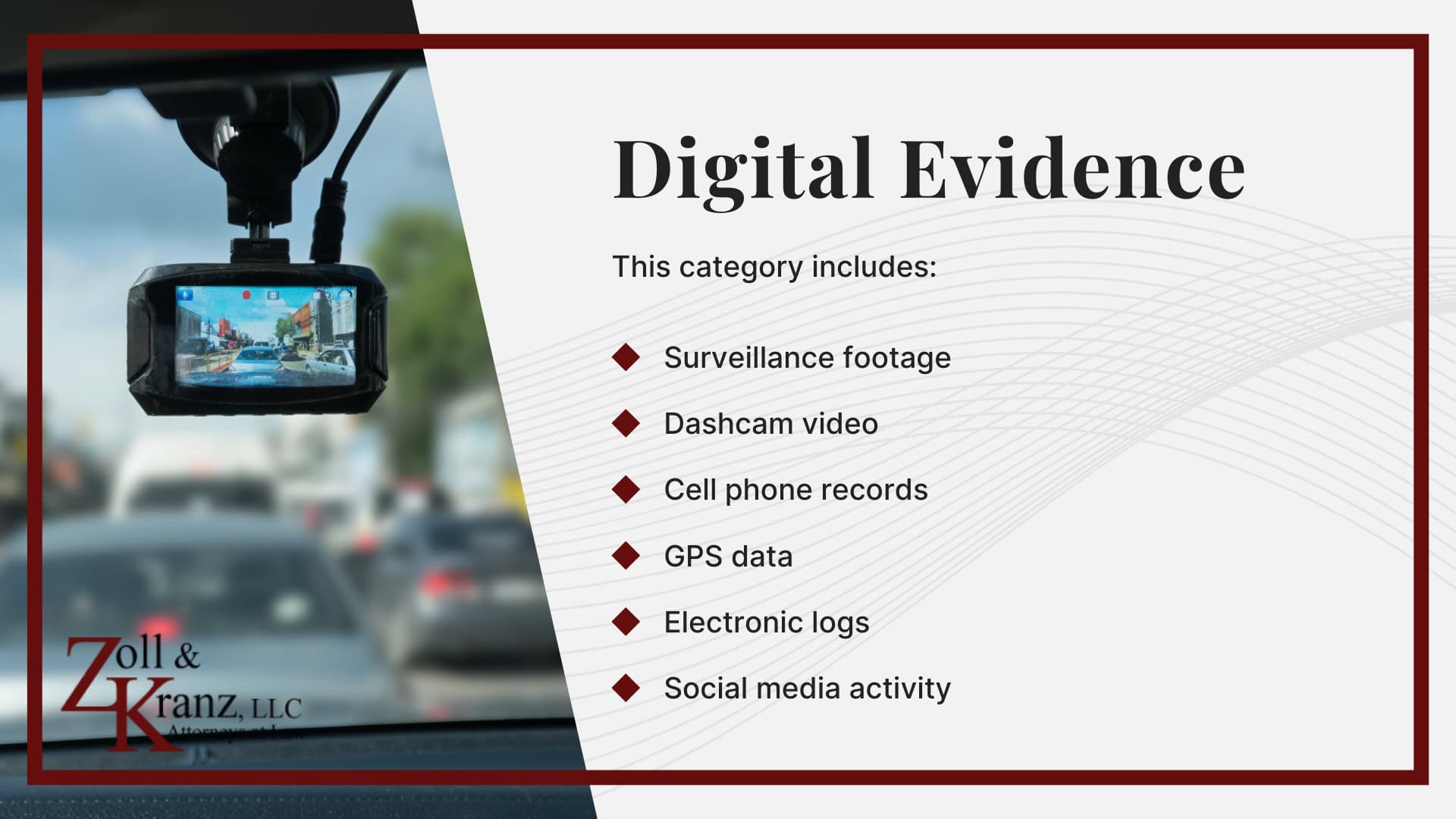
This category includes:
- Surveillance footage
- Dashcam video
- Cell phone records
- GPS data
- Electronic logs
- Social media activity
In many cases, digital records provide objective, time-stamped proof that supports or contradicts other forms of evidence.
Surveillance, Video, and Electronic Data
Video footage from businesses, traffic cameras, or nearby residences can capture how an incident occurred and who was involved.
In a car accident case, dashcams or vehicle data recorders may document speed, braking, or impact timing.
Cell phone and GPS data can help establish location, movement, or distracted driving claims.
These records are often critical in both negligence claims and complex matters such as medical malpractice, where electronic health records and system logs may reveal delays or errors in care.
Social Media and Online Activity
The importance of digital evidence was highlighted in the recent Guzman v. Dial Transportation Inc., where the court compelled the plaintiff to produce social media content during discovery.
The ruling reinforced that online posts, photos, and activity may be used to assess claimed injuries, limitations, and credibility.
Even unrelated posts can be misinterpreted without proper context.
Preserving and Managing Digital Evidence
An experienced injury lawyer can help identify relevant digital evidence early and advise on preservation while avoiding missteps.
When properly handled, digital evidence strengthens credibility and supports claims for fair compensation by aligning real-world activity with documented injuries and losses.