No fees unless we win.
Get a free consultation
8 Reviews
5.0
★★★★★

Ohio Agricultural Lawyer

Our Lawyers Handle Agricultural Disputes, Estate Planning, Regulatory Compliance, and More

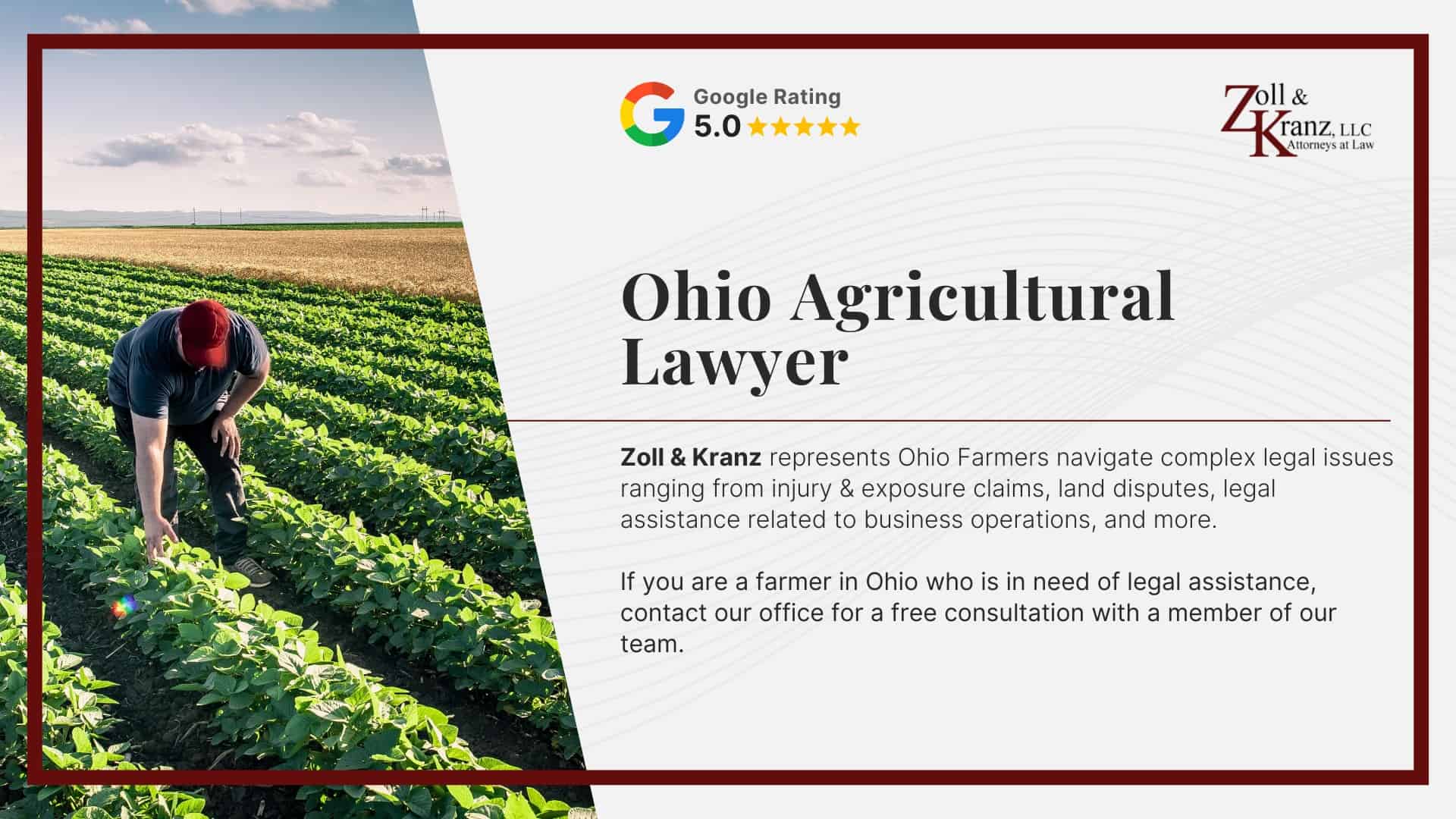
An Ohio agricultural lawyer from Zoll & Kranz helps farmers, landowners, and agribusinesses handle the legal issues that affect how agricultural operations run and how farmland is used.

Our law firm advises clients on farmland leases and real estate transactions, agricultural contracts, business formation, zoning and land use disputes, and regulatory compliance tied to farming activity.

We also represent landowners evaluating solar and energy leases where easements, access rights, drainage impacts, and long-term control of the property can change the value and usability of the land.

When a dispute escalates or an agency issue develops, Zoll & Kranz steps in early to protect the operation and move the matter toward a practical resolution.

Ohio Agricultural Lawyer

How Can the Agricultural Law Experts at Zoll & Kranz Help You?

Ohio agriculture is not a generic business environment.

The agricultural industry operates under overlapping rules that touch land use, water and nutrient application, livestock operations, transportation, and local permitting, and those regulatory issues often change the options available to a working operation.

Many farms also function as a family business, where ownership, labor, and decision-making authority are tied together in ways that can raise concerns when land is leased, equipment is shared, or succession planning is incomplete.

Legal counsel has to match that reality.

Legal issues often involve multiple aspects of the operation at once, such as a zoning question that intersects with a building expansion, or a contract dispute that turns into a compliance issue after a complaint.

Ohio farmers also face unique challenges tied to outside development pressure, energy leasing interest, and neighbor conflicts in areas where rural life sits closer to residential growth than it did a decade ago.

Our law firm represents clients in both preventive planning and active disputes.

That includes drafting and reviewing agreements that govern farmland use, production relationships, and business operations, along with advising on labor questions and regulatory issues that can expose farms and agribusinesses to enforcement or liability.

When conflict becomes unavoidable, we approach dispute resolution with a focus on protecting the operation, preserving land value, and moving the matter toward an outcome that still allows the business to function.

If you or your family operate a farm, own agricultural land, or run a business tied to the agricultural industry in Ohio and are facing legal questions about land use, contracts, regulatory issues, labor concerns, or a developing dispute, speaking with legal counsel early can help protect the operation and limit long-term risk.

Contact the Ohio agricultural lawyers at Zoll & Kranz today for a free consultation.

You can also use the chat feature on this page to get in touch with our attorneys.

Agricultural Law in Ohio: Legal Representation for Farmers, Landowners, and Agribusinesses

Agriculture remains one of Ohio’s most important industries, touching rural communities and the future of the state’s economy.

According to Ohio State University and USDA data, Ohio has tens of thousands of farms spread across more than 13.5 million acres of land, with farms varying widely in size and purpose, from small family operations to larger specialty and commodity producers.

Even as these numbers demonstrate the breadth of agricultural activity, Ohio continues to see farmland converted to other uses and shifting patterns of ownership and labor that shape how families and companies make decisions about their land.

At the same time, the nature of agricultural land use in the state has changed.

Development pressures and long-term energy projects, including solar and other renewable energy siting, have brought new considerations for landowners and operators evaluating leases and easements that can bind acres for decades.

These trends increase the importance of legal counsel that understands how agricultural activity intersects with planning, regulatory concerns, and evolving community expectations.

Agriculture law in Ohio is a broad field because the agricultural industry itself is broad.

It encompasses matters related to production contracts, how land can be used and zoned, disputes over nuisance complaints, questions about water rights and drainage, environmental compliance, agricultural labor and employment issues, food safety, livestock regulations, crop insurance, and more.

It also touches the internal legal structure behind a family’s farm or an agribusiness company, including how labor and ownership affect long-term planning, liability exposure, and succession.

Lawyers who focus on this area help clients navigate these issues in a way that protects ongoing operations and supports long-term security.

Many legal issues arise not because farming itself changes, but because the context around farming changes.

A longstanding lease can become contentious; a neighbor dispute may involve boundary or easement questions; regulatory requirements can evolve or become enforced after a complaint; and contracts that once worked well in practice may lead to disagreements when market conditions or labor needs shift.

Ohio agricultural lawyers provide services that help prevent or resolve these issues, including drafting and reviewing agreements, advising on land use and local ordinances, representing clients in eminent domain or energy siting matters, and guiding compliance with state and federal regulatory frameworks.

When conflict cannot be resolved through planning or negotiation, legal counsel represents clients in dispute resolution processes.

That can include litigation in court, mediation between parties, or arbitration where contracts specify a private path to resolution.

Agricultural lawyers handle boundary disputes, landlord-tenant disagreements, breach of contract claims, conflicts between farm partners, and other matters where relationships and operational continuity are at stake.

Agricultural Law in Ohio_ Legal Representation for Farmers, Landowners, and Agribusinesses

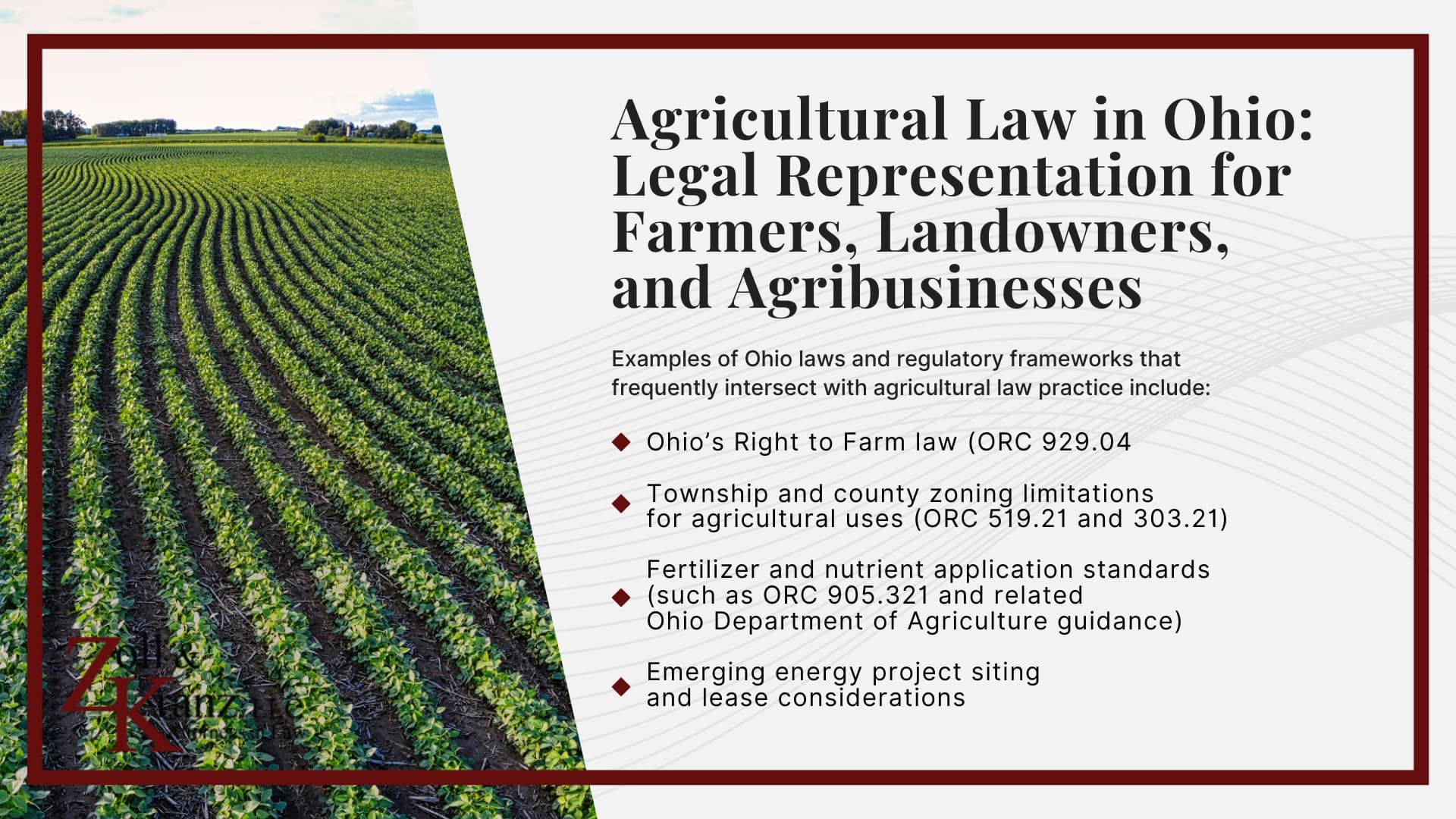
Examples of Ohio laws and regulatory frameworks that frequently intersect with agricultural law practice include:

  • Ohio’s Right to Farm law (ORC 929.04), which serves as a defense against nuisance lawsuits related to noise, dust, or odors under certain conditions, and is often relevant when neighbors raise complaints about normal agricultural activity.
  • Township and county zoning limitations for agricultural uses (ORC 519.21 and 303.21), which shape how local governments may regulate farm structures and operations and are key to understanding where agricultural activities fit within community planning.
  • Fertilizer and nutrient application standards (such as ORC 905.321 and related Ohio Department of Agriculture guidance), which impose requirements on who may apply fertilizer and under what conditions in order to protect water quality.
  • Emerging energy project siting and lease considerations, such as long-term solar or wind leases that affect access, easements, drainage, and future land use, requiring coordination among private agreements, local ordinances, and state oversight.

Legal issues in agriculture can include disputes between farmers, landlord-tenant conflicts, disagreements over farm business governance, and compliance questions that arise in the context of everyday agricultural labor and production.

Whether providing preventive counsel or representing clients through resolution processes, agricultural attorneys help farms, landowners, and agribusinesses manage risk and make informed decisions that support rural life, employment, and the long-term viability of their operations.

Who We Represent in Agricultural Legal Matters

Zoll & Kranz represents people and businesses whose work depends on land, equipment, seasonal timing, and long-term agreements.

Agricultural legal matters often involve overlapping concerns, including property rights, contracts, regulatory issues, and business structure.

Our law firm works with clients who want clear legal planning before problems surface, and strong advocacy when a dispute is already underway.

We focus on practical solutions that protect operations, preserve land value, and support continuity for the next stage of the farm or business.

Agricultural Law in Ohio_ Legal Representation for Farmers, Landowners, and Agribusinesses; Who We Represent in Agricultural Legal Matters

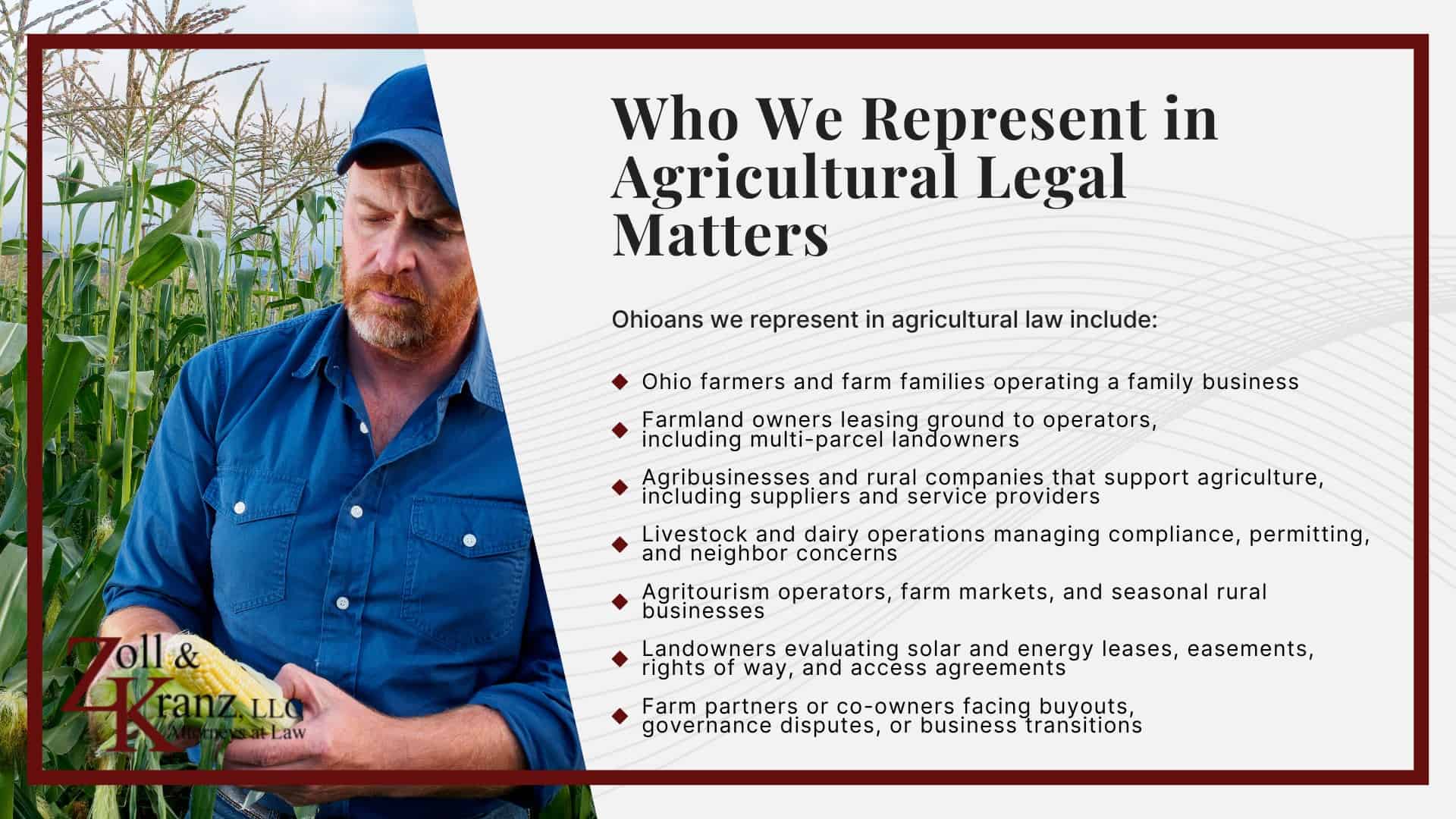
Ohioans we represent in agricultural law include:

  • Ohio farmers and farm families operating a family business
  • Farmland owners leasing ground to operators, including multi-parcel landowners
  • Agribusinesses and rural companies that support agriculture, including suppliers and service providers
  • Livestock and dairy operations managing compliance, permitting, and neighbor concerns
  • Agritourism operators, farm markets, and seasonal rural businesses
  • Landowners evaluating solar and energy leases, easements, rights of way, and access agreements
  • Farm partners or co-owners facing buyouts, governance disputes, or business transitions

Our Agricultural Law Practice: Legal Support for Working Farms

Our agricultural law practice is built around the realities of working farms and rural businesses, not abstract legal theory.

We stay actively involved with our clients as operations grow, change, or face unexpected legal pressure, providing guidance that fits how agricultural businesses actually function.

Agriculture law often overlaps with business law, land use, and regulatory compliance, which means legal decisions in one area can affect the entire operation.

Our Agricultural Law Practice_ Legal Support for Working Farms; Agricultural Law in Ohio_ Legal Representation for Farmers, Landowners, and Agribusinesses; Who We Represent in Agricultural Legal Matters

Our law firm is committed to helping clients address issues early, before they disrupt production, land use, or long-term planning.

When disputes arise, we step in with a clear strategy focused on protecting the farm, the business, and the relationships tied to it.

Across each practice area, our goal is to support stability, continuity, and informed decision-making for the future of the operation.

Agricultural Contracts and Farm Business Agreements

Contracts sit under most modern farm operations, even when the relationship feels informal.

USDA’s Economic Research Service reports that in 2020, agricultural contracts governed about 33% of U.S. farm commodity production by value, reflecting how often pricing, delivery, inputs, and performance standards are set by agreement rather than a simple cash sale.

In Ohio, contracts also shape everyday farm business decisions like leasing ground, sharing equipment, storing grain, or hiring services, and a weak contract can turn a routine season into a dispute.

Ohio State University Extension materials on farmland leases stress that written agreements force both sides to spell out responsibilities and expectations, which reduces conflict later.

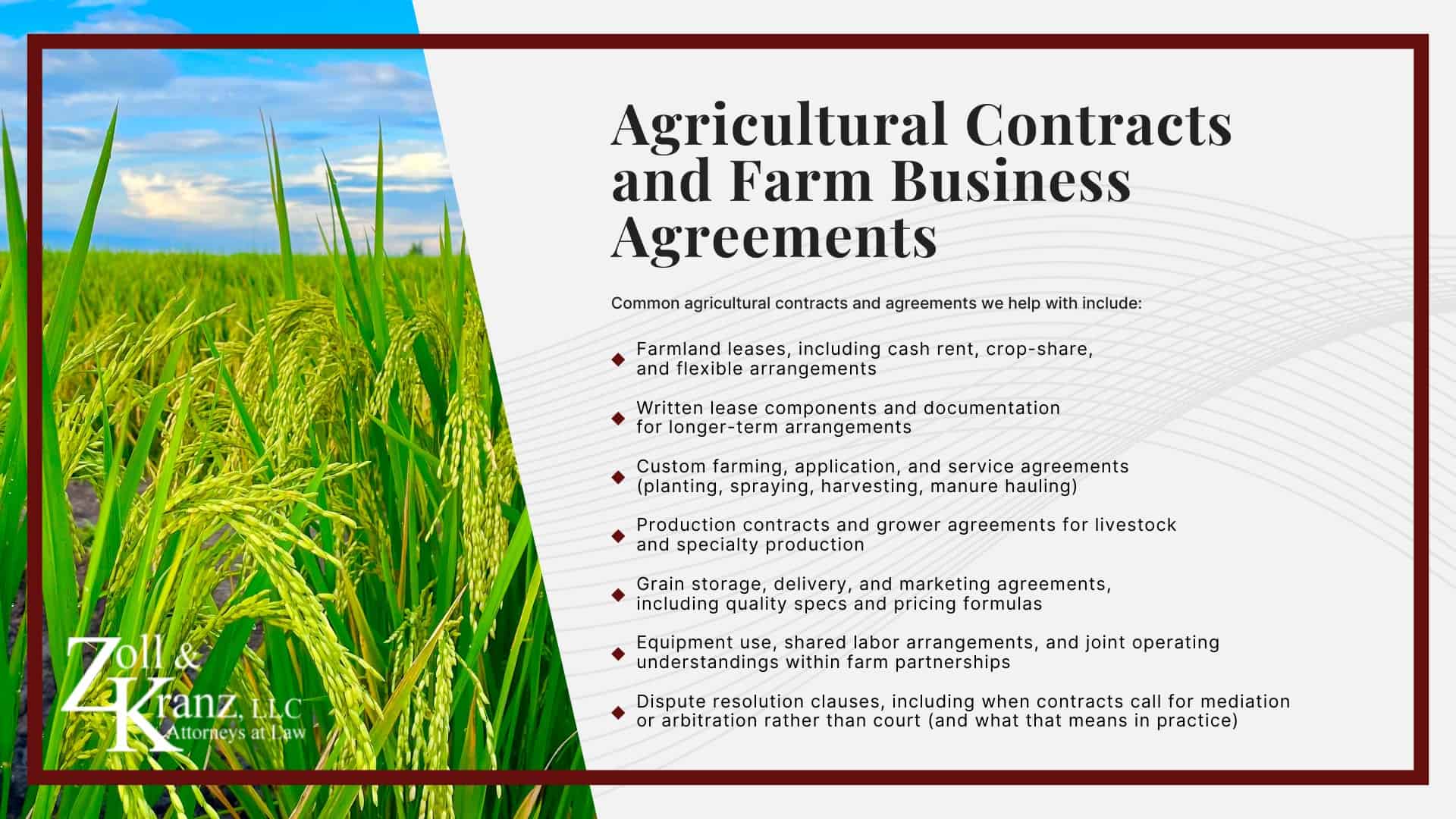
Common agricultural contracts and agreements we help with include:

  • Farmland leases, including cash rent, crop-share, and flexible arrangements
  • Written lease components and documentation for longer-term arrangements
  • Custom farming, application, and service agreements (planting, spraying, harvesting, manure hauling)
  • Production contracts and grower agreements for livestock and specialty production
  • Grain storage, delivery, and marketing agreements, including quality specs and pricing formulas
  • Equipment use, shared labor arrangements, and joint operating understandings within farm partnerships
  • Dispute resolution clauses, including when contracts call for mediation or arbitration rather than court (and what that means in practice)

A strong agreement does more than describe the deal.

It assigns responsibility for the things that cause the most conflict, like maintenance, access, timing, payment triggers, insurance, and what happens when conditions change.

When a disagreement develops, a well-built contract also creates leverage for negotiation and a clear record for litigation, mediation, or arbitration if the matter cannot be resolved informally.

Farmland Leasing, Ownership, and Real Estate Transactions

Farmland is often the most valuable real property a farm family or agribusiness will ever own, and small legal details can change what that land is worth and what it can be used for.

Many Ohio operations also rely on leased ground, and USDA data from the 2022 Census of Agriculture shows that 39% of U.S. farmland is rented or leased, which tracks with how commonly leasing shapes production decisions and long-term stability.

Our law firm supports clients through transactional work involving farm purchases and sales, lease drafting and enforcement, easements and access rights, and deal structures that protect the land’s usability over time.

For many clients, tax treatment is also part of the transaction, and Ohio’s CAUV framework is defined by statute in ORC 5713.30, which affects whether land is treated as “devoted exclusively to agricultural use” for valuation purposes.

When conflicts arise during or after a deal, we step in early to address boundary, access, and lease disputes with a strategy grounded in the documents and the real-world way the land is used.

Land Use, Zoning, and Agricultural Exemptions in Ohio

Land use disputes often begin at the local level.

A township zoning inquiry, a county notice, or a neighbor complaint can quickly place a farm’s buildings, access points, or expanding operations under scrutiny.

Ohio law limits how townships and counties may regulate agricultural land, but those limits depend on how the land and structures are actually used.

The question is rarely abstract, it is whether the activity qualifies as agricultural under Ohio law and whether any exceptions apply.

Ohio statutes restrict local zoning authority over agricultural uses and structures that are incident to agriculture.

Township zoning provisions generally may not prohibit agricultural uses or require zoning certificates for qualifying agricultural buildings, and county zoning law follows a similar framework.

In practice, disputes arise around activities that fall near the line, such as agritourism operations, farm markets, event traffic, parking, signage, or mixed-use buildings.

Attorney General opinions and Ohio State University Farm Office guidance reflect that the agricultural exemption has limits and must be applied to the specific facts of each situation.

Land use issues also intersect with infrastructure and development.

Road projects, utility corridors, and other public improvements can trigger eminent domain concerns that affect access, drainage, and long-term use of agricultural property.

Addressing these matters early can prevent operational disruption and preserve land value.

Ohio laws and frameworks commonly involved in agricultural land use matters include:

  • ORC 519.21, limiting township zoning authority over agricultural uses and qualifying structures
  • ORC 303.21, providing similar limits on county rural zoning authority
  • ORC 901.80, defining agritourism and shaping how public-facing farm activities are treated

Our law firm assists clients with evaluating agricultural exemptions, responding to zoning enforcement, reviewing local ordinances, and addressing related easement or access issues.

When land use conflicts cannot be resolved through administrative channels, we represent clients in dispute resolution and litigation with a focus on protecting the operation and keeping the land usable.

Agritourism Operations and Liability Protection

Agritourism can add meaningful revenue to a working farm, but bringing the public onto agricultural property changes the risk profile overnight.

Ohio has a specific agritourism immunity statute, and it can limit liability for injuries or deaths that result from the inherent risks of agritourism activities when the operation meets the law’s requirements.

One of the most important requirements is the statutory warning sign, with prescribed language and formatting, posted at entrances or near the activity areas.

Even with immunity tools available, agritourism still raises real exposure tied to premises conditions, animal interactions, equipment, crowd flow, and emergency response planning, and those issues can become expensive quickly if they are ignored.

Our law firm helps agritourism operators set up the legal foundation that supports safe public-facing operations, including risk planning, document review, and early response when a claim or incident occurs.

Solar, Wind, and Energy Leases on Agricultural Land

Energy leasing has become a central land use issue across Ohio, especially where large, flat tracts of farmland sit near transmission.

Ohio’s utility scale solar market grew quickly, a recent Ohio solar development white paper reports that by mid 2025 the Ohio Power Siting Board had approved over 8,800 MW of utility scale solar, with over 3,800 MW operational and about 1,200 MW under construction.

Long term leases tied to these projects can control land for decades, and that can affect a farm’s future plans, resale options, drainage patterns, and how surrounding parcels function.

Ohio law also matters here because projects at a certain size trigger state level siting rules and local review steps, which can change the leverage landowners have at different points in the process.

Ohio laws and regulatory frameworks that shape these deals include:

  • ORC 4906.01, which defines a “major utility facility” and applies to large solar projects designed for, or capable of, 50 MW or more, along with certain transmission facilities
  • Senate Bill 52 county review process, which requires a public meeting and gives county commissioners authority to adopt a resolution that can prohibit or reduce a proposed project, and that resolution is binding on the OPSB
  • County “restricted area” authority under SB 52, allowing counties to designate areas where utility scale solar projects are prohibited, including limits on certain material amendments in those areas
  • ORC 4906.13(B) preemption language, which limits additional local approvals for construction or initial operation of a major utility facility authorized by an OPSB certificate

Our law firm helps landowners and agricultural businesses treat energy leases as real property deals, not routine rental paperwork.

That includes reviewing term length, renewal rights, easements, access routes, drainage and tile protection, construction impacts, decommissioning obligations, and the security behind restoration promises.

We also advise on how private lease terms interact with county review, restricted areas, and state siting timelines, so the transaction matches the landowner’s long-term goals.

Environmental Compliance for Farms and Livestock Operations

Environmental compliance in Ohio agriculture is often less about day-to-day paperwork and more about what happens when something changes, an operation expands, a neighbor complains, or an agency asks questions.

Rules tied to manure, fertilizer, and water quality can apply differently depending on location and the type of operation, and the consequences can escalate quickly if a situation is handled informally.

In Northwest Ohio, nutrient management issues can be especially sensitive because Ohio law restricts certain surface applications of manure and fertilizers containing nitrogen and phosphorus in the Western Lake Erie Basin under specified soil and weather conditions.

Large livestock and poultry operations face an additional layer of oversight, and the Ohio Department of Agriculture’s Division of Livestock Environmental Permitting regulates the construction and operation of the state’s largest facilities, including how manure, wastewater, and nutrients are managed.

Compliance work also shows up through training and certification requirements. Ohio law requires certification to apply fertilizer for purposes of agricultural production, with rule-based requirements that can affect who may apply and under what conditions.

For some operations, compliance questions also overlap with federal permitting, site planning, and water-related concerns that touch drainage, runoff, and water rights in practical terms, even when the underlying issue begins as an operational decision.

Ohio laws and regulatory frameworks that often matter in farm and livestock compliance include:

  • ORC 905.321, fertilizer applicator certification requirements for agricultural production
  • ORC 905.326, restrictions on certain fertilizer applications in the Western Lake Erie Basin
  • ORC 939.08, restrictions on certain manure applications in the Western Lake Erie Basin
  • ORC Chapter 903, Ohio’s concentrated animal feeding facility program and permitting framework
  • OAC Chapter 901:10, rules administered through Ohio’s livestock environmental permitting program
  • ODA fertilizer and manure guidance, which consolidates key statutory references and program expectations
  • OSU Extension guidance on WLEB restrictions, explaining the surface-application limits and potential civil penalties

Agricultural Business Formation, Governance, and Transitions

Many farms operate as a family business, but the legal structure behind that business often lags behind how the operation actually runs.

Informal ownership, undocumented loans, and unclear authority can create problems when land is bought or sold, when new partners join, or when a lender or insurer needs clear documentation.

Business formation work in agriculture often involves separating real property ownership from the operating company, so land, equipment, and liability do not all sit in the same place.

Governance matters just as much as formation, especially when multiple family members work in the business or when off-farm heirs have ownership interests but no operational role.

Transition planning is rarely a single event, it is a series of decisions about control, compensation, buyouts, and how the farm continues after a key owner steps back.

These issues can also surface suddenly through conflict, including business divorces where the underlying dispute is control of assets, labor, and decision-making power.

Our law firm helps clients structure agricultural businesses in a way that supports day-to-day operations and reduces the chance that internal conflict disrupts planting, harvest, or long-term land stewardship.

When a transition is underway, we focus on agreements and governance tools that protect continuity and preserve the value built into the operation.

Agricultural Disputes, Neighbor Conflicts, and Litigation

Agricultural disputes in Ohio often start as practical disagreements, then escalate because land, timing, and long-term relationships are on the line.

A conflict may begin between neighbors or business partners, but it can quickly pull in zoning officials, insurers, lenders, or regulatory agencies.

Ohio law also shapes how these cases are fought, including Ohio’s Right to Farm law, which can serve as a defense to nuisance lawsuits tied to noise, dust, or odors when the statutory conditions are met.

When the dispute involves fencing, Ohio’s partition fence statute provides a framework for responsibilities and cost allocation between adjoining landowners.

Our law firm represents clients through negotiation and formal dispute resolution when necessary, with a focus on protecting operations and preventing a conflict from disrupting an entire season.

Common disputes, conflicts, and litigation matters include:

  • Nuisance claims involving odor, noise, dust, flies, or other complaints tied to agricultural activity (including Right to Farm defense analysis)
  • Boundary, access, and easement disputes involving farm roads, field access points, or recorded restrictions
  • Landlord-tenant disputes over farmland leases, termination, damages, repairs, and access during planting or harvest
  • Farm business disputes, including partnership breakups and “business divorces” involving control, labor, and asset division
  • Drainage, ditch, and water flow conflicts, including disputes that intersect with county ditch law or Soil and Water Conservation District processes
  • Fence disputes under Ohio partition fence law, including maintenance, cost allocation, and reimbursement claims
  • Zoning enforcement and land use conflicts where the agricultural exemption is disputed or narrowed by local interpretation

Not every dispute belongs in court, but every dispute benefits from a clear legal strategy.

We often start by documenting the facts, reviewing the governing agreements and property records, and identifying the leverage points that drive settlement.

If litigation, mediation, or arbitration becomes necessary, our law firm represents clients with a practical approach that keeps operational continuity and long-term land value at the center of the case.
Why Agricultural Clients Choose Zoll & Kranz

Agricultural clients choose our law firm because we approach agriculture law as a working reality tied to land, timing, labor, and long-term planning.

We understand that many matters affect a family’s farm and a company’s future at the same time, and we treat those decisions with the seriousness they deserve.

Our advice stays practical, not theoretical, because the goal is to keep the operation functioning while protecting real property value and reducing legal exposure.

We are direct about risk, clear about options, and focused on outcomes that make sense for rural clients who cannot pause production to manage a legal crisis.

When a dispute develops, we build the case around documents, facts, and the operational context, then pursue dispute resolution that matches the stakes.

Clients also value that our law firm stays accessible and engaged from the first call through completion of the matter.

Agricultural Contracts and Farm Business Agreements; Our Agricultural Law Practice_ Legal Support for Working Farms; Agricultural Law in Ohio_ Legal Representation for Farmers, Landowners, and Agribusinesses; Who We Represent in Agricultural Legal Matters

When working with our firm, clients can expect:

  • Clear, practical guidance grounded in agriculture law and real farm operations
  • Strong drafting and transactional work for leases, purchases, sales, and easements affecting real property
  • Experience with zoning, land use conflicts, and development pressure in rural communities
  • Regulatory and compliance support for farms and livestock operations, including agency response
  • Dispute resolution and litigation strategy for lease disputes, boundary conflicts, nuisance claims, and farm business breakups
  • Long-term counsel that supports continuity for a family business, not just one-off transactions

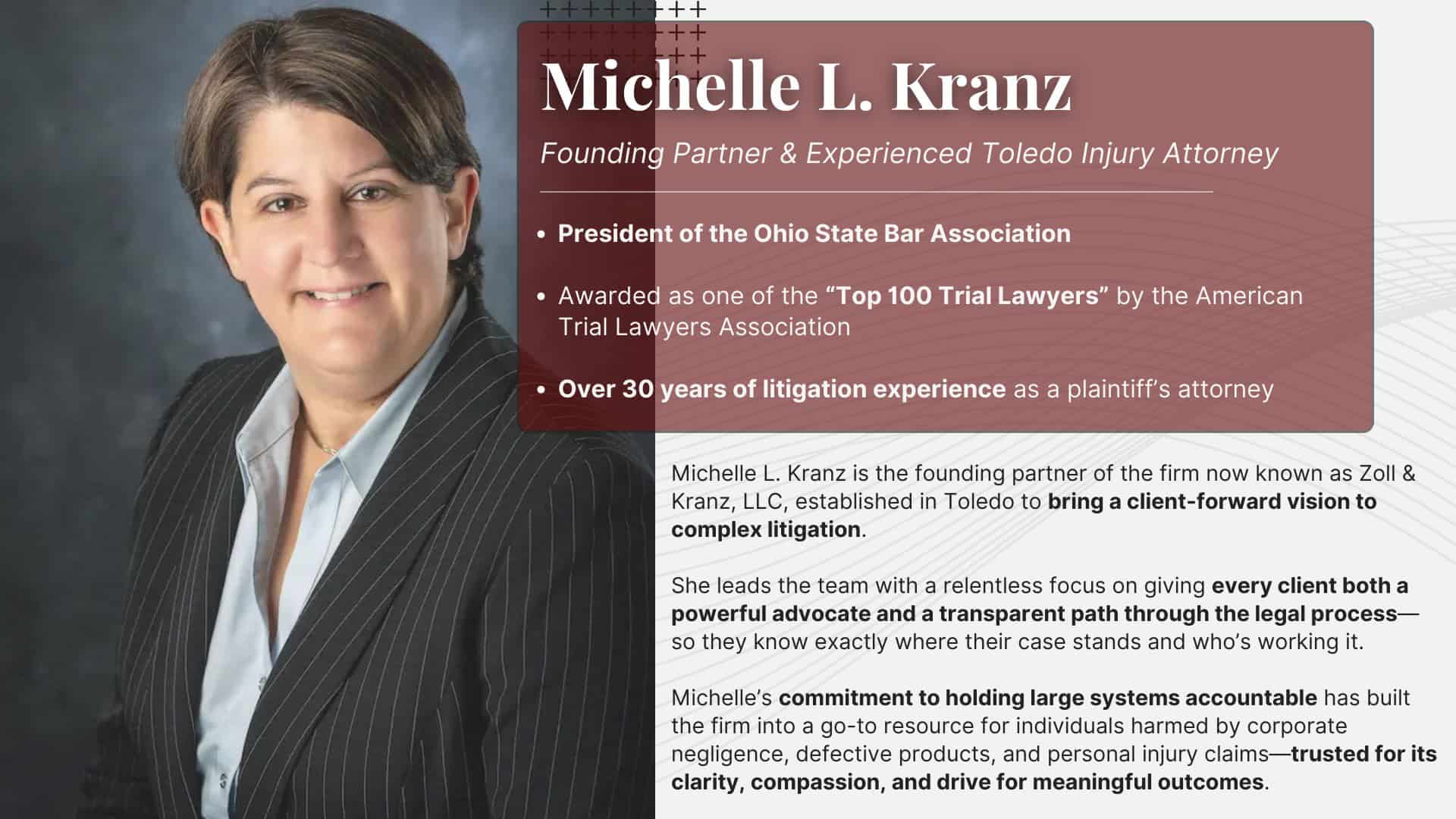
Michelle Kranz: Experienced Lawyer and Agribusiness Advocate

Michelle L. Kranz is a founding partner of Zoll & Kranz, LLC in Toledo, Ohio, and has practiced law for more than 30 years.

She graduated cum laude from Miami University and earned her Juris Doctor from the University of Toledo College of Law before joining the firm and helping build it into a trusted name for clients across the state.

Michelle also served as President of the Ohio State Bar Association for the 2023–24 bar year, and she has held leadership roles with the Toledo Bar Association, the Ohio State Bar Foundation, and the National Civil Justice Institute.

Though her primary practice has focused on litigation, including complex consolidated and class action matters, Michelle brings a unique perspective shaped by her deep agricultural roots.

She and her husband raise and exhibit beef cattle on their Wood County farm, and they are active members of the Ohio Farm Bureau, Ohio Cattlemen’s Association, and related livestock organizations.

Her involvement in agriculture is not just personal but community-oriented, including recognition from the Wood County Beef Producers and the Wood County Friend of 4-H Award.

Zoll & Kranz_ Contact an Ohio Agricultural Lawyer Today; Agricultural Contracts and Farm Business Agreements; Our Agricultural Law Practice_ Legal Support for Working Farms; Agricultural Law in Ohio_ Legal Representation for Farmers, Landowners, and Agribusinesses; Who We Represent in Agricultural Legal Matters; Michelle Kranz Experienced Lawyer and Agribusiness Advocate

Michelle’s experience in agricultural life helps her understand the realities faced by farmers and landowners, and it informs her work with clients on issues that affect both legal outcomes and operational continuity.

Whether advising on agricultural contracts, land use and zoning concerns, or disputes tied to rural operations, she brings a combination of trial experience, organizational leadership, and real-world farm insight to every matter.

Zoll & Kranz: Contact an Ohio Agricultural Lawyer Today

Agricultural legal issues rarely stay small.

Decisions involving land, contracts, labor, or regulatory compliance can affect an operation for years, and waiting to address a problem often limits the available options.

Whether the issue involves planning for growth, responding to a dispute, or protecting farmland from long-term risk, experienced legal guidance can make a meaningful difference in how the matter is resolved.

Zoll & Kranz represents Ohio farmers, landowners, and agricultural businesses with a practical approach grounded in how agricultural operations actually function.

We work with clients across the state on both preventive legal planning and active disputes, with a focus on protecting land value, operational continuity, and long-term stability.

Zoll & Kranz_ Contact an Ohio Agricultural Lawyer Today; Agricultural Contracts and Farm Business Agreements; Our Agricultural Law Practice_ Legal Support for Working Farms; Agricultural Law in Ohio_ Legal Representation for Farmers, Landowners, and Agribusinesses; Who We Represent in Agricultural Legal Matters

If you are facing an agricultural legal issue or want guidance before a concern escalates, contact Zoll & Kranz to speak with an Ohio agricultural lawyer.

An early conversation can help clarify your options and position your operation for the future.

Frequently Asked Questions

Published by:
Share
Picture of Michelle L. Kranz
Michelle L. Kranz

Michelle is a founding partner of Zoll & Kranz, located in Toledo, Ohio. Michelle has been a plaintiff’s lawyer for the entirety of her practice – over 32 years. She devotes the majority of her time to complex consolidated litigation and class action including advocating for people injured by medical devices, prescription medications, or corporate negligence.

This article has been written and reviewed for legal accuracy and clarity by the team of writers and attorneys at Zoll & Kranz, LLC and is as accurate as possible. This content should not be taken as legal advice from an attorney. If you would like to learn more about our owner and experienced Ohio injury lawyer, Michelle L. Kranz, you can do so here.

Zoll & Kranz, LLC does everything possible to make sure the information in this article is up to date and accurate. If you need specific legal advice about your case, contact us. This article should not be taken as advice from an attorney.

Other cases we handle in Ohio
All
Auto Accidents
Injury Types
Medical Malpractice
Nursing Home Abuse
Other Accidents & Injuries
You can learn more about other Ohio cases we handle below:
Were you or a loved one injured in Ohio?

A serious injury can have life-altering results.

Don’t settle for less than you deserve, speak with an award-winning personal injury lawyer today.

8 Reviews
5.0
★★★★★
Recovered damages
$35 Million+

Table of Contents

Practice Areas
About Zoll & Kranz, LLC

For over 37 years, Zoll & Kranz has been fighting for clients who have been the victims of the wrongful death of a loved one.

Do you believe you’re entitled to compensation?

Use our Instant Case Evaluator to find out in as little as 60 seconds!

Guides & Resources

Other Ohio Personal Injury Cases

All
Auto Accidents
Injury Types
Medical Malpractice
Nursing Home Abuse
Other Accidents & Injuries
Local Toledo Resources
Education
Emergency Services
Courthouses
Department of Motor Vehicles
Sights to See