No fees unless we win.
Get a free consultation
18 Reviews
5.0
★★★★★

Bedsores in Toledo Nursing Homes

Understanding Bedsores in Toledo Nursing Homes

Bedsores are among the most common signs of nursing home neglect because they often develop when residents are not repositioned, monitored, or cared for according to established prevention protocols.

These pressure-related wounds can progress from minor skin irritation to deep tissue injuries involving muscle, bone, serious infection, and other life-threatening complications.

In many cases, bedsores are preventable when nursing home staff follow accepted standards for repositioning, hygiene, nutrition, and skin assessment.

A Toledo nursing home lawyer at Zoll & Kranz can review the medical records, care plans, and facility documentation to determine whether a preventable breakdown in care contributed to a resident’s injuries.

Bedsores in Toledo Nursing Homes

Did a Loved One Get Bedsores in a Toledo Nursing Home? Contact Zoll & Kranz

Family members of nursing home patients often discover the first sign of a bedsore during a routine visit, long after the wound has already started forming under the skin.

By that point, the chart may already contain repositioning entries that do not match the bed sores or wound staging shown on the resident’s body during examination.

A bedsore that progresses through multiple stages inside Toledo nursing homes almost always reflects a documented breakdown in basic care, and that breakdown is what supports a legal claim against the facility.

If a loved one suffered bedsores in a Toledo nursing home, Zoll & Kranz can review the medical records and determine whether the wound was preventable under Ohio law.

Contact Zoll & Kranz today for a free consultation at (419) 841-9623.

Use the chat feature on this page to find out if you qualify for a bedsore claim under Ohio law.

What Are Bedsores?

Bedsores, known in medical literature as pressure ulcers and decubitus ulcers, are localized injuries to the skin and underlying tissue caused by sustained pressure that disrupts blood flow.

When flow to the skin is restricted for an extended period, the affected tissue is starved of oxygen, and skin cells begin to break down.

The breakdown typically appears over bony prominences such as the sacrum, coccyx, ischial tuberosities, greater trochanter, heels, and shoulder blades.

Bedsores often begin as minor skin changes in areas where bone is close to the skin, such as heels and tailbone.

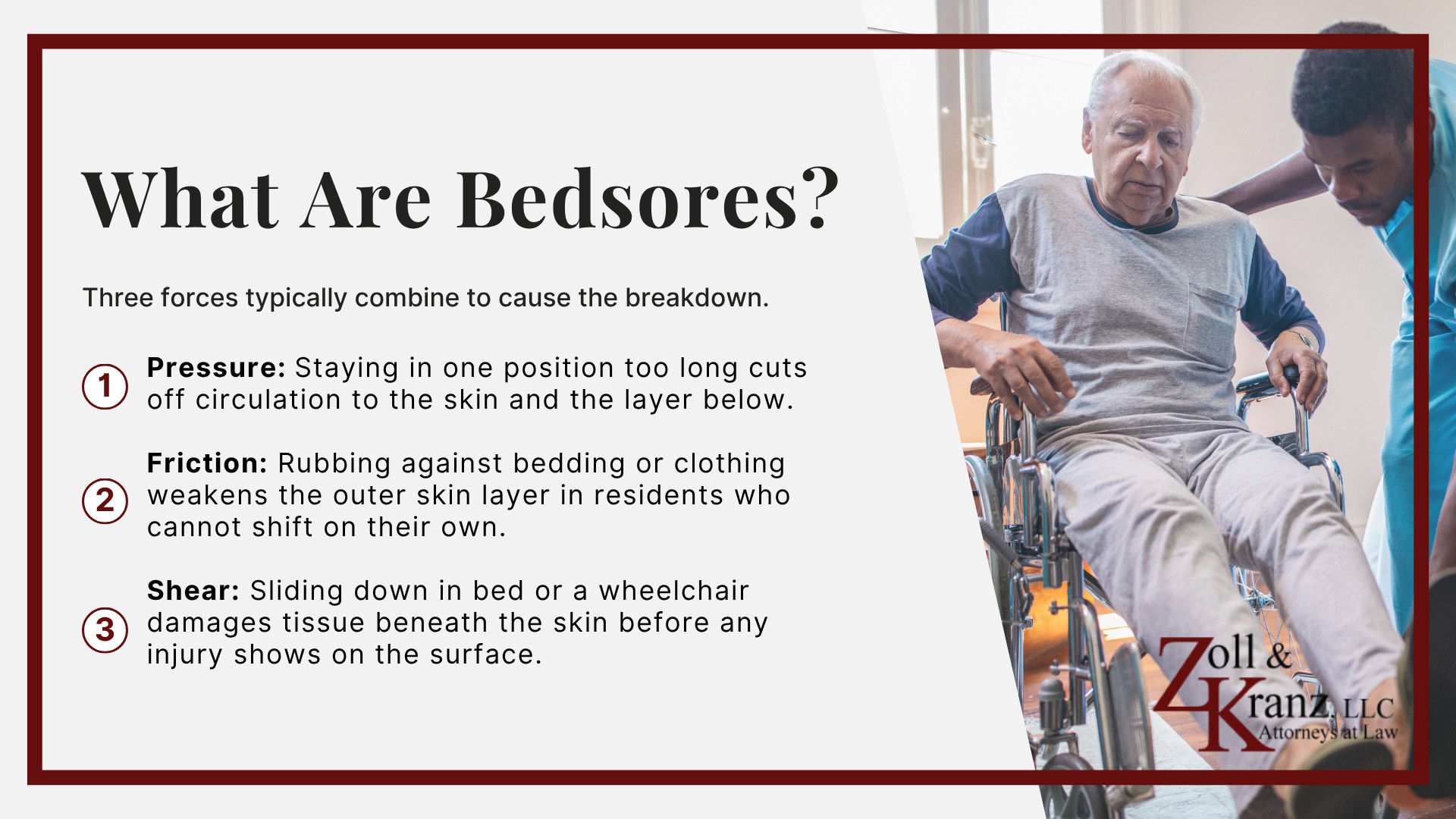
Three forces typically combine to cause the breakdown.

  1. Pressure: Staying in one position too long cuts off circulation to the skin and the layer below.
  2. Friction: Rubbing against bedding or clothing weakens the outer skin layer in residents who cannot shift on their own.
  3. Shear: Sliding down in bed or a wheelchair damages tissue beneath the skin before any injury shows on the surface.

These forces often act together, which is why prevention requires more than just one intervention.

Aging skin tends to be thinner and less elastic, which puts elderly residents at higher risk of pressure breakdown over bony prominences.

The risk increases further when medical conditions such as diabetes or peripheral vascular disease affect circulation, sensation, or healing capacity.

For nursing home residents in Toledo, this risk profile is the reason facilities are required to assess every resident for nursing home bedsores at admission and at regular intervals throughout the stay.

Stages and Classifications of Bedsores

Medical professionals classify pressure ulcers based on the depth of tissue damage, using the staging system developed by the National Pressure Injury Advisory Panel.

The prevalence of bedsores among nursing home residents ranges from 2% to 28%.

The most common system for staging bedsores classifies them into four stages based on the depth of soft tissue damage, from Stage 1 (least severe) to Stage 4 (most severe).

Stage 1: Bedsores at this stage are characterized by intact skin that appears red or discolored and may feel warm, tender, or firm compared to normal skin.

Repositioning and pressure relief at this stage almost always resolve the damaged skin before any break appears on the surface.

Stage 2: These bedsores penetrate the epidermis and dermis, creating a shallow wound that may resemble a ruptured blister and can appear red or pink.

At this stage, the affected area shows visible breakdown and requires consistent wound care, including dressing changes and protection from further pressure and moisture.

Stage 3: Stage 3 bedsores are deep wounds that expose fatty tissue and typically resemble a crater with a yellow-colored base.

These deep wounds reflect significant damage to underlying tissue and often develop without proper repositioning over time.

Stage 4: Stage 4 bedsores are the most severe, exposing muscles, tendons, or bones, and often contain dark, dead tissue at the base of the wound.

In severe cases, the dead tissue increases the risk of skin infection, osteomyelitis, septic shock, and other life threatening infections.

Some chronic Stage 4 wounds eventually progress to squamous cell carcinoma, and care of advanced bed sores at this stage requires surgical debridement and proper wound care to fight infection and manage infection complications.

Unstageable Pressure Ulcers

An unstageable pressure ulcer is a wound in which the full depth of tissue damage cannot be measured because the wound base is covered with slough or eschar.

Until this dead tissue is removed through debridement, the healthcare provider cannot determine whether the injury is a Stage 3 or Stage 4 wound.

Once the covering is removed and the wound base becomes visible, these injuries are most often reclassified as advanced-stage pressure ulcers.

The delay in staging can make a significant difference in clinical decisions and the legal evaluation of related bedsore injuries.

Deep Tissue Pressure Ulcers

A deep tissue pressure ulcer develops beneath the surface of intact skin, often appearing as a purple or maroon localized area of discolored skin or a blood-filled blister.

The damage progresses internally even while the skin appears unbroken, which is particularly dangerous in residents with limited mobility, spinal cord injuries, or neurological disorders that reduce sensation.

These injuries can rapidly progress into an open wound and carry an elevated risk of bone infections and systemic complications, especially when staff fail to recognize the early discoloration during routine skin checks.

Common Causes of Bedsores in Toledo Nursing Homes

Pressure ulcers in Toledo nursing homes usually result from a combination of preventable care failures rather than a single isolated event, with failures in repositioning residents being the most common starting point.

Older individuals may have skin that is thin, fragile, dry, and less elastic, making them more susceptible to developing bedsores.

Patients who are immobile or spend a lot of time in bed or a wheelchair are at a higher risk of developing bedsores, especially if they are not regularly repositioned.

The Braden Scale, the standard clinical tool used to assess pressure ulcer risk in nursing homes, evaluates sensory perception, moisture, activity, mobility, nutrition, and friction or shear forces.

The main cause of bedsores is a loss of blood flow to the skin for an extended period, often due to immobility in nursing home residents.

In Toledo nursing homes, that loss of blood flow often results from preventable care failures that leave residents under pressure for too long or allow fragile skin to break down.

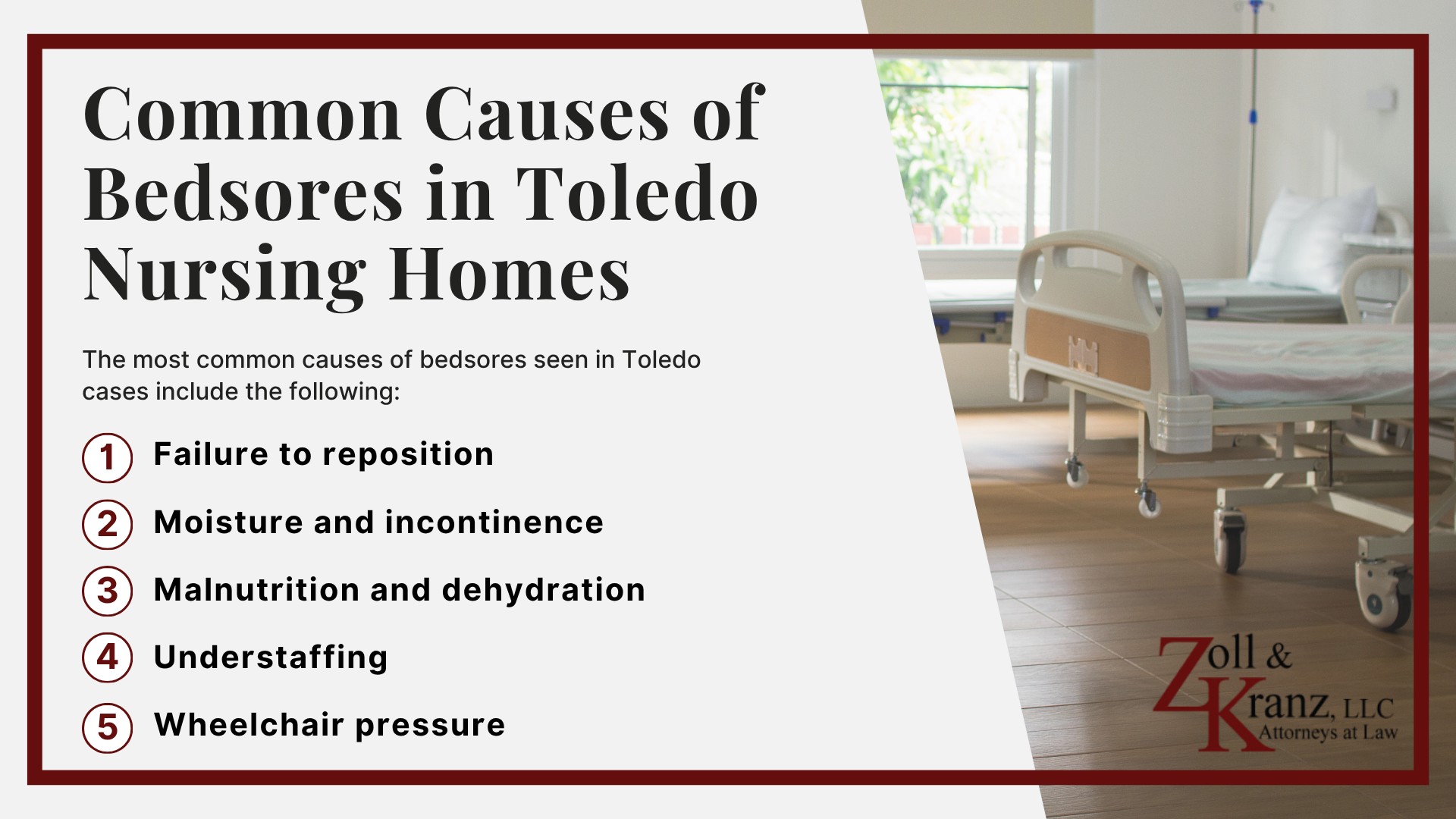
The most common causes of bedsores seen in Toledo cases include the following:

  1. Failure to reposition: Residents left in one position for extended hours lose perfusion at the pressure points, and once tissue damage begins, the injury can advance through stages within hours.
  2. Moisture and incontinence: Immediate cleaning of soiled skin is crucial in preventing breakdown in patients with incontinence. Delayed hygiene care by staff members accelerates skin breakdown and creates conditions where even minor friction causes ulceration.
  3. Malnutrition and dehydration: Inadequate nutrition and hydration can lead to skin health deterioration, increasing the risk of bedsores. Residents with poor nutrition face a greater risk of wound progression because the body lacks the protein, vitamins, and fluid balance needed for tissue repair. Many cases of pressure ulcers overlap with documented dehydration and malnutrition in the resident’s chart.
  4. Understaffing: Neglectful staffing practices, such as inadequate numbers of certified nursing assistants, contribute to the development of bedsores. Toledo nursing homes that run short-staffed miss turning schedules, miss skin assessments, and miss the early signs of a pressure sore before it progresses, which is a recurring pattern in cases of nursing home neglect.
  5. Wheelchair pressure: Regular repositioning is required to prevent and treat nursing home bedsores, with weight needing to be shifted about every fifteen minutes for wheelchair-bound individuals. Without proper repositioning, prolonged pressure on the ischial tuberosities and sacrum increases the risk of open wounds and progressive deep tissue damage.

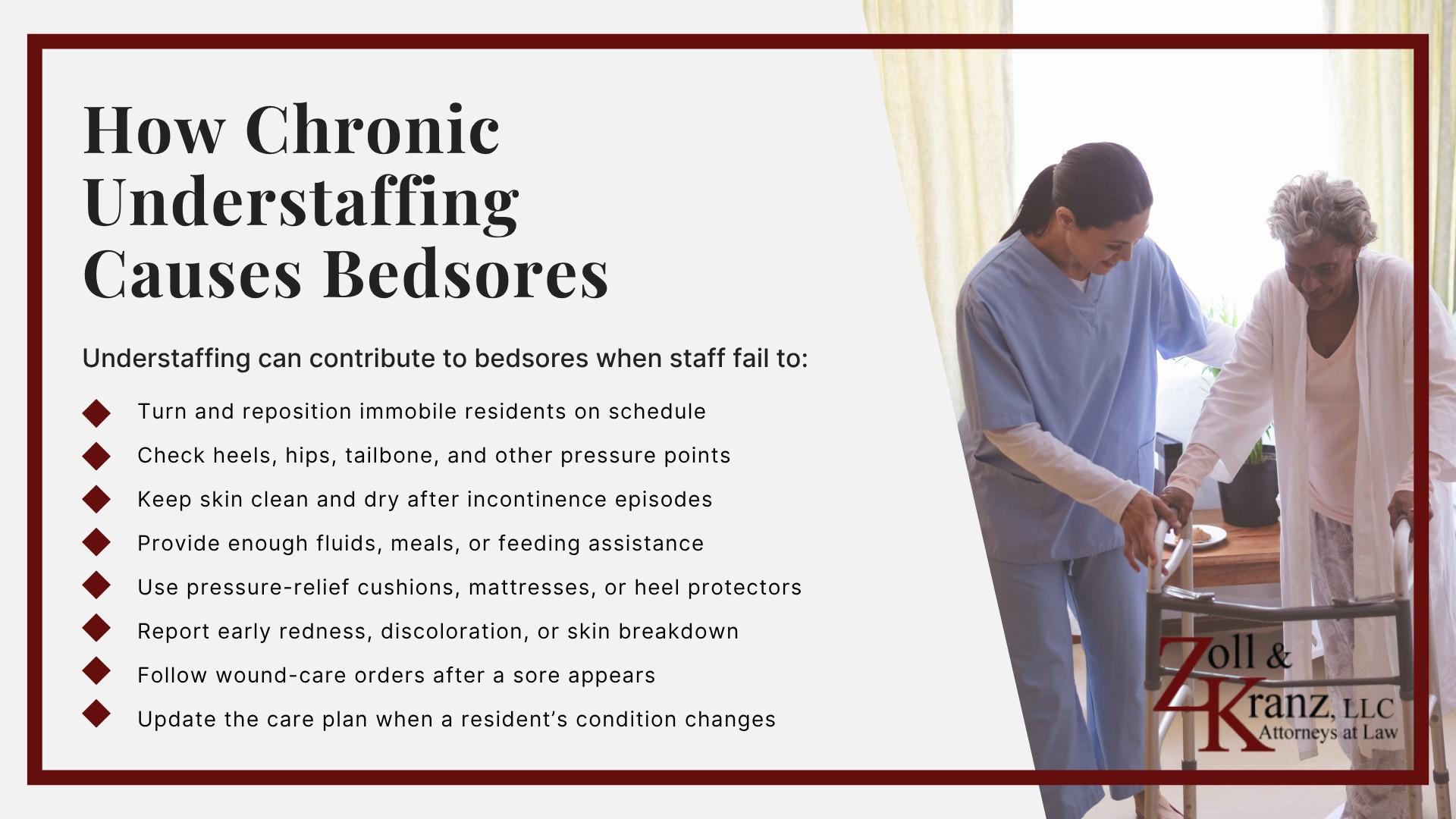
How Chronic Understaffing Causes Bedsores

Chronic understaffing is one of the most common facility-level failures behind preventable bedsores in nursing homes.

Residents who cannot turn, use the toilet, eat, drink, or report pain on their own depend on staff to complete basic prevention tasks throughout the day and night.

When a unit does not have enough trained staff, those tasks are often delayed, skipped, or charted without actually being completed.

Over time, missed repositioning, delayed hygiene care, and incomplete skin checks can allow a pressure injury to form and progress.

Understaffing can contribute to bedsores when staff fail to:

  • Turn and reposition immobile residents on schedule
  • Check heels, hips, tailbone, and other pressure points
  • Keep skin clean and dry after incontinence episodes
  • Provide enough fluids, meals, or feeding assistance
  • Use pressure-relief cushions, mattresses, or heel protectors
  • Report early redness, discoloration, or skin breakdown
  • Follow wound-care orders after a sore appears
  • Update the care plan when a resident’s condition changes

Bedsore cases often turn on whether the facility’s staffing records match the care documented in the resident’s chart.

A nursing home may claim that turning, toileting, hygiene, and skin checks were completed, but staffing logs may show too few aides were working to provide that level of care safely.

When chronic understaffing causes repeated missed care, the resulting wound may reflect a systemic breakdown rather than an unavoidable medical complication.

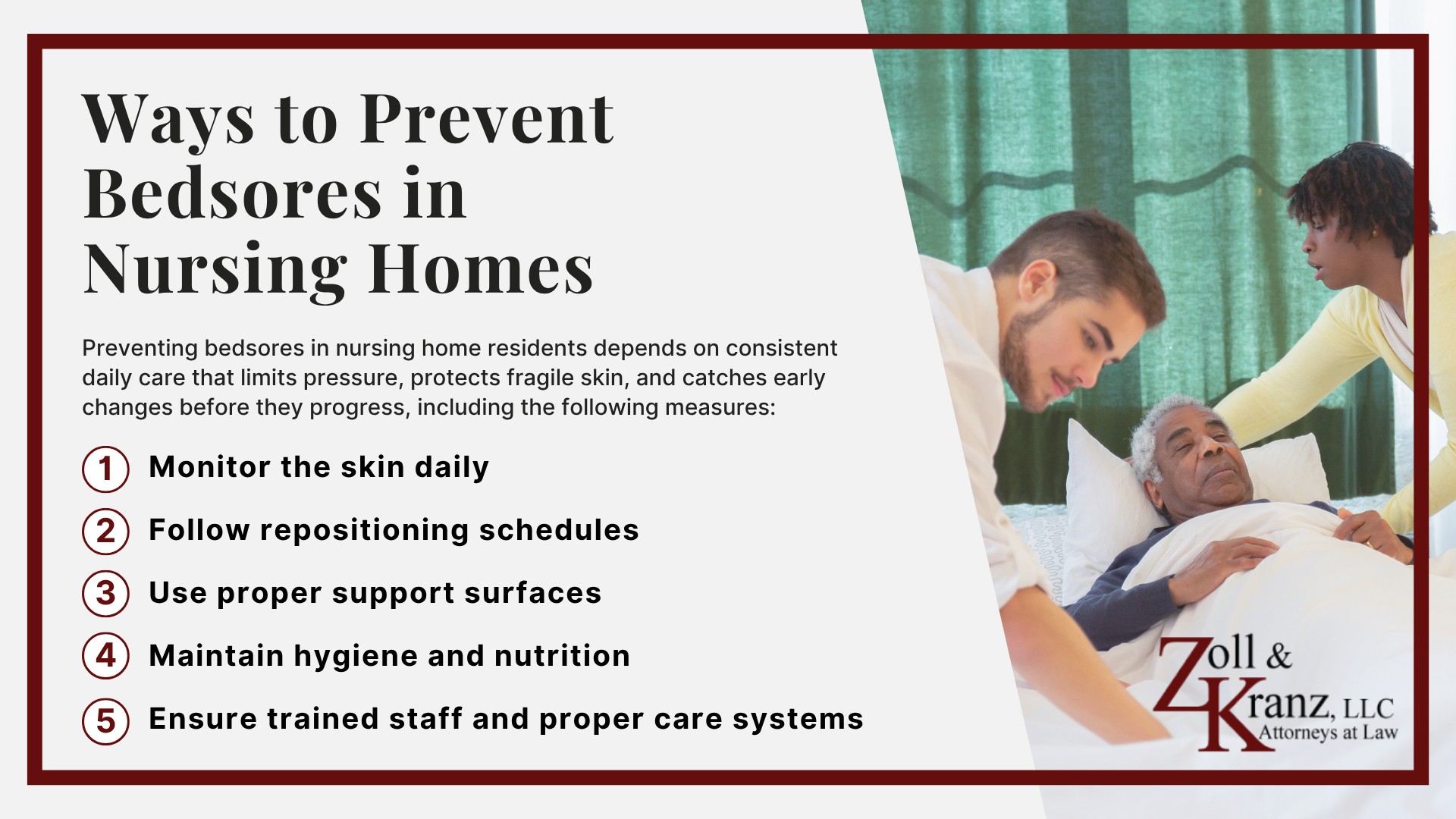
Ways to Prevent Bedsores in Nursing Homes

Bedsores in nursing homes are widely considered preventable by leading medical organizations, which is why federal nursing home regulations require every facility to follow specific prevention measures from the day of admission.

CMS enforces pressure ulcer prevention through survey tag F686, which identifies nursing homes that fail to provide adequate care to prevent and treat pressure ulcers.

For residents at risk of bedsores, prevention depends on daily care that limits pressure on bony areas, keeps fragile skin clean and dry, supports nutrition and hydration, and catches early skin changes before they become open wounds.

Preventing bedsores in nursing home residents depends on consistent daily care that limits pressure, protects fragile skin, and catches early changes before they progress, including the following measures:

  1. Monitor the skin daily: Monitoring skin daily for signs of pressure injuries is crucial for early detection and treatment.Bedsores often start as minor skin changes in areas where bone is close to the skin, so daily checks help catch problems in the early stages.
  2. Follow repositioning schedules: Residents who remain in the same position for long periods experience pressure buildup that restricts blood flow and leads to tissue damage.Repositioning bedridden residents at least every 2 hours is essential to prevent bedsores.
  3. Use proper support surfaces: Using special beds and mattresses can help reduce pressure on the skin and prevent bedsores in nursing home residents.Using specialized equipment, such as alternating air mattresses and cushions, helps relieve pressure and prevent bedsores in residents who cannot reposition themselves.
  4. Maintain hygiene and nutrition: Proper nutrition and hydration are essential for maintaining healthy skin and can play a significant role in preventing bedsores.
  5. Ensure trained staff and proper care systems: Nursing home staff should be trained to implement routines and treatment plans to prevent bedsores, paying close attention to bony areas of the body daily.

Choosing a high-quality nursing home with a good care rating can help ensure that residents receive proper care to prevent bedsores.

Nursing homes with stronger care ratings under the CMS Five-Star Quality Rating System are more likely to maintain these routines on a daily basis, document them properly, and meet the safety and preventative measures required under federal law.

Filing a Bed Sore Lawsuit Against a Nursing Home

A bedsore lawsuit against a Toledo nursing home rests on whether the facility met the standard of care that prevents pressure injuries, including repositioning schedules, skin assessments, hygiene maintenance, and nutritional support.

If a nursing home fails to provide proper care and treatment for bedsores, it may be liable for any harm caused, allowing families to pursue legal claims against the facility.

The legal question is whether the resident received the daily care that federal and Ohio law require, including repositioning, hygiene, monitoring, nutritional support, and timely intervention once a sore appears.

Victims of nursing home neglect can take legal action to pursue financial compensation for treatments and hold the nursing home staff accountable for their negligence.

Legal actions involving pressure sores in Toledo are often filed as ordinary negligence claims when the failure to provide basic supervision and hygiene drives the wound formation.

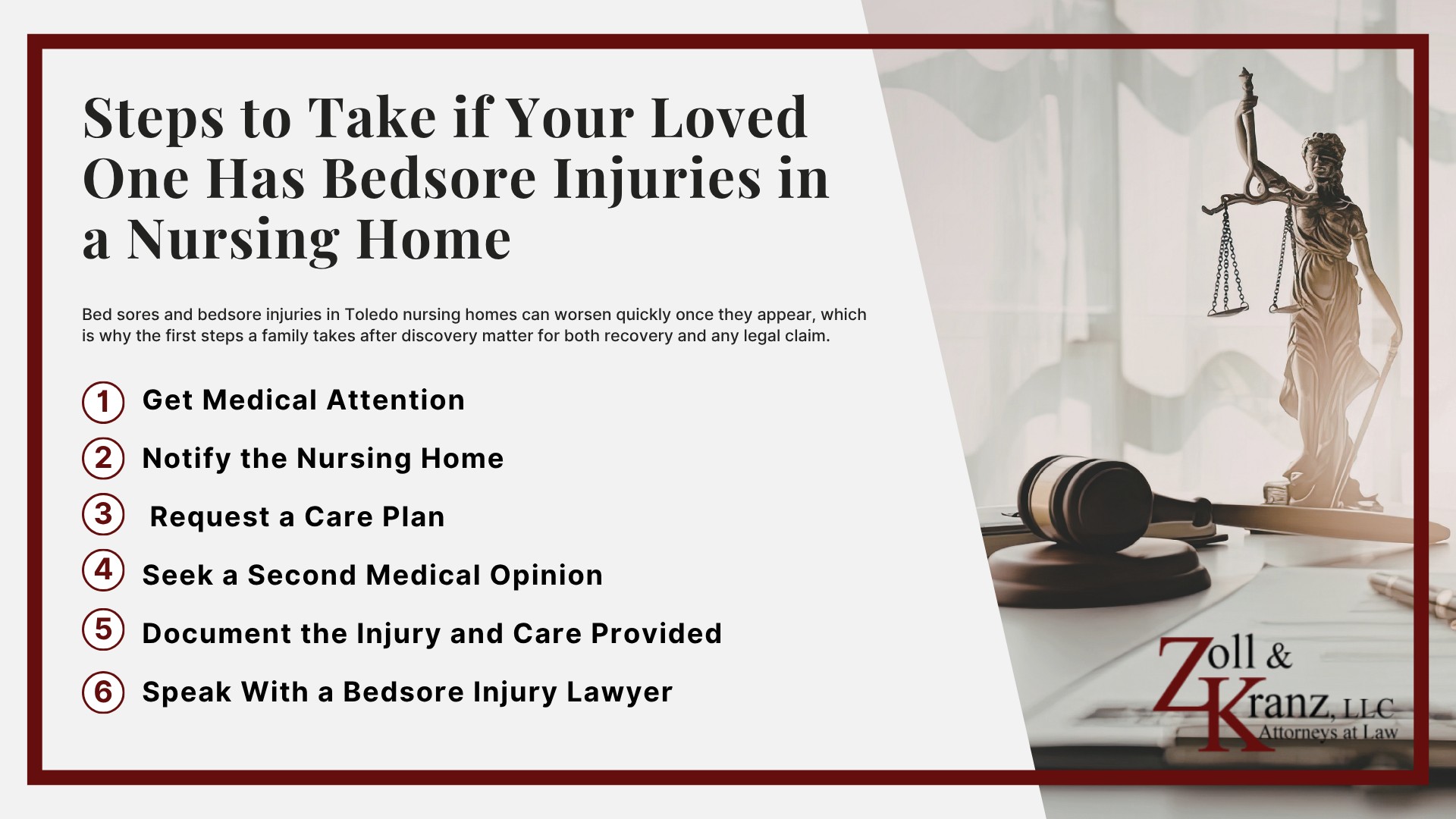
Steps to Take if Your Loved One Has Bedsore Injuries in a Nursing Home

Bed sores and bedsore injuries in Toledo nursing homes can worsen quickly once they appear, which is why the first steps a family takes after discovery matter for both recovery and any legal claim.

Step 1: Get Medical Attention

Have the bedsore examined by a nurse or physician without delay, ideally one outside the facility for an independent assessment of the wound stage and depth.

An outside evaluation also creates a medical record that is independent of the facility’s documentation, which becomes important if the chart later understates the severity of the injury.

Bedsores can rapidly turn into open sores requiring debridement, wound culture, and intravenous antibiotics if infection is suspected, and any delay in treatment at this point may allow the wound to progress to a higher stage within days.

Step 2: Notify the Nursing Home

Inform the nursing staff immediately and request to know what care has been initiated for the wound, including the date and time the wound was first identified in the chart.

The facility’s response to this notification is often the first sign of whether the wound was already known to staff and either left untreated or charted inaccurately.

If the response is delayed or incomplete, escalate the issue to the Director of Nursing or the facility administrator in writing, since written communication creates a dated record of what the family asked for and what the facility said in return.

Step 3: Request a Care Plan

Ask the nursing home to provide a written care plan for the bedsore, since federal regulations require every resident to have an individualized plan that addresses identified risks and active wounds.

The plan should explain how the wound will be treated, how often the resident will be repositioned, what dressings or pressure-relief surfaces will be used, what nutritional support will be added, and what steps will be taken to fight infection.

A facility that cannot produce a written plan, or that produces one with generic language and no resident-specific detail, has likely failed to meet the planning standard required under federal nursing home rules.

Step 4: Seek a Second Medical Opinion

Contact an outside physician or certified wound care specialist to review the condition and assess the wound’s healing process independently of the facility’s clinical team.

A second opinion often produces a more accurate wound staging, a different treatment plan, and a written record that the family can use to compare against what the nursing home has documented.

This step is especially important for older adults in nursing homes with diabetes, circulation problems, or other conditions where healing may be slower and where the facility may try to attribute the wound to underlying health rather than missed care.

Step 5: Document the Injury and Care Provided

Take dated photographs of the bedsore at consistent angles and lighting, note the size and characteristics of the affected area each time, and keep a written log of changes over time alongside the names of any staff who provided or refused care.

Photographs taken over consecutive days establish the progression of the wound in a way that the facility’s chart entries often fail to capture, particularly when those entries are recorded after the fact.

This type of documentation is often central to nursing home abuse cases and is supported by healthcare research on wound progression, since visual evidence and a dated family log can directly contradict charted entries that claim consistent repositioning and skin checks.

Step 6: Speak With a Bedsore Injury Lawyer

If the injury continues to worsen or raises concerns about the care being provided in nursing homes, a lawyer can review the records and decide whether legal action may be appropriate against negligent facilities.

A bedsore injury lawyer can issue a records preservation request to the facility, which prevents the destruction or alteration of turning logs, skin assessments, and nursing notes that are central to the case.

Early legal involvement also matters because Ohio applies a 1-year statute of limitations to most bedsore claims as medical claims, and key evidence such as eyewitness staff accounts and contemporaneous documentation can disappear within weeks of the resident’s discharge or death.

Proving a Bedsore Claim Against a Toledo Nursing Home

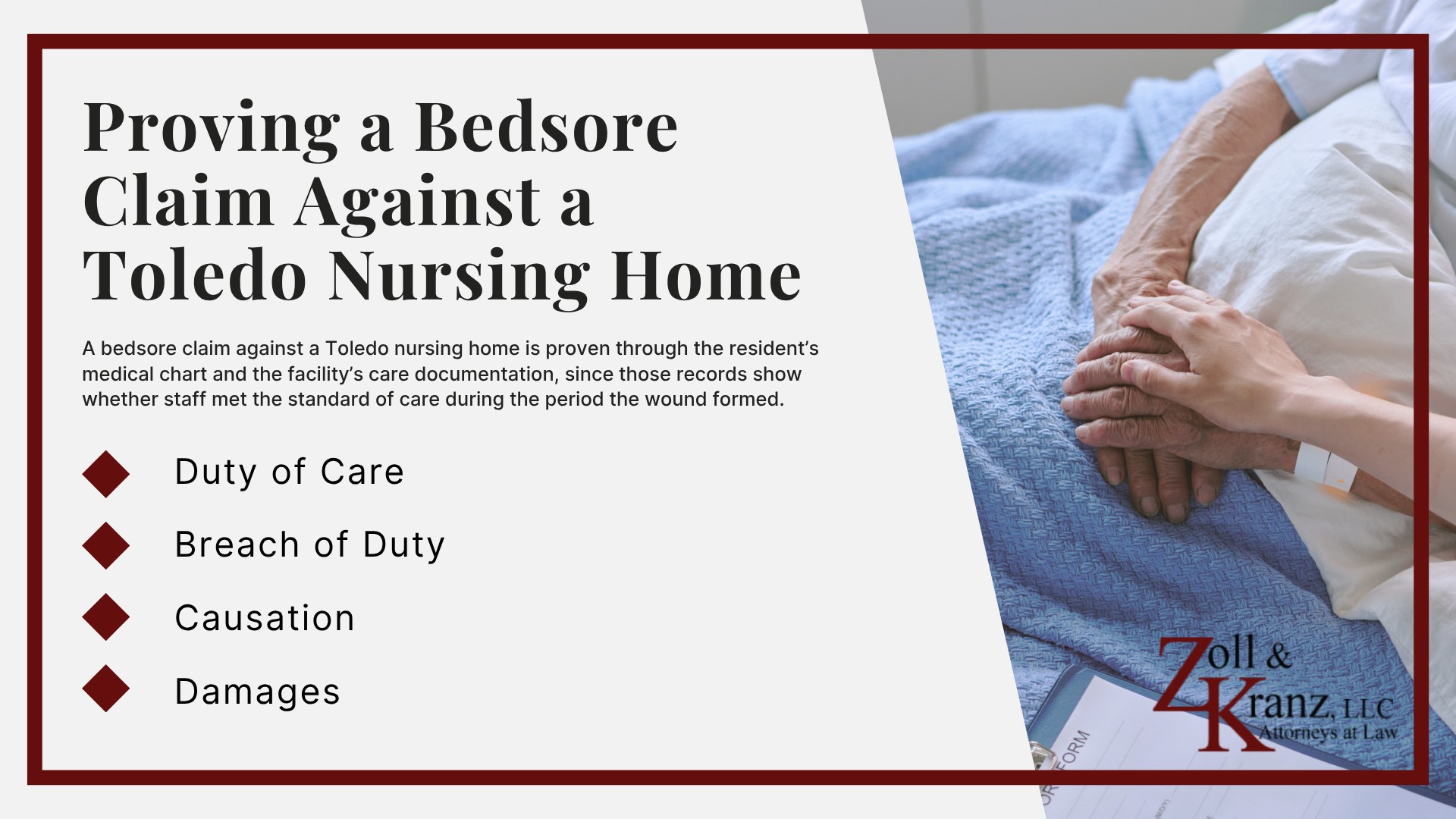
A bedsore claim against a Toledo nursing home is proven through the resident’s medical chart and the facility’s care documentation, since those records show whether staff met the standard of care during the period the wound formed.

The claim turns on four standard elements, duty, breach, causation, and damages, each of which is established through the same body of medical and facility records rather than separate evidence.

Duty of Care

Every Toledo nursing home owes its residents a duty under 42 CFR 483.25(b)(1) and the Ohio Nursing Home Residents Bill of Rights under Ohio Revised Code § 3721.13 to prevent pressure ulcers and provide appropriate medical care.

Under federal and Ohio law, nursing homes must ensure bedsores are preventable and treated aggressively.

That duty begins at admission and continues for the length of the resident’s stay, regardless of the resident’s underlying condition, as part of the broader duty of care owed by facilities.

Breach of Duty

A breach occurs when staff skip repositioning, miss skin assessments, ignore nutritional needs, or fail to follow the individualized care plan or Minimum Data Set assessment.

Causation

The breach must be tied directly to the bedsore.

A wound-care expert typically reviews the chart and connects the missed care to how the wound developed, worsened between stages, or led to secondary health problems such as infection or systemic complications.

Damages

The resident must have suffered actual harm.

Damages in a bedsore case include medical bills, pain and suffering, disfigurement, death from complications, and other injuries that flow from the original wound, including osteomyelitis, deep wound infection, and long-term loss of function.

Documenting these damages through collecting evidence from medical records, photographs, and physician testimony is what supports the value of the claim.

Time Limit to File a Bedsore Lawsuit in Ohio

In Ohio, the time to file a bedsore lawsuit against nursing homes depends on how the claim is classified under state law.

Most bedsore cases are handled as medical claims because care such as repositioning, skin checks, wound treatment, and nutritional support falls within the nursing care plan provided by licensed healthcare staff.

Under Ohio Revised Code § 2305.113, a medical claim must be filed within 1 year from when the injury occurred or was discovered, which in many bedsore cases is within a few weeks of clear symptoms appearing.

Guidance from the Centers for Disease Control and Prevention recognizes that pressure ulcers can worsen quickly without proper care, which is why claims are tied closely to when the injury becomes identifiable.

If the underlying issue involves basic neglect such as supervision, hygiene, or hygiene neglect rather than clinical care decisions, the 2-year limit under Ohio Revised Code § 2305.10 may apply instead.

Ohio law allows a 180-day extension if written notice is sent to the potential defendant before the 1-year period expires.

A separate 4-year statute of repose under § 2305.113(C) sets a final deadline regardless of when the injury is discovered.

If the bedsore leads to death, a 2-year wrongful death limit applies from the date of death under Ohio Revised Code § 2125.02.

Medical claims also require an affidavit of merit at filing under Ohio Civil Rule 10(D)(2), which affects how quickly the case must be prepared and reviewed by a qualified medical expert.

Arbitration Agreements in Nursing Home Bedsore Claims

Signing an arbitration agreement during admission to one of Ohio’s nursing homes does not take away the right to bring a bedsore claim against the facility.

Under the Federal Arbitration Act, 9 U.S.C. § 2, arbitration agreements are generally treated as valid contracts.

The U.S. Supreme Court has held that arbitration agreements in nursing home admission contracts must be enforced on the same terms as other contracts.

This includes situations where the agreement was signed by an authorized agent acting under a power of attorney.

In Ohio nursing home cases, the central dispute typically focuses on whether the arbitration agreement is enforceable against the resident or the resident’s estate.

If the agreement is enforced, the claim proceeds in arbitration rather than in court.

The substantive legal issues remain the same, including negligence, causation, damages, and the resident’s patient rights under federal and state law.

Damages Available in a Bedsore Settlement

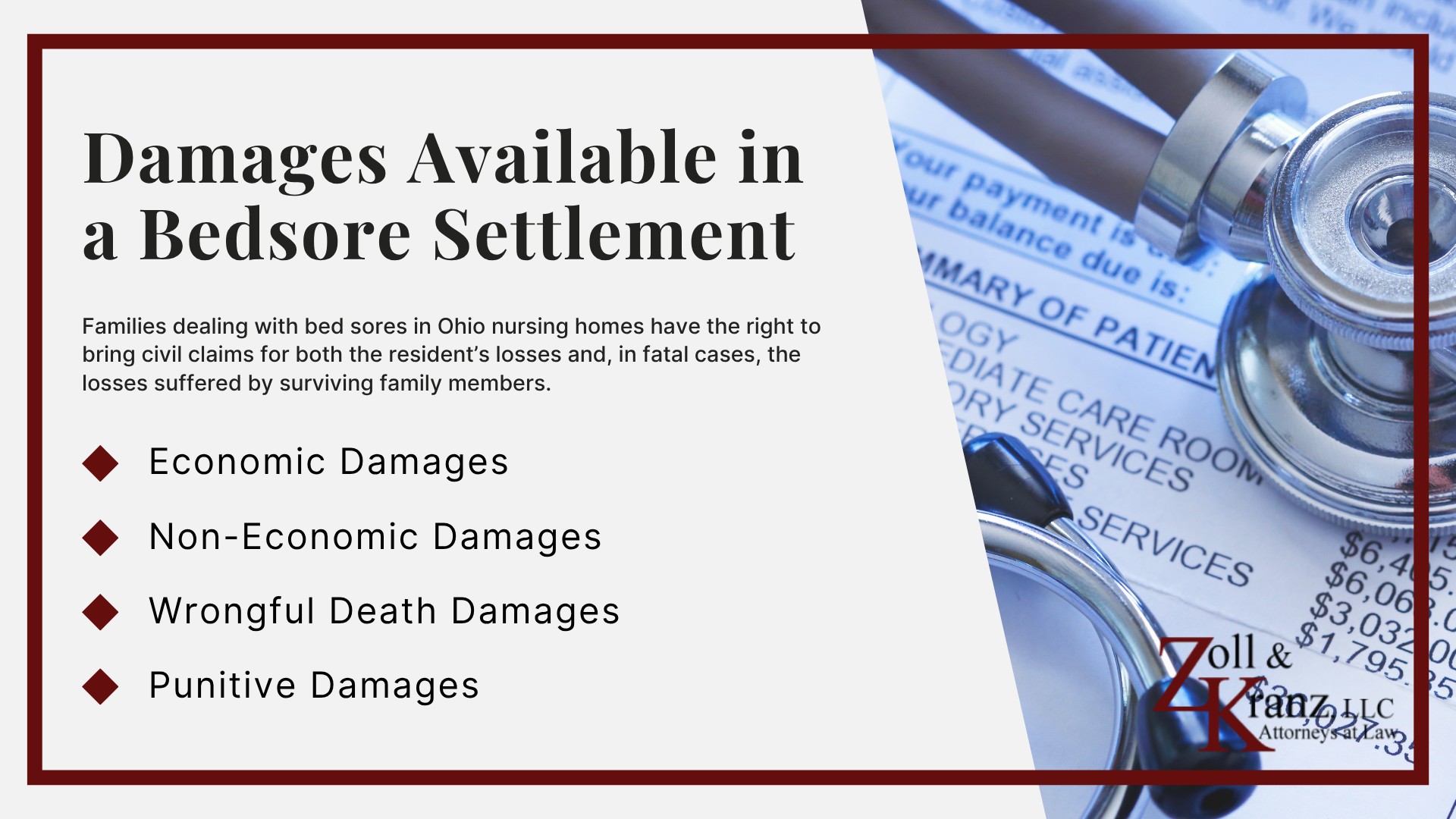
Bedsore claims against Toledo nursing homes allow recovery under Ohio law for the losses caused by pressure sores and related injuries, with compensation structured around the type of harm the resident and family have suffered.

If your parent’s bed sores are the result of nursing home negligence or abuse, you may have legal options to pursue compensation for medical expenses, pain and suffering, and other damages.

Families dealing with bed sores in Ohio nursing homes have the right to bring civil claims for both the resident’s losses and, in fatal cases, the losses suffered by surviving family members.

Economic Damages

These cover measurable financial losses tied to the injury.

This includes medical expenses for hospitalization, wound care, surgical debridement, medication, long-term skilled care, and additional care caused by the bedsore.

Future costs may also be included where the condition results in ongoing medical care or permanent impairment requiring continued wound management.

Non-Economic Damages

These address the human impact of the injury, including physical pain, emotional distress, disfigurement from scarring, loss of dignity, and the diminished quality of life that follows a serious pressure ulcer.

Ohio caps most non-economic damages under Ohio Revised Code § 2315.18, though the cap does not apply when the injury results in permanent and substantial physical deformity, loss of a limb, or loss of bodily organ system function.

Wrongful Death Damages

When life threatening bedsores in nursing homes result in even death, Ohio wrongful death law allows recovery for the losses suffered by surviving family members.

This may include loss of financial support, loss of services, and the loss of companionship and society previously provided by the resident, with these claims often handled as part of broader nursing home wrongful death cases.

Punitive Damages

Additional damages may apply in cases involving aggravated neglect or even abuse, including other damages tied to the full impact of the injury on the resident and the family.

Punitive damages against nursing homes under Ohio law depend on whether the conduct rises beyond ordinary negligence to a showing of conscious disregard for the resident’s safety.

Speak With a Toledo Bedsore Attorney at Zoll & Kranz

Bedsore claims involving Ohio nursing homes often depend on whether required health care was actually provided and how that care is reflected in medical records.

These cases focus on identifying the gap between documented health care services, such as repositioning schedules, wound treatment, and monitoring, and the resident’s actual physical condition over time.

A Toledo personal injury lawyer at Zoll & Kranz helps families pursue justice in Toledo nursing home cases involving preventable injuries such as bedsores.

When a bedsore contributes to the death of a resident, the case may also be evaluated by a Toledo wrongful death lawyer at the firm to determine what damages the surviving family may recover under Ohio wrongful death law.

Zoll & Kranz has represented people seriously harmed by negligence in Ohio for 37 years and has recovered $35 million for clients on a contingency-fee basis, with no fee owed unless the case results in compensation.

If a loved one has been injured by bedsores at a Toledo nursing home, Zoll & Kranz can review the records and determine whether the case supports a claim under Ohio law.

Call (419) 841-9623 to schedule a free consultation with the firm.

Use the chat feature on this page to find out if you qualify for a bedsore claim against a Toledo nursing home.

Frequently Asked Questions

Published by:
Share
Picture of Michelle L. Kranz
Michelle L. Kranz

Michelle is a founding partner of Zoll & Kranz, located in Toledo, Ohio. Michelle has been a plaintiff’s lawyer for the entirety of her practice – over 32 years. She devotes the majority of her time to complex consolidated litigation and class action including advocating for people injured by medical devices, prescription medications, or corporate negligence.

This article has been written and reviewed for legal accuracy and clarity by the team of writers and attorneys at Zoll & Kranz, LLC and is as accurate as possible. This content should not be taken as legal advice from an attorney. If you would like to learn more about our owner and experienced Ohio injury lawyer, Michelle L. Kranz, you can do so here.

Zoll & Kranz, LLC does everything possible to make sure the information in this article is up to date and accurate. If you need specific legal advice about your case, contact us. This article should not be taken as advice from an attorney.

Other cases we handle in Toledo
All
Auto Accidents
Injury Types
Medical Malpractice
Nursing Home Abuse
Other Accidents & Injuries
You can learn more about other Toledo cases we handle below:
Auto Accident Lawsuit Timeline in Toledo
Auto Accident Statute of Limitations in Toledo, OH
Collecting Evidence in Toledo Medical Malpractice Cases
Collecting Evidence in Toledo Nursing Home Negligence Cases
Common Car Accident Injuries in Toledo, OH
Common Causes of Nursing Home Negligence in Toledo
Common Types of Car Accident Damages
Dehydration and Malnutrition in Nursing Homes
Distracted Driving Accidents in Toledo, OH
Dropped Patients in Nursing Homes
DUI Accidents in Toledo
Duty of Care Owed by Nursing Home Facilities in Ohio
Evidence in Toledo Auto Accident Cases
Failure to Perform Procedure Malpractice Lawyer in Toledo
Falls in Toledo Nursing Homes
Head-On Collisions in Toledo
Hit-and-Run Accidents in Toledo
How is Fault Determined in a Car Accident?
How To File a Car Crash Lawsuit in Toledo
How to Report Nursing Home Abuse in Toledo, Ohio
Inattentive Nursing Home Staff: Steps to Take
Infections in Toledo Nursing Homes
Initial Steps To Take in a Toledo Medical Malpractice Case
Interstate Accidents in Toledo
Liability in Toledo Medical Malpractice Claims
Liability in Toledo Nursing Home Negligence Cases
Medication Errors in Toledo Nursing Homes
Mental and Emotional Abuse in Nursing Homes
Neglect in Toledo Nursing Homes
Negligence in Toledo Medical Malpractice Cases
Negligent Hiring or Training in Toledo Nursing Homes
Nursing Home Negligence Wrongful Death Cases in Toledo
Paralysis in Auto Accidents
Patient Rights in Toledo Nursing Homes
Personal Injury Lawyer Toledo, Ohio
Physical Abuse in Toledo Nursing Homes
Process of a Medical Malpractice Case in Toledo
Rear-End Collisions in Toledo, OH
Rental Car Accidents in Toledo
Rollover Accidents in Toledo
Securing a Police Report in Toledo After an Auto Accident
Sexual Abuse in Toledo Nursing Homes
Sideswipe Accidents in Toledo
Toledo Anesthesia Errors Lawyer
Toledo Auto Accident Comparative Negligence Explained
Toledo Auto Accident Lawyer
Toledo Bicycle Accident Lawyer
Toledo Burn Injury Lawyer
Toledo Bus Accident Lawyer
Toledo Cancer Misdiagnosis Lawyer
Toledo Car Accident Lawyer
Toledo Catastrophic Injury Lawyer
Toledo Daycare Injury Lawyer
Toledo Delayed Diagnosis Lawyer
Toledo Emergency Room Error Lawyer
Toledo Failure To Diagnose Lawyer
Toledo Insurance Claim Lawyer
Toledo Mass Torts Lawyer
Toledo Medical Malpractice Lawyer
Toledo Medication Error Lawyer
Toledo Misdiagnosis Medical Malpractice Lawyer
Toledo Motorcycle Accident Lawyer
Toledo Nurse Error Lawyer
Toledo Nursing Home Abuse Lawyer
Toledo Nursing Home Negligence Safety and Preventative Measures
Toledo Pedestrian Accident Lawyer
Toledo Spinal Cord Injury Lawyer
Toledo Surgical Error Lawyer
Toledo Toxic Exposure Lawyer
Toledo Traumatic Brain Injury Lawyer
Toledo Truck Accident Lawyer
Toledo Wrongful Death Lawyer
Wrong Site Surgery Malpractice in Toledo
Were you or a loved one injured in Toledo?

A serious injury can have life-altering results.

Don’t settle for less than you deserve, speak with an award-winning personal injury lawyer today.

18 Reviews
5.0
★★★★★
Recovered damages
$108 Million+

Table of Contents

Practice Areas
About Zoll & Kranz, LLC

For over 37 years, Zoll & Kranz has been fighting for clients who have been the victims of the wrongful death of a loved one.

Do you believe you’re entitled to compensation?

Use our Instant Case Evaluator to find out in as little as 60 seconds!

Guides & Resources

Other Toledo Personal Injury Cases

All
Auto Accidents
Injury Types
Medical Malpractice
Nursing Home Abuse
Other Accidents & Injuries
Local Toledo Resources
Education
Emergency Services
Courthouses
Department of Motor Vehicles
Sights to See