
Interstate accidents in Toledo often involve higher speeds, heavier traffic, and more severe injuries than crashes on local roads. Major corridors like I-75, I-80/90, and I-475 carry a mix of commuters, commercial trucks, and out-of-state traffic, which increases the risk of complex, multi-vehicle collisions.
Sudden congestion, construction zones, and frequent lane changes contribute to abrupt braking and chain-reaction crashes.
Weather shifts off Lake Erie can also create hazardous driving conditions with little warning. Because interstates are designed for sustained high speeds, even minor driver errors can lead to serious outcomes.
Truck traffic plays a significant role in interstate crashes, particularly where merging and exits are tightly spaced.
Emergency response and crash reconstruction on these roadways often require lane closures, which can complicate evidence collection.
The resulting injuries and property damage tend to be extensive, making interstate accident claims more involved than standard car crash cases.
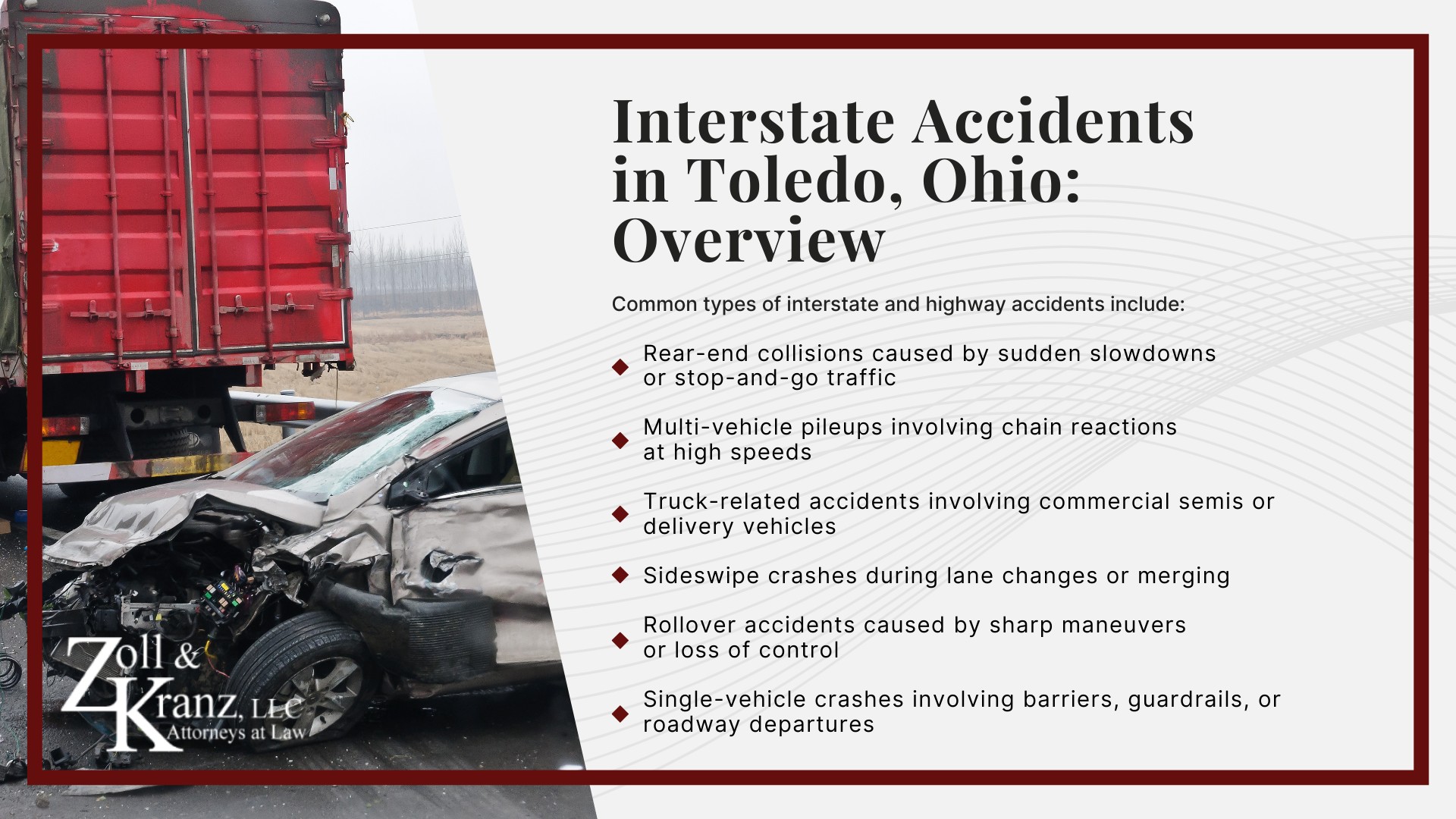
Common types of interstate and highway accidents include:
- Rear-end collisions caused by sudden slowdowns or stop-and-go traffic
- Multi-vehicle pileups involving chain reactions at high speeds
- Truck-related accidents involving commercial semis or delivery vehicles
- Sideswipe crashes during lane changes or merging
- Rollover accidents caused by sharp maneuvers or loss of control
- Single-vehicle crashes involving barriers, guardrails, or roadway departures
Interstate accidents often raise complex questions about speed, following distance, and driver attention.
They may also involve multiple insurance policies and overlapping liability issues.
A clear understanding of how these crashes happen is essential when evaluating fault and the full scope of resulting damages.
Where Interstate Accidents Occur in Toledo
Interstate accidents in the Toledo area frequently happen on the major corridors and interchange zones where traffic funnels, merges, and changes speed: I-75, I-475, I-280, and the Ohio Turnpike corridor near the metro area.
These are also the places where road closures and sudden lane shifts can catch drivers off guard, especially during construction season or when emergency response narrows travel lanes.
Detours can push drivers onto nearby surface routes; for example, Pleasant Hill Rd in Maumee is one of the local roads you may see used when freeway flow is disrupted, depending on where the closure hits.
Interstate Accident Statistics
Interstate crashes make up a smaller share of overall fatal accidents nationally, but they tend to involve higher speeds and more severe outcomes.
The Ohio State Highway Patrol’s Lucas County fatal-crash map shows 51 fatal traffic crashes in 2023, following 38 in 2022 and 53 in 2021, with interstate corridors clearly featured in the county roadway map (including I-75, I-475, and I-280).
The same Lucas County report also identifies how often impairment intersects with fatal outcomes locally, listing 30 OVI-related fatal crashes in 2023.
Ohio’s fatal-crash reporting shows that statewide traffic deaths remain high year over year. For example, the OSHP five-year summary lists 1,242 traffic fatalities in 2023 and 1,150 fatal traffic crashes that same year.
Nationwide, only about 18% of fatal crashes occur on interstates, compared to 42% on state highways, yet interstate collisions often result in catastrophic injuries due to speed, traffic volume, and heavy truck presence.
In 2021, U.S. traffic deaths reached 43,230, with a fatality rate of 1.38 deaths per 100 million vehicle miles traveled, while more recent mid-year data shows the rate dropped to 1.06, the lowest mid-year rate since 2014.
Ohio and Toledo-area interstates reflect these national trends, with impairment, speed, and restraint use playing a major role in crash severity.
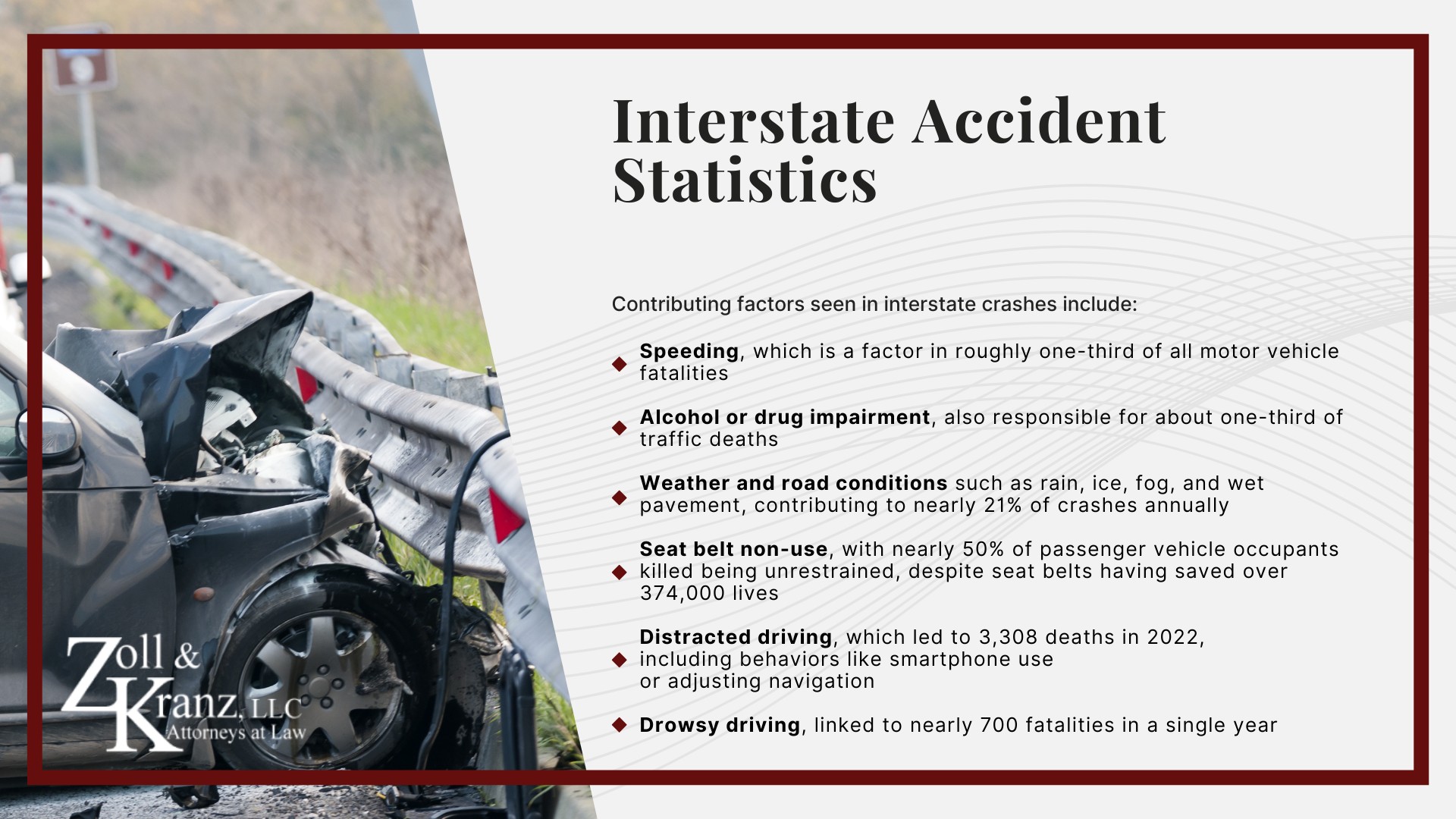
Contributing factors seen in interstate crashes include:
- Speeding, which is a factor in roughly one-third of all motor vehicle fatalities
- Alcohol or drug impairment, also responsible for about one-third of traffic deaths
- Weather and road conditions such as rain, ice, fog, and wet pavement, contributing to nearly 21% of crashes annually
- Seat belt non-use, with nearly 50% of passenger vehicle occupants killed being unrestrained, despite seat belts having saved over 374,000 lives
- Distracted driving, which led to 3,308 deaths in 2022, including behaviors like smartphone use or adjusting navigation
- Drowsy driving, linked to nearly 700 fatalities in a single year
These statistics show that while interstate crashes are less frequent than other roadway collisions, they are often more dangerous.
High speeds reduce reaction time and magnify the impact of driver error, impairment, or distraction.
As a result, interstate accidents frequently lead to severe injuries or fatalities, particularly when safety restraints are not used.
Preventing Accidents on Interstates and Highways
Preventing accidents on interstates and highways starts with understanding how quickly conditions can change at high speeds.
Small mistakes become dangerous when traffic is dense, speeds are elevated, and reaction time is limited.
Many serious crashes are tied to preventable behaviors like distraction, tailgating, and inattention.
Drivers who stay alert and give themselves space have more time to respond to sudden braking, lane changes, or debris.
Consistent defensive driving habits reduce the risk of collisions and help protect everyone on the road.
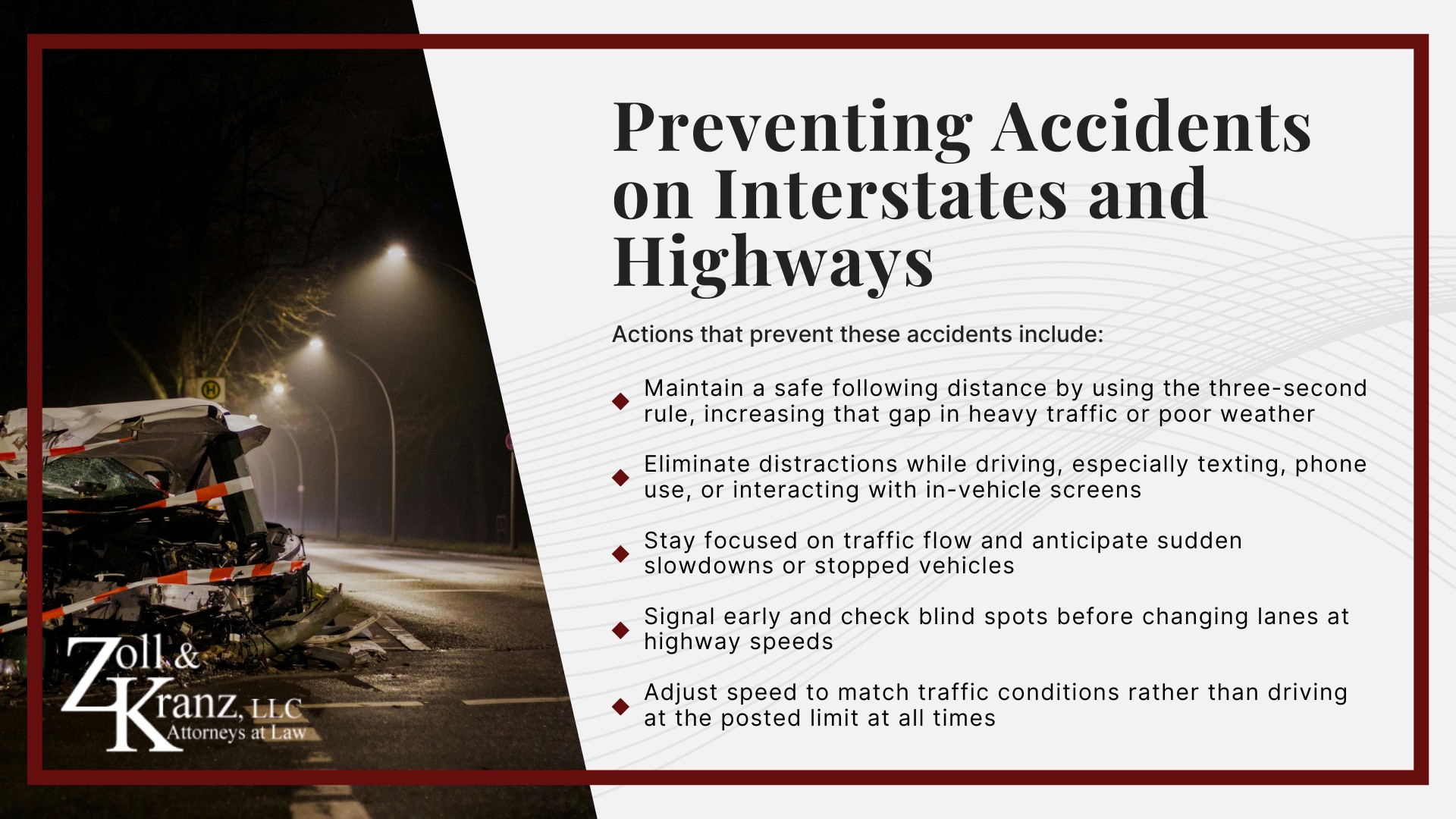
Actions that prevent these accidents include:
- Maintain a safe following distance by using the three-second rule, increasing that gap in heavy traffic or poor weather
- Eliminate distractions while driving, especially texting, phone use, or interacting with in-vehicle screens
- Stay focused on traffic flow and anticipate sudden slowdowns or stopped vehicles
- Signal early and check blind spots before changing lanes at highway speeds
- Adjust speed to match traffic conditions rather than driving at the posted limit at all times