No fees unless we win.
Get a free consultation
18 Reviews
5.0
★★★★★

Dehydration and Malnutrition in Nursing Homes

Understanding Dehydration and Malnutrition in Toledo Nursing Homes

Inadequate food and water is among the most preventable forms of resident harm, and Toledo family members face the same risk as families across the country.

Dehydration occurs when a nursing home resident loses more fluid than they take in, which can lead to serious health complications if not addressed promptly.

Further, malnutrition in nursing homes affects up to 20–30% of residents and can lead to severe health impacts like weight loss and increased mortality.

Repeated failures to provide adequate nutrition, hydration, monitoring, or feeding assistance may constitute neglect under federal and Ohio law.

An experienced Toledo nursing home abuse attorney at Zoll & Kranz can investigate the conduct, document the harm, and pursue compensation for the resident.

Dehydration and Malnutrition in Nursing Homes

Did a Toledo Nursing Home Fail to Feed or Hydrate Your Loved One Properly?

Families are usually the first to sense that something inside the nursing home has changed, and that instinct often appears weeks before any clinical concern is documented in the chart.

The shift can look like a loved one who eats less, drinks less, seems quieter, or appears thinner on each visit, and these signs reflect specific gaps in how the staff has cared for the resident.

Ohio law treats those gaps as a breach of duty owed every resident, and the weight logs, intake charts, and care plan entries that prove the breach are easier to obtain in the early weeks after family members raise concerns.

A Toledo nursing home abuse attorney can request the records, work with geriatric and nutrition experts, file a claim within Ohio time limits, and pursue full compensation for the loved one’s injuries.

If your loved one has suffered serious harm from dehydration or malnutrition in a Toledo nursing home, you may be eligible to file a nursing home neglect claim and seek compensation for the harm caused.

Contact Zoll & Kranz today for a free consultation.

You can also use the chat feature on this page to find out if you qualify for a nursing home neglect case under Ohio law.

Why Nutrition and Hydration Matter for Nursing Home Residents

Older adults and elderly people in long-term care face physical changes that make them far more vulnerable to fluid loss, and even short periods without receiving adequate fluids can produce serious consequences.

Muscle mass decreases with age, metabolism slows, and the body holds less water overall, leaving elderly residents in nursing homes with a smaller margin of safety.

Thirst sensation also diminishes, which means many residents will not feel thirsty even when the body’s ability to retain water has reached a dangerous low.

Chronic illnesses and certain medications including diabetes drugs and diuretics compound the risk and require careful tracking by nursing home staff.

Proper nutrition supports the immune system, helps wounds heal, and gives residents the strength to participate in therapy alongside other residents.

When either nutrition or enough fluids are missing for extended periods, the body breaks down quickly and the resident does not recover the strength they had before.

Warning Signs of Dehydration in Nursing Home Residents

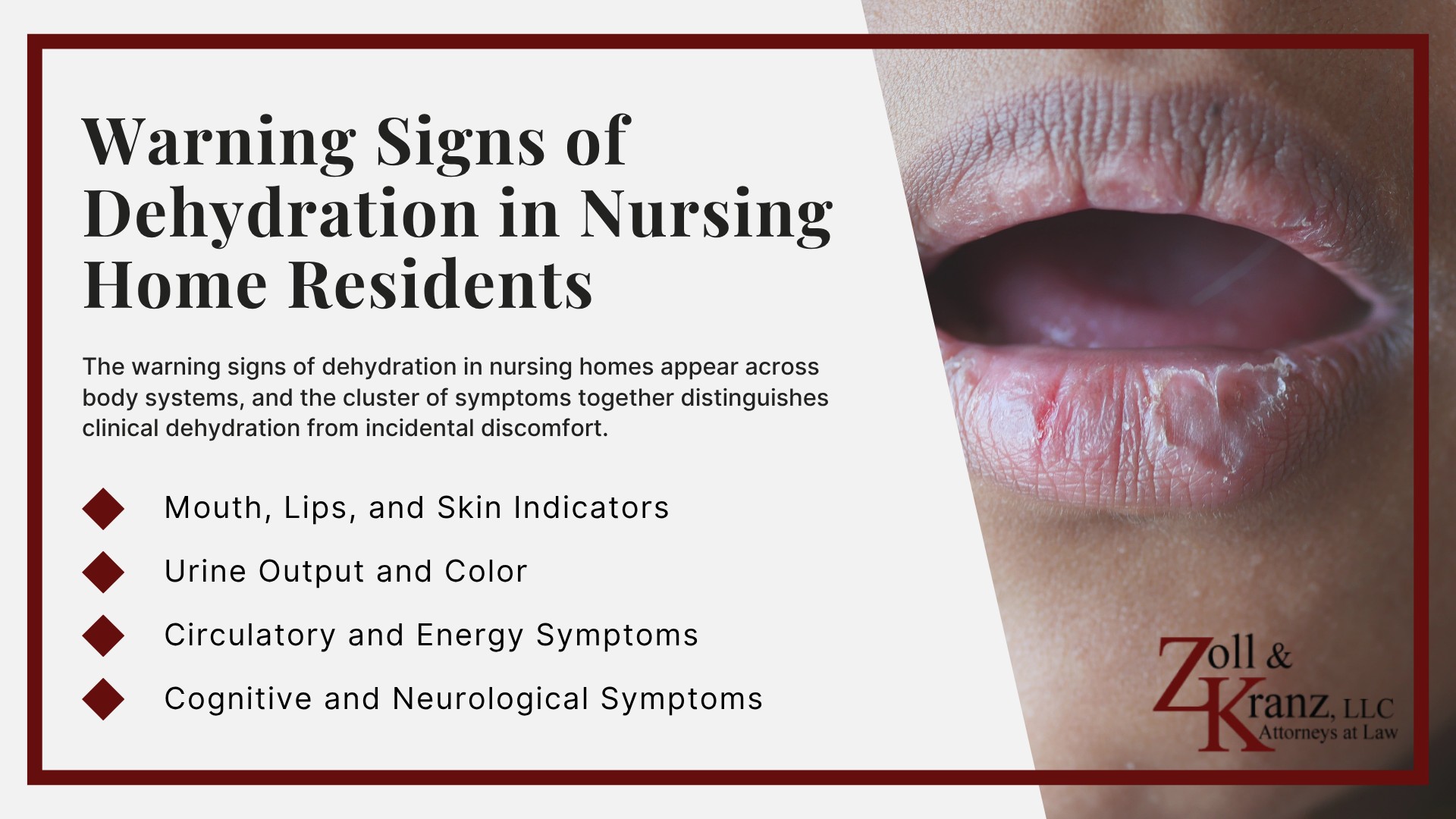
The warning signs of dehydration in nursing homes appear across body systems, and the cluster of symptoms together distinguishes clinical dehydration from incidental discomfort.

Mouth, Lips, and Skin Indicators

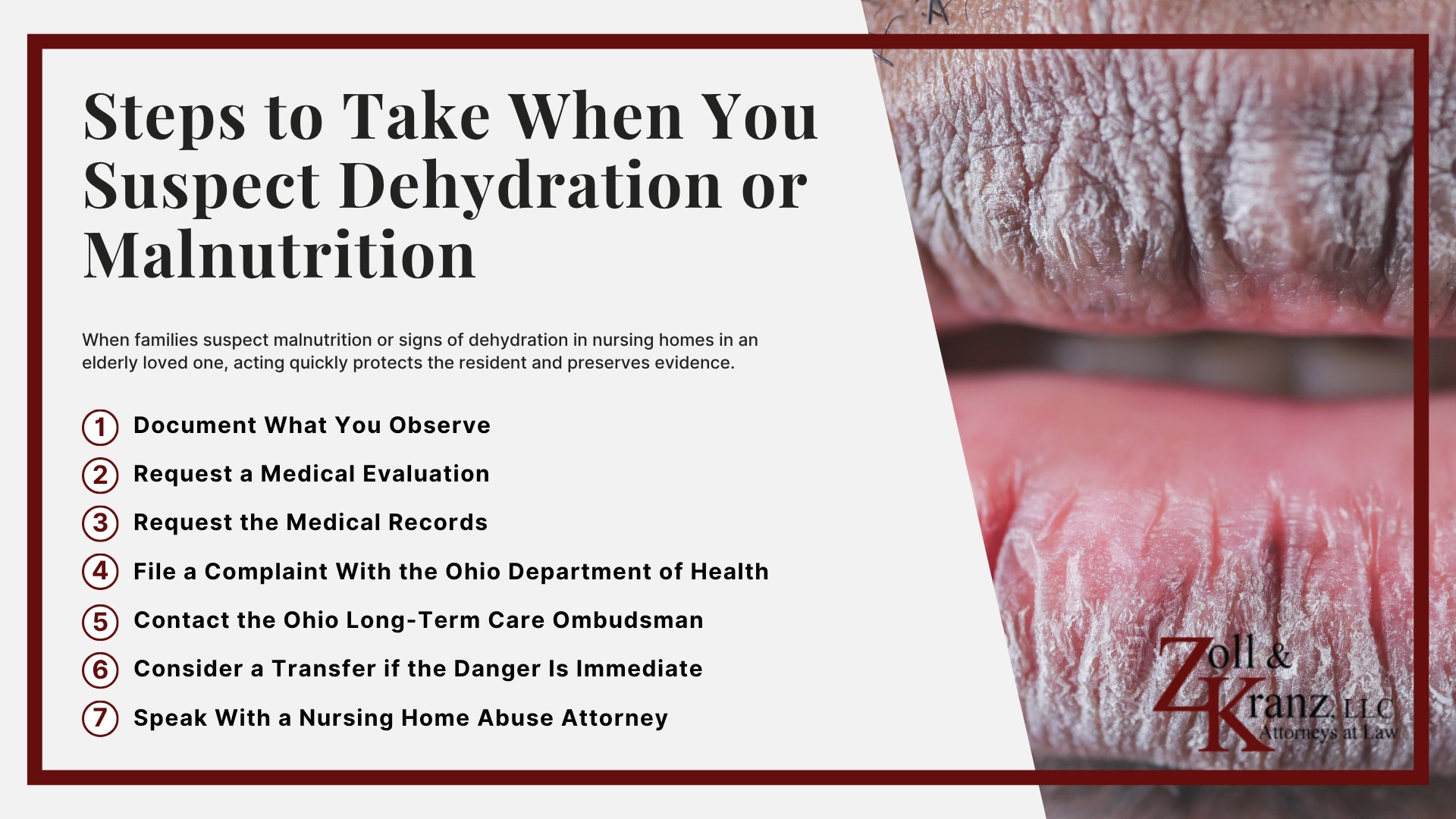
Dry mouth, lips, and throat are common early signs of dehydration; families should observe if their loved one frequently complains of thirst despite having water available.

Dry mouth, cracked lips, sores at the corners of the mouth, dry coated tongue, and skin that does not bounce back when gently pinched are reliable indicators of inadequate fluid intake.

Sunken eyes and dry, papery skin on the hands also appear once fluid loss has progressed beyond mild.

Urine Output and Color

Dark urine and infrequent urination are reliable indicators of dehydration, signaling that the body is conserving water due to insufficient intake.

Urine output of less than 800 mL across 24 hours is low for an adult resident, and any drop below this level requires immediate physician notification.

Circulatory and Energy Symptoms

As fluid loss progresses, residents experience dizziness on standing, low blood pressure drops of more than 20 mmHg between lying and standing, a rapid pulse above 100 beats per minute, muscle weakness, fatigue, headaches, and muscle cramps.

Cognitive and Neurological Symptoms

Confusion, irritability, and lethargy can indicate severe dehydration, and these symptoms may be mistakenly attributed to dementia or normal aging.

A previously alert resident who becomes suddenly disoriented or unresponsive needs immediate medical evaluation, because severe dehydration can progress to fainting, seizures, kidney failure, and hypovolemic shock within hours.

Warning Signs of Malnutrition in Nursing Home Residents

Research indicates that 18 to 20% of nursing home residents experience malnutrition on average, while nearly 50%are at risk of malnutrition, with rates in poorly managed facilities reaching 30 to 85%.

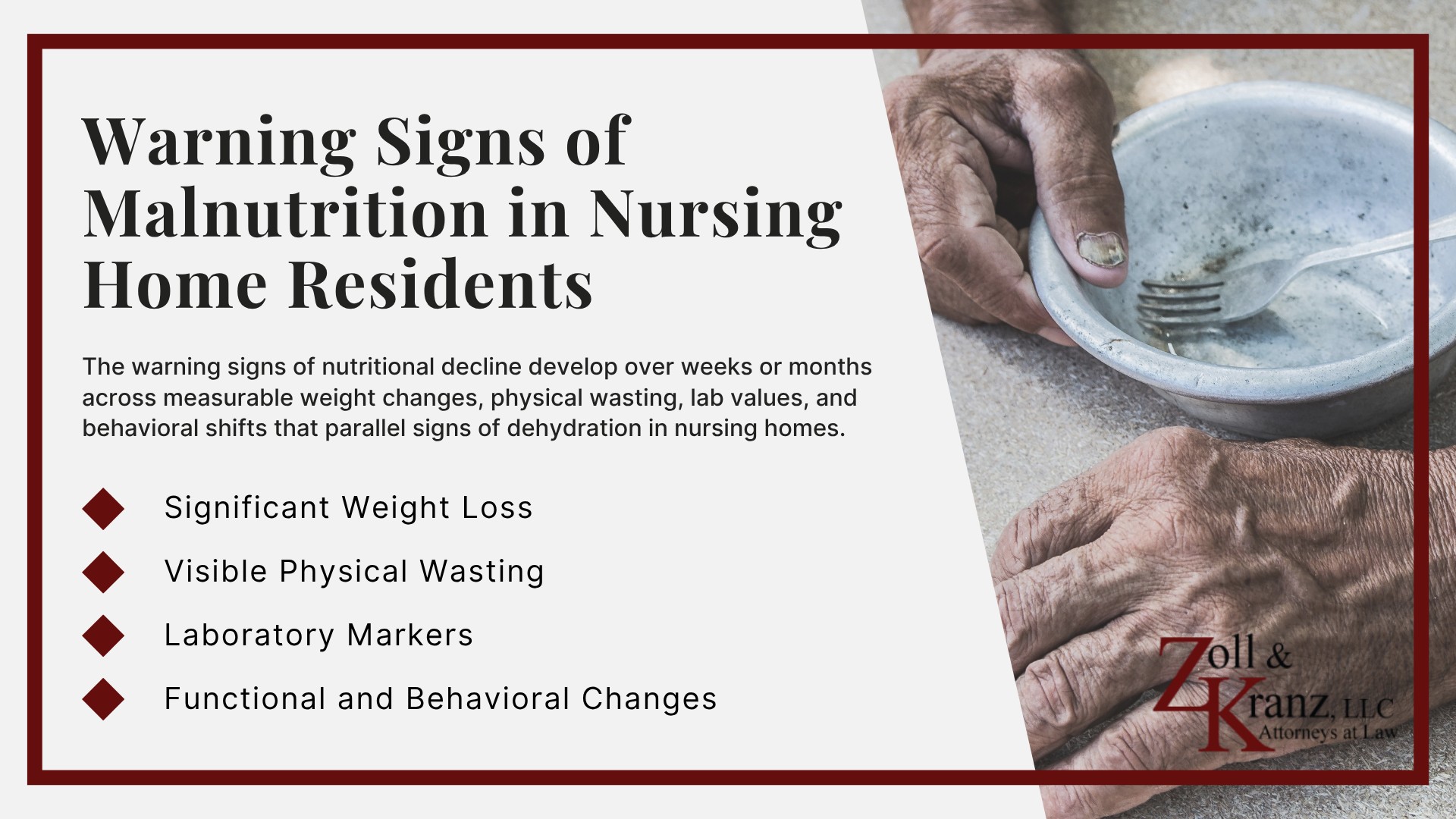
The warning signs of nutritional decline develop over weeks or months across measurable weight changes, physical wasting, lab values, and behavioral shifts that parallel signs of dehydration in nursing homes.

Significant Weight Loss

Malnutrition in nursing homes often presents as unexplained weight loss and chronic fatigue, caused by inadequate nutrient intake stemming from poor food quality and lack of assistance.

The federal standard for clinically significant weight loss is 5 percent of body weight in 30 days, 7.5 percent in 90 days, or 10 percent in 180 days, and any of these thresholds triggers an obligation for the nursing home to investigate and adjust the care plan.

Loose-fitting clothing, rings sliding off fingers, dentures that no longer fit, and visible sharpening of facial features track the same loss the scale would record if the nursing home were weighing the resident.

Visible Physical Wasting

Malnutrition affects between 35% and 85% of nursing home residents and results from a mix of medical conditions and facility-level care gaps.

A malnourished resident develops hollowed cheeks, sunken eyes, thinning hair, and visible muscle wasting in the arms and shoulders.

These changes reflect tissue breakdown that the body relies on when intake is inadequate, and they often appear before the facility acknowledges the resident is failing.

Laboratory Markers

Hospital labs commonly confirm malnutrition through a series of tests.

Elevated sodium, anemia, and high blood urea nitrogen frequently accompany these values and confirm the resident has been failing for some time.

A chart review often shows the same markers were trending wrong for weeks while the facility took no action.

Functional and Behavioral Changes

Early signs of nutritional decline include chronic fatigue, weakness, and a loss of interest in food, and these often appear before any visible weight loss.

A resident who once dressed independently and now needs help is showing functional decline that staff must document in the care plan.

Sudden confusion, withdrawal, or a flat affect mistakenly attributed to dementia often resolve once nutrition and hydration are restored.

Common Causes of Dehydration and Malnutrition in Nursing Homes

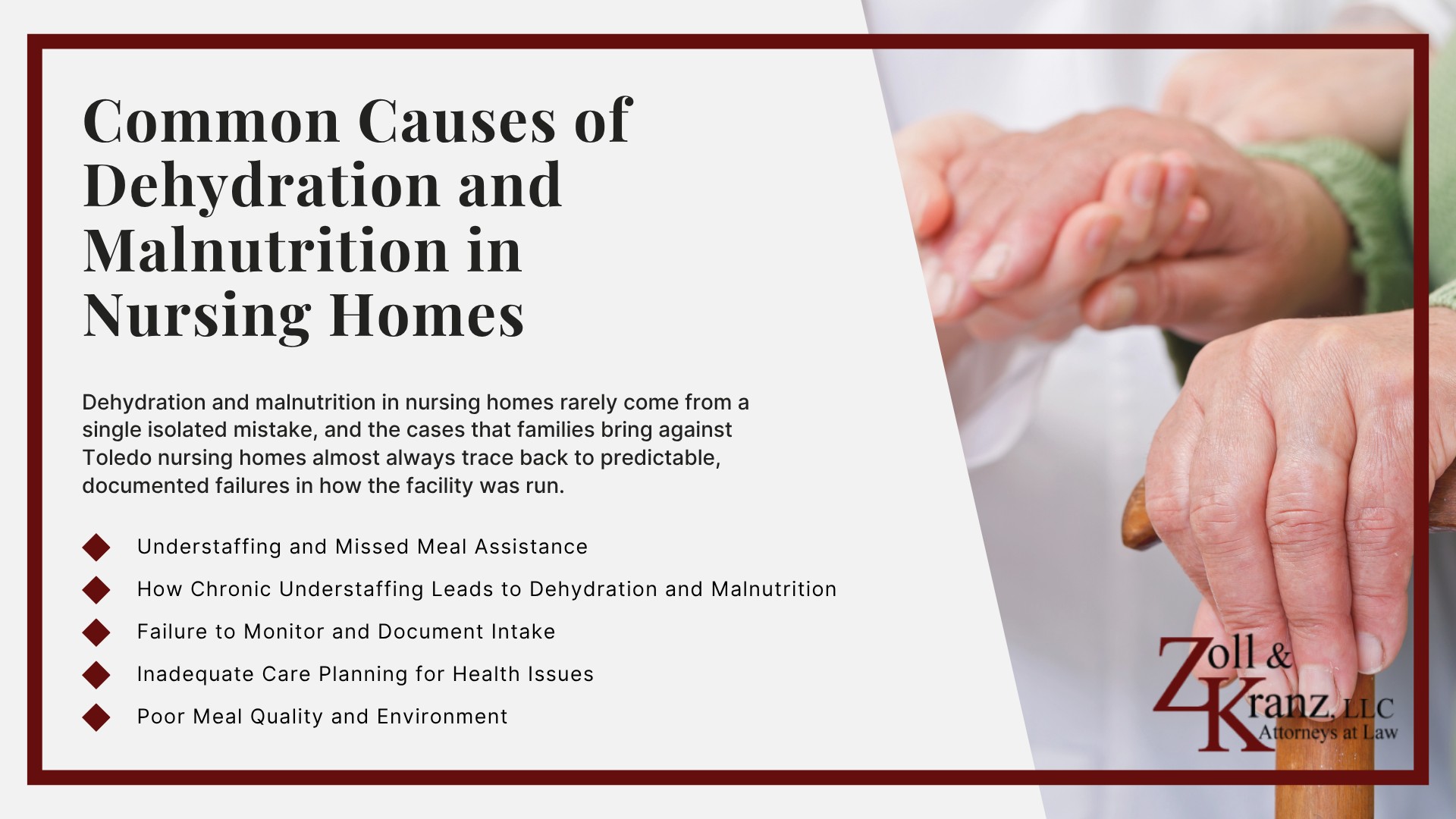
Dehydration and malnutrition in nursing homes rarely come from a single isolated mistake, and the cases that families bring against Toledo nursing homes almost always trace back to predictable, documented failures in how the facility was run.

The common causes of dehydration and malnutrition in nursing homes include understaffing that leaves residents without help at mealtime, failure to monitor and document daily food and fluid intake, inadequate care planning for residents with dementia, dysphagia, or other health conditions, and poor meal quality combined with an environment that discourages residents from eating.

Understaffing and Missed Meal Assistance

Nursing home residents are at risk of dehydration often due to inadequate staffing and poor care planning.

Inadequate staffing in nursing homes makes it difficult for residents to receive necessary assistance during meals, leading to missed meals and potential malnutrition.

In nursing homes where one aide is responsible for 12 to 15 residents at mealtime, residents who need help eating or drinking do not get fed within the time the meal is on the unit, and overworked staff members cannot document who ate or drank what.

How Chronic Understaffing Leads to Dehydration and Malnutrition

Chronic understaffing is one of the most common underlying causes of dehydration and malnutrition in nursing homes.

Residents who need help eating, drinking, opening containers, using adaptive utensils, or following specialized diets often depend entirely on staff assistance during meals.

When too few nurses or aides are available, residents may wait long periods for help or receive no meaningful assistance at all.

Over time, these missed opportunities to provide food and fluids can lead to weight loss, dehydration, declining health, and preventable medical complications.

Understaffing may contribute to dehydration and malnutrition when staff fail to:

  • Assist residents who cannot feed themselves independently
  • Monitor daily food and fluid intake
  • Refill water pitchers and encourage hydration throughout the day
  • Follow physician-ordered diets and nutritional plans
  • Identify significant weight loss and nutritional decline
  • Respond to swallowing difficulties or feeding problems
  • Provide supervision during meals for residents with cognitive impairments
  • Document changes in appetite, intake, or eating habits
  • Notify physicians about concerning nutritional trends
  • Update care plans when a resident’s condition changes

Many dehydration and malnutrition cases reveal a pattern of missed care rather than a single isolated mistake.

Staffing schedules, payroll records, assignment sheets, and meal assistance documentation may show that the facility did not have enough personnel available to meet residents’ basic needs.

When chronic understaffing prevents residents from receiving adequate food, fluids, monitoring, and assistance, the resulting harm may reflect a systemic failure in the operation of the nursing home rather than an unavoidable medical condition.

Failure to Monitor and Document Intake

Nursing home staff are required to record daily food and fluid intake for at-risk residents, and missing entries in the intake log are the first sign that nursing home management has broken down.

When records show gaps, no recorded weights for weeks, or sudden changes the chart does not explain, the nursing home is operating outside the standard of care.

Inadequate Care Planning for Health Issues

Cognitive impairment and depression are major factors contributing to malnutrition by reducing residents’ appetite and ability to eat.

Residents with dementia and underlying health issues may forget to eat, refuse food they no longer recognize, or be unable to communicate hunger, and the nursing home is legally required to plan around these conditions.

Residents with dysphagia and other cognitive impairments need texture-modified diets and thickened liquids, and any failure to follow physician orders leads directly to refusal of food.

Poor Meal Quality and Environment

Improving the mealtime experience through social dining and ensuring staff assistance can significantly enhance nutritional intake for nursing home residents.

Bedside trays sent to rooms without supervision lead to far lower intake than meals served in a shared dining room with staff present.

Serious Health Complications From Dehydration and Malnutrition

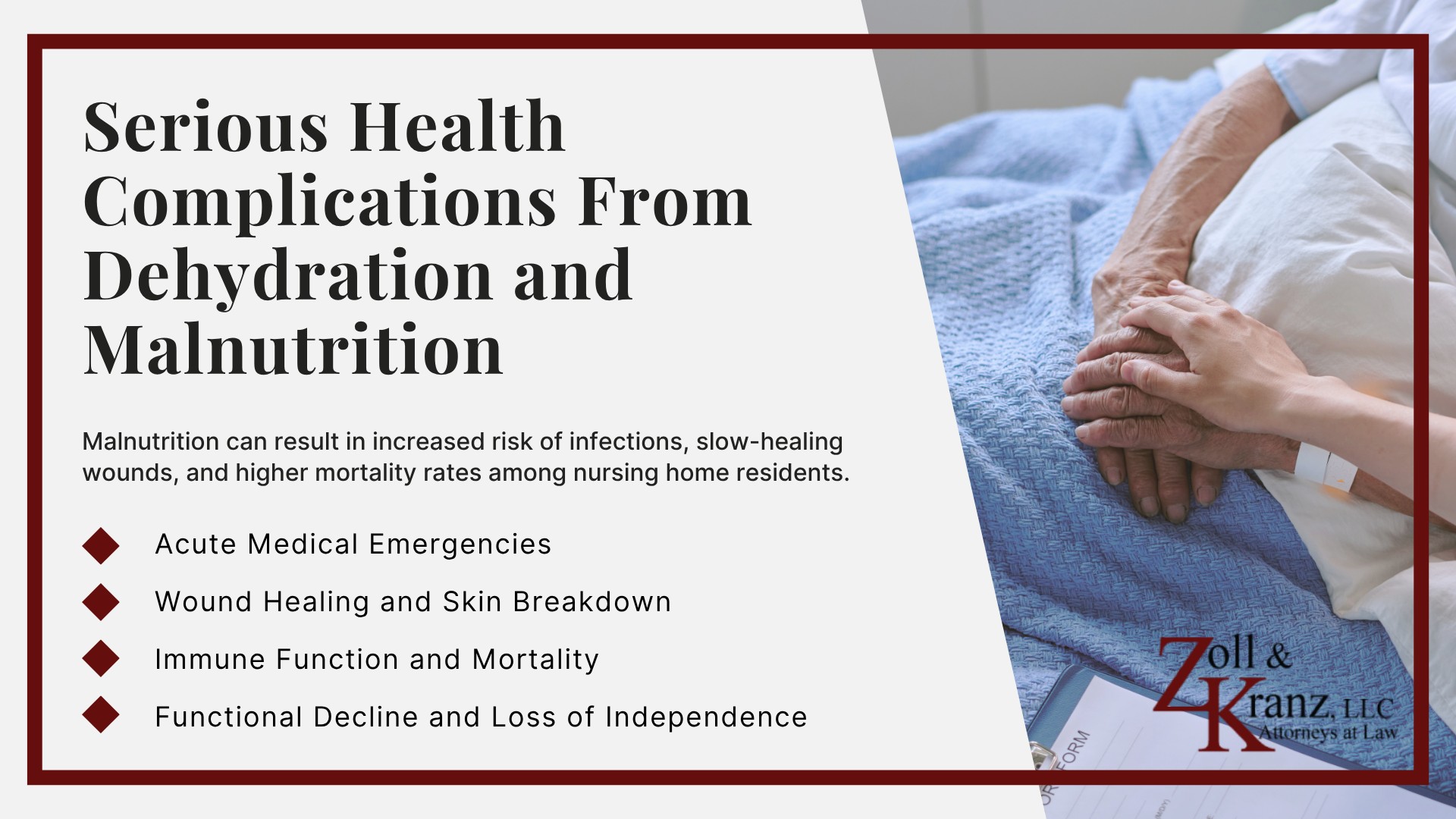
Malnutrition can result in increased risk of infections, slow-healing wounds, and higher mortality rates among nursing home residents.

Elderly people often face serious complications from malnutrition or dehydration in nursing homes that include hospitalization or even death.

Acute Medical Emergencies

Complications from dehydration in elderly nursing home residents can include hypovolemic shock, which is life-threatening and may lead to death if not treated immediately.

Urinary tract infections, pressure ulcers, pneumonia, kidney failure, low blood pressure, electrolyte imbalances, falls, frequent infections, and cognitive decline are common dehydration symptoms requiring emergency care.

Wound Healing and Skin Breakdown

A malnourished resident is far more likely to develop bedsores in nursing homes and slow healing wounds, and any pressure ulcer that forms deepens quickly because the body lacks the protein needed to repair tissue.

Immune Function and Mortality

Malnutrition can weaken the immune system, slow wound healing, and exacerbate existing medical conditions, significantly impacting the health of elderly residents in nursing homes.

A weakened immune system raises the risk of sepsis, pneumonia, and infection-related death, and the combined effect of malnutrition or dehydration is associated with higher mortality.

Functional Decline and Loss of Independence

When malnutrition or dehydration occur together, the resident experiences rapid functional decline including loss of mobility, increased confusion, and higher risk of hospitalization within months.

A common clinical question is how quickly can malnutrition produce these effects, and the answer is that visible decline can begin within weeks when intake is consistently low.

Federal and Ohio Standards for Nutrition and Hydration

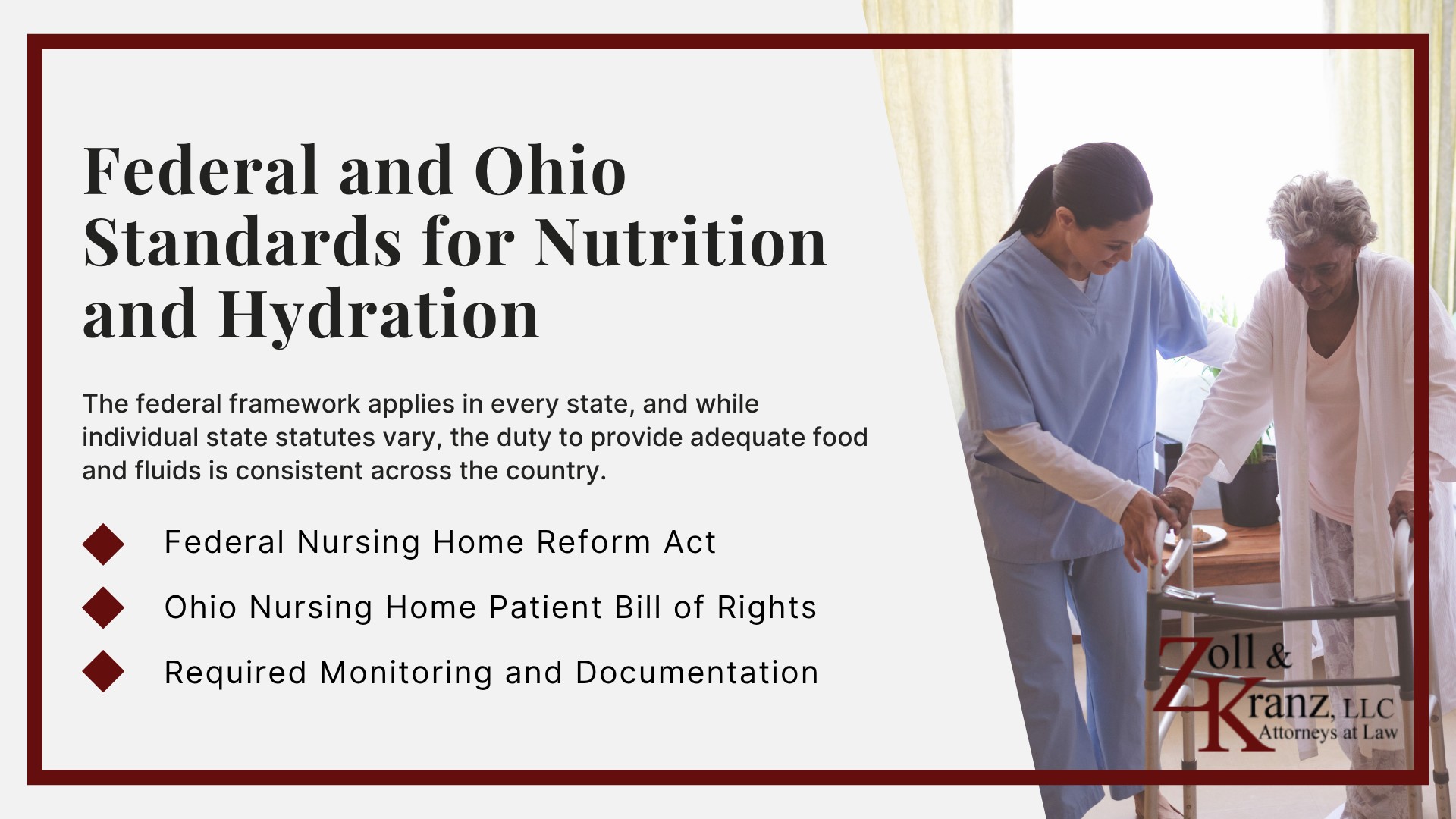
Resident protections against malnutrition or dehydration in nursing homes exist at both the federal and Ohio level, with binding obligations on every nursing home receiving Medicare and Medicaid funding.

The federal framework applies in every state, and while individual state statutes vary, the duty to provide adequate food and fluids is consistent across the country.

Federal Nursing Home Reform Act

Under the federal Nursing Home Reform Act, nursing homes have a legal duty to provide adequate nutrition and hydration to all residents, and failure to meet this obligation can lead to preventable health complications and legal consequences.

The 42 CFR 483.60, food and nutrition rules require that each resident maintains acceptable nutritional status, is offered sufficient fluid intake, and receives a therapeutic diet when there is a nutritional problem.

Nursing homes are legally required to assist residents who cannot feed or hydrate themselves independently, and care plans must address individual dietary needs, including accommodations for medical conditions affecting nutrition.

Any nursing home that violates these requirements can be cited following CMS nursing home surveys, fined, and stripped of Medicare and Medicaid funding.

Ohio Nursing Home Patient Bill of Rights

The Ohio Nursing Home Patient Bill of Rights at Ohio Revised Code Section 3721.13 grants every resident the right to a safe living environment, adequate nutrition and fluids, individualized care planning, and qualified staff in sufficient numbers.

Required Monitoring and Documentation

Regular nutritional assessments should include monitoring weight and conducting hydration and dietary status evaluations to prevent malnutrition.

To prevent dehydration and ensure residents receive sufficient fluids, nursing homes are required to weigh residents monthly, follow written hydration protocols, maintain adequate staffing at meals, notify physicians of changes in mental status or weight, and update the care plan.

Screening and monitoring should utilize valid tools like the Mini Nutritional Assessment (MNA) to periodically assess nutritional status of residents.

When a nursing home fails to use validated screening tools or record intake, the records become evidence of noncompliance.

If a nursing home fails to provide adequate hydration and nutrition, it can be held legally responsible for any harm that occurs, as this constitutes a breach of their duty of care to residents.

How Ohio Inspection Deficiencies Can Support a Nursing Home Neglect Claim

Ohio nursing homes are subject to inspections and complaint investigations that review whether facilities comply with federal and state care standards.

When inspectors find problems involving nutrition, hydration, staffing, care planning, or resident monitoring, those findings may appear in deficiency reports and public survey records.

These records do not automatically prove a civil claim, but they can help show whether a facility had prior problems with the same type of care failure involved in a resident’s injury.

In dehydration and malnutrition cases, inspection records may help identify patterns of missed monitoring, inadequate staffing, poor care planning, or failure to respond to resident decline.

Inspection records may be relevant when they involve:

  • Failure to provide adequate food or fluids
  • Failure to assist residents during meals
  • Failure to follow therapeutic diets or physician orders
  • Failure to monitor weight loss or fluid intake
  • Failure to update care plans after nutritional decline
  • Failure to notify physicians of significant changes
  • Inadequate staffing during meals or high-care periods
  • Poor documentation of intake, output, or weight records
  • Failure to prevent avoidable dehydration or malnutrition
  • Prior complaints involving similar resident-care failures

A deficiency finding can help place the resident’s experience in a broader facility context. If a nursing home was previously cited for nutrition, hydration, staffing, or care-planning problems, that history may support an argument that the harm was not an isolated event.

A nursing home negligence attorney can review Ohio Department of Health records, CMS inspection reports, complaint findings, and facility documentation to determine whether prior deficiencies are relevant to the claim.

Steps to Take When You Suspect Dehydration or Malnutrition

When families suspect malnutrition or signs of dehydration in nursing homes in an elderly loved one, acting quickly protects the resident and preserves evidence.

Step 1: Document What You Observe

Note dates, visit times, physical signs, weights from the bedside chart, and the names of staff members on duty.

Photograph weight loss, sunken features, dry skin, untouched meal trays, and empty water pitchers to gather evidence of the well being of your loved one.

Step 2: Request a Medical Evaluation

Ask the nursing home to call the physician for medical attention, or take your loved one directly to the emergency room.

Lab work for serum sodium, BUN, creatinine, and albumin documents fluid loss and protein malnutrition with measurements that support a later claim.

Step 3: Request the Medical Records

Ask in writing for the most recent weight log, intake and output records, care plan, physician progress notes, and nutrition consult notes.

Ohio law gives residents and their representatives the right to inspect and obtain copies of the medical records.

Step 4: File a Complaint With the Ohio Department of Health

The Ohio Department of Health Bureau of Survey and Certification investigates licensed nursing homes through unannounced surveys, and a written complaint from a family member can trigger an investigation that documents deficiencies in the resident’s care.

Families can file an Ohio Department of Health complaint using the online complaint form HEA 1685, by email to HCComplaints@odh.ohio.gov, or by calling the ODH Complaint Hotline at 1-800-342-0553, and the identity of the complainant and the resident remains confidential under Ohio law.

An ODH citation against the facility creates an independent government finding of substandard care, and an attorney can use that documented citation in a civil claim as evidence that the nursing home breached its legal duties.

Step 5: Contact the Ohio Long-Term Care Ombudsman

The Ohio long-term care ombudsman is a free advocate who can investigate the complaint and protect the rights of your loved one.

The ombudsman can visit the nursing home, speak with staff on your behalf, and document the conditions your loved one is living with.

You can reach the Ohio ombudsman through the Ohio Department of Aging at 1-800-282-1206.

Step 6: Consider a Transfer if the Danger Is Immediate

A short-term transfer to a hospital or different licensed nursing home may be necessary when the current nursing home cannot or will not provide proper care.

Ohio law allows residents and their families to transfer without notice when the safety of the resident is at risk.

Document the reason for the transfer in writing and keep copies, since the transfer itself becomes evidence that the original nursing home failed to provide adequate care.

Step 7: Speak With a Nursing Home Abuse Attorney

A Toledo nursing home negligence lawyer can request the records the nursing home will not share, work with experts, and file a civil claim within Ohio time limits.

The attorney can also send a litigation hold letter that legally requires the nursing home to preserve all records, charts, photographs, and surveillance footage.

Most Toledo nursing home abuse attorneys work on contingency, which means no upfront cost and the attorney is paid only if the case results in a recovery.

Filing a Negligence Lawsuit Against a Toledo Nursing Home

Filing a claim against Toledo nursing homes for dehydration or malnutrition requires a documentary record connecting the conduct of the facility to the harm, and most of that record comes from the nursing home itself.

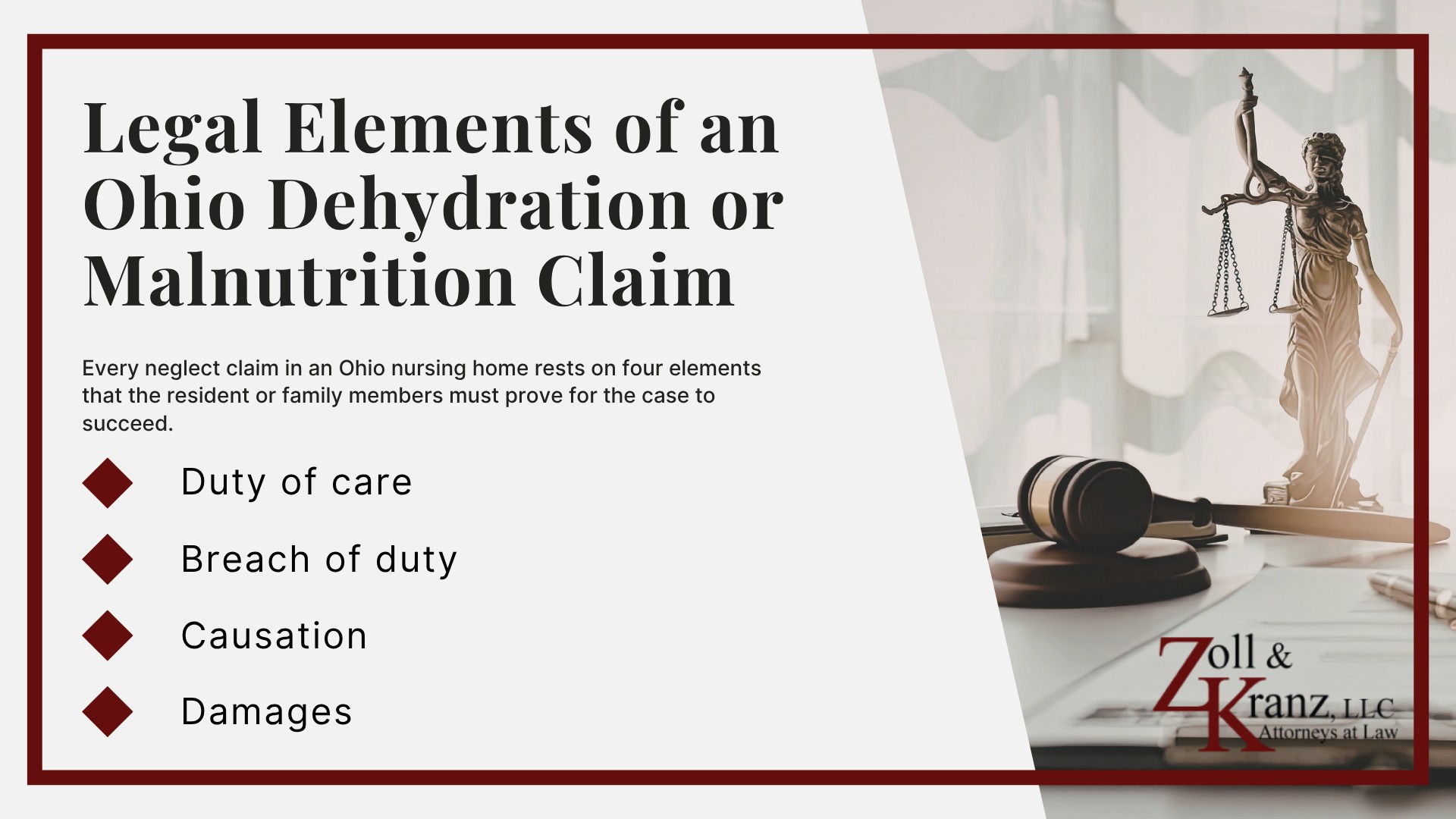
Legal Elements of an Ohio Dehydration or Malnutrition Claim

Every neglect claim in an Ohio nursing home rests on four elements that the resident or family members must prove for the case to succeed.

Duty of care: The nursing home has a legal obligation to meet the standard set by federal regulation, the Ohio Nursing Home Patient Bill of Rights, and the individualized care plan that the facility itself prepared for the resident, and this nursing home duty of care in Ohio applies from the day of admission forward.

Breach of duty: The nursing home failed to weigh the resident on schedule, failed to track intake, ignored physician orders, failed to refer for nutritional assessment, or failed to provide assistance at meals.

Causation: The breach is what produced the harm, shown through hospital labs, weight records, and expert testimony connecting the failure of care to the dehydration, malnutrition, infection, fall, or death that followed.

Damages: The resident suffered measurable harm including medical bills, hospitalization, pain and suffering, loss of dignity, loss of independence, or, in fatal cases, wrongful death damages under Ohio law.

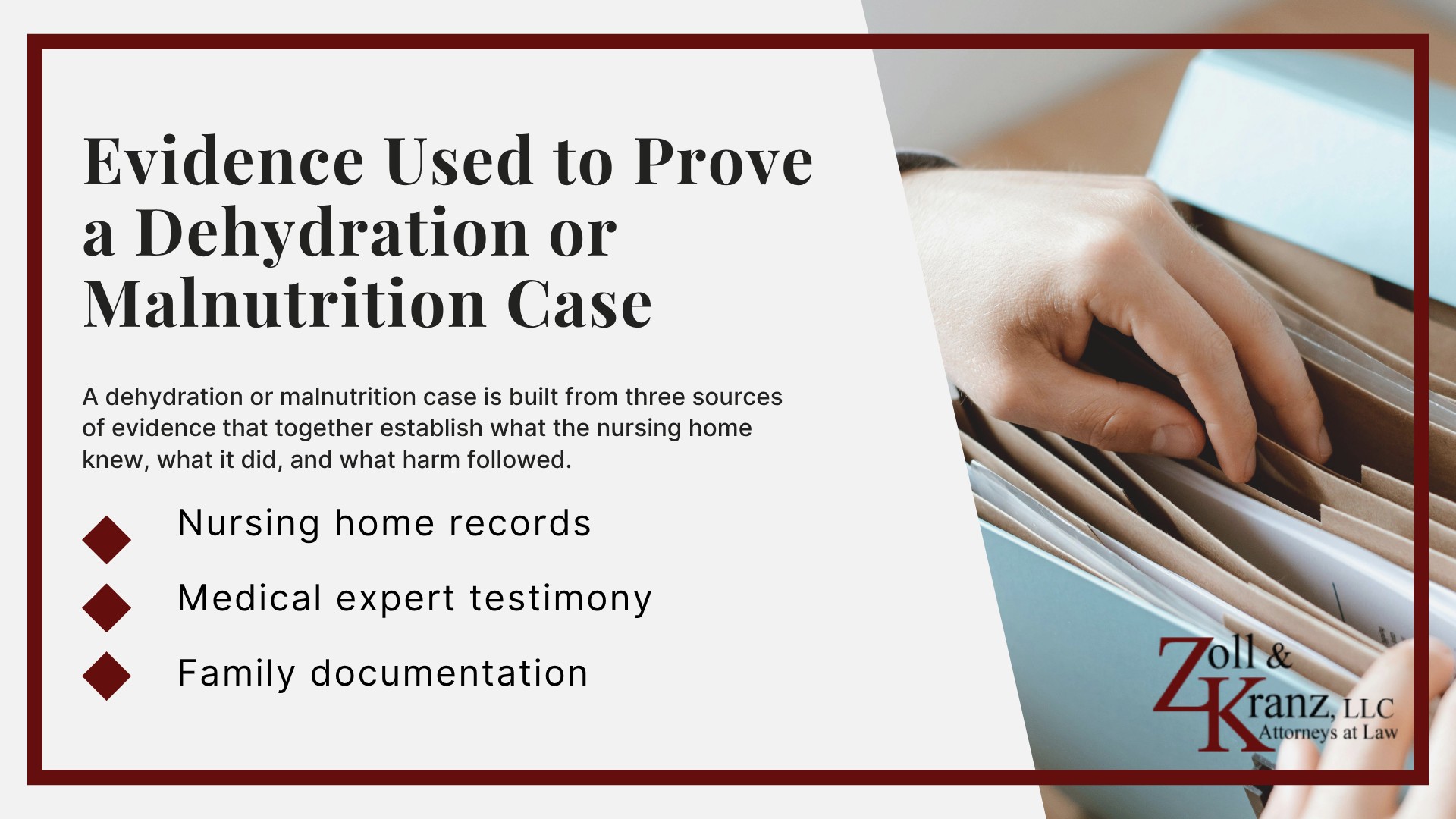
Evidence Used to Prove a Dehydration or Malnutrition Case

A dehydration or malnutrition case is built from three sources of evidence that together establish what the nursing home knew, what it did, and what harm followed.

Nursing home records: These include weight logs, intake and output charts, meal consumption records, care plan entries, physician progress notes, staffing schedules, and incident reports, all of which are discoverable in litigation.

When records show gaps in monitoring, ignored physician orders, or weight loss that triggered no intervention, the records themselves prove the breach.

Medical expert testimony: This evidence comes from hospital admission records showing elevated sodium, BUN, low albumin, or other clinical markers that document the harm and link it to care inside nursing homes.

A geriatric medical provider, registered dietitian, or nursing home administrator can explain to a jury what the standard of care required and how nursing homes fell short.

Family documentation: This evidence includes detailed family logs recording dates, observed physical changes, photographs of the resident, and conversations with staff, all of which are admissible in Ohio civil court.

These records often supply the timeline that records from nursing homes leave out, and they are usually the earliest written account of what was happening to the resident.

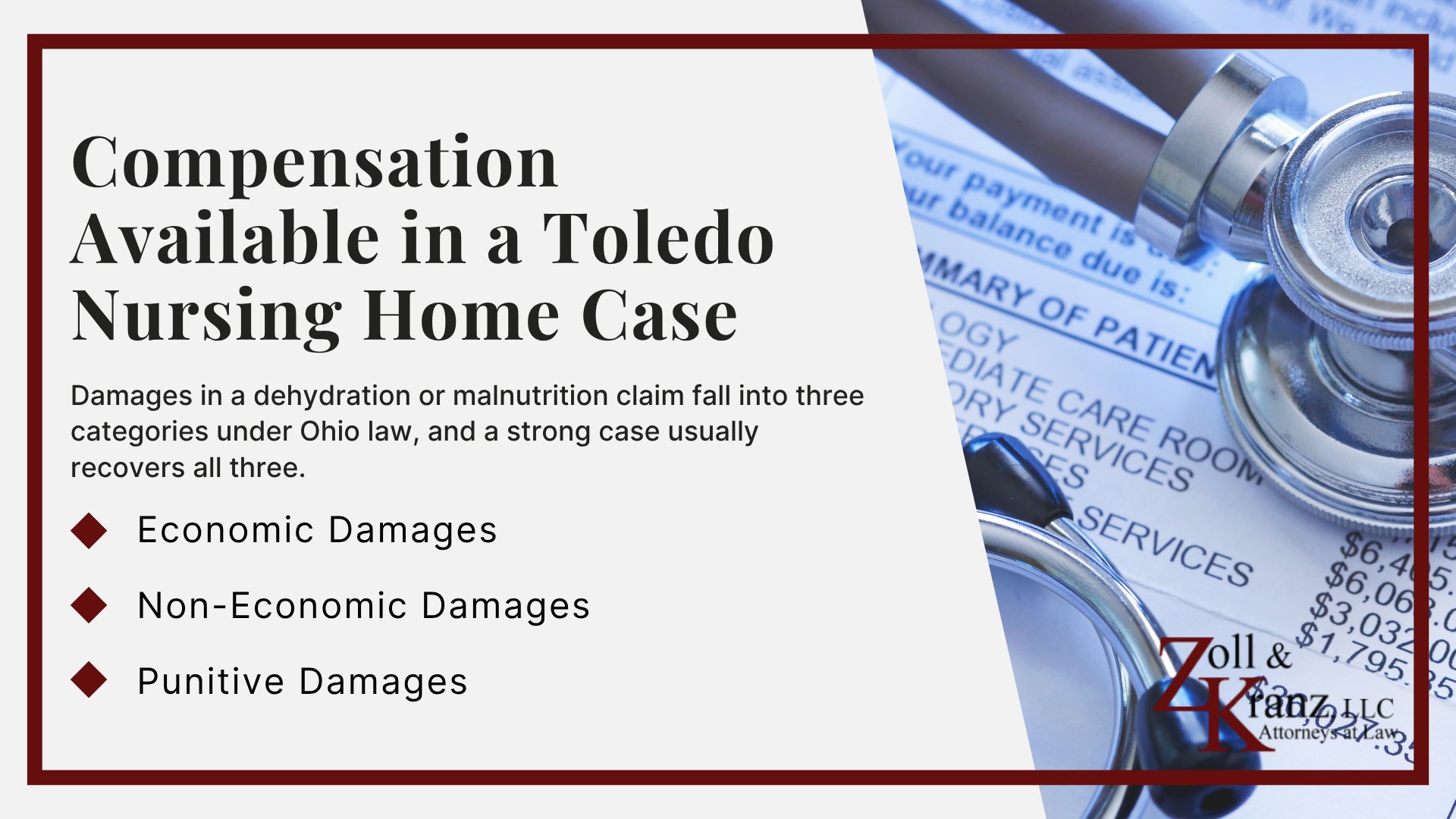
Compensation Available in a Toledo Nursing Home Case

Damages in a dehydration or malnutrition claim fall into three categories under Ohio law, and a strong case usually recovers all three.

Economic damages: These cover the financial losses the family can document on paper, including medical expenses, hospital costs, ambulance bills, ER charges, prescription costs, physical therapy and rehabilitation, future medical care, the cost of transferring the resident to another facility, and any out-of-pocket expense the family paid while caring for the resident.

Non-economic damages: These compensate for the personal harm the resident suffered that cannot be itemized on a bill, such as pain and suffering, mental anguish, loss of dignity, loss of independence, loss of enjoyment of life, and emotional distress experienced during the period of neglect.

Punitive damages: These are awarded when the conduct of the nursing home was severe or reckless, such as ignoring repeated weight loss warnings, falsifying records, or knowingly operating with staffing levels far below safe ratios, and they are intended to punish the nursing home and deter similar conduct.

Wrongful death damages apply when dehydration or malnutrition contributes to the death of the resident, and Ohio Revised Code Section 2125.02 allows recovery for loss of companionship, mental anguish, loss of services, and funeral and burial expenses.

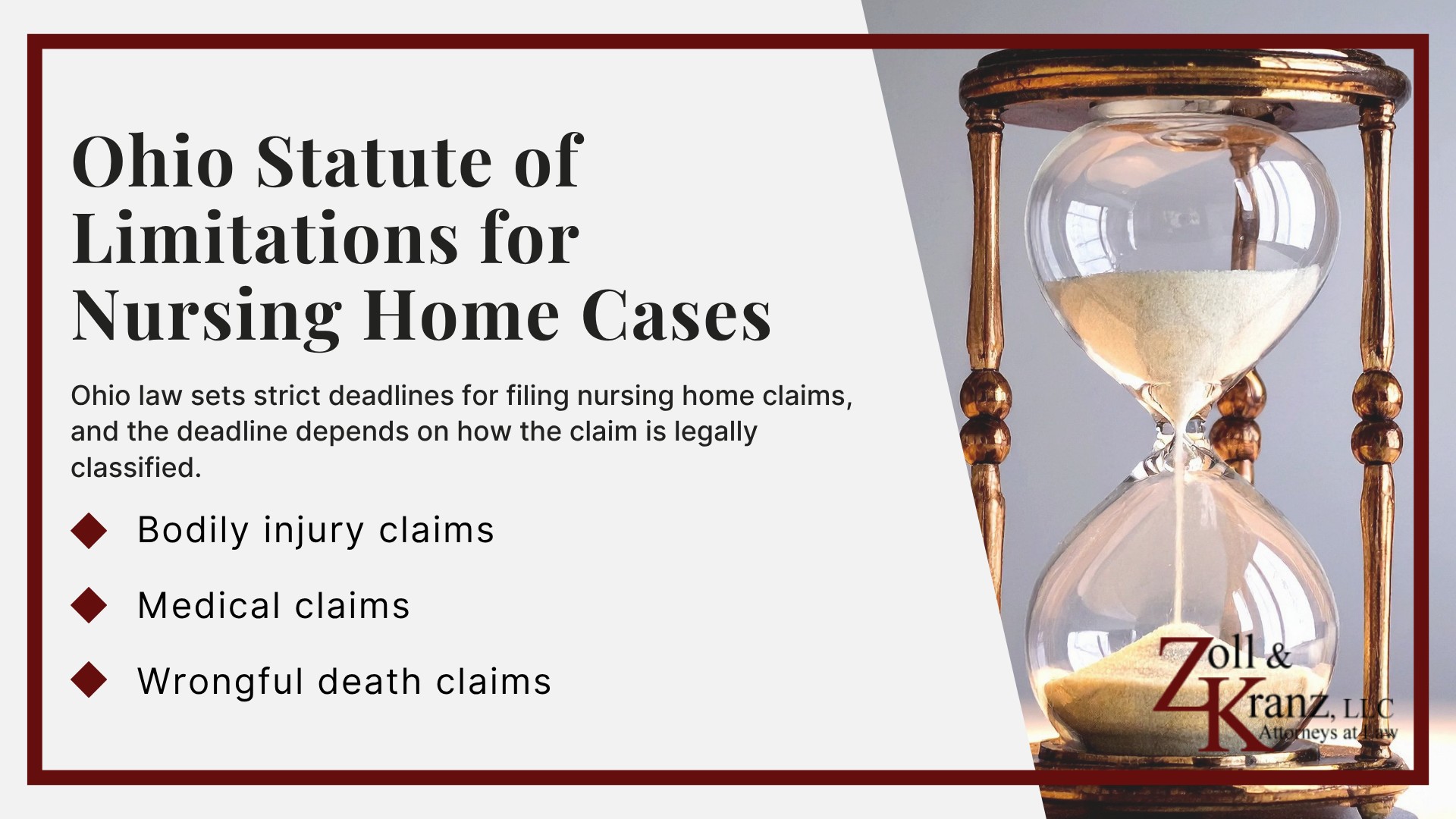
Ohio Statute of Limitations for Nursing Home Cases

Ohio law sets strict deadlines for filing nursing home claims, and the deadline depends on how the claim is legally classified.

Bodily injury claims: These claims must be filed within two years from the date of injury under Ohio Revised Code Section 2305.10, and this is the common deadline that applies to most nursing home negligence cases involving dehydration, malnutrition, or related harm.

Medical claims: These claims must be filed within one year from the date the harm was discovered under Ohio Revised Code Section 2305.113, and this shorter deadline can apply when the nursing home is also providing medical treatment or skilled nursing services to the resident.

Wrongful death claims: These claims must be filed within two years from the date of death under Ohio Revised Code Section 2125.02, and this deadline is separate from the injury deadline even when the underlying harm began much earlier.

The clock generally starts on the date the harm occurred or the date the family discovered the harm, whichever is later, and an attorney can review the timeline to confirm which deadline applies to your case.
Speak With a Toledo Nursing Home Abuse Attorney at Zoll & Kranz

A dehydration or malnutrition case in Toledo nursing homes rests on the records the facility holds, and the strongest cases are where the paperwork itself documents the breach.

A claim for missed meals rests on intake records, meal charts, and staffing logs from the shifts when meals were skipped, while a claim for unmonitored weight loss rests on the weight log, care plan updates, and physician notes that should have followed any clinically significant loss.

A Toledo nursing home wrongful death claim rests on hospital admission notes, autopsy or death certificate, and the records Toledo nursing homes maintain from the final weeks of life.

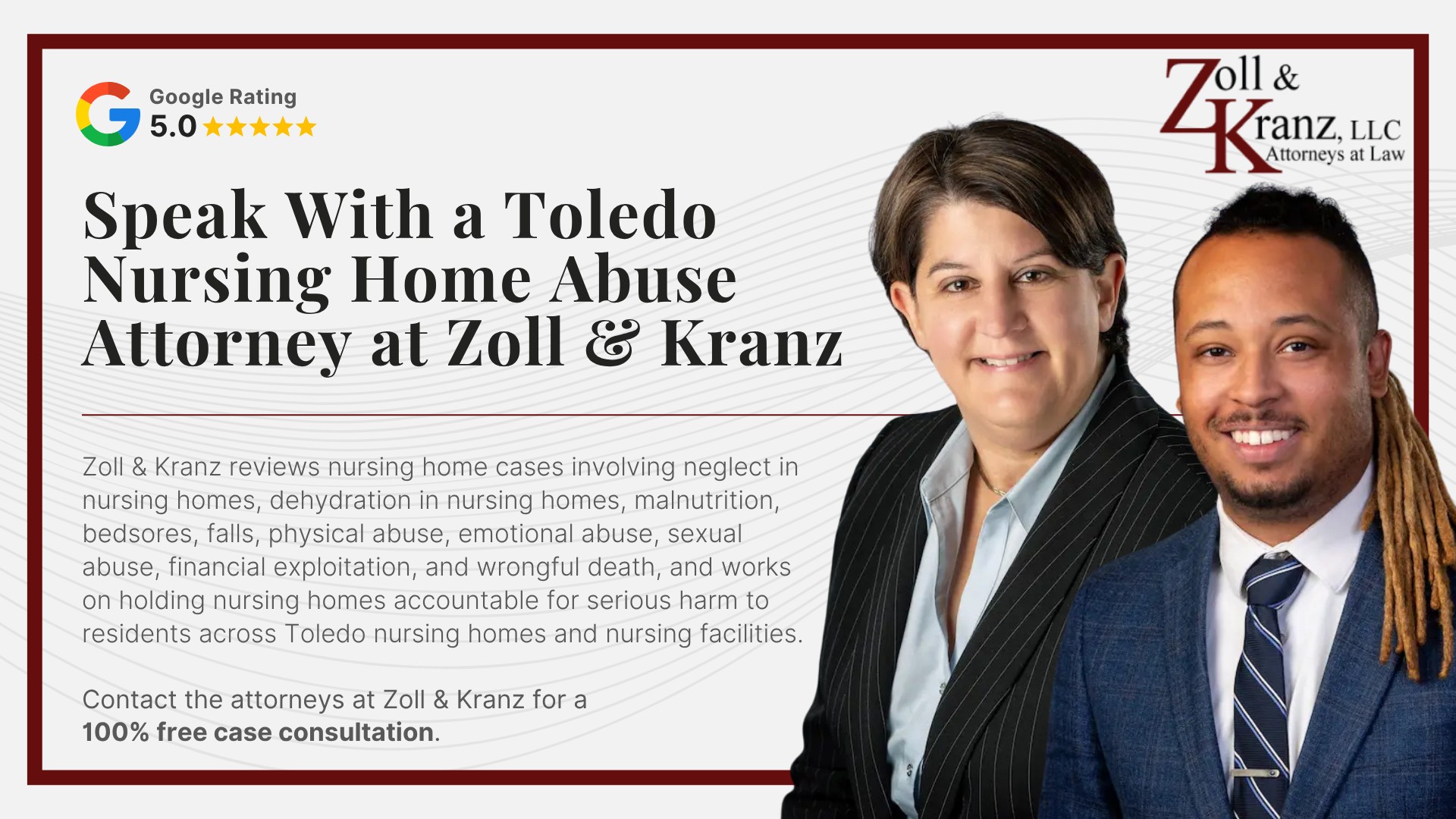
Zoll & Kranz reviews nursing home cases involving neglect in nursing homes, dehydration in nursing homes, malnutrition, bedsores, falls, physical abuse, emotional abuse, sexual abuse, financial exploitation, and wrongful death, and works on holding nursing homes accountable for serious harm to residents across Toledo nursing homes and nursing facilities.

If your loved one has suffered serious harm from dehydration or malnutrition at a Toledo nursing home, contact Zoll & Kranz today for a free consultation.

You can also use the chat feature on this page to find out if you qualify for a nursing home neglect case under Ohio law.

Frequently Asked Questions

Published by:
Share
Picture of Michelle L. Kranz
Michelle L. Kranz

Michelle is a founding partner of Zoll & Kranz, located in Toledo, Ohio. Michelle has been a plaintiff’s lawyer for the entirety of her practice – over 32 years. She devotes the majority of her time to complex consolidated litigation and class action including advocating for people injured by medical devices, prescription medications, or corporate negligence.

This article has been written and reviewed for legal accuracy and clarity by the team of writers and attorneys at Zoll & Kranz, LLC and is as accurate as possible. This content should not be taken as legal advice from an attorney. If you would like to learn more about our owner and experienced Ohio injury lawyer, Michelle L. Kranz, you can do so here.

Zoll & Kranz, LLC does everything possible to make sure the information in this article is up to date and accurate. If you need specific legal advice about your case, contact us. This article should not be taken as advice from an attorney.

Other cases we handle in Toledo
All
Auto Accidents
Injury Types
Medical Malpractice
Nursing Home Abuse
Other Accidents & Injuries
You can learn more about other Toledo cases we handle below:
Auto Accident Lawsuit Timeline in Toledo
Auto Accident Statute of Limitations in Toledo, OH
Bedsores in Toledo Nursing Homes
Collecting Evidence in Toledo Medical Malpractice Cases
Collecting Evidence in Toledo Nursing Home Negligence Cases
Common Car Accident Injuries in Toledo, OH
Common Causes of Nursing Home Negligence in Toledo
Common Types of Car Accident Damages
Distracted Driving Accidents in Toledo, OH
Dropped Patients in Nursing Homes
DUI Accidents in Toledo
Duty of Care Owed by Nursing Home Facilities in Ohio
Evidence in Toledo Auto Accident Cases
Failure to Perform Procedure Malpractice Lawyer in Toledo
Falls in Toledo Nursing Homes
Head-On Collisions in Toledo
Hit-and-Run Accidents in Toledo
How is Fault Determined in a Car Accident?
How To File a Car Crash Lawsuit in Toledo
How to Report Nursing Home Abuse in Toledo, Ohio
Inattentive Nursing Home Staff: Steps to Take
Infections in Toledo Nursing Homes
Initial Steps To Take in a Toledo Medical Malpractice Case
Interstate Accidents in Toledo
Liability in Toledo Medical Malpractice Claims
Liability in Toledo Nursing Home Negligence Cases
Medication Errors in Toledo Nursing Homes
Mental and Emotional Abuse in Nursing Homes
Neglect in Toledo Nursing Homes
Negligence in Toledo Medical Malpractice Cases
Negligent Hiring or Training in Toledo Nursing Homes
Nursing Home Negligence Wrongful Death Cases in Toledo
Paralysis in Auto Accidents
Patient Rights in Toledo Nursing Homes
Personal Injury Lawyer Toledo, Ohio
Physical Abuse in Toledo Nursing Homes
Process of a Medical Malpractice Case in Toledo
Rear-End Collisions in Toledo, OH
Rental Car Accidents in Toledo
Rollover Accidents in Toledo
Securing a Police Report in Toledo After an Auto Accident
Sexual Abuse in Toledo Nursing Homes
Sideswipe Accidents in Toledo
Toledo Anesthesia Errors Lawyer
Toledo Auto Accident Comparative Negligence Explained
Toledo Auto Accident Lawyer
Toledo Bicycle Accident Lawyer
Toledo Burn Injury Lawyer
Toledo Bus Accident Lawyer
Toledo Cancer Misdiagnosis Lawyer
Toledo Car Accident Lawyer
Toledo Catastrophic Injury Lawyer
Toledo Daycare Injury Lawyer
Toledo Delayed Diagnosis Lawyer
Toledo Emergency Room Error Lawyer
Toledo Failure To Diagnose Lawyer
Toledo Insurance Claim Lawyer
Toledo Mass Torts Lawyer
Toledo Medical Malpractice Lawyer
Toledo Medication Error Lawyer
Toledo Misdiagnosis Medical Malpractice Lawyer
Toledo Motorcycle Accident Lawyer
Toledo Nurse Error Lawyer
Toledo Nursing Home Abuse Lawyer
Toledo Nursing Home Negligence Safety and Preventative Measures
Toledo Pedestrian Accident Lawyer
Toledo Spinal Cord Injury Lawyer
Toledo Surgical Error Lawyer
Toledo Toxic Exposure Lawyer
Toledo Traumatic Brain Injury Lawyer
Toledo Truck Accident Lawyer
Toledo Wrongful Death Lawyer
Wrong Site Surgery Malpractice in Toledo
Were you or a loved one injured in Toledo?

A serious injury can have life-altering results.

Don’t settle for less than you deserve, speak with an award-winning personal injury lawyer today.

18 Reviews
5.0
★★★★★
Recovered damages
$108 Million+

Table of Contents

Practice Areas
About Zoll & Kranz, LLC

For over 37 years, Zoll & Kranz has been fighting for clients who have been the victims of the wrongful death of a loved one.

Do you believe you’re entitled to compensation?

Use our Instant Case Evaluator to find out in as little as 60 seconds!

Guides & Resources

Other Toledo Personal Injury Cases

All
Auto Accidents
Injury Types
Medical Malpractice
Nursing Home Abuse
Other Accidents & Injuries
Local Toledo Resources
Education
Emergency Services
Courthouses
Department of Motor Vehicles
Sights to See