No fees unless we win.
Get a free consultation
29 Reviews
5.0
★★★★★

Types of Neglect in Nursing Homes

Understanding Neglect in Nursing Homes

Nursing home neglect often begins with small warning signs that families may not recognize at first.

A missed meal, an unanswered call light, unchanged bedding, skipped medication, or a new bedsore can signal that a resident is no longer receiving the care they need. Left unaddressed, those failures can lead to dehydration, infections, falls, malnutrition, hospitalization, or other serious harm.

Nursing home neglect occurs when a facility fails to provide the care, supervision, or basic services necessary to protect a resident’s health and safety.

Neglect can involve inadequate medical care, poor hygiene, failure to meet basic needs, emotional neglect, or unsafe living conditions, and many residents experience more than one form of neglect at the same time.

Zoll & Kranz investigates nursing home neglect claims, identifies where a facility failed to meet the required standard of care, and helps families pursue compensation for the harm caused by neglect.

Can You Sue for Nursing Home Abuse Ohio Injury Law Firm Explains YouTube Thumbnail

Was Your Loved One Neglected in a Nursing Home? Speak With a Lawyer

Nursing home neglect rarely happens because of a single mistake.

More often, it develops when elderly people in residential settings do not receive consistent medical care, assistance with daily activities, adequate supervision, or the basic services they depend on to remain healthy and safe.

Staffing shortages, poor training, weak oversight, and inadequate care planning can allow small problems to become serious medical emergencies over time.

A resident who misses medications, develops a preventable infection, becomes dehydrated, or is left in the same position for too long may suffer injuries that could have been avoided with proper care.

Families are often the first to notice unexplained weight loss, bedsores, frequent falls, changes in behavior, poor hygiene, or other warning signs that something is wrong.

Federal regulations and Ohio law require nursing homes to provide individualized care that helps residents maintain their highest practicable level of physical, mental, and psychosocial well-being.

When a facility fails to meet those standards and a resident is harmed, the nursing home may be legally responsible for the injuries that result.

Understanding the different types of nursing home neglect, the warning signs, and the evidence that supports a claim can help families protect their loved ones and make informed decisions about their legal options.

If your loved one was harmed by a nursing home’s failure to provide proper care, you may be eligible to file a nursing home neglect claim and seek compensation for the harm.

Contact Zoll & Kranz today for a free consultation with an experienced nursing home neglect attorney.

You can also use the chat feature on this page to find out if your family qualifies.

Types of Neglect in Nursing Homes

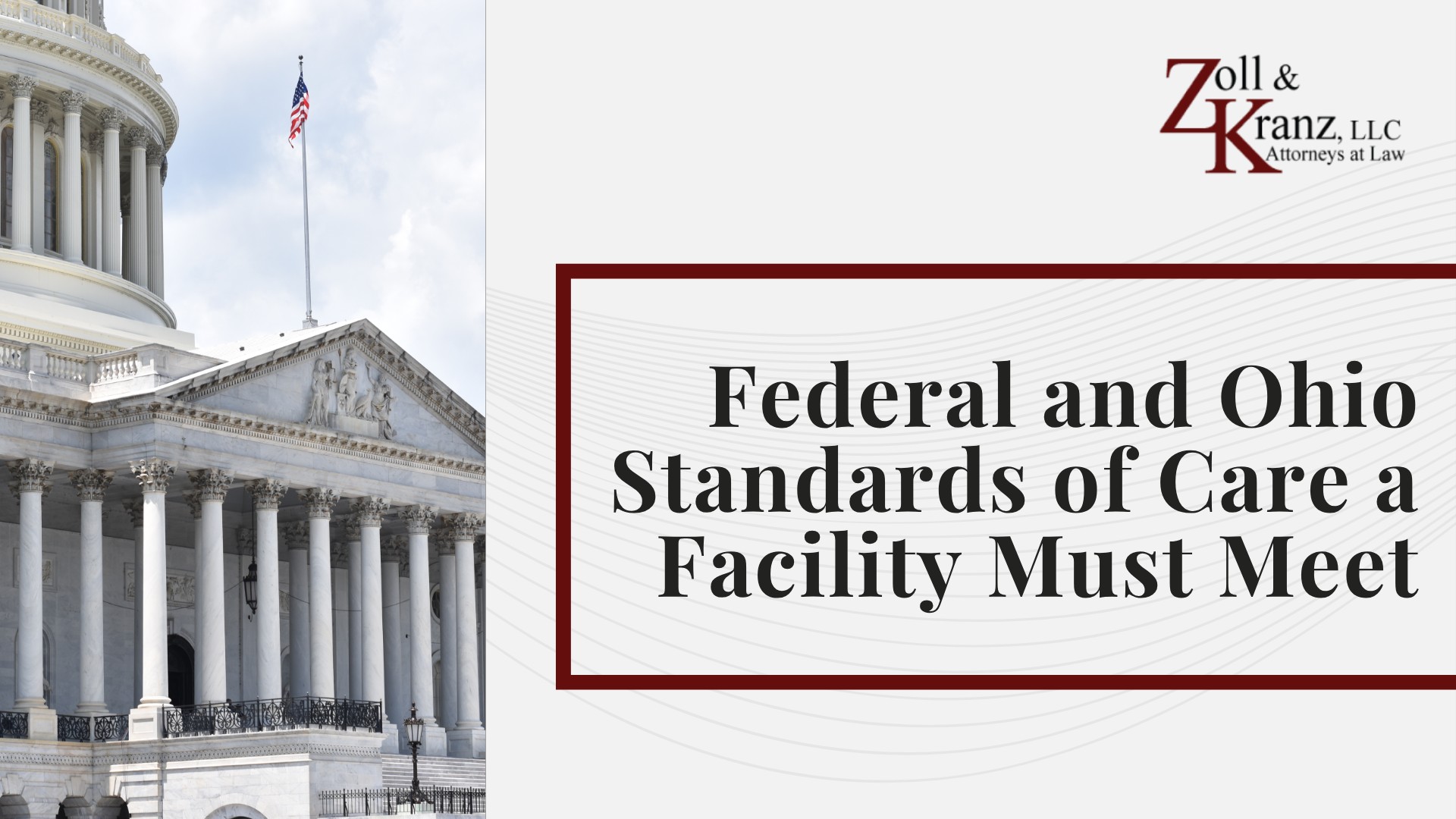
Federal and Ohio Standards of Care a Facility Must Meet

A nursing home’s duties to a resident arise from two sources, federal regulation and Ohio statute, and both bind every Medicare- or Medicaid-certified facility in the state.
Each source creates obligations a resident or family can enforce in court, and a facility that breaches either one answers for the harm that results.

Federal Standards

Federal law sets minimum standards for nursing home care through the Nursing Home Reform Act, enacted as part of OBRA in 1987.

Under 42 CFR 483.25, a facility must provide the treatment and care each resident needs to maintain or attain the highest practicable level of physical, mental, and psychosocial well-being, based on the resident’s assessment, care plan, and choices.

A separate rule at 42 CFR 483.12 gives residents the right to be free from abuse, neglect, exploitation, misappropriation of property, corporal punishment, involuntary seclusion, and improper physical or chemical restraints.

Any facility that accepts Medicare or Medicaid agrees to follow these federal regulations as a condition of payment.

The Centers for Medicare and Medicaid Services enforces those rules within the U.S. Department of Health and Human Services.

Federal rules also require facilities to complete resident assessments, develop comprehensive person-centered care plans, and provide residents access to their personal and medical records.

Under 42 CFR 483.10, residents generally have the right to access their records within 24 hours, excluding weekends and holidays, and to obtain copies with advance notice.

Ohio Standards

Ohio law adds its own protections for residents of nursing homes and other long-term care facilities.

Ohio Administrative Code 3701-64-01 define neglect as a caregiver recklessly failing in his or her obligations to provide a resident the care needed for health or safety, to the point of serious physical harm.

Ohio’s Residents’ Bill of Rights, ORC 3721.13 gives residents rights that include a safe and clean living environment, freedom from abuse, and adequate and appropriate medical treatment and nursing care.

ORC 3721.17 allows residents or appropriate representatives to bring a civil action when a facility violates those rights.

The Ohio Department of Health inspects facilities and looks into hundreds of nursing home complaints in a typical year, many of them involving neglect rather than outright abuse.

A facility that falls below these federal and Ohio standards and harms a resident commits a breach that can support a civil claim for nursing home negligence.
Neglect Versus Abuse in Nursing Homes

Nursing home abuse and neglect describe two different failures, and the difference decides how a claim is framed.

Abuse is a willful act meant to cause harm, and it includes physical abuse, sexual abuse, emotional abuse, verbal abuse, mental abuse, psychological abuse, and financial abuse such as theft of resident property.

Both abuse and neglect fall under the wider category of elder abuse, also called elder mistreatment.

Neglect is a breach of the duty of care through omission, such as failing to reposition an immobile resident or leaving a call light unanswered for hours.

A single situation can involve both, as when a facility leaves a resident unsupervised and a worker then handles them roughly.

That line matters at trial, since proving willful and wanton neglect is the bridge to punitive damages, while ordinary negligence supports only compensatory damages.

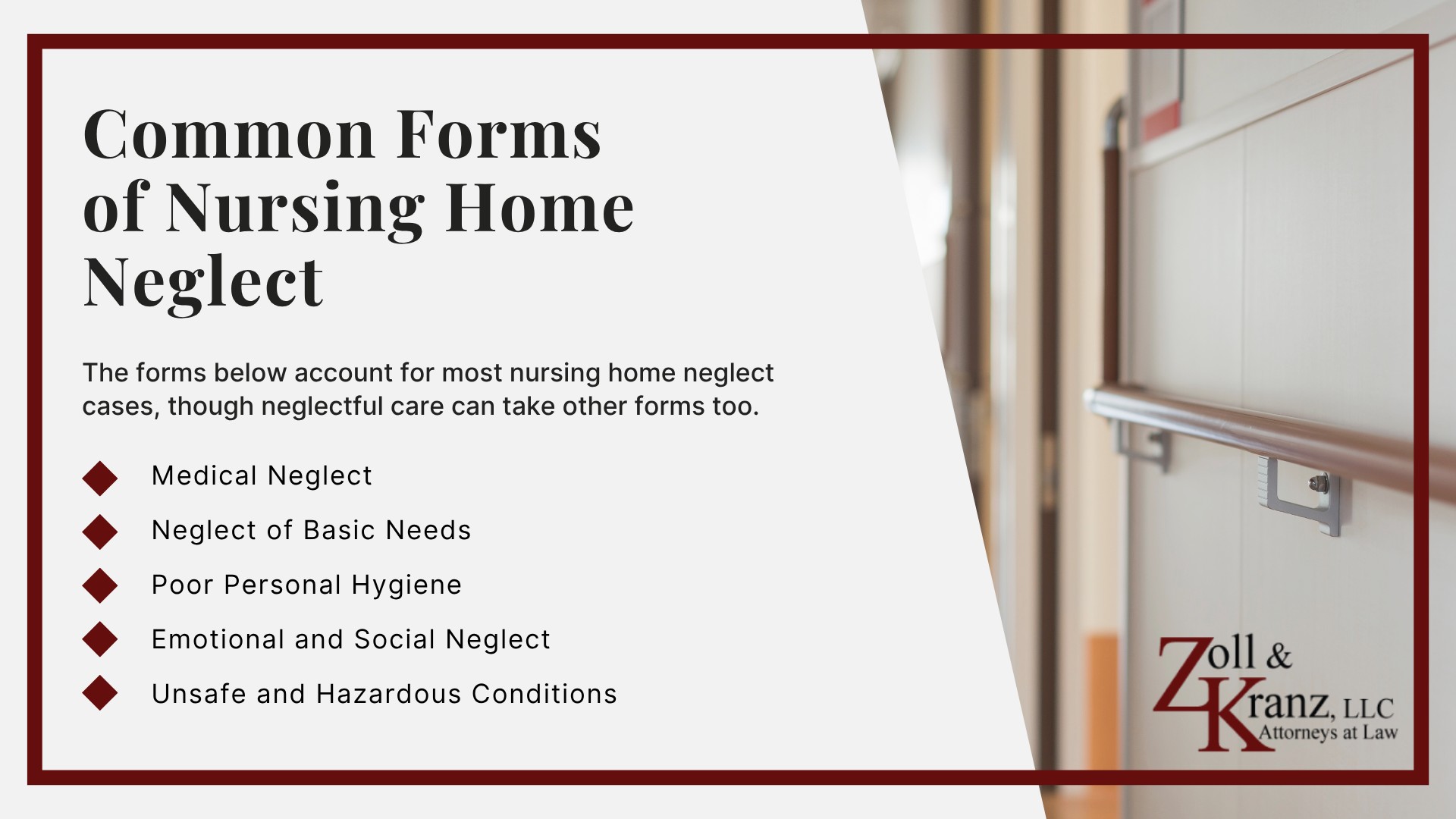
Common Forms of Nursing Home Neglect

Neglect appears in several recognized forms, and many harmed nursing home residents experience several forms at the same time.

The forms below account for most nursing home neglect cases, though neglectful care can take other forms too.

Medical Neglect

Medical neglect happens when a resident does not get the medical care they need.

It includes delayed medical treatment for infections, missed or incorrect medications, poor wound care, and ignored complaints of pain.

A single medication error can turn a manageable problem into a hospital transfer or a permanent injury.

Failing to send a declining resident to the hospital in time is among the most serious forms of medical neglect.

Medical neglect can also overlap with medical malpractice when a physician or nurse on site acts below the accepted clinical standard.

Neglect of Basic Needs

Basic care neglect leaves residents without the daily support they need to stay safe.

It shows up as skipped meals, too little to drink, unsanitary rooms, and residents left in soiled clothing.

These gaps lead to malnutrition and dehydration, skin breakdown, and infection that wear a person down over time.

Poor Personal Hygiene

Poor personal hygiene is one of the clearest early signs that care is slipping.

Many residents need help bathing, brushing their teeth, and staying clean, and a short-staffed floor often leaves that help undone.

Poor hygiene also raises the risk of infection.

Emotional and Social Neglect

Emotional neglect can lead to serious emotional and physical changes.

Staff who isolate residents or ignore their requests can cross into emotional and mental abuse, cutting them off from the daily contact they depend on.

Psychological trauma can result from chronic isolation, and it often surfaces as withdrawal, mental anguish, or a sudden decline.

This form is harder to see than a physical injury, so regular family contact is often the only way the harm to a resident’s mental health gets noticed.

Unsafe and Hazardous Conditions

Neglect of resident safety involves preventable dangers in facilities.

It includes falls from missing supervision, burns, wandering by residents with dementia, and serious harm from broken fixtures.

Neglect also occurs when a facility fails to separate a known aggressive resident who then harms vulnerable residents or other residents nearby.

CMS records this as a resident-to-resident altercation, and the duty to supervise applies whether the danger is the environment or another resident.

Elopement, where a resident with dementia leaves the building unnoticed, is one of the most dangerous safety failures.

Warning Signs of Nursing Home Neglect

Families must recognize warning signs of nursing home neglect, since residents with cognitive decline often cannot report it.

According to the National Institute on Aging, residents with Alzheimer’s disease, dementia, or other cognitive impairment are at higher risk of abuse or neglect, since declining cognitive functioning leaves them less able to report what is happening.

Older adults who depend on staff for bathing, dressing, and medication face the higher risk of abuse or neglect, and the most vulnerable residents are often the nursing home residents who cannot describe what they are going through.

Elderly residents with dementia, limited mobility, or few visitors are the ones a short-staffed floor is most likely to overlook, which is why regular family visits matter.

Physical Signs of Neglectful Care

Physical signs are often the earliest indication that a resident is not receiving appropriate care.

Many injuries associated with nursing home neglect develop gradually as basic needs go unmet, allowing families to recognize changes before the facility acknowledges a problem.

Unexplained weight loss, bedsores, dehydration, bruising, and poor hygiene are not considered normal parts of aging and may indicate that a resident is not receiving the supervision, nutrition, medical care, or assistance required by their care plan.

Recognizing these warning signs early can help protect a loved one from additional harm and preserve evidence if neglect has occurred.

The body usually shows the first visible injuries from unmet care:

  • Bedsores: Severe bedsores indicate nursing home neglect and are preventable with routine repositioning that a short-staffed floor often skips.
  • Weight loss: Sudden weight loss can signal inadequate nutrition in nursing homes.
  • Dehydration and malnutrition: These are common signs of nursing home neglect and show as fatigue, confusion, and a steady loss of strength over weeks.
  • Unexplained injuries: Unexplained injuries or bruises may indicate abuse or neglect, especially when staff cannot explain how they happened.

Emotional and Behavioral Signs of Nursing Home Neglect

Neglect does not always leave visible injuries.

Many residents experience emotional and behavioral changes long before physical complications become obvious, particularly when they feel isolated, frightened, ignored, or are living with untreated pain or unmet needs.

Family members who visit regularly are often the first to notice sudden personality changes, withdrawal, anxiety, or unusual fearfulness that cannot be explained by the resident’s underlying medical condition.

Changes in mood or behavior should never be dismissed without asking whether the resident is receiving the care, attention, and supervision they need.

Harm that leaves no mark often shows in how a resident acts:

  • Withdrawal: A resident who pulls away from family and the activities they once enjoyed may be reacting to care that has quietly fallen off.
  • Depression and anxiety: Behavioral shifts like depression and anxiety can signal neglect.
  • Fear of staff: Sudden fear of certain caregivers, or a new reluctance to speak when they enter the room, can point to mistreatment.
  • Agitation: New agitation or mood swings can follow unmet needs or untreated pain.

Common Causes of Neglect in Nursing Homes

Nursing home neglect rarely results from a single mistake.

In many cases, it develops because of ongoing operational problems that prevent staff from providing consistent, timely, and appropriate care.

When facilities are understaffed, poorly managed, or fail to adequately train and support caregivers, residents are more likely to experience missed medications, preventable falls, untreated medical conditions, poor hygiene, malnutrition, and other forms of neglect.

Understanding the underlying causes of neglect can help families recognize that many preventable injuries stem from systemic failures rather than isolated incidents.

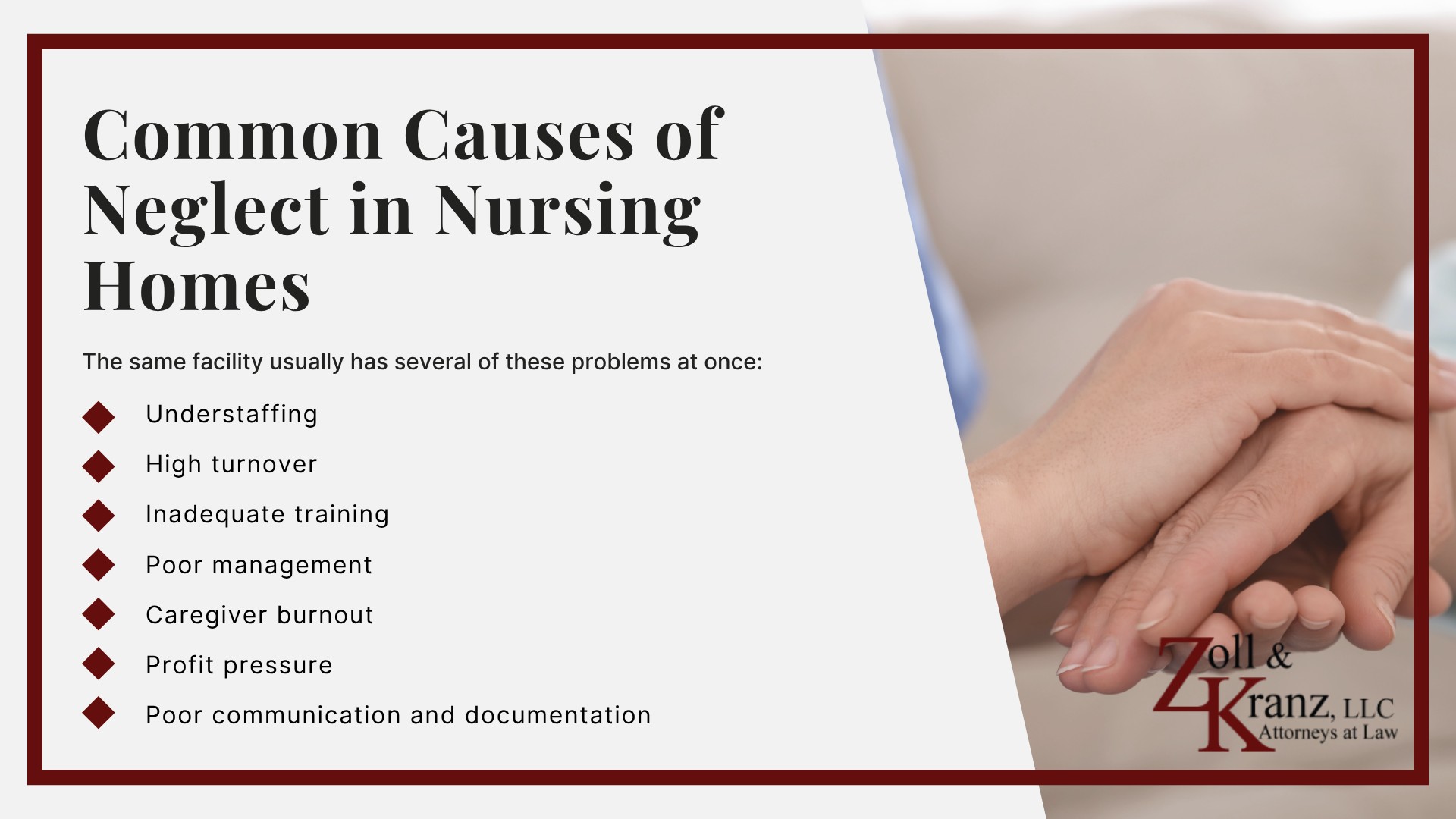
The same facility usually has several of these problems at once:

  • Understaffing: A short-staffed floor cannot provide the care each resident’s plan requires, which makes understaffing a top cause of nursing home neglect.
  • High turnover: High employee turnover increases the risk of neglect, since new staff members rarely know the residents well enough to catch early problems.
  • Inadequate training: Poor training puts workers on the floor before they can safely handle medical and mobility needs, which contributes to nursing home neglect.
  • Poor management: Weak oversight and missing supplies lead to systemic neglect in nursing homes.
  • Caregiver burnout: Caregiver burnout contributes to neglectful behavior, and the emotional demands on staff predict neglect and abuse.
  • Profit pressure: Corporate profit prioritization can lower the quality of elderly care services when ownership treats staffing as a cost to cut.
  • Poor communication and documentation: Breakdowns in communication between caregivers, incomplete documentation, and missed handoffs during shift changes can delay treatment, contribute to medication errors, and allow changes in a resident’s condition to go unnoticed.

Most of these causes trace back to one root, too few trained staff for the number of residents who depend on them.

Strict staff-to-resident ratios are necessary for adequate care, and the absence of enough hands is what turns these pressures into harm.

Residents who need the most hands-on care, the bedbound and the cognitively impaired, face the higher risk when staffing falls short.

Health and Emotional Toll of Untreated Neglect

Untreated nursing home neglect can have lasting consequences for both a resident’s physical health and emotional well-being.

Many preventable injuries begin as relatively minor problems but become far more serious when staff fail to recognize symptoms, provide timely treatment, or follow the resident’s care plan.

Older adults are especially vulnerable because chronic medical conditions, limited mobility, and weakened immune systems can make recovery more difficult.

As neglect continues, the resulting complications often lead to hospitalization, permanent disability, loss of independence, diminished quality of life, or even death.

Most of these injuries start small, as everyday problems that adequate staff would catch before they turn serious:

  • Pressure ulcers: Bedsores deepen when an immobile resident is not repositioned, and severe pressure ulcers can reach muscle and bone.
  • Infections: Severe infections can arise from unmanaged hygiene and untreated health issues, and an untreated infection can escalate to sepsis.
  • Malnutrition and dehydration: Skipped meals and missed fluids weaken a resident and slow healing from every other condition.
  • Falls and fractures: Missing supervision leads to broken hips and head injuries that elderly residents rarely fully recover from.
  • Worsening chronic conditions: Medical oversights let a stable diagnosis decline sharply when monitoring slips.
  • Psychological harm: Psychological trauma can lead to deep depression, along with anxiety and withdrawal.

Many nursing home residents who survive serious injuries from neglect never return to their prior level of independence, and the frailest face a higher risk of permanent decline once an injury sets in.

Untreated neglect causes emotional harm alongside the physical decline, and every delay risks further harm.

Parties That Can Be Held Liable for Neglect

Liability for nursing home neglect can reach beyond the worker on the floor to the people who set the conditions for the harm.

A resident’s injuries are often the result of systemic failures rather than the actions of a single caregiver, particularly when understaffing, poor supervision, inadequate training, or unsafe policies affect the quality of care throughout the facility.

Depending on the circumstances, responsibility may extend to the nursing home itself, corporate owners, administrators, healthcare providers, contractors, or other parties whose decisions contributed to the neglect.

Identifying every potentially responsible party is an important step in building a claim and pursuing full compensation for the resident’s injuries.

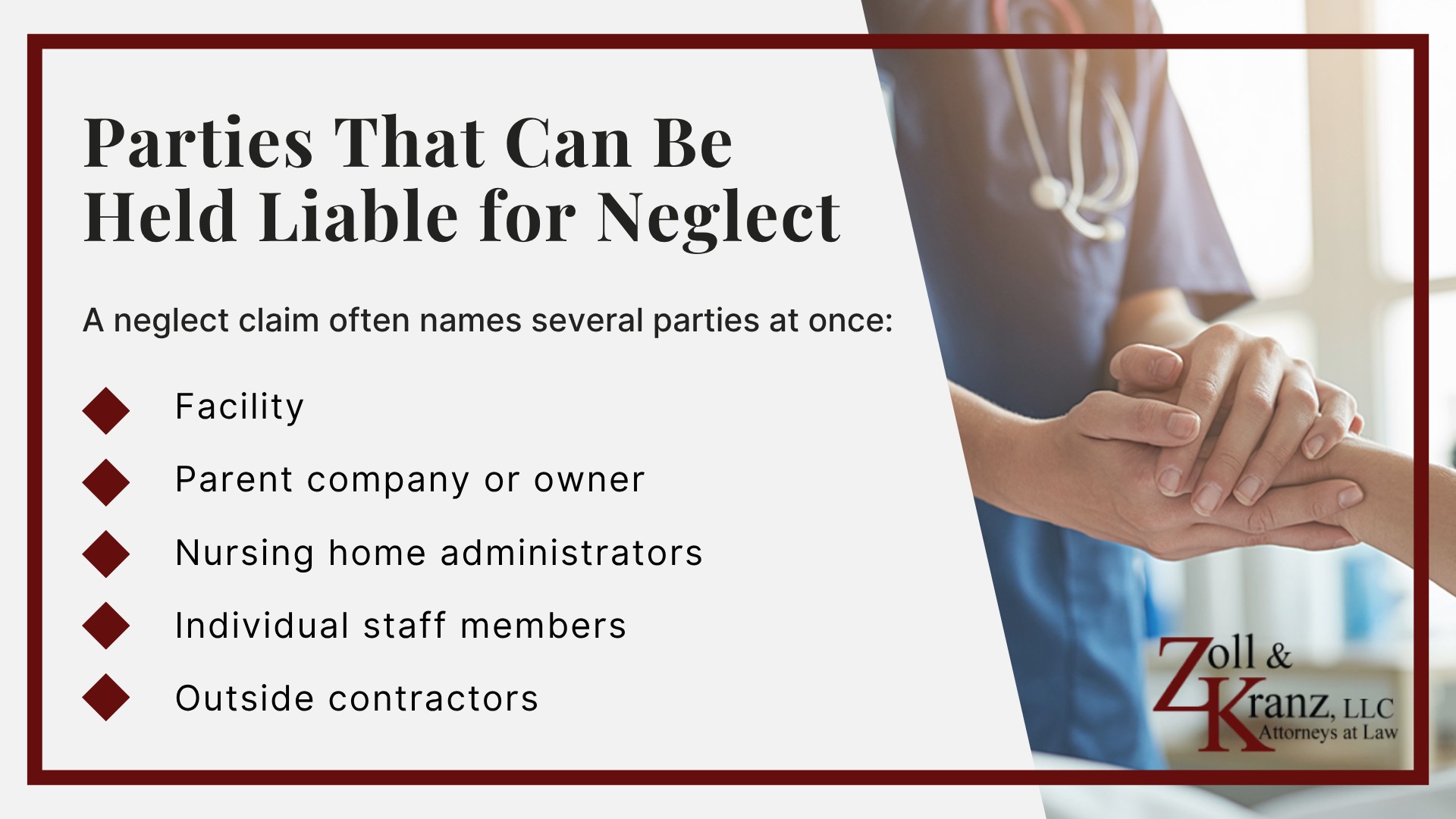
A neglect claim often names several parties at once:

  • Facility: The home is liable for failing to staff, train, and supervise at the level the law requires, and it answers for its employees under respondeat superior.
  • Parent company or owner: A management company or private equity owner can share liability when its budget and staffing decisions caused the shortfall.
  • Nursing home administrators: An administrator can be personally liable when the understaffing or unsafe policies they oversaw caused the neglect.
  • Individual staff members: A nurse, aide, or on-site physician can be liable when their own conduct fell below the standard of care.
  • Outside contractors: A staffing agency or therapy provider can be liable when its work contributed to the harm.

Identifying every responsible party early matters, since the records that prove who controlled the staffing are often held by the corporate owner rather than the local home.

A lawsuit can reach those corporate records in discovery, where the staffing and budget decisions behind the harm first appear.

Proving a Neglect Claim Comes Down to Four Elements

A nursing home is not automatically liable simply because a resident suffered an injury.

Like other negligence cases, a nursing home neglect claim requires evidence showing that the facility failed to meet the applicable standard of care and that the failure caused measurable harm.

Courts generally analyze these claims by examining four essential legal elements: duty, breach, causation, and damages.

Each element must be supported by medical records, witness testimony, facility documentation, expert opinions, or other evidence.

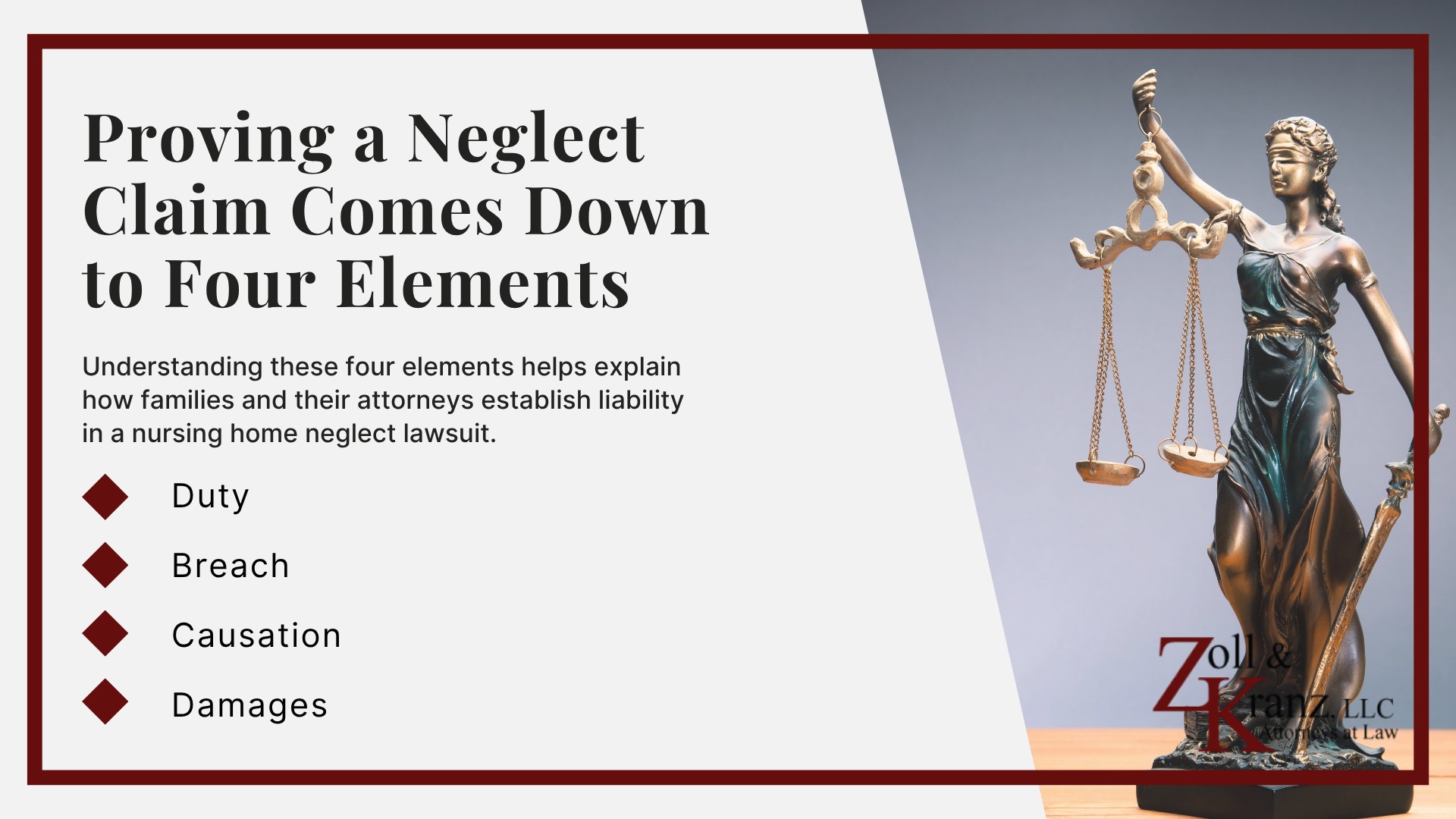
Understanding these four elements helps explain how families and their attorneys establish liability in a nursing home neglect lawsuit.

Duty

The facility owed the resident the care, supervision, and services regulators deem essential, set by federal and Ohio standards and by the resident’s care plan under 42 CFR 483.25.

This element is rarely in dispute, since the duty attaches the moment the facility admits the resident.

Breach

The facility fell below that standard, by running below safe staffing or failing to act on a known risk a prudent person would have addressed.

A breach can be a single lapse or a series of failures that the facility’s own records reveal over time.

Causation

The breach, rather than an unrelated condition, produced the resulting physical harm, which is usually the hardest element to prove since the facility will argue the injury came from age or a pre-existing condition.

The records and the medical experts who read them are what answer that argument.

Damages

The resident suffered measurable harm, from a fractured hip or sepsis to wrongful death, and without a documented injury even clear understaffing will not support a claim.

Evidence in a Nursing Home Neglect Claim

Evidence is the foundation of every successful nursing home neglect claim.

While families often notice the warning signs first, proving that neglect occurred usually requires medical records, facility documentation, photographs, witness testimony, and other evidence showing that the nursing home failed to provide appropriate care.

Much of the most important evidence remains in the facility’s possession, making it important to request records and preserve documentation as early as possible.

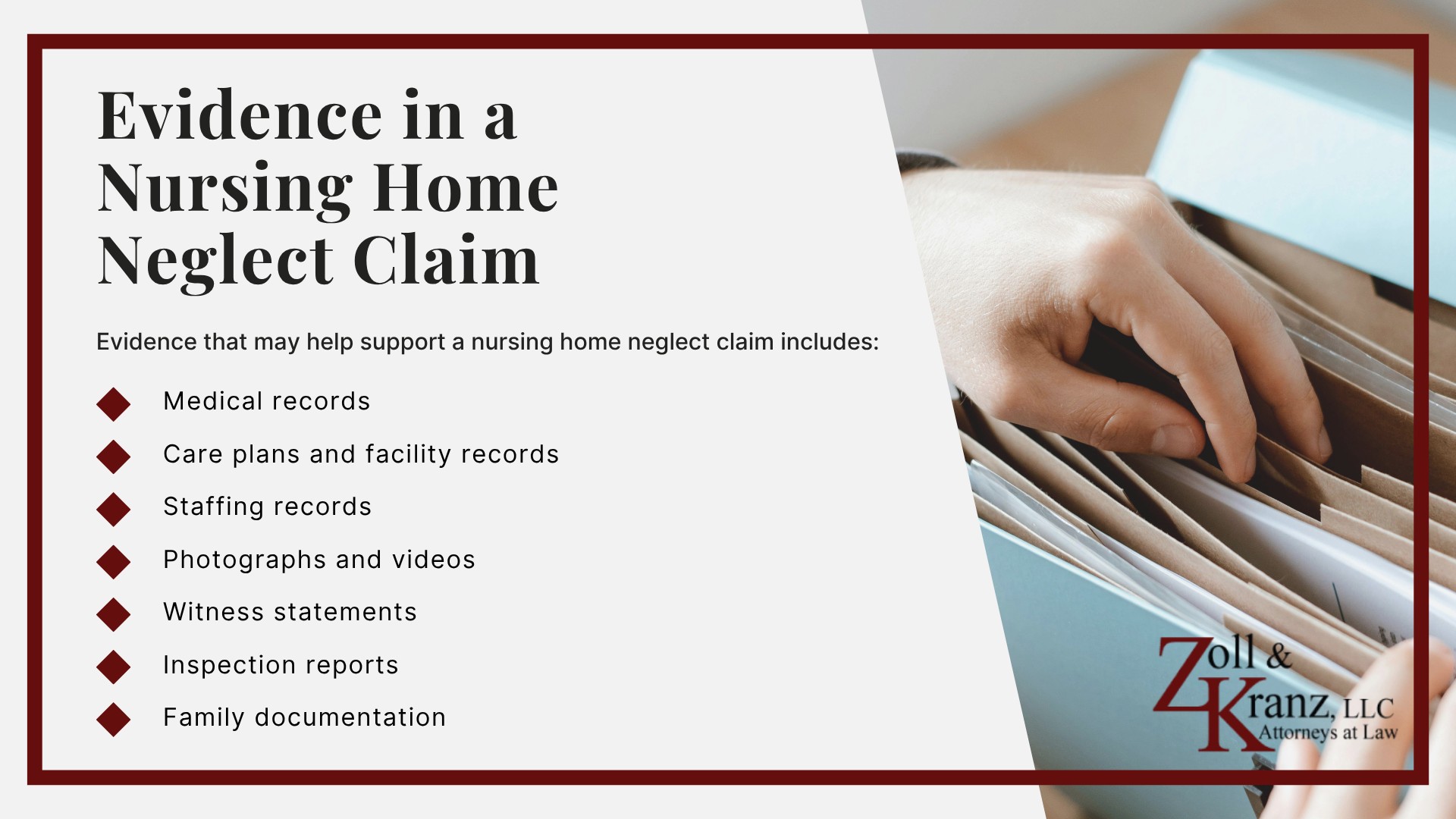
Evidence that may help support a nursing home neglect claim includes:

  • Medical records: Hospital records, physician notes, nursing records, and treatment records can document the resident’s injuries and medical condition.
  • Care plans and facility records: Care plans, medication records, nursing notes, and incident reports may show whether the facility followed the resident’s required care.
  • Staffing records: Staffing schedules and related records can help determine whether the facility had enough qualified employees to provide appropriate care.
  • Photographs and videos: Images of bedsores, bruises, poor hygiene, unsafe living conditions, or other injuries can provide important evidence.
  • Witness statements: Testimony from family members, other residents, visitors, or employees may help establish what occurred and when.
  • Inspection reports: State inspection findings, complaint investigations, and prior violations may show a history of similar problems at the facility.
  • Family documentation: Notes, emails, text messages, and a timeline of visits or conversations with staff can help establish when changes in the resident’s condition first appeared.

Steps to Take If You Suspect Nursing Home Neglect

Acting quickly can help protect both your loved one and any future nursing home neglect claim.

Prompt medical attention may prevent additional harm, while preserving records, photographs, and other evidence can make it easier to determine what happened and whether the facility failed to provide appropriate care.

Families should document their concerns, request important records, and report suspected neglect to the appropriate authorities as soon as possible.

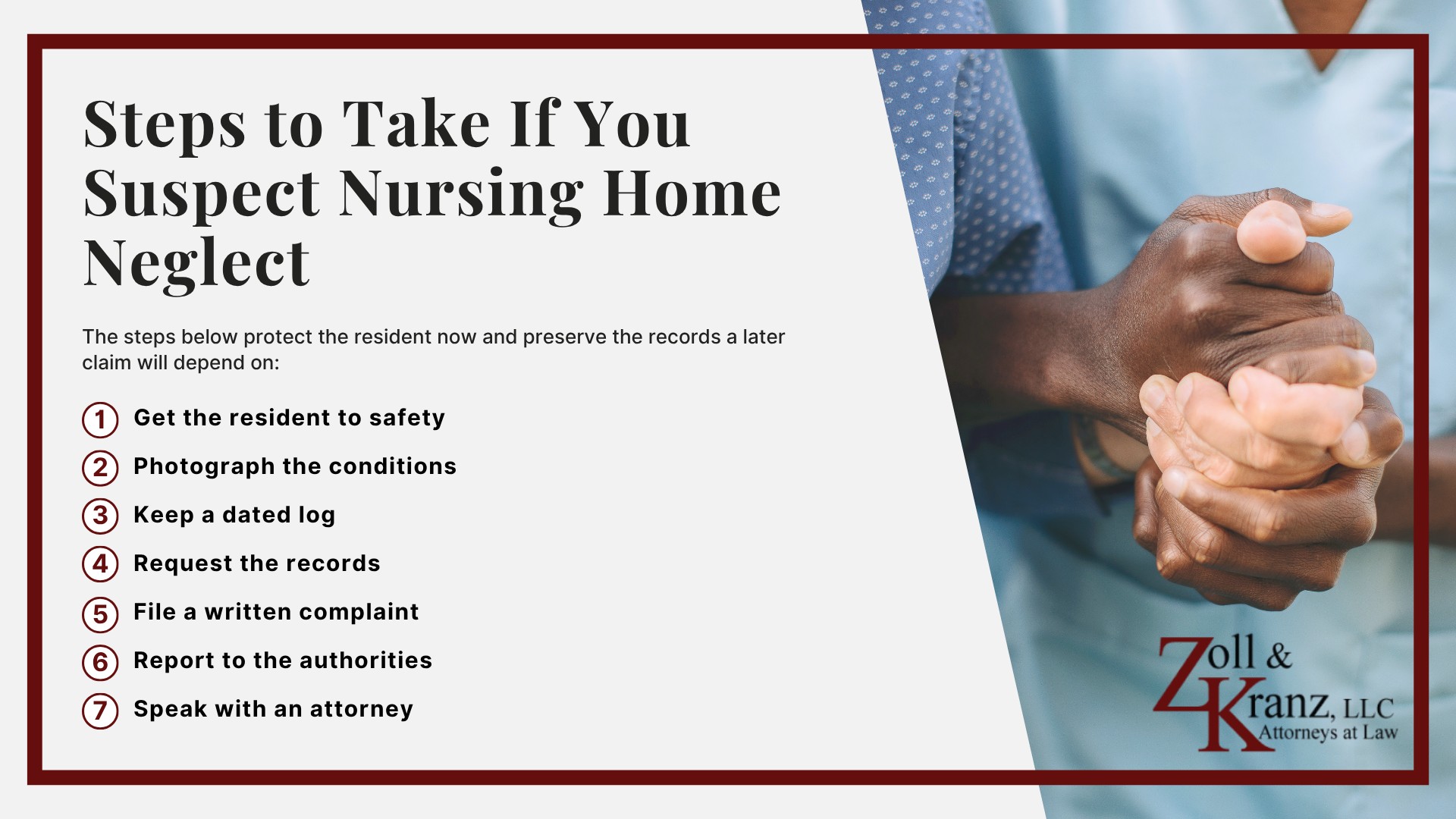
The steps below protect the resident now and preserve the records a later claim will depend on:

  1. Get the resident to safety: Call 911 if a loved one is in immediate danger, and have an independent ER document the injuries, which the facility cannot dispute as easily as its own chart.
  2. Photograph the conditions: Take dated photos of bedsores, bruises, and soiled bedding before staff clean the room or the wounds begin to heal, since this evidence disappears within days.
  3. Keep a dated log: Record events as they happen, since a contemporaneous note can refresh your testimony or be read into evidence under Ohio Evid.R. 803(5).
  4. Request the records: Ask in writing for the chart, the Medication Administration Records, and the care plan, which the facility must produce within 24 hours and cannot lawfully backdate.
  5. File a written complaint: Put the concern in writing and keep a copy, since that written notice defeats a later “we never knew” defense and supports any claim for punitive damages.
  6. Report to the authorities: Notify the Long-Term Care Ombudsman Program and the Ohio Department of Health, whose survey can issue a Statement of Deficiencies on CMS Form 2567 against the home.
  7. Speak with an attorney: Contact a nursing home neglect attorney early, who can send a spoliation letter that freezes the facility’s records, keycard logs, and camera footage before they are overwritten.

Reporting red flags like unexplained weight loss can help address neglect before it deepens.

Under Ohio’s Esther’s Law, a resident or family can authorize electronic monitoring in the resident’s room.

Ohio Agencies That Investigate Nursing Home Neglect

Several state and local agencies investigate reports of nursing home neglect in Ohio.

Depending on the circumstances, a complaint may result in an inspection, an administrative investigation, a protective services response, or, in the most serious cases, a criminal investigation.

Reporting suspected neglect can help protect your loved one from further harm while also creating an official record of the concerns.

Several agencies in Ohio take these reports, and you can report abuse or neglect to the one that fits how urgent the situation is:

  • Local law enforcement: Police can remove a resident from danger and open a criminal investigation when the harm is severe or criminal.
  • Ohio Department of Health: The ODH Complaint Unit, the body responsible for licensing nursing homes, investigates abuse complaints and neglect complaints, and its surveys are unannounced and keep the complainant’s identity confidential.
  • Long-term care ombudsman: Nursing home neglect can be reported to the ombudsman, and the Long-Term Care Ombudsman Program operates within the Ohio Department of Aging under the federal Older Americans Act.
  • Adult Protective Services: Contact your local Adult Protective Services to report neglect, which in Ohio runs through county Job and Family Services for residents aged 60 or older.

You can report neglect anonymously in most states, and you do not need proof to report suspected neglect.

Ohio and federal rules also require the facility itself to report a neglect allegation to the state, within 2 hours if the resident suffered serious bodily injury and within 24 hours otherwise, and federal rules protect a resident and family from retaliation for reporting.

Filing a Nursing Home Neglect Lawsuit

Filing a nursing home neglect lawsuit is a legal process that begins with investigating what happened and gathering evidence to support the claim.

Before a lawsuit is filed, an attorney will typically review medical records, facility documents, witness statements, and other evidence to determine whether the nursing home failed to meet the required standard of care.

Although every case is different, most nursing home neglect claims follow a similar sequence from the initial investigation through settlement negotiations or trial.

Once the facts support a claim, the case moves through a set sequence:

  • Consult an attorney: A nursing home neglect attorney reviews the facts in a free case review to confirm the claim and the controlling deadline.
  • Investigate and gather evidence: Counsel collects the medical records, staffing data, care plans, and incident reports.
  • File the complaint: The lawyer files a formal complaint naming the facility and any other liable party, and an Ohio medical claim must include an affidavit of merit under Civ.R. 10(D)(2).
  • Serve the nursing home: The facility is served with the complaint and has a set time to answer in court.
  • Discovery: Both sides exchange documents and take depositions, where the staffing and budget decisions surface.
  • Settlement or trial: Most cases settle, often after discovery or at mediation, and the rest proceed to trial.

Bringing the claim early protects the evidence, since staffing logs and electronic records are easiest to obtain before they age or change hands.

Damages in a Nursing Home Neglect Claim

Victims of neglect may be entitled to financial compensation in 3 categories, with the amount depending on the severity of the harm and how far the facility’s conduct fell below the standard of care.

Ohio law treats these categories differently at trial, and the difference controls how much a family recovers, since economic and non-economic damages compensate the resident for the loss itself while punitive damages depend on how reckless the facility’s conduct was.

Economic Damages

Economic damages are the measurable costs of the harm, including medical bills, the cost of a transfer to a safer facility, and, in fatal cases, funeral expenses.

In a fatal case, a wrongful death claim brought through the estate recovers these losses for the family.

Non-Economic Damages

Non-economic damages account for the human cost the resident bore, including the pain, suffering, and loss of dignity that neglect causes, which a court values case by case.

These often make up the largest part of a serious neglect award.

Punitive Damages

Punitive damages punish conduct that rises to willful and wanton neglect or reckless disregard, and they are rare, requiring clear proof that the facility acted with conscious disregard for resident safety.

Ohio caps non-economic damages under ORC 2315.18 and punitive damages under ORC 2315.21, with exceptions for the most catastrophic injuries.

Deadline to File a Nursing Home Neglect Claim

Each state has statutes of limitations for filing lawsuits, and in Ohio that deadline varies, often running shorter than families expect.

A neglect claim falls under one of several deadlines, set by how the claim is classified:

  • Ordinary negligence: 2 years from the injury or its discovery, under ORC 2305.10.
  • Medical claim: 1 year, under ORC 2305.113, with a 4-year outer limit.
  • Wrongful death: 2 years from the date of death, under ORC 2125.02.
  • Government-run facility: A separate, much shorter notice deadline before any suit.

Ohio courts read medical claim broadly, and care given under a resident’s plan of care can fall under the 1-year rule, even for routine tasks like repositioning or bathing.

That gray area is why you should speak with a nursing home neglect attorney early, since missing your deadline ends the claim no matter how clear the neglect was.

Zoll & Kranz: Speak With a Nursing Home Neglect Attorney

A neglect claim asks a family to do several hard things at once, working out who is liable, proving the breach, valuing the harm, and meeting a deadline that can run as short as 1 year in Ohio.

The strongest cases rest on the facility’s own records, the staffing logs, care plans, and audit trails that show how the home was run against what its residents needed.

Those records often reveal a shortfall the facility never disclosed, and the discovery a claim forces can push the home to fix conditions for every resident on the unit.

Zoll & Kranz reviews nursing home neglect claims, obtains and analyzes those records, identifies every responsible party, and pursues the compensation a resident and family are owed.

If your loved one was harmed by a nursing home’s failure to provide proper care, you may be eligible to file a nursing home neglect claim and seek compensation for the harm.

Contact Zoll & Kranz today for a free consultation with an experienced nursing home neglect attorney.

You can also use the chat feature on this page to find out if your family qualifies.

Frequently Asked Questions

Published by:
Share
Picture of Michelle L. Kranz
Michelle L. Kranz

Michelle is a founding partner of Zoll & Kranz, located in Toledo, Ohio. Michelle has been a plaintiff’s lawyer for the entirety of her practice – over 32 years. She devotes the majority of her time to complex consolidated litigation and class action including advocating for people injured by medical devices, prescription medications, or corporate negligence.

This article has been written and reviewed for legal accuracy and clarity by the team of writers and attorneys at Zoll & Kranz, LLC and is as accurate as possible. This content should not be taken as legal advice from an attorney. If you would like to learn more about our owner and experienced Ohio injury lawyer, Michelle L. Kranz, you can do so here.

Zoll & Kranz, LLC does everything possible to make sure the information in this article is up to date and accurate. If you need specific legal advice about your case, contact us. This article should not be taken as advice from an attorney.

Other cases we handle in Toledo
All
Auto Accidents
Injury Types
Medical Malpractice
Nursing Home Abuse
Other Accidents & Injuries
You can learn more about other Toledo cases we handle below:
Auto Accident Lawsuit Timeline in Toledo
Auto Accident Statute of Limitations in Toledo, OH
Bedsores in Toledo Nursing Homes
Collecting Evidence in Toledo Medical Malpractice Cases
Collecting Evidence in Toledo Nursing Home Negligence Cases
Common Car Accident Injuries in Toledo, OH
Common Causes of Nursing Home Negligence
Common Types of Car Accident Damages
Dehydration and Malnutrition in Nursing Homes
Distracted Driving Accidents in Toledo, OH
Dropped Patients in Nursing Homes
DUI Accidents in Toledo
Duty of Care Owed by Nursing Home Facilities in Ohio
Evidence in Toledo Auto Accident Cases
Failure to Perform Procedure Malpractice Lawyer in Toledo
Head-On Collisions in Toledo
Hit-and-Run Accidents in Toledo
How is Fault Determined in a Car Accident?
How To File a Car Crash Lawsuit in Toledo
How to Report Nursing Home Abuse in Toledo, Ohio
Inattentive Nursing Home Staff: Steps to Take
Infections in Nursing Homes | Can You Sue?
Initial Steps To Take in a Toledo Medical Malpractice Case
Interstate Accidents in Toledo
Liability in Nursing Home Negligence Cases
Liability in Toledo Medical Malpractice Claims
Medication Errors in Nursing Homes
Mental and Emotional Abuse in Nursing Homes
Negligence in Toledo Medical Malpractice Cases
Negligent Hiring in Nursing Homes
Nursing Home Negligence Wrongful Death Cases in Toledo
Paralysis in Auto Accidents
Patient Falls in Nursing Homes
Patient Rights in a Nursing Home
Personal Injury Lawyer Toledo, Ohio
Physical Abuse in Nursing Homes
Process of a Medical Malpractice Case in Toledo
Rear-End Collisions in Toledo, OH
Rental Car Accidents in Toledo
Rollover Accidents in Toledo
Securing a Police Report in Toledo After an Auto Accident
Sexual Abuse in Toledo Nursing Homes
Sideswipe Accidents in Toledo
Toledo Anesthesia Errors Lawyer
Toledo Auto Accident Comparative Negligence Explained
Toledo Auto Accident Lawyer
Toledo Bicycle Accident Lawyer
Toledo Burn Injury Lawyer
Toledo Bus Accident Lawyer
Toledo Cancer Misdiagnosis Lawyer
Toledo Car Accident Lawyer
Toledo Catastrophic Injury Lawyer
Toledo Daycare Injury Lawyer
Toledo Delayed Diagnosis Lawyer
Toledo Emergency Room Error Lawyer
Toledo Failure To Diagnose Lawyer
Toledo Insurance Claim Lawyer
Toledo Mass Torts Lawyer
Toledo Medical Malpractice Lawyer
Toledo Medication Error Lawyer
Toledo Misdiagnosis Medical Malpractice Lawyer
Toledo Motorcycle Accident Lawyer
Toledo Nurse Error Lawyer
Toledo Nursing Home Abuse Lawyer
Toledo Nursing Home Negligence Safety and Preventative Measures
Toledo Pedestrian Accident Lawyer
Toledo Spinal Cord Injury Lawyer
Toledo Surgical Error Lawyer
Toledo Toxic Exposure Lawyer
Toledo Traumatic Brain Injury Lawyer
Toledo Truck Accident Lawyer
Toledo Wrongful Death Lawyer
Wrong Site Surgery Malpractice in Toledo
Were you or a loved one injured in Toledo?

A serious injury can have life-altering results.

Don’t settle for less than you deserve, speak with an award-winning personal injury lawyer today.

29 Reviews
5.0
★★★★★
Recovered damages
$108 Million+

Table of Contents

Legal Guides
About Zoll & Kranz, LLC

For over 37 years, Zoll & Kranz has been fighting for clients who have been the victims of the wrongful death of a loved one.

Do you believe you’re entitled to compensation?

Use our Instant Case Evaluator to find out in as little as 60 seconds!

Guides & Resources

Other Toledo Personal Injury Cases

All
Auto Accidents
Injury Types
Medical Malpractice
Nursing Home Abuse
Other Accidents & Injuries
Local Toledo Resources
Education
Emergency Services
Courthouses
Department of Motor Vehicles
Sights to See