No fees unless we win.
Get a free consultation
18 Reviews
5.0
★★★★★

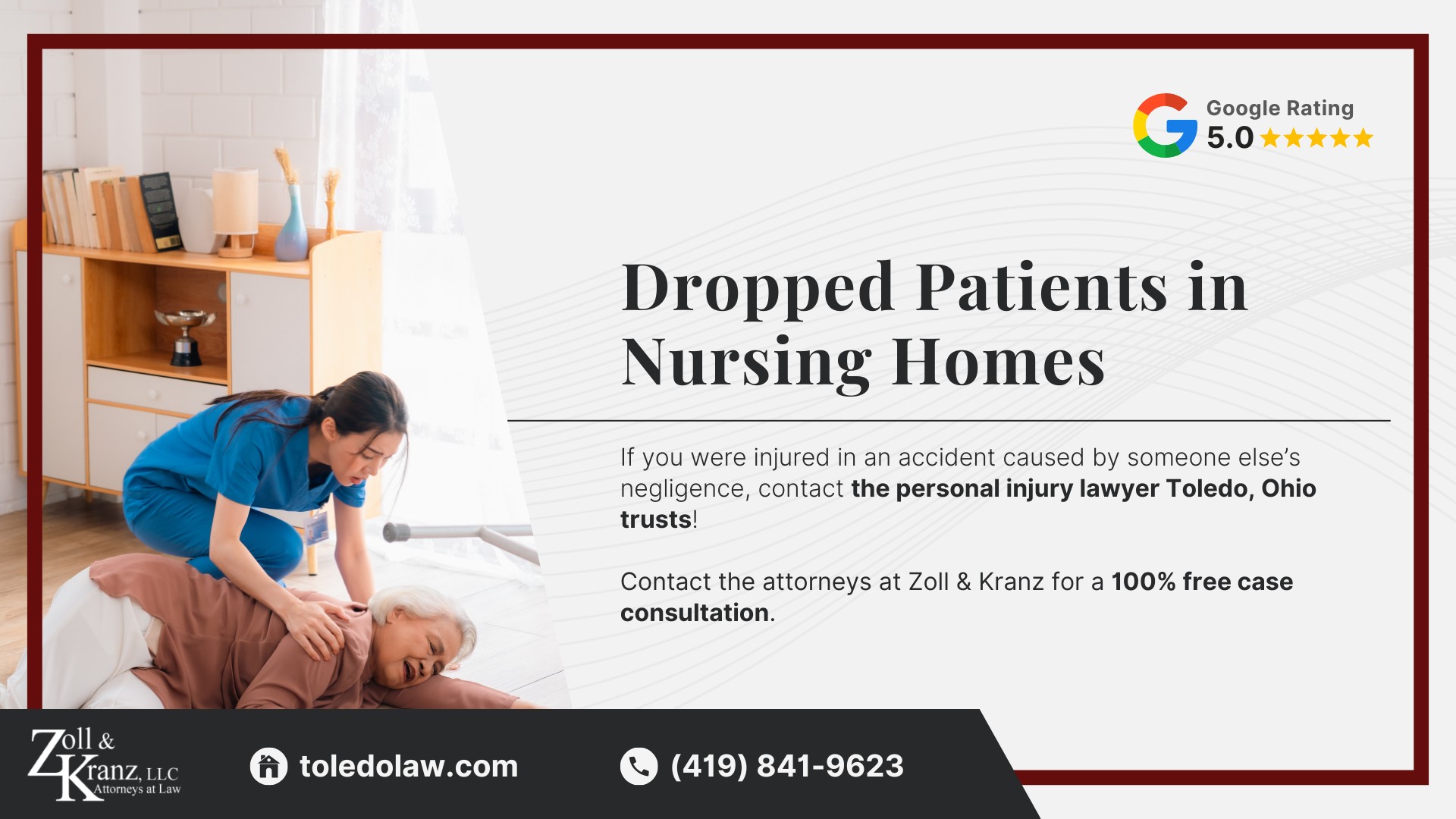
Dropped Patients in Nursing Homes

Dropped Patients and Facility Liability in Toledo Nursing Homes

Dropped patients in nursing homes are often preventable falls that happen when staff lose control of a resident during a lift, transfer, toileting trip, shower transfer, or repositioning.

These incidents usually involve elderly nursing home residents who depend on nursing home staff for movement between a bed, wheelchair, toilet, shower chair, bedside commodes, or other assistive devices.

When the records show that required precautions were ignored, the drop may amount to nursing home negligence.

Our experienced Toledo nursing home abuse lawyers at Zoll & Kranz review the care plan, staffing records, and incident report, then file a nursing home negligence claim for injured nursing home patients.

Dropped Patients in Nursing Homes

Has Your Loved One Been Dropped by Toledo Nursing Home Staff?

Families are often told that a resident “slipped,” “lost balance,” or “was lowered to the floor.”

Those phrases do not answer the legal question: whether the facility followed the care plan, used required equipment, and provided enough trained staff.

Dropping a patient can lead to severe injuries including hip fractures, traumatic brain injuries, and internal organ damage.

Most falls in nursing homes are preventable through proper care, monitoring, and maintaining a safe environment.

If you or a loved one suffered serious injuries after being dropped by nursing home staff in Toledo, you may be eligible to pursue a claim for compensation.

Contact Zoll & Kranz today for a free consultation with an experienced Toledo nursing home abuse lawyer.

You can also use the chat feature on this page to find out if you qualify for a dropped patient claim.

Why Patient Drops Happen During Nursing Home Transfers

Transfer falls in long-term care are a public health concern when they cause serious injuries that could have been avoided through safer staffing, supervision, or equipment use.

Most falls of this kind in nursing homes follow a set of repeating root causes, and almost every one of these falls is preventable with proper care, fall prevention planning, and adequate staffing.
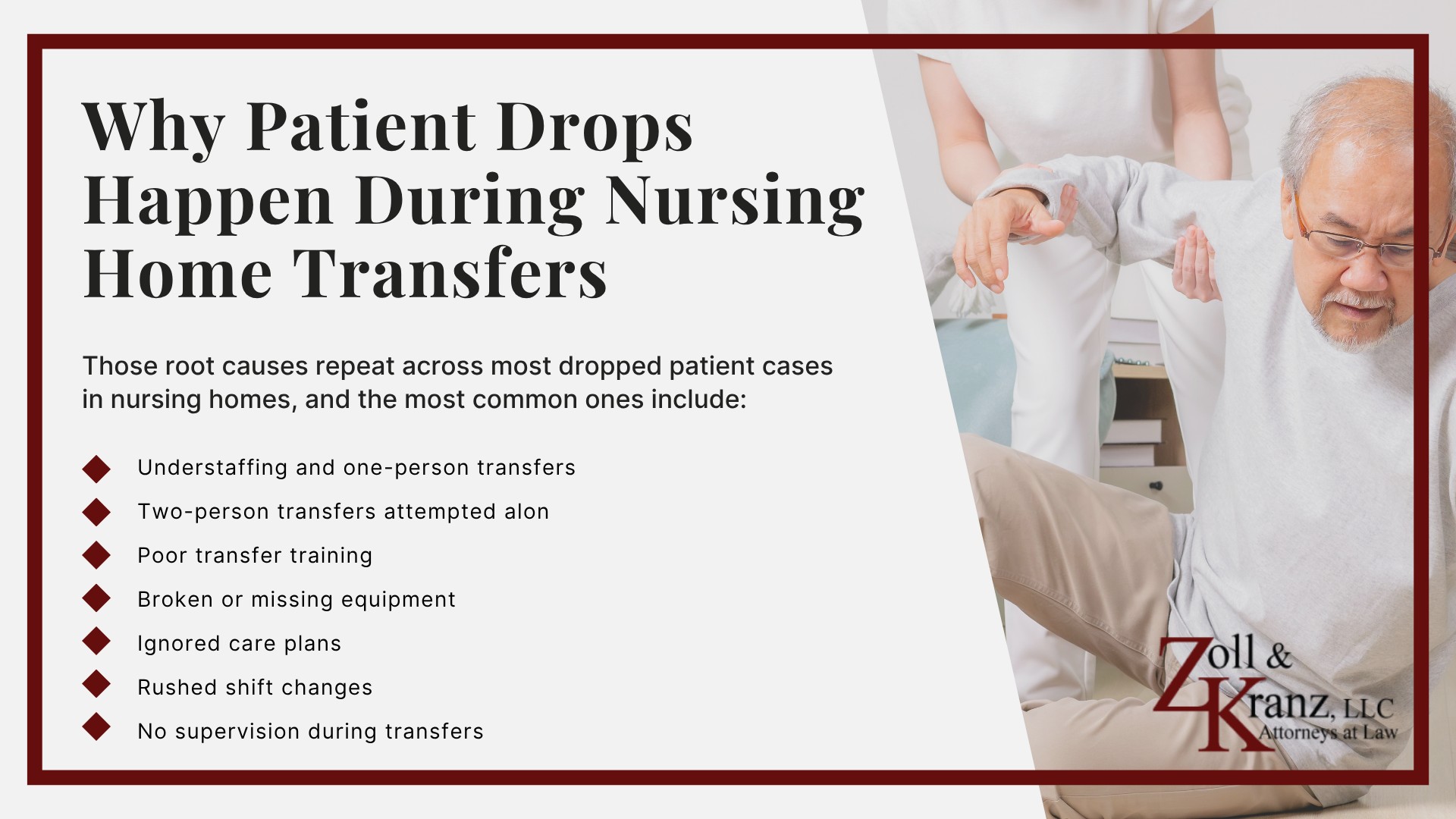
Those root causes repeat across most dropped patient cases in nursing homes, and the most common ones include:

  • Understaffing and one-person transfers: Understaffing in nursing homes often results in staff rushing or attempting to move residents alone, increasing the risk of drops. When a nursing home runs short on certified nursing assistants, transfers that require two people are routinely attempted by one person, which is one of the leading reasons resident falls happen during care and a textbook example of nursing home neglect.
  • Two-person transfers attempted alone: Bed-to-wheelchair, wheelchair-to-toilet, and wheelchair-to-shower transfers that require two staff are often attempted by one rushed aide, raising the risk of serious falls.
  • Poor transfer training: Poor training of staff can lead to improper handling techniques during patient transfers, significantly increasing the risk of accidents. Some staff members are placed on the floor without being trained in safe transfer techniques, gait belt use, or two-person lifts, which is a documented contributor to nursing home falls and to repeated falls of the same resident.
  • Broken or missing equipment: Improperly functioning mechanical lifts, such as those with broken parts, are a major extrinsic risk factor for dropped patients. A Hoyer lift with a frayed sling, broken straps, or a bent base is a known mechanical hazard inside the nursing home, and continuing to use such equipment puts every resident at high risk of preventable falls.
  • Ignored care plans: A resident whose care plan requires a two-person transfer or a mechanical lift is moved manually anyway when staff are short, exposing the resident to avoidable falls and serious fall injuries.
  • Rushed shift changes: Transfers performed quickly at shift change, mealtime, or during medication rounds, when supervision is at its lowest and falls are more likely to occur.
  • No supervision during transfers: Inadequate supervision due to lack of staffing is a major contributor to falls among nursing home residents, especially those with dementia. When residents with cognitive impairment are left alone or asked to wait for help that does not come, many attempt to move on their own and then fall when staff finally arrive to assist, and these falls in nursing homes are often the most serious.

How Chronic Understaffing Leads to Dropped Patient Incidents

Chronic understaffing is one of the most common factors behind dropped patient incidents in nursing homes.

Residents who require assistance with transfers often depend on multiple caregivers, mechanical lifts, gait belts, and careful supervision to move safely between a bed, wheelchair, toilet, shower chair, or other location.

When too few staff members are available, transfers may be rushed, delayed, or performed by employees who do not have the assistance required by the resident’s care plan.

Those shortcuts can increase the likelihood of a resident being dropped during routine care.
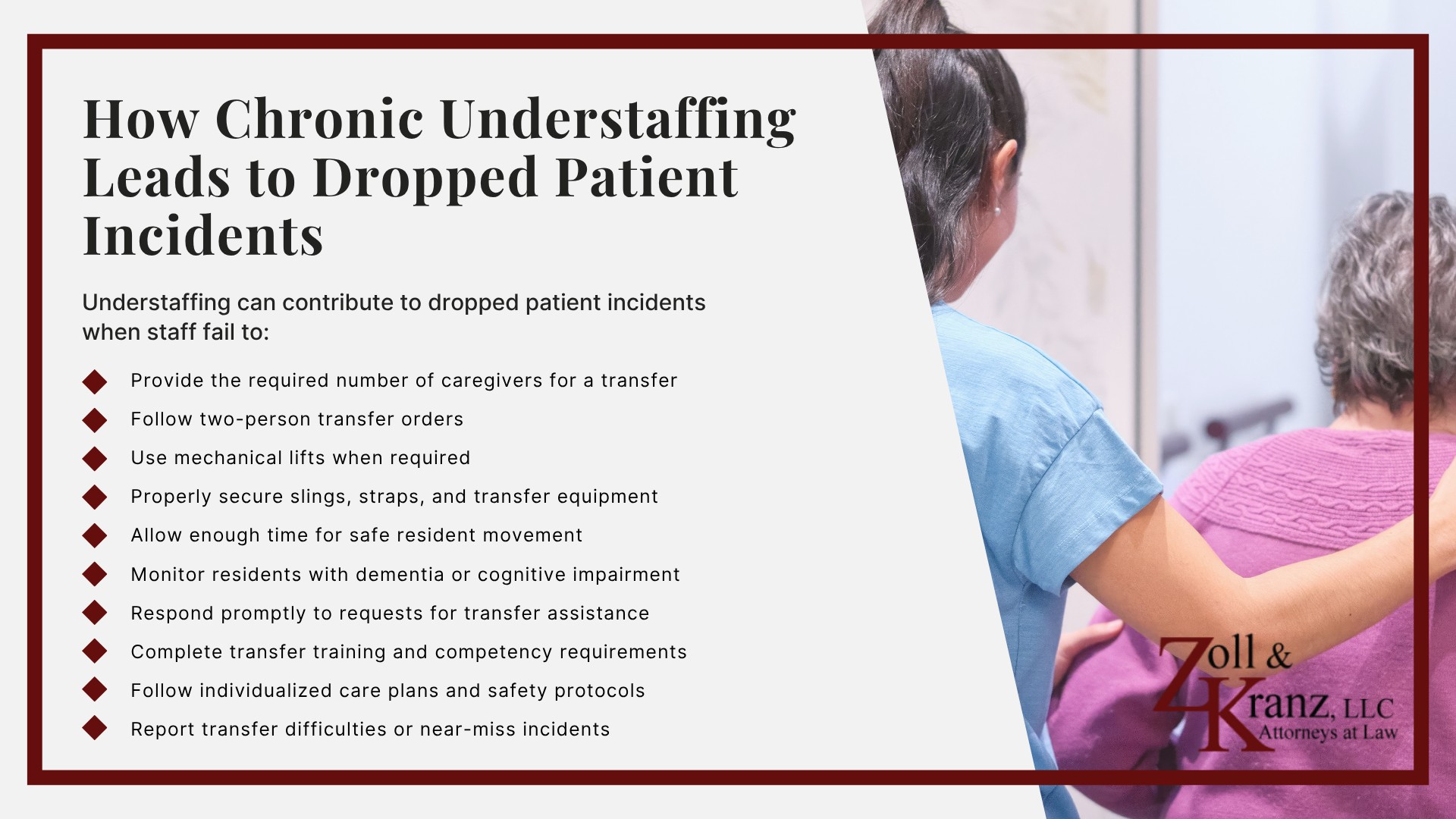
Understaffing can contribute to dropped patient incidents when staff fail to:

  • Provide the required number of caregivers for a transfer
  • Follow two-person transfer orders
  • Use mechanical lifts when required
  • Properly secure slings, straps, and transfer equipment
  • Allow enough time for safe resident movement
  • Monitor residents with dementia or cognitive impairment
  • Respond promptly to requests for transfer assistance
  • Complete transfer training and competency requirements
  • Follow individualized care plans and safety protocols
  • Report transfer difficulties or near-miss incidents

Many dropped patient cases involve a pattern of staffing shortages rather than a single mistake by an individual employee.

Staffing schedules, assignment sheets, payroll records, and facility staffing reports may help show whether enough qualified personnel were available when the incident occurred.

When a nursing home routinely operates with inadequate staffing levels, preventable transfer accidents may reflect a broader breakdown in resident care rather than an isolated error during a single shift.
Common Injuries After a Nursing Home Transfer Fall

Residents dropped during transfers often fall from unstable positions, which leaves little time to protect the head, hip, spine, or arms before impact.

Falls can cause serious injuries in 1 in 5 cases, leading to fractures, head trauma, and fatal injuries. These fall related injuries can turn a transfer error into a medical emergency.

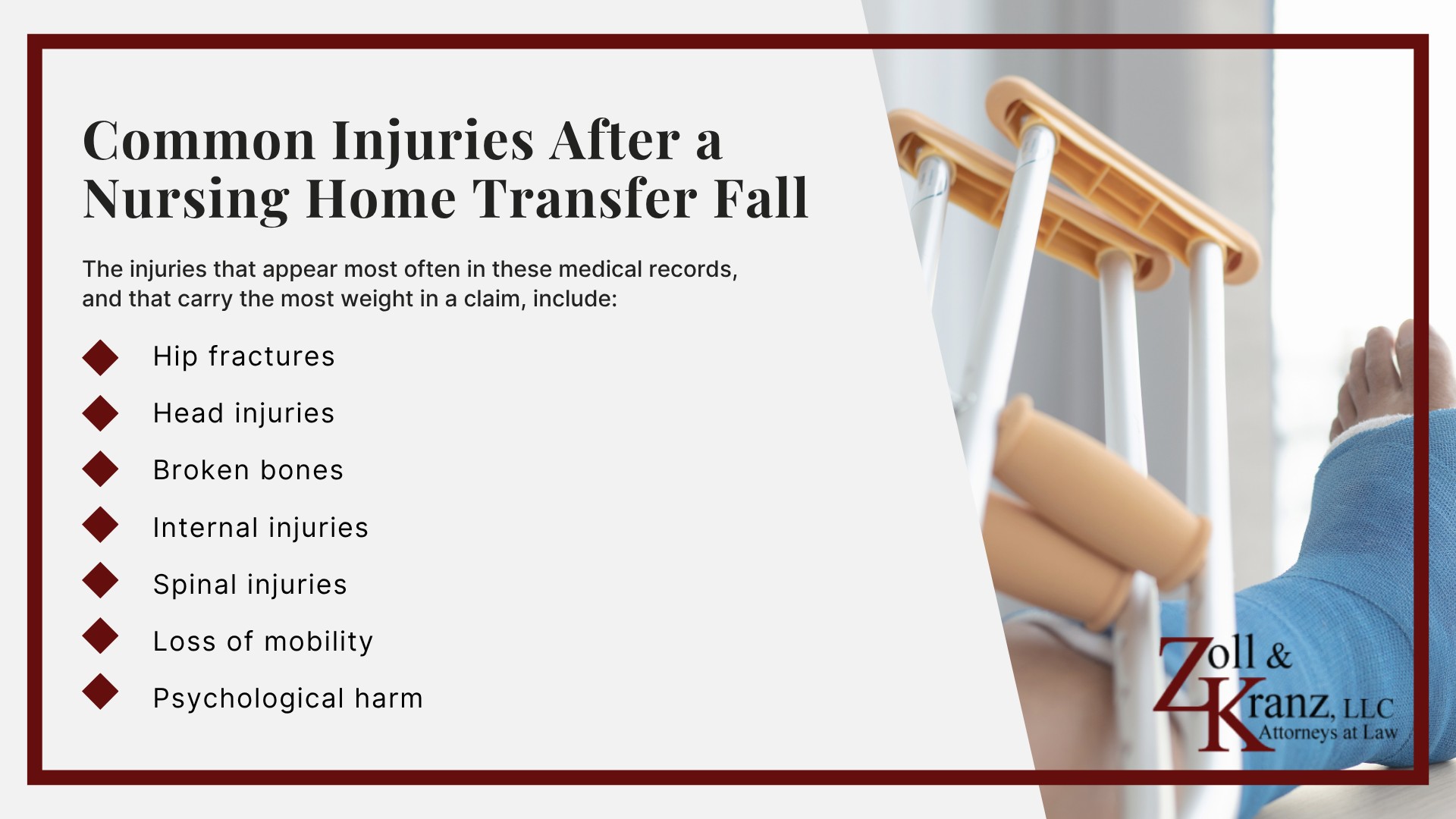
The injuries that appear most often in these medical records, and that carry the most weight in a claim, include:

  • Hip fractures: A hip fracture is often a major injury requiring emergency surgery, hospitalization, rehabilitation, and a long period of reduced mobility.
  • Head injuries: Head injuries may include concussions, brain bleeds, subdural hematomas, or traumatic brain injuries after the resident strikes the floor, toilet, wheelchair, bed frame, or lift equipment.
  • Broken bones: Broken bones may involve the wrist, arm, shoulder, ribs, femur, pelvis, or tailbone when the resident lands sideways or tries to break the fall.
  • Internal injuries: Internal organ damage or internal bleeding may not be obvious at the facility, especially when the resident has dementia or cannot describe pain clearly.
  • Spinal injuries: A fall can cause vertebral compression fractures, disc damage, nerve pain, weakness, or permanent mobility loss.
  • Loss of mobility: Dropping patients can cause permanent loss of mobility and independence, which may force previously mobile residents into wheelchairs or bedridden states.
  • Psychological harm: Psychological consequences of being dropped can include anxiety, depression, and self-imposed restrictions on activity.

Women in nursing homes are twice as likely to suffer serious injuries or death from falls compared to men, largely due to higher rates of osteoporosis and longer life expectancy.

Federal and Ohio Laws That Apply to Nursing Home Falls

Federal law sets the baseline safety duties for certified nursing homes, while Ohio law gives residents specific legal rights inside the facility.

Federal Nursing Home Reform Act

The federal Nursing Home Reform Act requires certified nursing homes to provide services that help each resident maintain the highest practicable physical, mental, and psychosocial well-being.

Federal regulations, such as those found in 42 CFR Part 483, mandate that nursing homes provide a safe environment free from hazards and ensure adequate supervision to prevent accidents, including falls.

Facilities are required by law to prevent avoidable drops through proper staffing, training, and equipment.

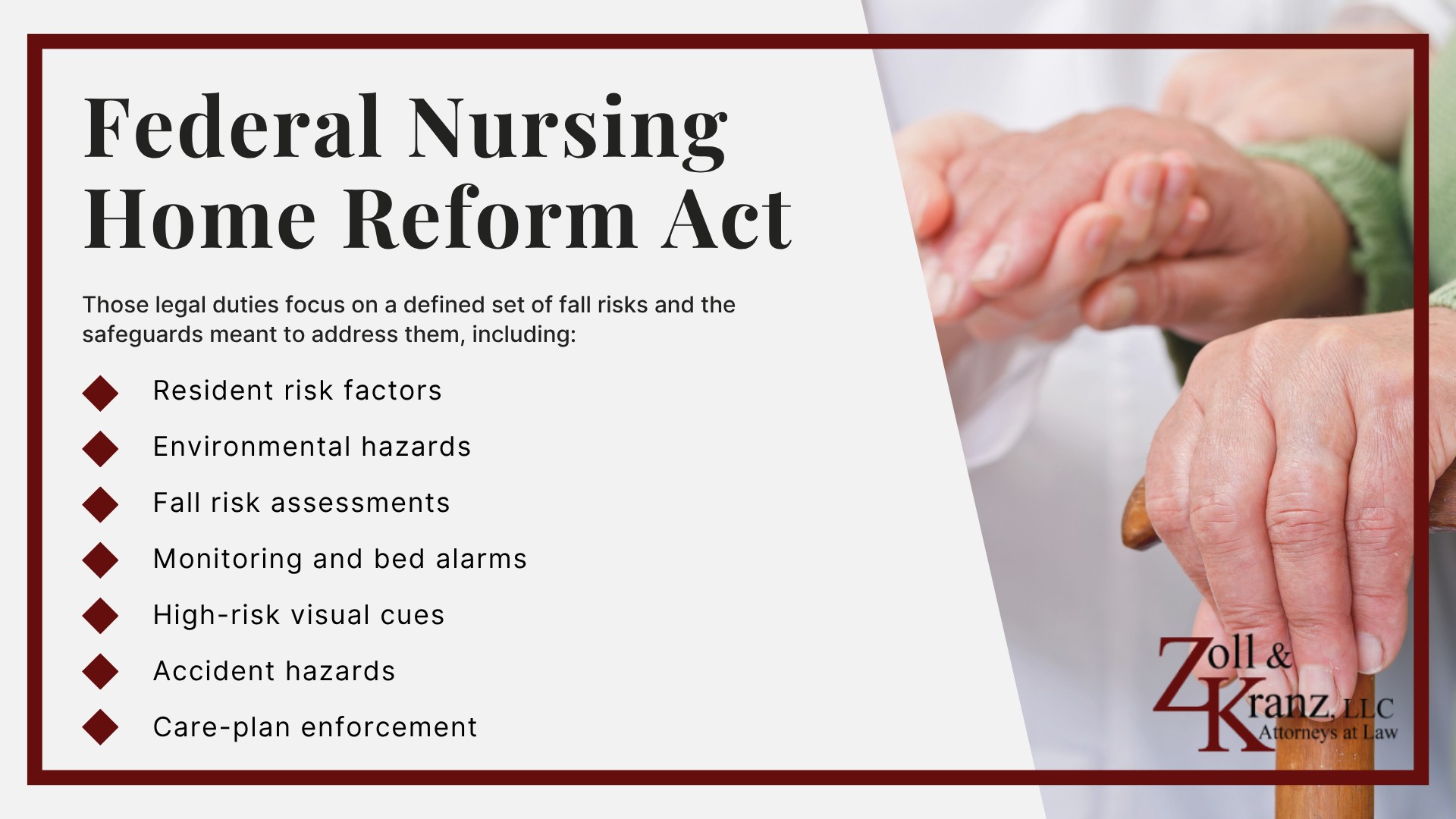
Those legal duties focus on a defined set of fall risks and the safeguards meant to address them, including:

  • Resident risk factors: Older adults in nursing homes often have multiple health issues, such as memory problems, poor balance, and chronic conditions, which significantly increase their risk of falling. Residents suffering from general muscle weakness frequently experience falls, with 81% of those falling having this issue.The more severe their illness, the more a resident depends on staff to move safely, and the greater the risk that a transfer ends in a drop.
  • Environmental hazards: Environmental hazards, such as slippery floors and poor lighting, contribute to falls in nursing homes, with nearly 30% of falls attributed to these preventable conditions.
  • Fall risk assessments: Nursing homes are legally required to implement fall prevention strategies, which include conducting regular assessments of residents to identify those at risk of falling.
  • Monitoring and bed alarms: Effective fall prevention strategies in nursing homes include regular monitoring of residents, implementing toileting schedules, and using bed alarms to alert staff when a resident attempts to get up unassisted.
  • High-risk visual cues: Nursing homes should utilize visual cues, such as placing stickers on the doors of residents identified as high fall risks, to ensure staff provide appropriate attention and care.
  • Accident hazards: 42 CFR Section 483.25(d) requires the resident environment to remain as free of accident hazards as possible, including cluttered hallways and unsafe transfer areas.
  • Care-plan enforcement: A facility can violate the federal duty when a transfer order exists in the chart but staff do not follow it during care, especially for short stay residents or residents with underlying health issues.

Falls often lead to poor survey results from health departments, which can affect a facility’s star rating and Medicare/Medicaid certification.

A serious fall record can also affect medicaid services participation when survey findings show repeated safety failures.

Ohio Nursing Home Residents’ Bill of Rights

Ohio Revised Code Section 3721.13 gives residents legal rights that matter directly in dropped patient cases, including the right to a safe and clean living environment and adequate nursing care.

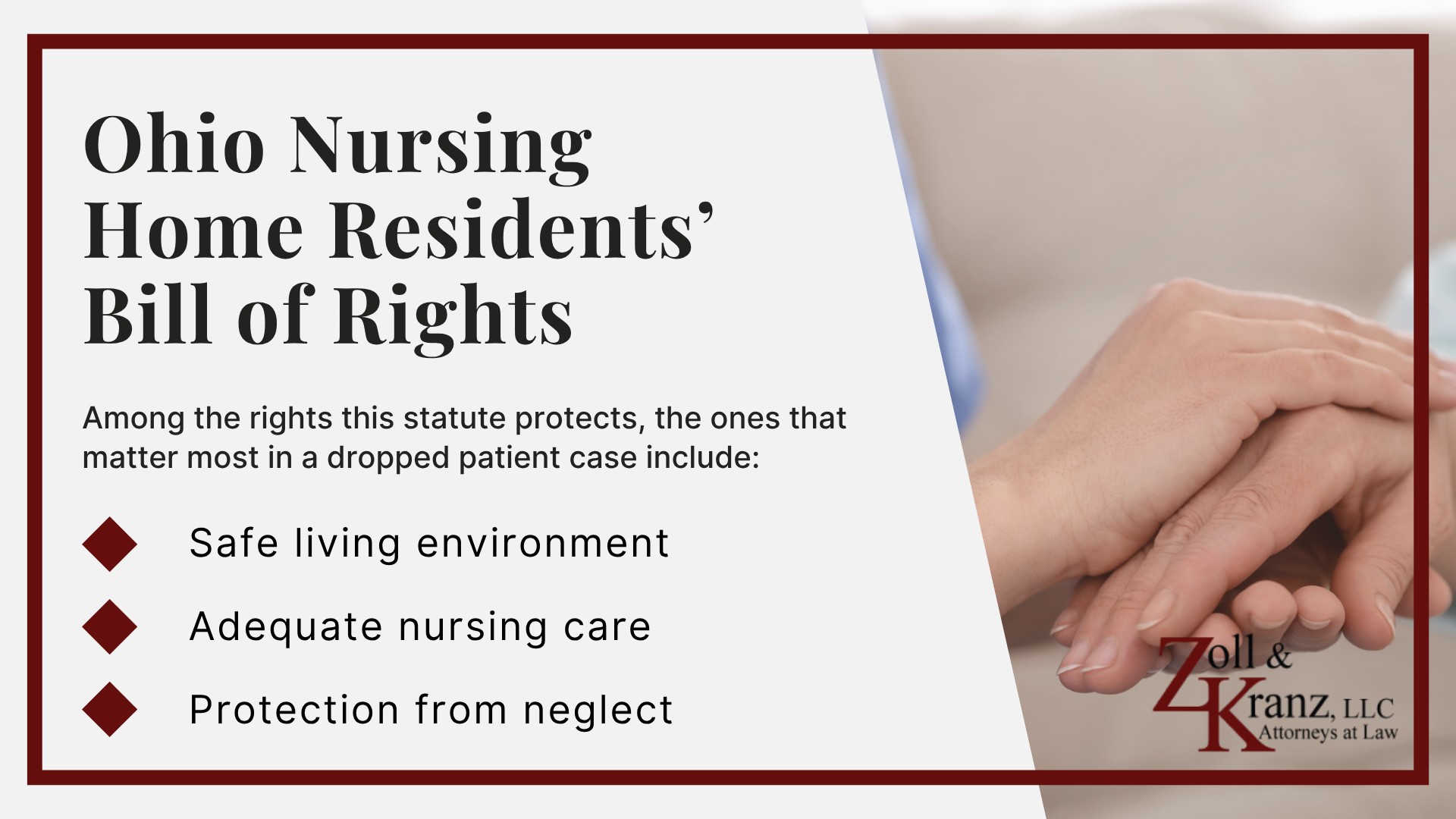
Among the rights this statute protects, the ones that matter most in a dropped patient case include:

  • Safe living environment: A resident has the right to live in a facility that addresses known fall hazards, poor lighting, unsafe bathrooms, broken equipment, and unsafe transfer areas.
  • Adequate nursing care: A resident who needs two-person assistance, a mechanical lift, or a gait belt should receive care that matches those documented needs.
  • Protection from neglect: Ignoring a fall risk assessment, rushing a transfer, or leaving a high-risk resident unsupervised may support a nursing home abuse or neglect claim.

Nursing homes are legally required to implement reasonable fall precautions to prevent falls, and failure to do so can be considered a form of negligence.

When nursing homes fail to meet safety standards and a resident falls as a result, they may be held liable for the injuries sustained, which can include medical costs and other damages.

Steps to Take After a Nursing Home Transfer Fall

After a nursing home transfer fall, the family should focus on the resident’s medical condition, the transfer facts, and the records that show whether staff followed the care plan.

The most useful early steps are the ones that preserve what happened before the facility’s account becomes the only version in the chart.

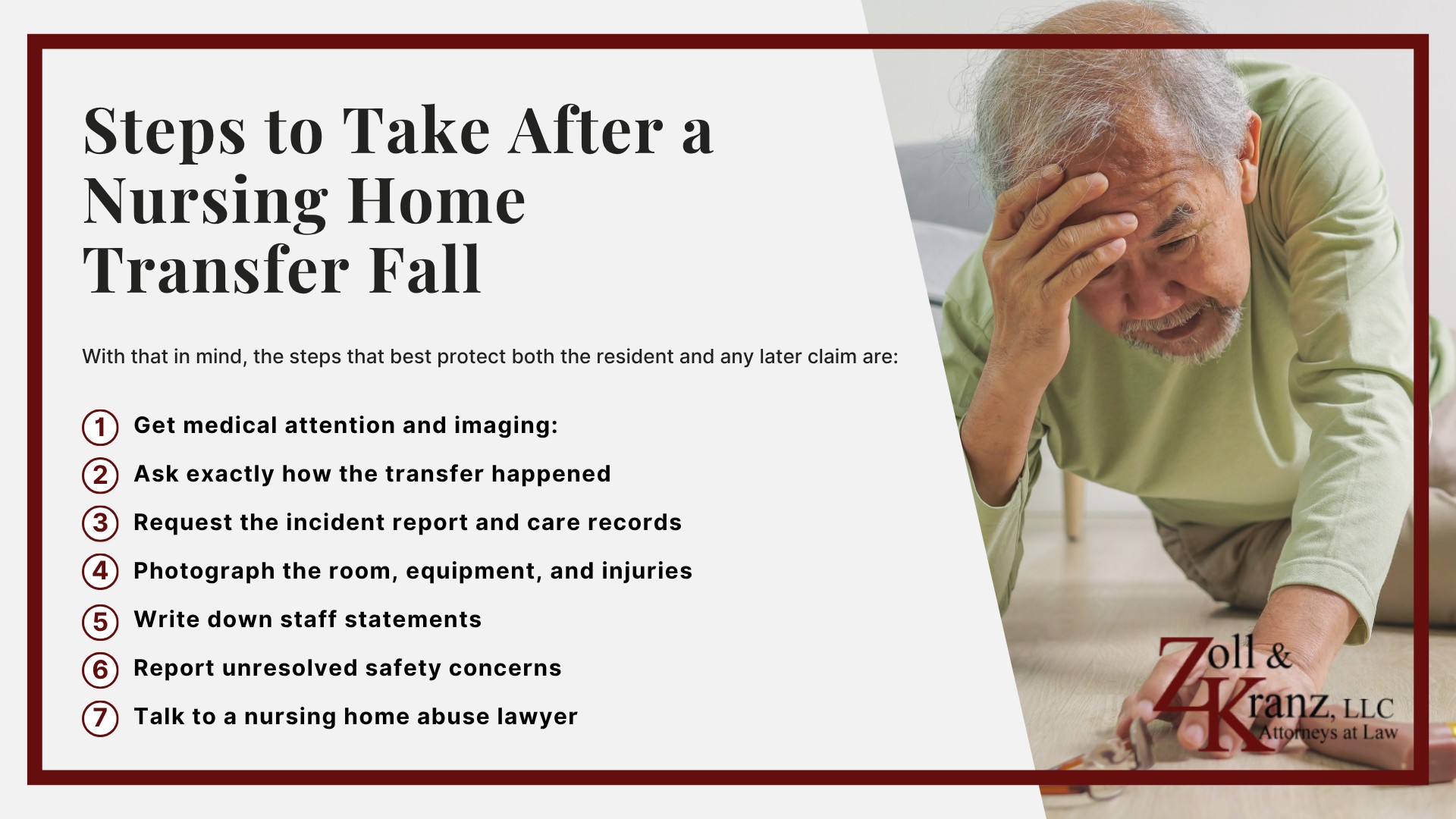
With that in mind, the steps that best protect both the resident and any later claim are:

  1. Get medical attention and imaging: Ask whether the resident was examined by a doctor, sent to the hospital, or checked with imaging after the fall. Head impact, hip pain, confusion, swelling, bruising, vomiting, or loss of mobility may signal a serious injury.
  2. Ask exactly how the transfer happened: Confirm where the resident was being moved, who performed the transfer, whether 2 staff members were required, and whether a Hoyer lift, gait belt, wheelchair lock, or shower chair was used.
  3. Request the incident report and care records: Ask for the incident report, fall risk assessment, care plan, transfer orders, nursing notes, medication records, staffing logs, and any internal investigation notes.
  4. Photograph the room, equipment, and injuries: Document the bed, wheelchair, bathroom, floor, lift, sling, call light location, lighting, visible injuries, and any missing or broken assistive devices.
  5. Write down staff statements: Record what each staff member said, when the family was notified, whether the explanation changed, and whether the injury pattern matches the facility’s account.
  6. Report unresolved safety concerns: If the resident remains at risk or the facility refuses to explain the fall, contact the Ohio Department of Health or the Long-Term Care Ombudsman.
  7. Talk to a nursing home abuse lawyer: Legal review is important when the facility’s explanation does not match the care plan, the incident report, the medical records, or the injuries. A lawyer can determine whether the transfer fall may support a nursing home negligence claim.

Proving Nursing Home Negligence in a Dropped Patient Case

A preventable fall occurs when the facility knows the resident is high risk but still fails to follow the care plan, provide trained staff, or use safe equipment.

A dropped patient claim usually turns on whether the records show a foreseeable transfer risk, a broken safety rule, and an injury that followed from that failure.

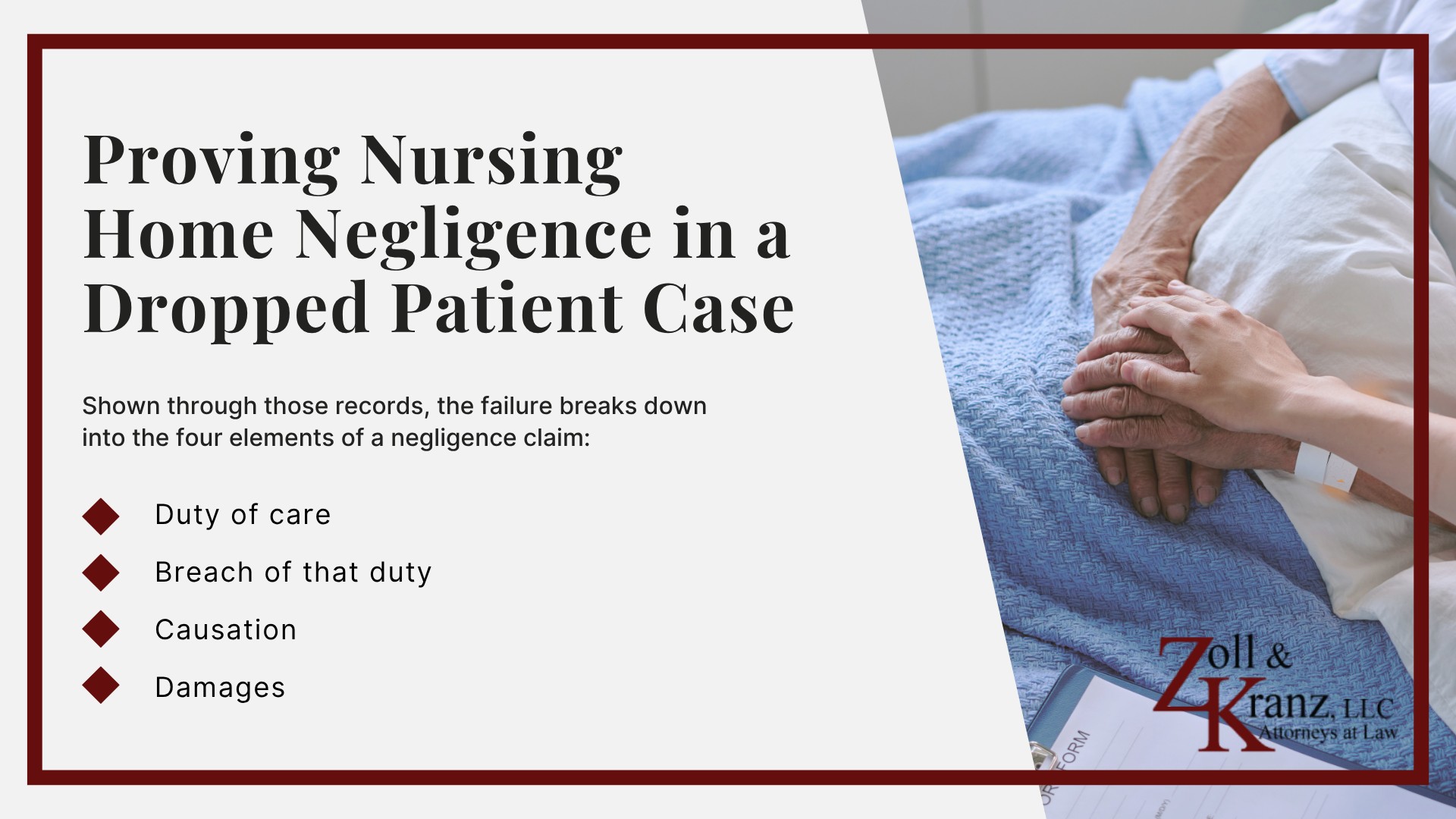
Shown through those records, the failure breaks down into the four elements of a negligence claim:

  • Duty: The nursing home owed the resident safe care based on the admission relationship, fall risk assessment, care plan, Ohio resident rights law, and federal nursing home regulations.
  • Breach: Breach may involve a one-person transfer despite a two-person order, failure to use a mechanical lift, unsafe equipment, ignored bed alarms, poor supervision, or failure to update fall prevention measures after prior falls.
  • Causation: Causation connects the facility failure to the resident falls and resulting injuries. The legal question is whether the fall likely would have been avoided if the nursing home followed the care plan and safety measures.
  • Damages: Damages may include hospitalization, surgery, rehabilitation costs, chronic pain, loss of mobility, emotional harm, relocation to another healthcare facility, and wrongful death damages in fatal cases.

When residents experience drops, it is classified as a sign of neglect, significantly impacting both legal standing and the facility’s reputation.

Families can file a lawsuit against a nursing home if negligence contributed to a fall, allowing them to seek compensation for medical expenses and other costs.

Evidence Needed to Prove a Dropped Patient Claim

A dropped patient claim starts with collecting evidence that connects the resident’s known fall risk to the transfer failure and the injuries that followed.

The strongest claims usually compare the written care plan against what staff actually did during the transfer.

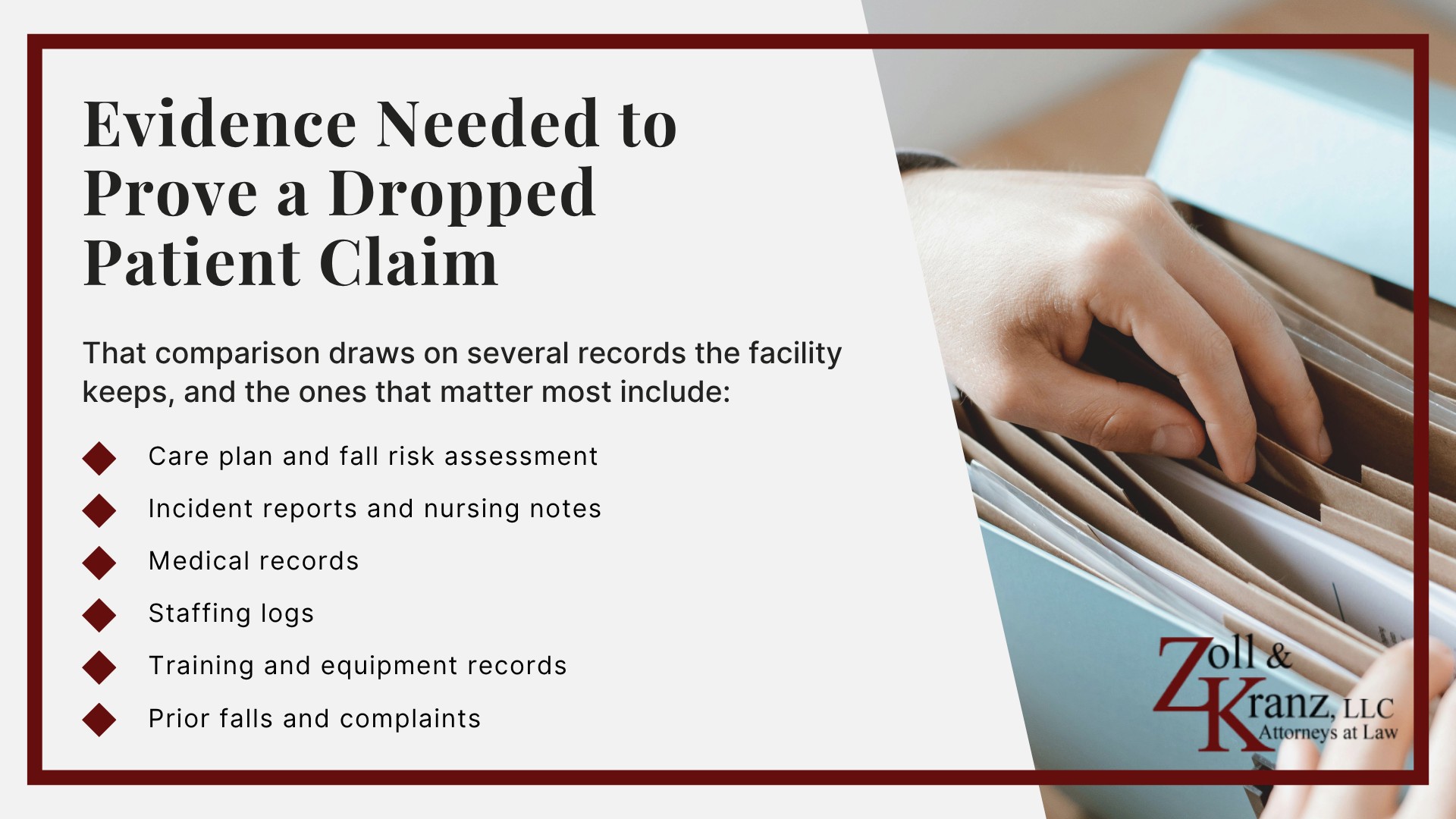
That comparison draws on several records the facility keeps, and the ones that matter most include:

  • Care plan and fall risk assessment: These records show whether the resident required a two-person transfer, mechanical lift, gait belt, bed alarm, toileting schedule, or other fall prevention measures.
  • Incident reports and nursing notes: These records show how the facility described the fall, who was present, when the report was written, and whether the account matches the injuries.
  • Medical records: Hospital records, imaging, surgical notes, rehabilitation records, and discharge instructions connect the fall to head injuries, broken bones, internal injuries, and other harm.
  • Staffing logs: Staffing records show whether enough nurses and certified nursing assistants were on duty when the fall occurred.
  • Training and equipment records: These files show whether staff were trained to use Hoyer lifts, gait belts, transfer boards, bedside commodes, bed alarms, and other assistive devices.
  • Prior falls and complaints: Prior falls, survey citations, family complaints, and health department findings may show that the facility knew about the danger before the loved one’s fall.

How Inspection Reports and Prior Citations Can Support a Claim

Nursing home inspection reports can provide important context in a dropped patient case, particularly when a facility has a documented history of transfer-related safety violations.

Ohio nursing homes are subject to inspections, complaint investigations, and surveys that evaluate whether residents are receiving adequate care and protection from avoidable accidents.

When inspectors identify deficiencies involving staffing, supervision, transfer procedures, fall prevention, or equipment maintenance, those findings may help explain how a resident was injured.

While a citation does not automatically establish liability, it may provide evidence that the facility was aware of safety concerns before the incident occurred.

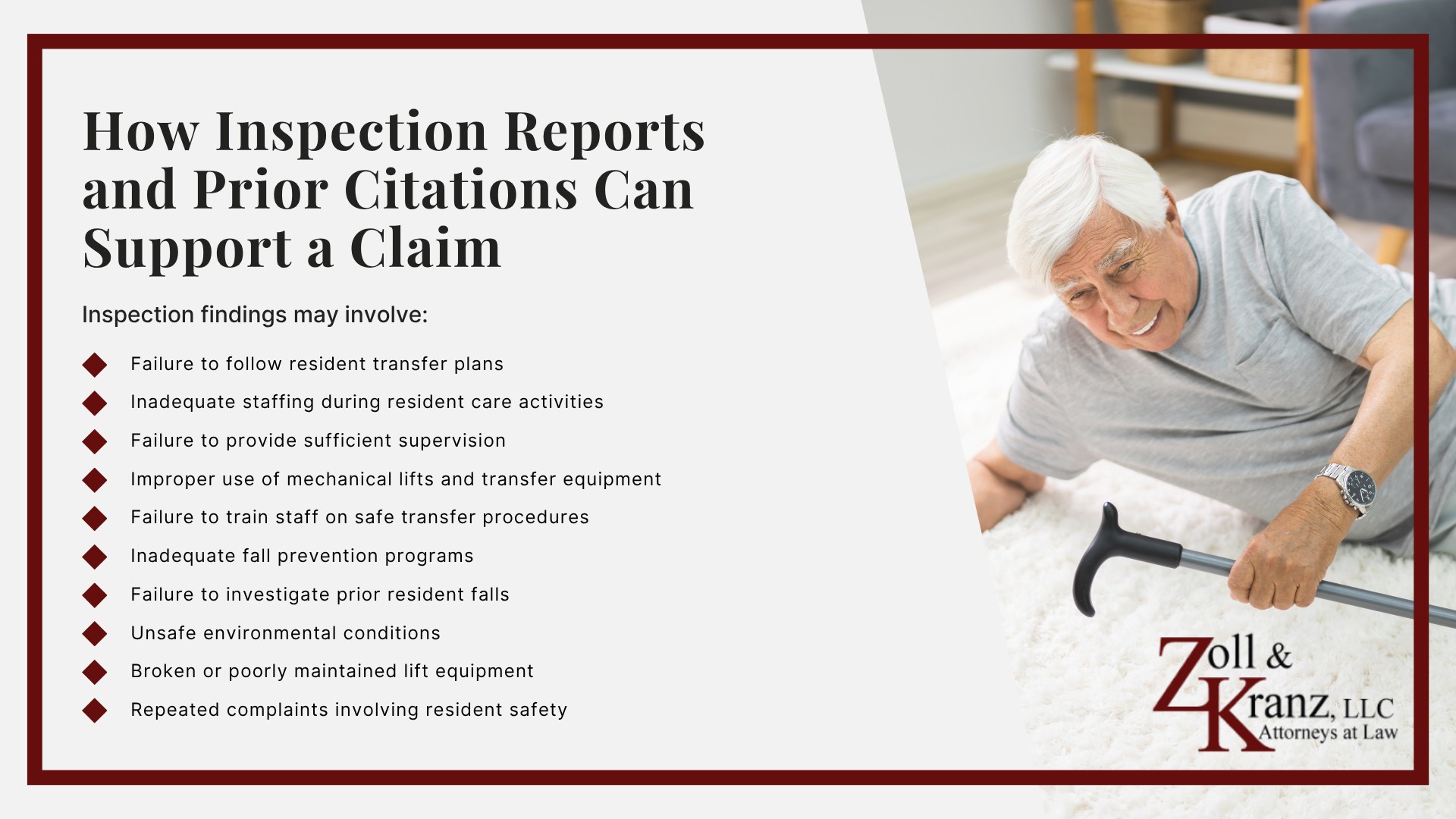
Inspection findings may involve:

  • Failure to follow resident transfer plans
  • Inadequate staffing during resident care activities
  • Failure to provide sufficient supervision
  • Improper use of mechanical lifts and transfer equipment
  • Failure to train staff on safe transfer procedures
  • Inadequate fall prevention programs
  • Failure to investigate prior resident falls
  • Unsafe environmental conditions
  • Broken or poorly maintained lift equipment
  • Repeated complaints involving resident safety

In some cases, inspection records reveal that similar problems existed long before a resident was dropped during a transfer.

Prior citations involving transfer safety, staffing shortages, equipment failures, or fall prevention may help demonstrate that the facility had notice of a recurring problem but failed to correct it.

An attorney can review Ohio Department of Health inspection reports, complaint investigations, survey findings, and facility records to determine whether prior deficiencies are relevant to the nursing home negligence claim.

Compensation and Damages in Nursing Home Fall Cases

Damages in a nursing home fall case depend on the injury, the treatment required, and whether the records show the fall should have been prevented.

The strongest damages proof usually comes from hospital records, imaging, surgery notes, rehabilitation plans, and documentation showing how the resident’s mobility changed after the fall.

Compensation from nursing home lawsuits can help cover medical costs, rehabilitation, and even relocation to a safer facility if necessary.

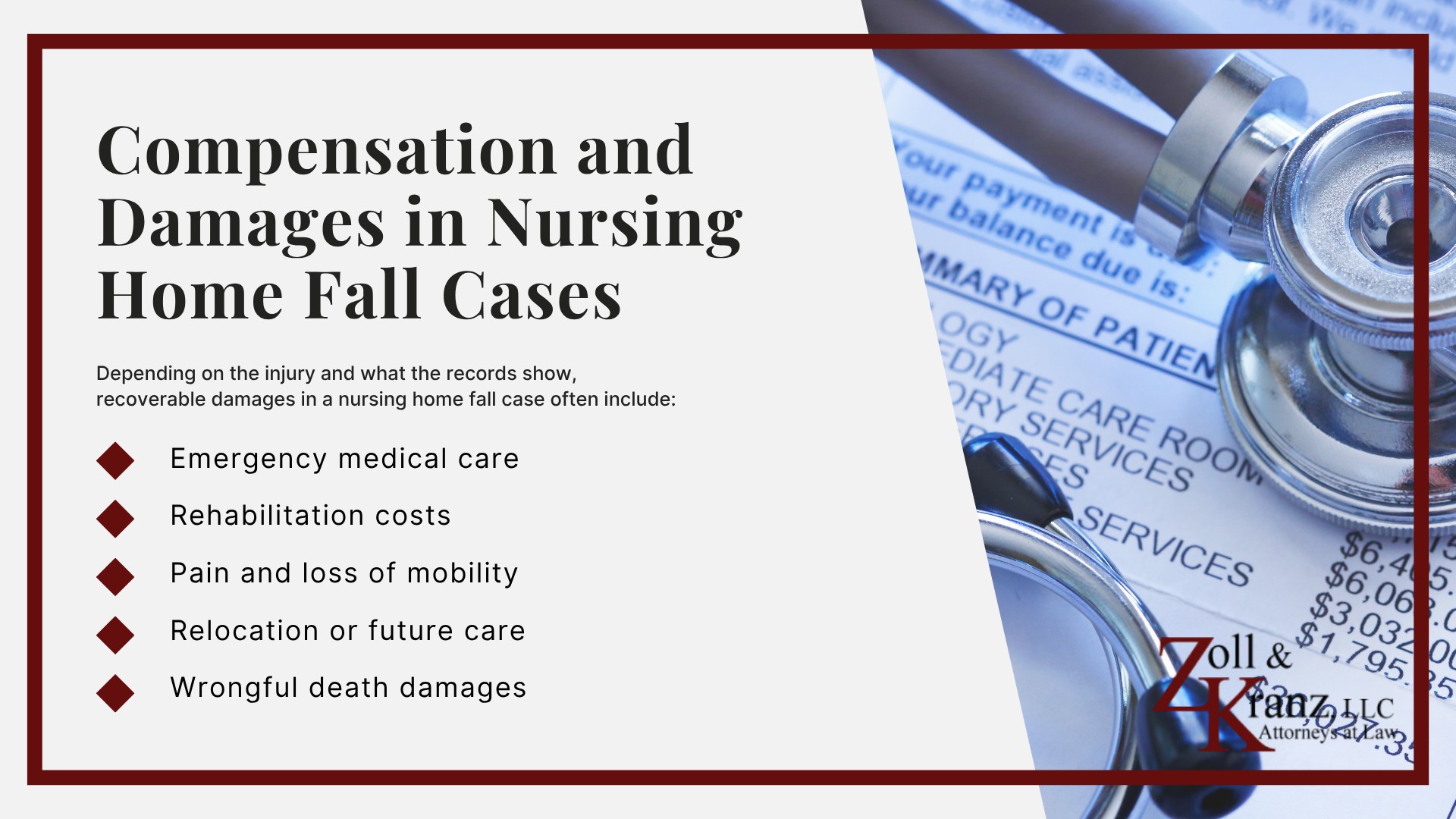
Depending on the injury and what the records show, recoverable damages in a nursing home fall case often include:

  • Emergency medical care: Ambulance transport, emergency room treatment, diagnostic imaging, hospital admission, surgery, and specialist follow-up may be part of the claim.
  • Rehabilitation costs: Physical therapy, occupational therapy, skilled nursing care, mobility support, and assistive devices may be recoverable when the fall changes the resident’s function.
  • Pain and loss of mobility: Damages may account for chronic pain, reduced independence, fear of future falls, and limits on basic daily movement.
  • Relocation or future care: A serious fall may require transfer to another healthcare facility or living facility when the original nursing home cannot safely care for the resident.
  • Wrongful death damages: If a loved one dies due to a fall in a nursing home, families may be able to file a wrongful death lawsuit against the facility for negligence.

Case value depends on the severity of injuries, prior falls, staffing records, facility history, ignored safety measures, and whether the records support holding the nursing home liable and the facility accountable for what it may have to pay.

Contact Zoll & Kranz About Your Toledo Nursing Home Drop Case

The Zoll & Kranz office reviews Toledo nursing home fall cases involving dropped patients, unsafe transfers, ignored care plans, broken lift equipment, poor supervision, head injuries, fractures, and fatal falls.

The legal team reviews care plans, incident reports, medical records, staffing history, equipment issues, and prior facility citations to determine whether nursing home negligence caused the harm.

For background on how a dropped patient case fits the broader claims process, the firm publishes a Toledo personal injury lawsuit guide.

If your loved one was dropped in a nursing home or other healthcare facility in Toledo, contact Zoll & Kranz for a free, no obligation case review.

You can also use the chat feature on this page to review your legal options and find out whether your nursing home fall claim qualifies.

Frequently Asked Questions

Published by:
Share
Picture of Michelle L. Kranz
Michelle L. Kranz

Michelle is a founding partner of Zoll & Kranz, located in Toledo, Ohio. Michelle has been a plaintiff’s lawyer for the entirety of her practice – over 32 years. She devotes the majority of her time to complex consolidated litigation and class action including advocating for people injured by medical devices, prescription medications, or corporate negligence.

This article has been written and reviewed for legal accuracy and clarity by the team of writers and attorneys at Zoll & Kranz, LLC and is as accurate as possible. This content should not be taken as legal advice from an attorney. If you would like to learn more about our owner and experienced Ohio injury lawyer, Michelle L. Kranz, you can do so here.

Zoll & Kranz, LLC does everything possible to make sure the information in this article is up to date and accurate. If you need specific legal advice about your case, contact us. This article should not be taken as advice from an attorney.

Other cases we handle in Toledo
All
Auto Accidents
Injury Types
Medical Malpractice
Nursing Home Abuse
Other Accidents & Injuries
You can learn more about other Toledo cases we handle below:
Auto Accident Lawsuit Timeline in Toledo
Auto Accident Statute of Limitations in Toledo, OH
Bedsores in Toledo Nursing Homes
Collecting Evidence in Toledo Medical Malpractice Cases
Collecting Evidence in Toledo Nursing Home Negligence Cases
Common Car Accident Injuries in Toledo, OH
Common Causes of Nursing Home Negligence in Toledo
Common Types of Car Accident Damages
Dehydration and Malnutrition in Nursing Homes
Distracted Driving Accidents in Toledo, OH
DUI Accidents in Toledo
Duty of Care Owed by Nursing Home Facilities in Ohio
Evidence in Toledo Auto Accident Cases
Failure to Perform Procedure Malpractice Lawyer in Toledo
Falls in Toledo Nursing Homes
Head-On Collisions in Toledo
Hit-and-Run Accidents in Toledo
How is Fault Determined in a Car Accident?
How To File a Car Crash Lawsuit in Toledo
How to Report Nursing Home Abuse in Toledo, Ohio
Inattentive Nursing Home Staff: Steps to Take
Infections in Toledo Nursing Homes
Initial Steps To Take in a Toledo Medical Malpractice Case
Interstate Accidents in Toledo
Liability in Toledo Medical Malpractice Claims
Liability in Toledo Nursing Home Negligence Cases
Medication Errors in Toledo Nursing Homes
Mental and Emotional Abuse in Nursing Homes
Neglect in Toledo Nursing Homes
Negligence in Toledo Medical Malpractice Cases
Negligent Hiring or Training in Toledo Nursing Homes
Nursing Home Negligence Wrongful Death Cases in Toledo
Paralysis in Auto Accidents
Patient Rights in Toledo Nursing Homes
Personal Injury Lawyer Toledo, Ohio
Physical Abuse in Toledo Nursing Homes
Process of a Medical Malpractice Case in Toledo
Rear-End Collisions in Toledo, OH
Rental Car Accidents in Toledo
Rollover Accidents in Toledo
Securing a Police Report in Toledo After an Auto Accident
Sexual Abuse in Toledo Nursing Homes
Sideswipe Accidents in Toledo
Toledo Anesthesia Errors Lawyer
Toledo Auto Accident Comparative Negligence Explained
Toledo Auto Accident Lawyer
Toledo Bicycle Accident Lawyer
Toledo Burn Injury Lawyer
Toledo Bus Accident Lawyer
Toledo Cancer Misdiagnosis Lawyer
Toledo Car Accident Lawyer
Toledo Catastrophic Injury Lawyer
Toledo Daycare Injury Lawyer
Toledo Delayed Diagnosis Lawyer
Toledo Emergency Room Error Lawyer
Toledo Failure To Diagnose Lawyer
Toledo Insurance Claim Lawyer
Toledo Mass Torts Lawyer
Toledo Medical Malpractice Lawyer
Toledo Medication Error Lawyer
Toledo Misdiagnosis Medical Malpractice Lawyer
Toledo Motorcycle Accident Lawyer
Toledo Nurse Error Lawyer
Toledo Nursing Home Abuse Lawyer
Toledo Nursing Home Negligence Safety and Preventative Measures
Toledo Pedestrian Accident Lawyer
Toledo Spinal Cord Injury Lawyer
Toledo Surgical Error Lawyer
Toledo Toxic Exposure Lawyer
Toledo Traumatic Brain Injury Lawyer
Toledo Truck Accident Lawyer
Toledo Wrongful Death Lawyer
Wrong Site Surgery Malpractice in Toledo
Were you or a loved one injured in Toledo?

A serious injury can have life-altering results.

Don’t settle for less than you deserve, speak with an award-winning personal injury lawyer today.

18 Reviews
5.0
★★★★★
Recovered damages
$108 Million+

Table of Contents

Practice Areas
About Zoll & Kranz, LLC

For over 37 years, Zoll & Kranz has been fighting for clients who have been the victims of the wrongful death of a loved one.

Do you believe you’re entitled to compensation?

Use our Instant Case Evaluator to find out in as little as 60 seconds!

Guides & Resources

Other Toledo Personal Injury Cases

All
Auto Accidents
Injury Types
Medical Malpractice
Nursing Home Abuse
Other Accidents & Injuries
Local Toledo Resources
Education
Emergency Services
Courthouses
Department of Motor Vehicles
Sights to See