No fees unless we win.
Get a free consultation
8 Reviews
5.0
★★★★★

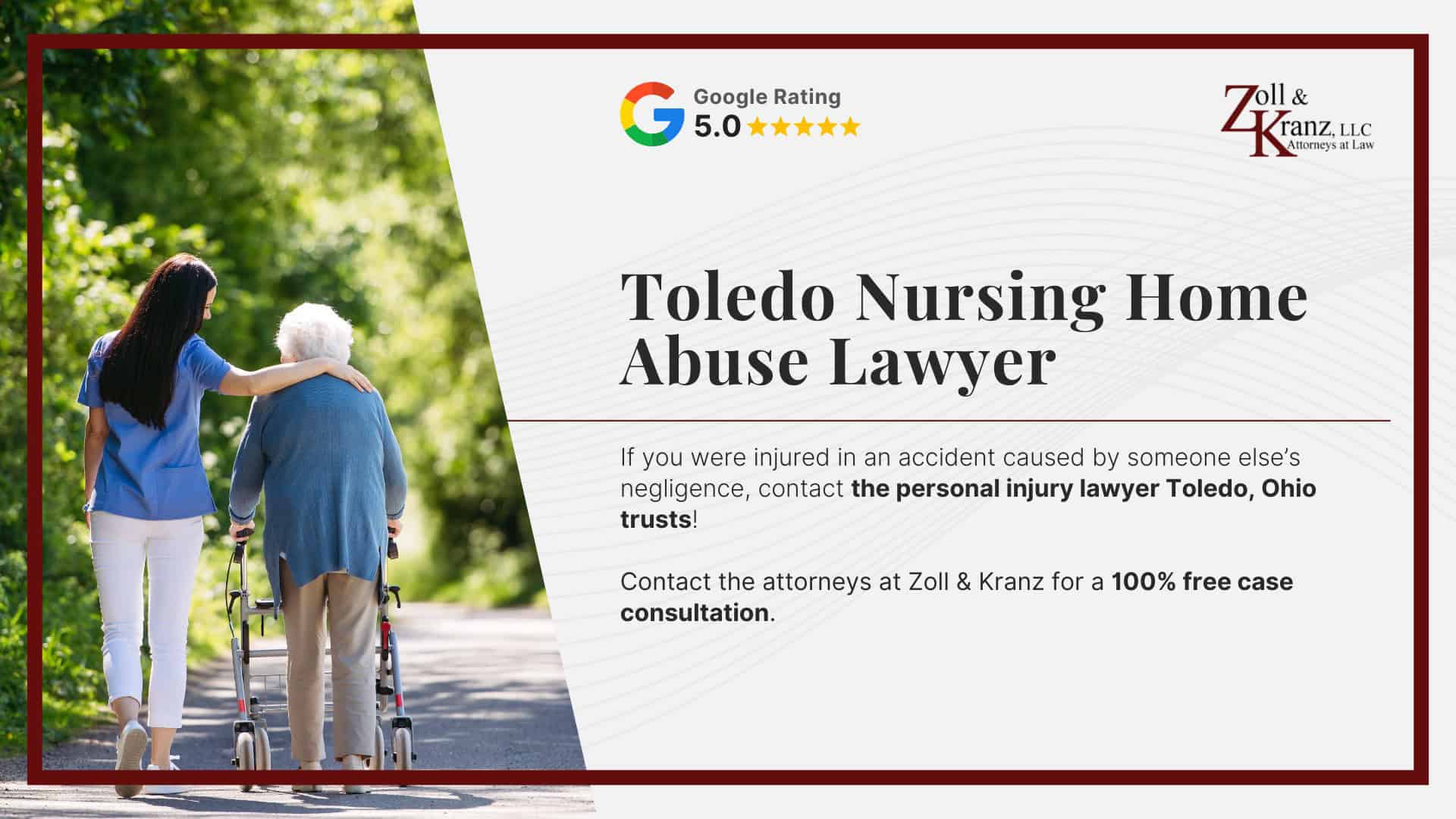
Toledo Nursing Home Abuse Lawyer

Need Help From a Toledo Nursing Home Abuse Lawyer? Contact Zoll & Kranz

A Toledo nursing home abuse lawyer from Zoll & Kranz helps families respond when a nursing facility fails to protect a resident from abuse, neglect, or unsafe care.

These cases often involve preventable harm tied to missed care, poor supervision, medication mistakes, or staffing decisions that leave residents exposed.

We move quickly to document what happened, request key records, and evaluate whether Ohio law supports a claim for the injuries or losses involved.

To speak with an experienced and compassionate Toledo nursing home abuse lawyer, contact Zoll & Kranz.

Toledo Nursing Home Abuse Lawyer

Our Law Firm Helps Families Respond to Abuse, Neglect, And Unsafe Nursing Home Care

When nursing home neglect causes a serious injury, families often find themselves dealing with shifting explanations, missing details, and a facility that controls the records.

Our law firm handles nursing home abuse lawsuits involving elderly residents in Toledo and across Northwest Ohio, including cases tied to unsafe supervision, missed care, medication mistakes, and preventable medical decline.

Some claims involve nursing homes, and others involve an assisted living facility where staffing and oversight break down in different ways.

We focus on what the documentation shows, including care plans, incident reports, charting, and the timeline of how the resident’s condition changed.

These cases are rarely about one isolated mistake, they often involve patterns that families could not see until harm occurred.

Our goal is to hold negligent facilities accountable through a claim built around objective proof and clear medical causation.

When the harm is fatal, we can evaluate whether the facts support a wrongful death claim under Ohio law and what that process requires.

We pursue damages intended to secure financial compensation for medical costs, increased care needs, and the pain and loss the resident experienced.

If your loved one suffered abuse, neglect, or other forms of harm resulting in injuries or death, you may be eligible to file a nursing home abuse claim and seek financial compensation.

Contact Zoll & Kranz today for a free consultation.

You can also use the chat feature on this page to find out if you qualify for a nursing home abuse case.

What Counts as Nursing Home Abuse And Neglect In Ohio

In Ohio, nursing home abuse and neglect can involve intentional misconduct, careless care, or systemic breakdowns that place residents at risk.

Elder abuse can include direct physical harm, but it also covers situations where a nursing home fails to provide basic medical care, supervision, or timely escalation when a resident’s condition changes.

Abuse or neglect may be obvious, such as bruises or an unsafe restraint, or it may appear as a slow decline tied to missed medications, untreated infections, or dehydration.

Psychological abuse often shows up through intimidation, isolation, humiliation, or threats that leave a resident fearful and withdrawn.

The common thread is that the resident’s safety and dignity are compromised because the facility did not act with the level of care the situation required.
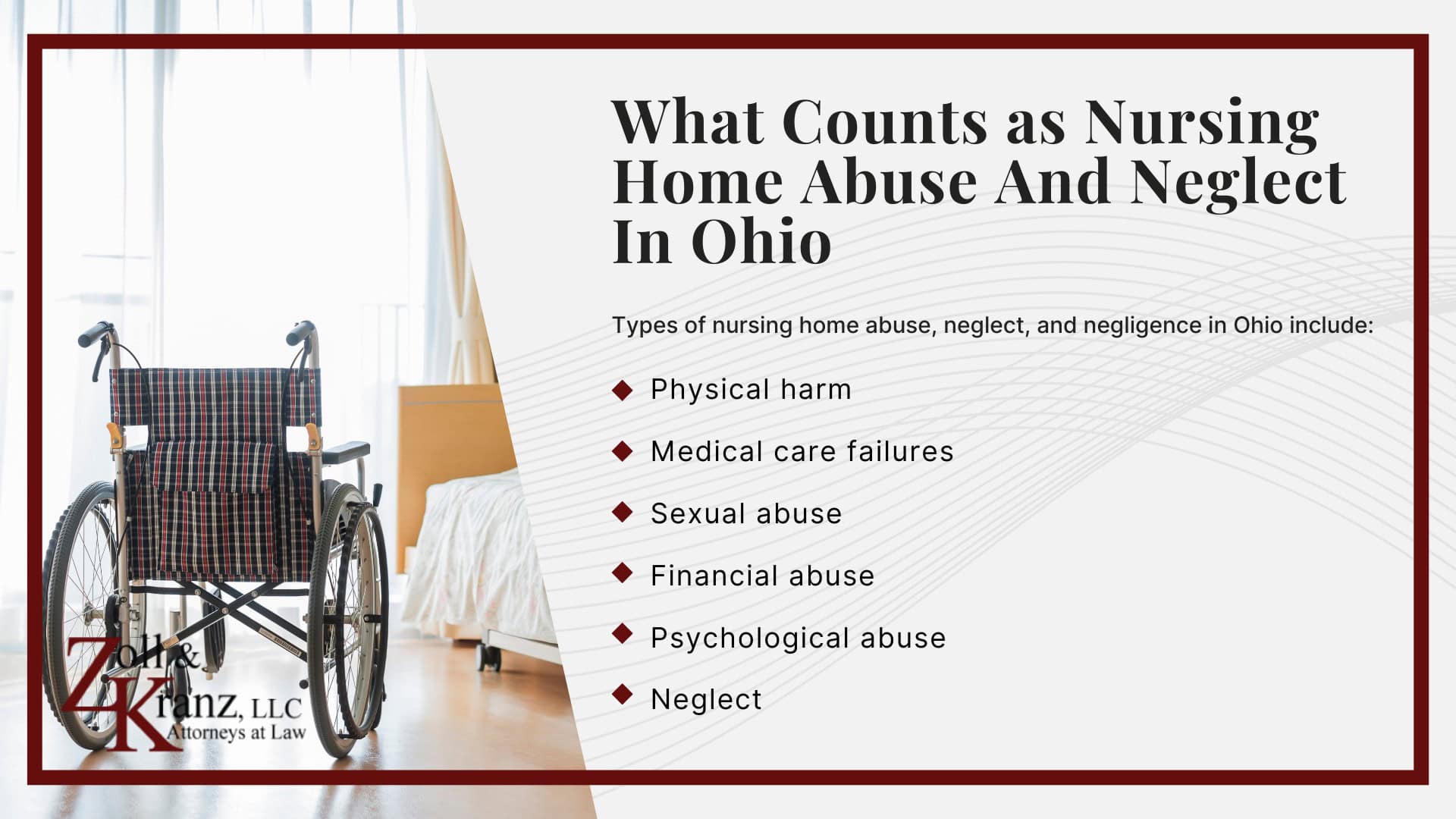
Types of nursing home abuse, neglect, and negligence in Ohio include:

  • Physical harm, including hitting, rough handling, improper restraints, or preventable falls tied to poor supervision
  • Medical care failures, including missed medications, delayed treatment, ignored care plans, or failure to respond to signs of infection or decline
  • Sexual abuse, including any unwanted sexual contact, exploitation, or assault in a facility setting
  • Financial abuse, including theft, coerced signatures, unauthorized charges, or suspicious account activity involving staff or other residents
  • Psychological abuse, including threats, verbal degradation, isolation, or retaliation that affects a resident’s mental health and behavior
  • Neglect, including unsafe living conditions, hygiene failures, missed meals, dehydration, and delayed toileting assistance

Many cases involve severe health issues because residents are medically vulnerable and cannot protect themselves or clearly report what happened.

That vulnerability increases the facility’s responsibility to supervise, document, and respond to changes in condition.

When the nursing home fails to follow a care plan or ignores warning signs, the results can compound quickly.

Families often learn about the scope of the problem only after an emergency hospitalization, rapid decline, or repeated injuries.

Our job is to identify what happened, when it happened, and whether the facility’s actions or omissions meet the definition of abuse or neglect under Ohio law.

A claim becomes stronger when we can tie the harm to specific failures in supervision, documentation, staffing, and response.

Contact us if you believe your family member was harmed by nursing home abuse or neglect.

Abuse, Neglect, And Exploitation Often Overlap In These Cases

Abuse, neglect, and exploitation often show up together because the same breakdowns that allow mistreatment also allow unsafe care and financial wrongdoing.

In a nursing home lawsuit, we often see a pattern where a resident’s physical decline, emotional distress, and missing property all point back to the same lack of supervision and accountability.

Many nursing home residents who experience abuse are also dealing with untreated medical problems, missed care routines, or preventable complications that were allowed to progress.

Exploitation can happen quietly while staff cut corners on basic needs, especially when a resident is isolated or has limited ability to communicate.

Families may first notice one issue, like bruising or a sudden change in behavior, then uncover a broader problem once records and timelines are reviewed.

That overlap is why these cases require a full look at care practices, reporting, documentation, and the facility’s internal controls, not just one incident.

Nursing Home Negligence Can Include System Failures, Not Just One Staff Member’s Conduct

Nursing home negligence often stems from systemic problems rather than a single careless act by one employee.

In a nursing home setting, understaffing, poor training, and weak oversight can create conditions where harm becomes predictable.

Residents may suffer not because one person made a mistake, but because the facility failed to build safeguards into daily care.

These system failures tend to repeat until a serious injury or crisis forces attention.
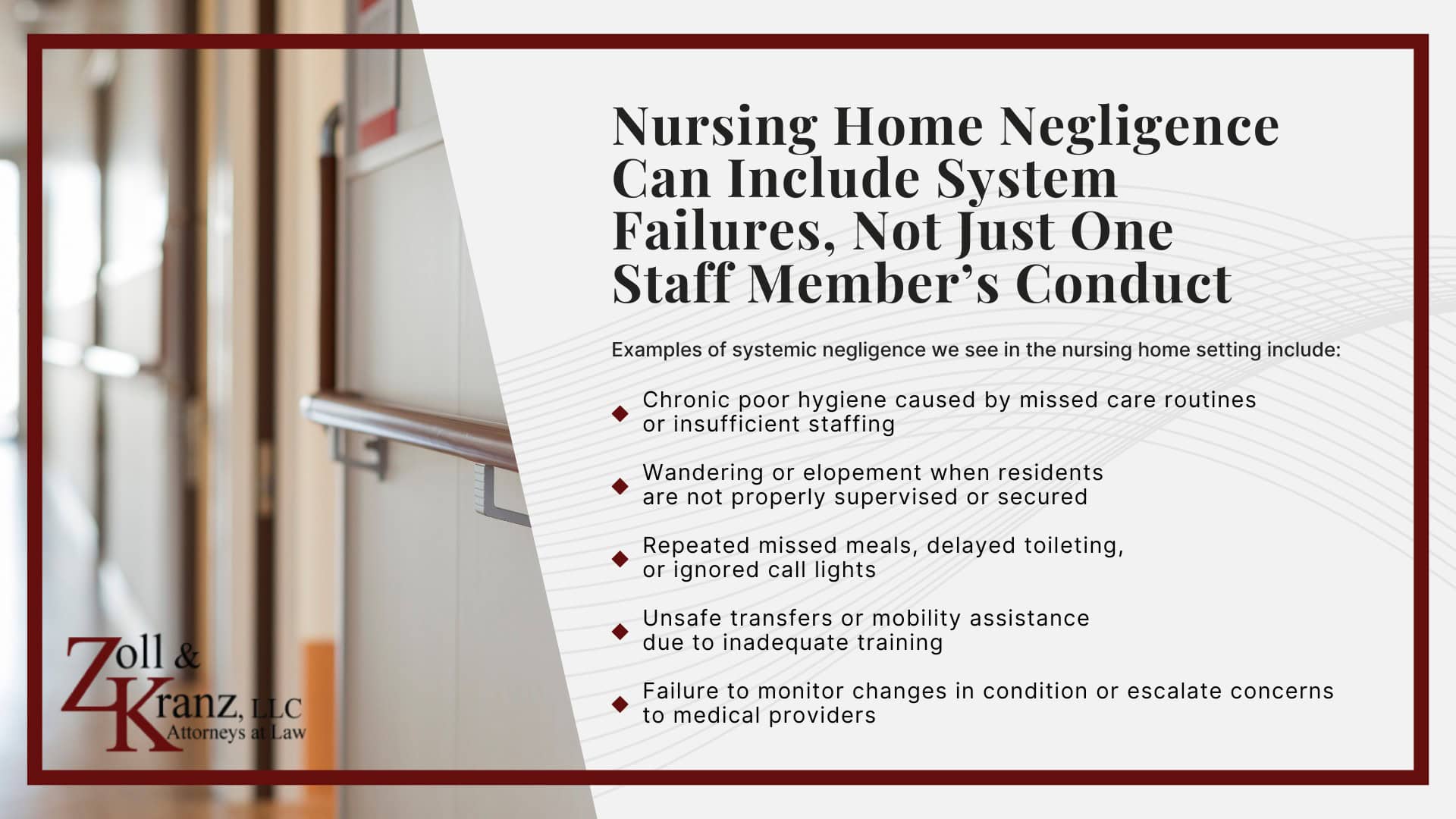
Examples of systemic negligence we see in the nursing home setting include:

  • Chronic poor hygiene caused by missed care routines or insufficient staffing
  • Wandering or elopement when residents are not properly supervised or secured
  • Repeated missed meals, delayed toileting, or ignored call lights
  • Unsafe transfers or mobility assistance due to inadequate training
  • Failure to monitor changes in condition or escalate concerns to medical providers
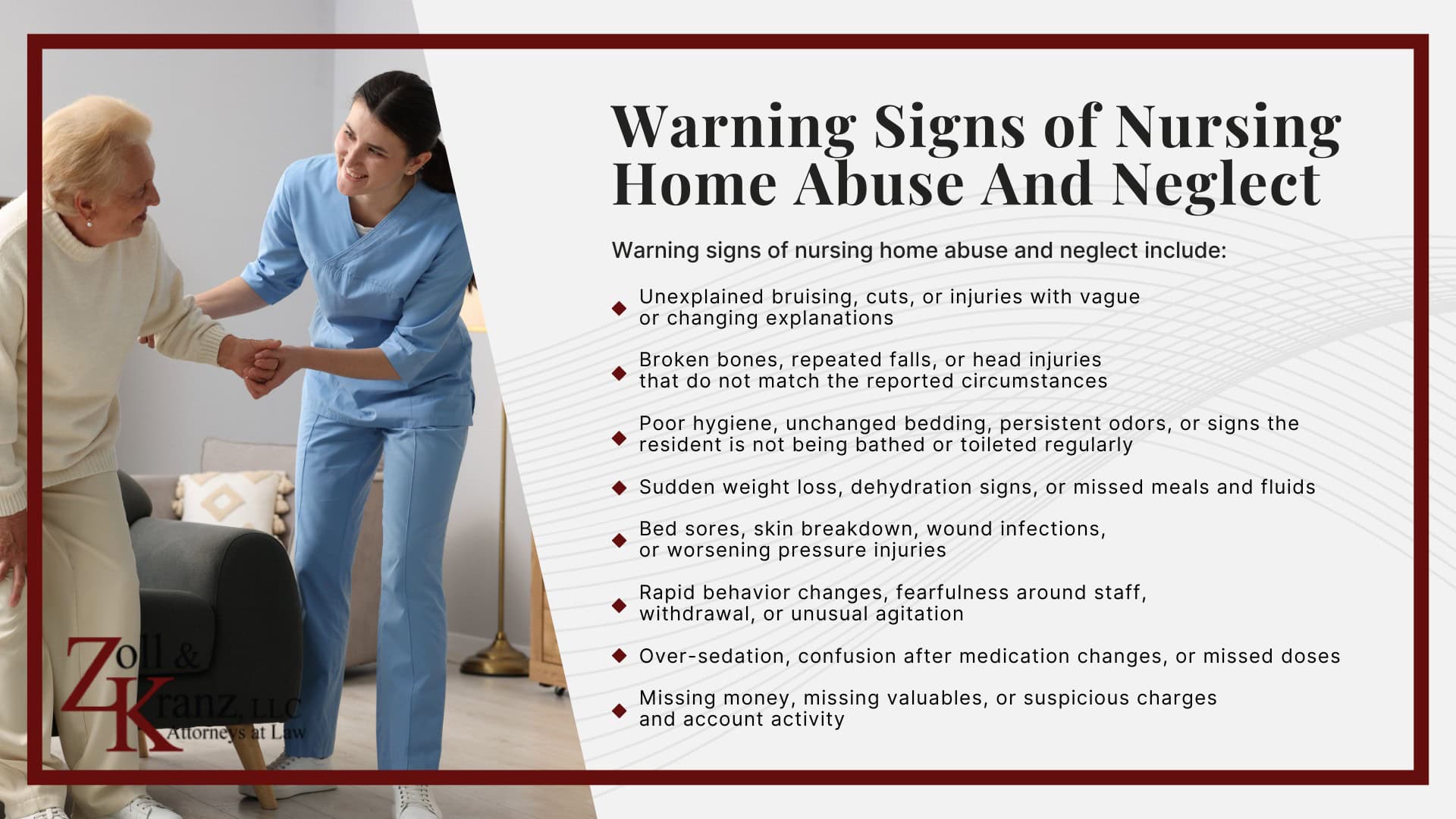
Warning Signs of Nursing Home Abuse And Neglect

Families usually do not walk into a facility expecting to look for signs of harm.

Many people realize something is wrong only after a loved one’s behavior changes, injuries appear without a clear explanation, or a hospital visit exposes deeper problems.

In long-term care facilities, the resident often cannot fully describe what happened, especially when dementia, sedation, or fear is involved.

Families may hear conflicting accounts from staff members, or be told the injury was “just a fall” without details about supervision, call light response, or prior incidents.

Nursing home patients can deteriorate quickly when basic care slips, and that decline can be mistaken for normal aging until the pattern becomes impossible to ignore.

Poor hygiene and unsafe living conditions are not small issues, they can signal that routine care is being missed across shifts.

Negligent nursing homes may also document events in a way that minimizes responsibility, leaving families with more questions than answers.

If you suspect abuse, the earlier you document what you are seeing and request explanations in writing, the harder it becomes for the facility to rewrite the timeline later.

Warning signs of nursing home abuse and neglect include:

  • Unexplained bruising, cuts, or injuries with vague or changing explanations
  • Broken bones, repeated falls, or head injuries that do not match the reported circumstances
  • Poor hygiene, unchanged bedding, persistent odors, or signs the resident is not being bathed or toileted regularly
  • Sudden weight loss, dehydration signs, or missed meals and fluids
  • Bed sores, skin breakdown, wound infections, or worsening pressure injuries
  • Rapid behavior changes, fearfulness around staff, withdrawal, or unusual agitation
  • Over-sedation, confusion after medication changes, or missed doses
  • Missing money, missing valuables, or suspicious charges and account activity

When warning signs appear, families should treat them as a safety issue, not a customer service issue.

We can help evaluate whether the facts point to neglect, abuse, or a broader pattern inside the facility.

The goal is to secure the records and clarity needed to take action against negligent nursing homes.

Types of Nursing Home Abuse Cases We Handle

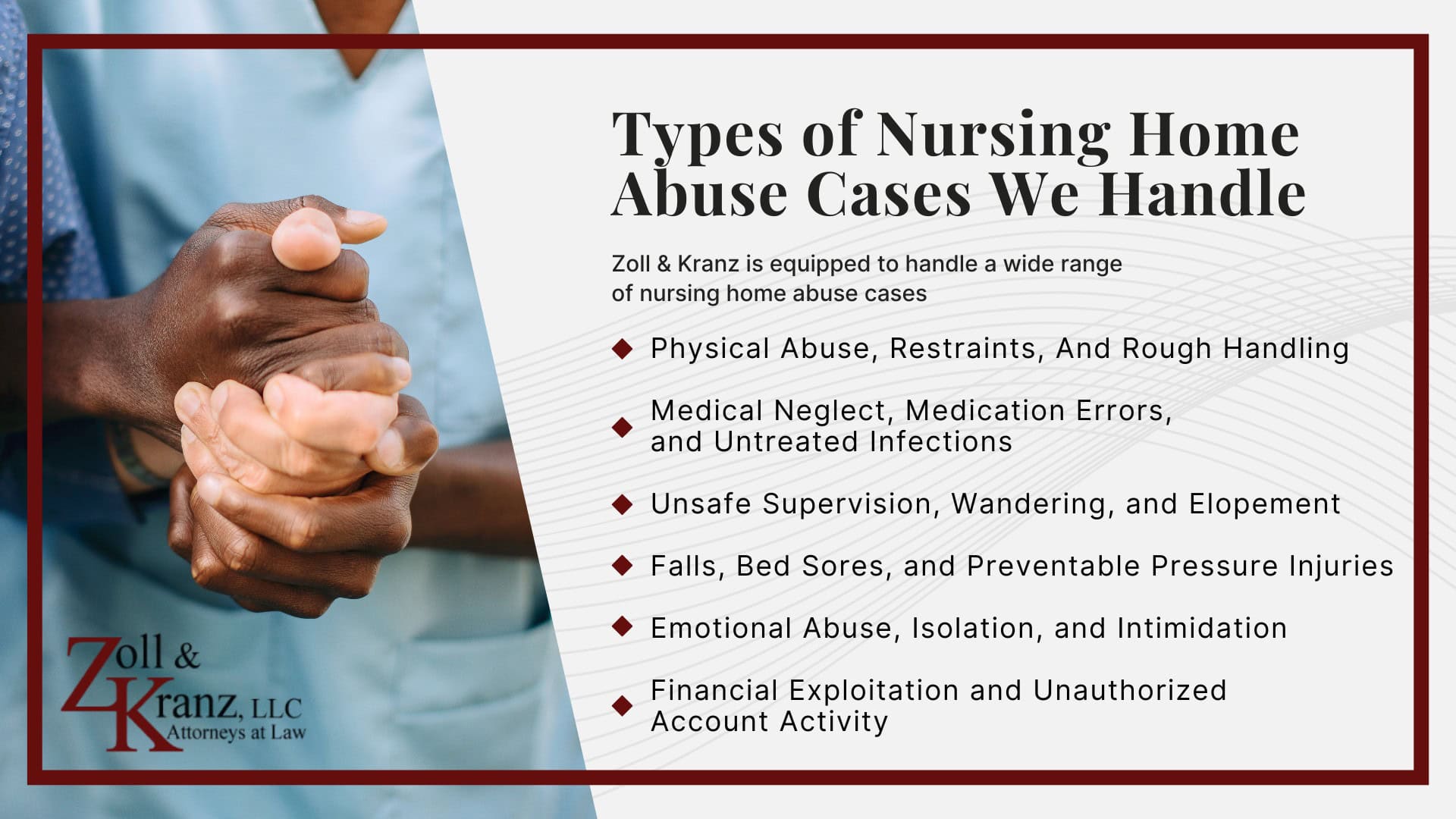
Zoll & Kranz is equipped to handle a wide range of nursing home abuse cases, from preventable falls and medication errors to physical abuse, financial abuse, and neglect that leads to rapid medical decline.

Michelle L. Kranz has spent more than 30 years as a plaintiff’s lawyer, with substantial experience in complex litigation involving serious harm and corporate negligence, which translates well to contested long-term care cases built on records and proof.

Damon Williams focuses on litigation and is involved in complex and personal injury matters at Zoll & Kranz, bringing additional courtroom-focused support to cases that require structured investigation and follow-through.

When a facility’s failures contribute to a fatal outcome, our attorneys can evaluate whether the facts support a wrongful death claim and pursue accountability through the civil process.

Physical Abuse, Restraints, And Rough Handling

Physical abuse in a nursing home setting often involves direct force or unsafe handling that causes unnecessary pain or injury.

Improper restraints and rough transfers can leave residents bruised, fractured, or fearful of routine care.

These incidents frequently occur when staff are rushed, inadequately trained, or working without proper supervision.

Even a single episode can signal deeper problems in how residents are handled day to day.

Examples include:

  • Hitting, slapping, pushing, or forceful physical contact
  • Rough transfers between beds, wheelchairs, or toilets
  • Improper use of physical restraints or restraint-like devices
  • Leaving residents restrained longer than medically justified
  • Injuries caused during bathing, dressing, or repositioning

Medical Neglect, Medication Errors, and Untreated Infections

Medical neglect often involves missed warning signs, delayed treatment, or a failure to follow a resident’s care plan as their condition changes.

Medication errors can include missed doses, incorrect dosages, dangerous drug interactions, or continued use of medications that cause harm without proper monitoring.

Untreated infections are especially dangerous in elderly residents, where a minor issue can escalate into sepsis or permanent injury within days.

While nursing homes are not hospitals, they are still expected to involve medical professionals when symptoms require evaluation or escalation.

When a facility ignores these obligations, the resulting harm may overlap with principles seen in medical malpractice, particularly when basic standards of care are not met.

Unsafe Supervision, Wandering, and Elopement

Unsafe supervision places nursing home residents at risk of injury, exposure, and medical emergencies that could have been prevented with proper oversight.

Wandering and elopement often involve residents with cognitive impairment who require structured monitoring and secure environments.

When staff fail to follow supervision plans, a resident can leave a safe area unnoticed or be left alone in hazardous conditions.

These incidents frequently point to understaffing, ignored care plans, or broken safety systems.

Examples include:

  • Residents leaving secured areas without detection
  • Failure to monitor residents with dementia or memory loss
  • Inoperable alarms, unsecured doors, or disabled monitoring systems
  • Residents found outside, injured, or exposed to traffic or weather
  • Delayed response when a resident is reported missing

Falls, Bed Sores, and Preventable Pressure Injuries

Falls and pressure injuries are often treated as unavoidable in long-term care, but many result from missed care and ignored risk factors.

Residents who need assistance with mobility, repositioning, or transfers rely on staff to follow documented precautions.

Bed sores and other pressure injuries develop when turning schedules, skin checks, and nutrition needs are not followed.

Falls may occur when call lights go unanswered, mobility aids are missing, or supervision levels are reduced.

When these injuries appear repeatedly or worsen without explanation, they often point to preventable failures rather than natural decline.

Emotional Abuse, Isolation, and Intimidation

Emotional abuse in a nursing home can be harder to spot than physical injury, but it can be just as damaging.

Isolation, threats, and intimidation often leave residents anxious, withdrawn, or fearful of speaking up about their care.

These behaviors are frequently tolerated when oversight is weak or complaints are ignored.

Examples include:

  • Verbal threats, yelling, or degrading language
  • Intentionally isolating residents from family or social interaction
  • Retaliation after a resident or family member raises concerns
  • Ignoring residents as a form of punishment or control

Financial Exploitation and Unauthorized Account Activity

Financial exploitation often occurs quietly, especially when residents depend on others to manage daily needs and access money.

Unauthorized account activity may involve missing cash, altered checks, unexplained charges, or pressure to sign documents the resident does not understand.

These cases frequently arise alongside other forms of neglect, where poor supervision allows exploitation to go unnoticed.

Identifying responsible parties requires reviewing access to accounts, transaction history, and the roles staff or third parties played.

When financial abuse is uncovered, it can support broader claims about a facility’s failure to protect residents from harm.

What To Do If You Suspect Nursing Home Abuse In Toledo

When you suspect nursing home abuse, the first priority is the resident’s safety and medical condition.

Families are often unsure whether to confront the facility, move their loved one, or document concerns, and those early choices can affect what evidence is preserved.

Taking measured steps helps protect the resident while keeping legal options open.

Seeking guidance early can also prevent a facility from controlling the narrative before questions are asked.

Steps to take:

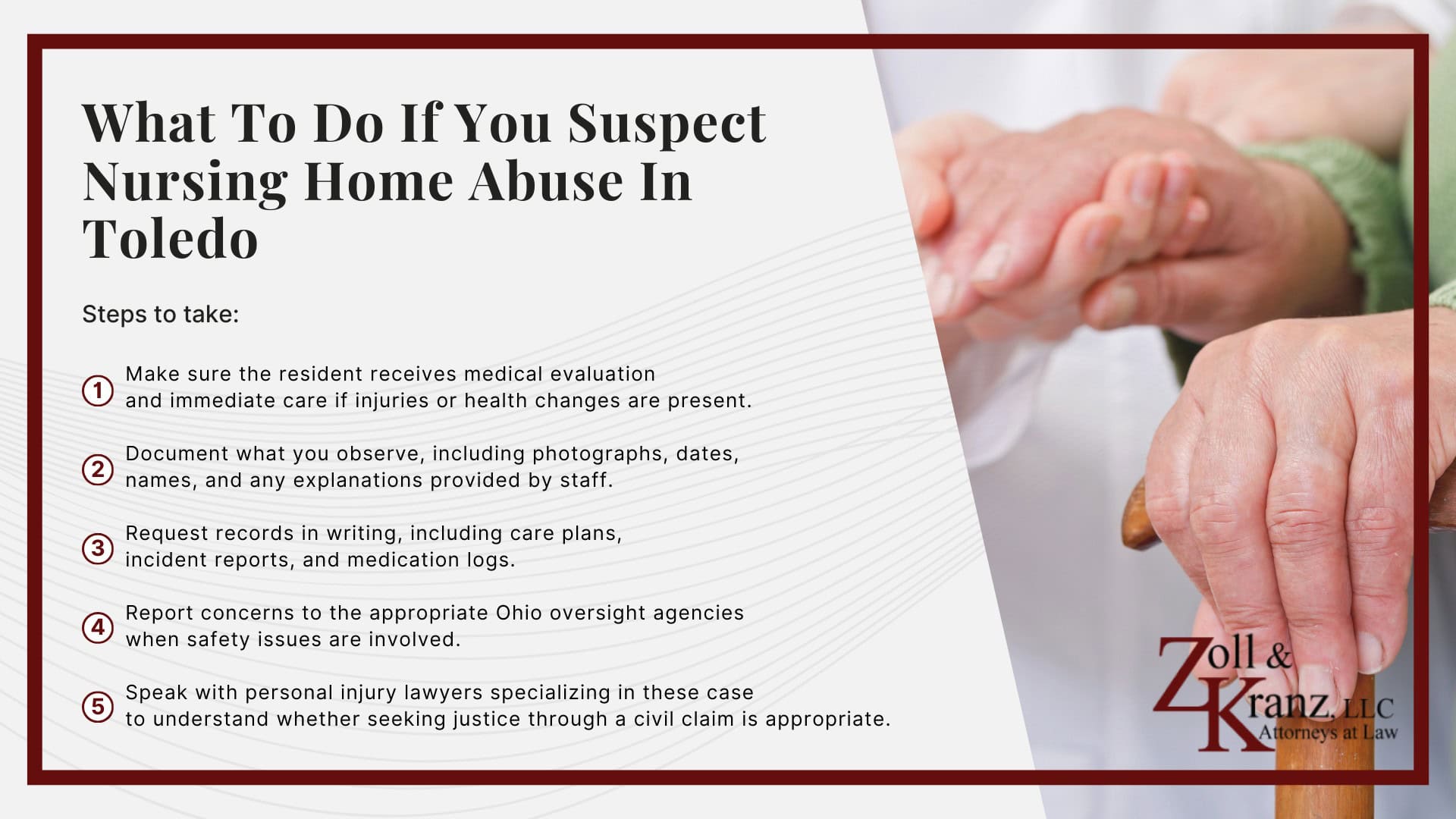
  1. Make sure the resident receives medical evaluation and immediate care if injuries or health changes are present.
  2. Document what you observe, including photographs, dates, names, and any explanations provided by staff.
  3. Request records in writing, including care plans, incident reports, and medication logs.
  4. Report concerns to the appropriate Ohio oversight agencies when safety issues are involved.
  5. Speak with personal injury lawyers specializing in these cases to understand whether seeking justice through a civil claim is appropriate.

Steps Families Can Take Without Confrontation Or Guesswork

When nursing home abuse occurs, families often feel pressure to demand answers immediately, even though direct confrontation can limit access to information.

A more effective approach focuses on observation, documentation, and formal requests that create a clear record.

Asking for records in writing and keeping copies of all responses helps establish what the facility knew and when.

Medical evaluations outside the facility can also provide independent documentation of injuries or decline.

Elder abuse attorneys can explain how these early steps fit into the broader legal process and help families avoid mistakes that weaken a potential claim.

Taking a structured approach allows concerns to be addressed without speculation or unnecessary conflict.

How To Report Concerns to Ohio Agencies And The Long-Term Care Ombudsman

Federal and state laws give nursing home residents specific rights, and Ohio agencies can investigate complaints when those rights are violated.

Reporting concerns can also create an external record that supports elder abuse cases, especially when a facility disputes what happened or delays producing information.

Our legal team can walk you through which reports make sense for your situation and how to document what you are seeing without putting a resident at greater risk.

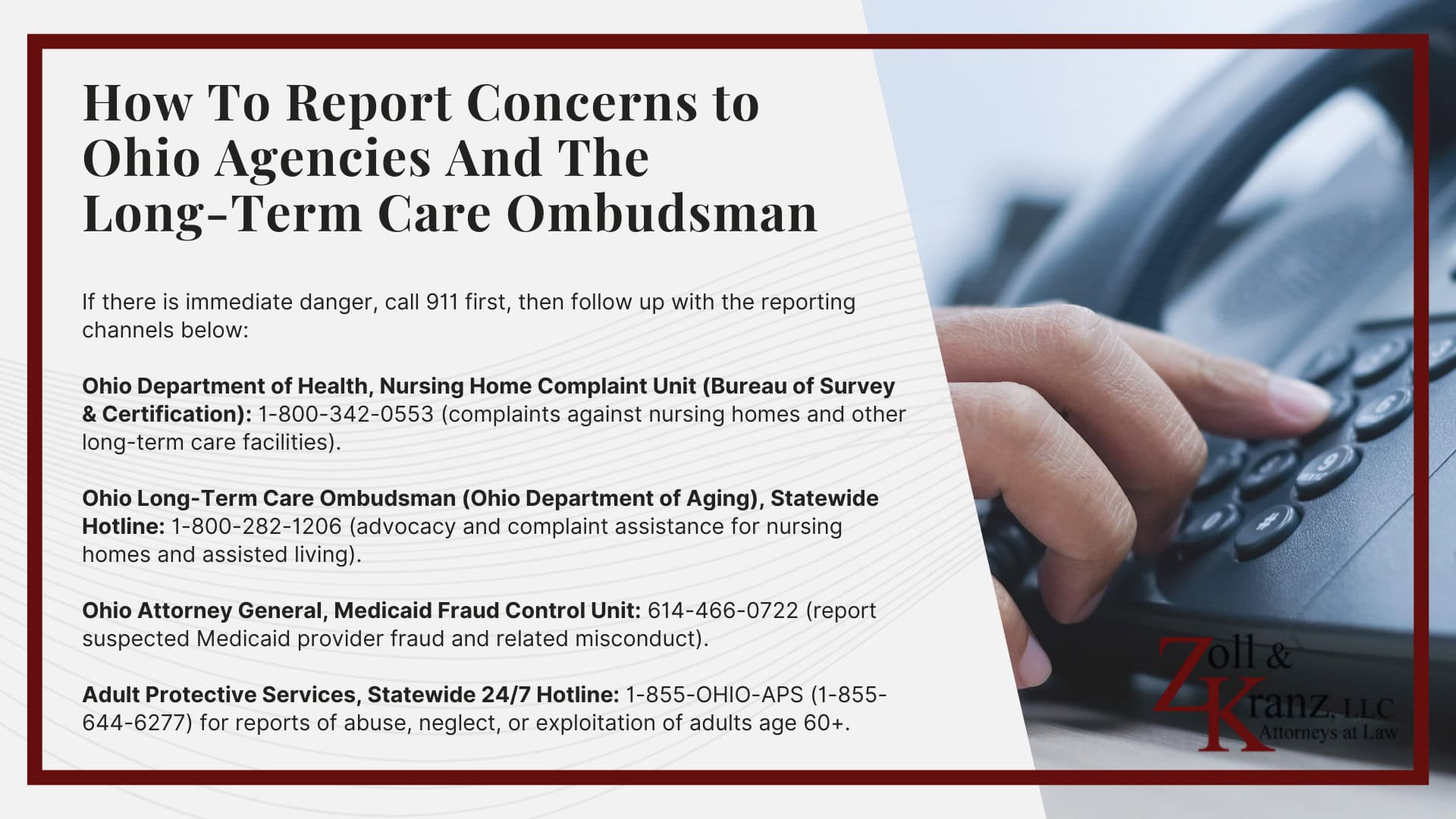
If there is immediate danger, call 911 first, then follow up with the reporting channels below:

  • Ohio Department of Health, Nursing Home Complaint Unit (Bureau of Survey & Certification): 1-800-342-0553 (complaints against nursing homes and other long-term care facilities).
  • Ohio Long-Term Care Ombudsman (Ohio Department of Aging), Statewide Hotline: 1-800-282-1206 (advocacy and complaint assistance for nursing homes and assisted living).
  • Ohio Attorney General, Medicaid Fraud Control Unit: 614-466-0722 (report suspected Medicaid provider fraud and related misconduct).
  • Adult Protective Services, Statewide 24/7 Hotline: 1-855-OHIO-APS (1-855-644-6277) for reports of abuse, neglect, or exploitation of adults age 60+.

Why Moving A Resident Should Be Planned Carefully

Moving a resident after suspected abuse or neglect can feel urgent, but unplanned moves can create new problems for nursing home abuse victims.

A sudden transfer may disrupt medical care, increase confusion, or worsen emotional trauma, especially for residents with cognitive impairment.

It can also complicate efforts to document injuries, obtain records, or preserve evidence tied to what happened inside the facility.

Facilities may argue that injuries occurred elsewhere once a resident is moved, shifting attention away from earlier failures.

Nursing home lawyers often advise families to balance safety with documentation so the resident is protected without weakening potential claims.

Careful planning allows families to prioritize health while preserving the facts needed to evaluate legal responsibility.

Proving Liability In An Ohio Nursing Home Abuse Claim

Proving liability in an Ohio nursing home negligence claim starts with a clear timeline and a clear explanation of what the skilled nursing facility was supposed to do.

Nursing homes often argue that injuries were unavoidable or tied to age and medical decline, so the case has to connect the harm to specific failures in care, supervision, or response.

Documentation matters because the facility controls most of the paper trail, including charting, incident reports, staffing logs, and internal policies.

We look for objective proof that shows what staff did, what they failed to do, and what changed in the resident’s condition afterward.

An experienced attorney can use those records to test the facility’s explanations against what the documentation actually supports.

A nursing home attorney will attempt to establish the following to prove liability:

  • Duty Of Care: The skilled nursing facility owed the resident reasonable care consistent with the resident’s condition, care plan, and applicable standards.
  • Breach Of Duty: The facility fell short through abuse, neglect, unsafe supervision, poor documentation, or other failures in care.
  • Causation: The breach contributed to the injury, decline, or medical outcome, supported by medical evidence and a coherent timeline.
  • Damages: The resident suffered measurable losses, such as medical costs, increased care needs, pain, and loss of quality of life.

A nursing home negligence claim is stronger when the records show repeated issues, ignored warnings, or a breakdown in basic safety systems.

A skilled nursing home injury attorney focuses on proving what happened shift by shift, then tying those failures to the harm through medical documentation.

That is how a skilled nursing facility can be held accountable through the civil process.

Records That Often Matter Most In Long-Term Care Cases

Long-term care cases often rise or fall on documentation, because the facility’s records show what care was planned, what care was delivered, and how staff responded when problems surfaced.

These records also expose inconsistencies between what a nursing home says happened and what was actually charted.

Gathering them early can prevent gaps, edits, or missing context.

Records to collect include:

  • Care plans and assessments, including updates after changes in condition
  • Nursing notes, CNA flow sheets, and shift documentation
  • Medication administration records and pharmacy logs
  • Incident reports, fall logs, and internal investigation paperwork
  • Wound care records, turning and repositioning logs, and skin assessments
  • Hydration and nutrition records, weight logs, and intake monitoring
  • Staffing schedules, assignment sheets, and call light response documentation
  • Hospital transfer records and communications with physicians or medical providers

When More Than One Party May Be Responsible

In many nursing home cases, responsibility does not stop with the person who was on shift when the injury happened.

A facility’s management can be responsible when staffing levels, training, supervision, and reporting systems are set up in ways that predictably lead to harm.

Corporate owners and operators may also play a role when they control budgets, staffing models, and policies that affect day-to-day care.

Outside contractors, such as pharmacy providers, therapy companies, or staffing agencies, can contribute when their failures intersect with resident care and safety.

Identifying all responsible parties requires tracing decision-making authority, documentation control, and who had the ability to prevent the harm.

Ohio Laws And Regulations That Apply to Nursing Home Abuse Cases

Ohio nursing home abuse cases are shaped by a mix of resident rights statutes, licensing rules, and the same civil liability framework that applies to other injury claims.

These laws and regulations help define what a facility must do, what conduct is prohibited, and how families can pursue accountability through a civil case.

They also influence timing, because different statutes of limitations can apply depending on whether the claim is treated as ordinary negligence, a “medical claim,” or a wrongful death action.

When we evaluate a case, we map the facts to these standards and then build the proof around records, timelines, and medical causation.

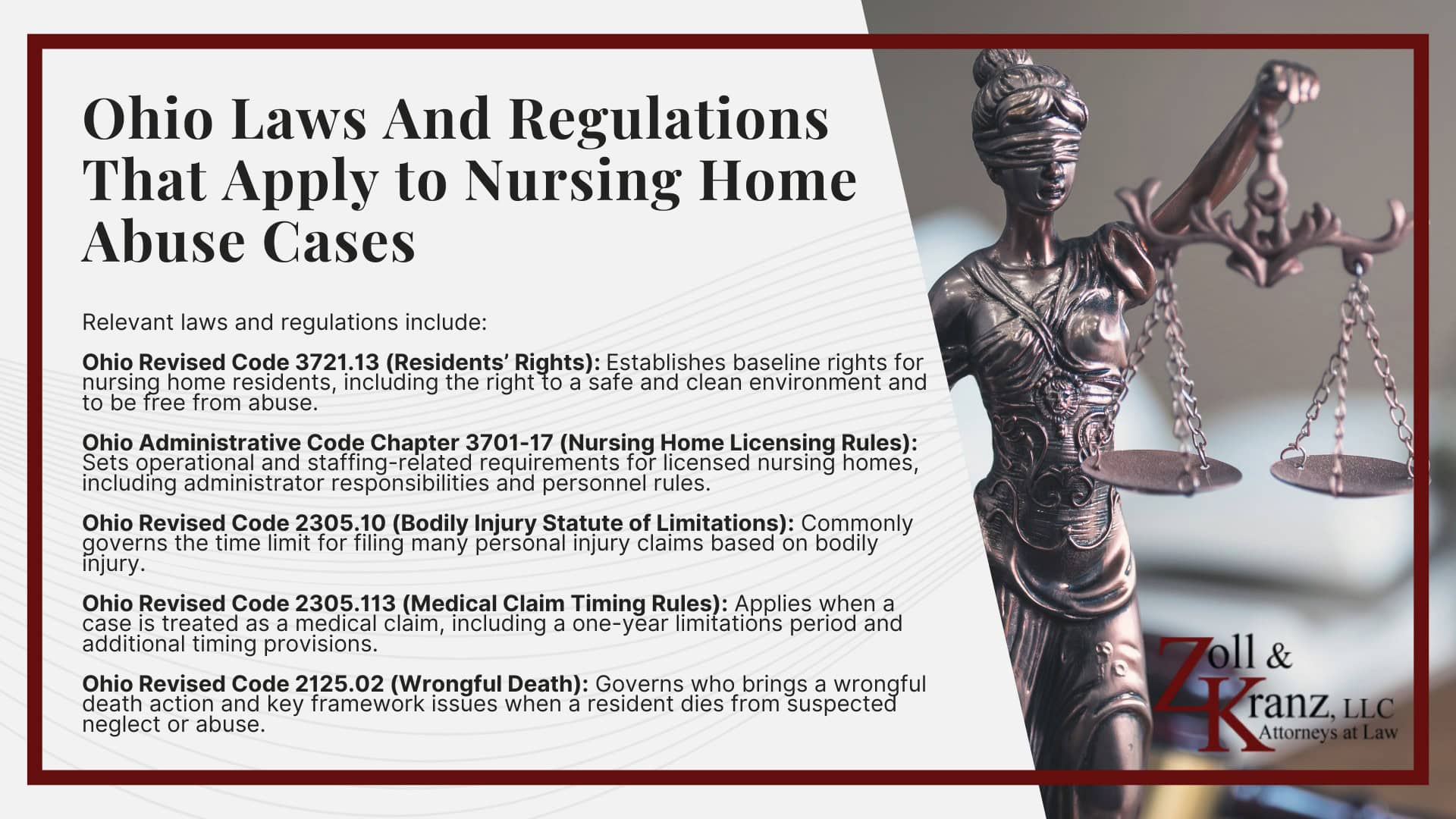
Relevant laws and regulations include:

  • Ohio Revised Code 3721.13 (Residents’ Rights): Establishes baseline rights for nursing home residents, including the right to a safe and clean environment and to be free from abuse.
  • Ohio Administrative Code Chapter 3701-17 (Nursing Home Licensing Rules): Sets operational and staffing-related requirements for licensed nursing homes, including administrator responsibilities and personnel rules.
  • Ohio Revised Code 2305.10 (Bodily Injury Statute of Limitations): Commonly governs the time limit for filing many personal injury claims based on bodily injury.
  • Ohio Revised Code 2305.113 (Medical Claim Timing Rules): Applies when a case is treated as a medical claim, including a one-year limitations period and additional timing provisions.
  • Ohio Revised Code 2125.02 (Wrongful Death): Governs who brings a wrongful death action and key framework issues when a resident dies from suspected neglect or abuse.

Federal standards also matter because many nursing homes participate in Medicare and Medicaid and must follow federal Conditions of Participation.

These rules include resident rights requirements and facility duties related to dignity, communication, and care planning under 42 C.F.R. 483.10.

They also include explicit protections requiring freedom from abuse, neglect, exploitation, and misappropriation of resident property under 42 C.F.R. 483.12, along with related compliance duties in the broader Part 483 framework.

Damages In Nursing Home Abuse And Neglect Cases

Damages are the losses a resident and family can claim in a civil case when abuse or neglect causes harm.

A nursing home abuse attorney evaluates damages by tying every category of loss to documentation, treatment records, and a clear timeline of decline.

We start with medical bills and medical expenses, then assess what the injury changed about the resident’s care needs, mobility, cognition, and daily functioning.

We also look at pain, suffering, and loss of dignity, which often require careful detail and credible support rather than general statements.

Our attorneys use records, provider notes, and life care planning concepts when needed to quantify long-term needs and avoid undervaluation.

The goal is to demand a fair settlement grounded in proof and consistent with the full impact of the harm.

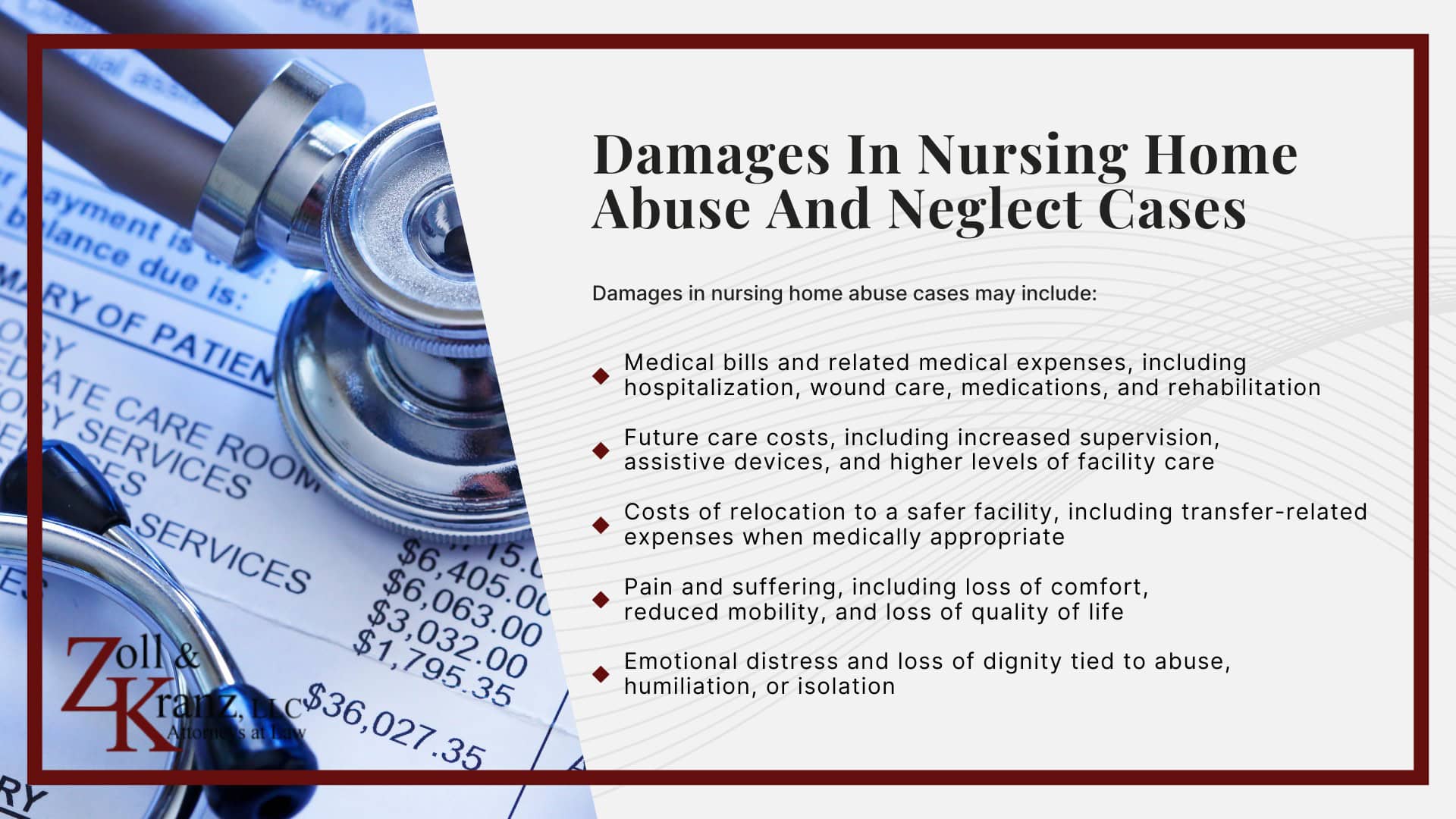
Damages in nursing home abuse cases may include:

  • Medical bills and related medical expenses, including hospitalization, wound care, medications, and rehabilitation
  • Future care costs, including increased supervision, assistive devices, and higher levels of facility care
  • Costs of relocation to a safer facility, including transfer-related expenses when medically appropriate
  • Pain and suffering, including loss of comfort, reduced mobility, and loss of quality of life
  • Emotional distress and loss of dignity tied to abuse, humiliation, or isolation

Wrongful Death Damages When Neglect Leads to Fatal Harm

When neglect leads to fatal harm, the civil case can shift into an Ohio wrongful death claim brought on behalf of eligible surviving family members.

These damages focus on the losses caused by the death itself, along with certain costs tied to the final injury and passing.

The specific damages available depend on the facts and the family circumstances, so the case has to be built with documentation and careful valuation.

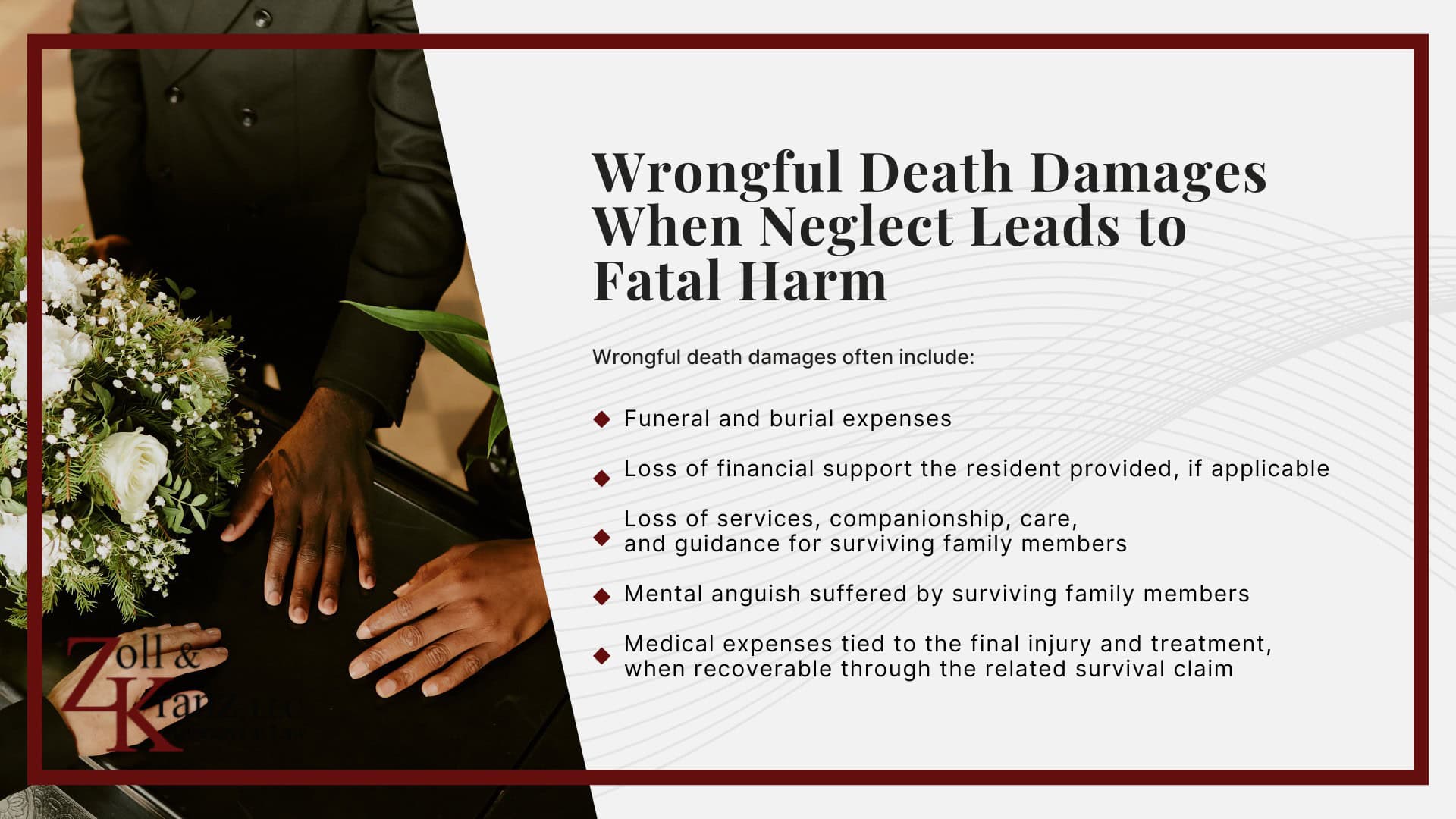
Wrongful death damages often include:

  • Funeral and burial expenses
  • Loss of financial support the resident provided, if applicable
  • Loss of services, companionship, care, and guidance for surviving family members
  • Mental anguish suffered by surviving family members
  • Medical expenses tied to the final injury and treatment, when recoverable through the related survival claim

How Our Law Firm Investigates Nursing Home Abuse And Neglect

Our nursing home abuse attorneys focus on elder abuse and neglect cases and build claims around documentation, medical causation, and a clear timeline of events.

Families can file nursing home abuse lawsuits on behalf of a loved one when that person is unable to act independently, and our nursing home abuse lawyers use that early involvement to preserve records before they are lost or rewritten.

We provide free consultations to assess potential cases without any obligation, and we handle qualifying matters on a contingency fee basis, meaning attorney fees are tied to the outcome.

Nursing home abuse attorneys often collaborate with medical professionals and forensic investigators to interpret records, evaluate injuries, and test whether the facility’s explanations align with the evidence.

The legal process typically involves gathering evidence, filing a lawsuit when appropriate, and negotiating settlements, with the goal of securing financial compensation that reflects the full scope of harm.

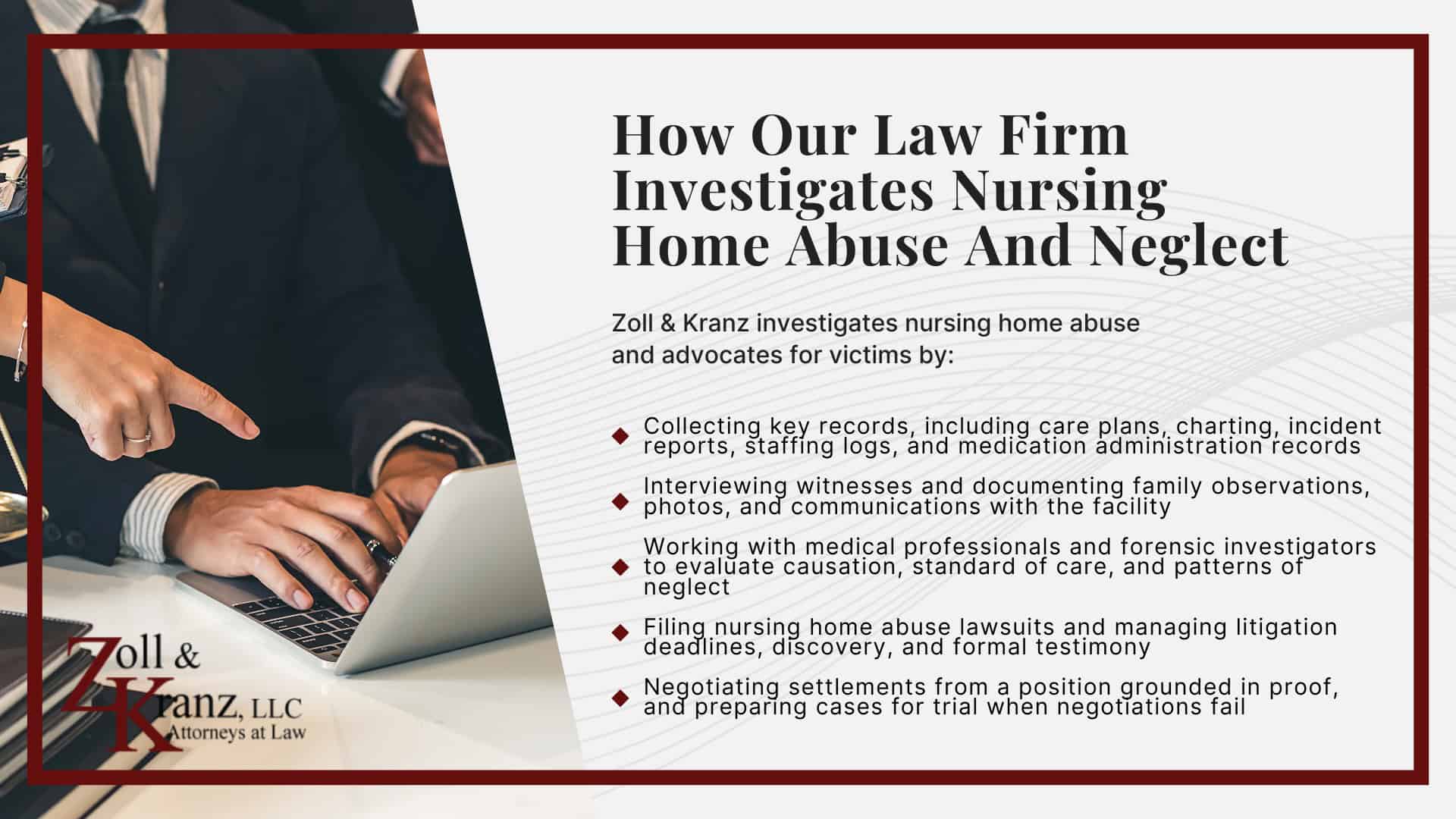
Zoll & Kranz investigates nursing home abuse and advocates for victims by:

  • Collecting key records, including care plans, charting, incident reports, staffing logs, and medication administration records
  • Interviewing witnesses and documenting family observations, photos, and communications with the facility
  • Working with medical professionals and forensic investigators to evaluate causation, standard of care, and patterns of neglect
  • Filing nursing home abuse lawsuits and managing litigation deadlines, discovery, and formal testimony
  • Negotiating settlements from a position grounded in proof, and preparing cases for trial when negotiations fail

Contact Zoll & Kranz: Toledo Nursing Home Abuse Lawyer

If you believe a loved one has been harmed in a Toledo nursing home or assisted living facility, you do not have to rely on the facility’s explanation or wait for the situation to get worse.

We can review what happened, identify the records that matter, and explain whether the facts support a claim under Ohio law.

Our nursing home abuse attorneys offer free consultations, and we handle qualifying cases on a contingency fee basis.

To speak with a Toledo nursing home abuse lawyer, contact Zoll & Kranz today.

You can also use the chat feature on this page to get started.

Frequently Asked Questions

Published by:
Share
Picture of Michelle L. Kranz
Michelle L. Kranz

Michelle is a founding partner of Zoll & Kranz, located in Toledo, Ohio. Michelle has been a plaintiff’s lawyer for the entirety of her practice – over 32 years. She devotes the majority of her time to complex consolidated litigation and class action including advocating for people injured by medical devices, prescription medications, or corporate negligence.

This article has been written and reviewed for legal accuracy and clarity by the team of writers and attorneys at Zoll & Kranz, LLC and is as accurate as possible. This content should not be taken as legal advice from an attorney. If you would like to learn more about our owner and experienced Ohio injury lawyer, Michelle L. Kranz, you can do so here.

Zoll & Kranz, LLC does everything possible to make sure the information in this article is up to date and accurate. If you need specific legal advice about your case, contact us. This article should not be taken as advice from an attorney.

Other cases we handle in Toledo
All
Auto Accidents
Injury Types
Medical Malpractice
Nursing Home Abuse
Other Accidents & Injuries
You can learn more about other Toledo cases we handle below:
Bedsores in Toledo Nursing Homes
Collecting Evidence in Toledo Medical Malpractice Cases
Collecting Evidence in Toledo Nursing Home Negligence Cases
Common Causes of Nursing Home Negligence in Toledo
Dehydration and Malnutrition in Toledo Nursing Homes
Dropped Patients in Toledo Nursing Homes
Duty of Care Owed by Toledo Nursing Home Facilities
Emotional and Mental Abuse in Toledo Nursing Homes
Failure to Perform Procedure Malpractice Lawyer in Toledo
Falls in Toledo Nursing Homes
How To Report Poor Nursing Home Care in Toledo
Inattentive Staff in Toledo Nursing Homes
Infections in Toledo Nursing Homes
Initial Steps To Take in a Toledo Medical Malpractice Case
Liability in Toledo Medical Malpractice Claims
Liability in Toledo Nursing Home Negligence Cases
Medication Errors in Toledo Nursing Homes
Neglect in Toledo Nursing Homes
Negligence in Toledo Medical Malpractice Cases
Negligent Hiring or Training in Toledo Nursing Homes
Nursing Home Negligence Wrongful Death Cases in Toledo
Patient Rights in Toledo Nursing Homes
Personal Injury Lawyer Toledo, Ohio
Physical Abuse in Toledo Nursing Homes
Process of a Medical Malpractice Case in Toledo
Sexual Abuse in Toledo Nursing Homes
Toledo Anesthesia Errors Lawyer
Toledo Auto Accident Lawyer
Toledo Bicycle Accident Lawyer
Toledo Burn Injury Lawyer
Toledo Bus Accident Lawyer
Toledo Cancer Misdiagnosis Lawyer
Toledo Car Accident Lawyer
Toledo Catastrophic Injury Lawyer
Toledo Daycare Injury Lawyer
Toledo Delayed Diagnosis Lawyer
Toledo Emergency Room Error Lawyer
Toledo Failure To Diagnose Lawyer
Toledo Insurance Claim Lawyer
Toledo Mass Torts Lawyer
Toledo Medical Malpractice Lawyer
Toledo Medication Error Lawyer
Toledo Misdiagnosis Medical Malpractice Lawyer
Toledo Motorcycle Accident Lawyer
Toledo Nurse Error Lawyer
Toledo Nursing Home Negligence Safety and Preventative Measures
Toledo Pedestrian Accident Lawyer
Toledo Spinal Cord Injury Lawyer
Toledo Surgical Error Lawyer
Toledo Toxic Exposure Lawyer
Toledo Traumatic Brain Injury Lawyer
Toledo Truck Accident Lawyer
Toledo Wrongful Death Lawyer
Wrong Site Surgery Malpractice in Toledo
Were you or a loved one injured in Toledo?

A serious injury can have life-altering results.

Don’t settle for less than you deserve, speak with an award-winning personal injury lawyer today.

8 Reviews
5.0
★★★★★
Recovered damages
$35 Million+

Table of Contents

Practice Areas
About Zoll & Kranz, LLC

For over 37 years, Zoll & Kranz has been fighting for clients who have been the victims of the wrongful death of a loved one.

Do you believe you’re entitled to compensation?

Use our Instant Case Evaluator to find out in as little as 60 seconds!

Guides & Resources

Other Toledo Personal Injury Cases

All
Auto Accidents
Injury Types
Medical Malpractice
Nursing Home Abuse
Other Accidents & Injuries
Local Toledo Resources
Education
Emergency Services
Courthouses
Department of Motor Vehicles
Sights to See