No fees unless we win.
Get a free consultation
8 Reviews
5.0
★★★★★

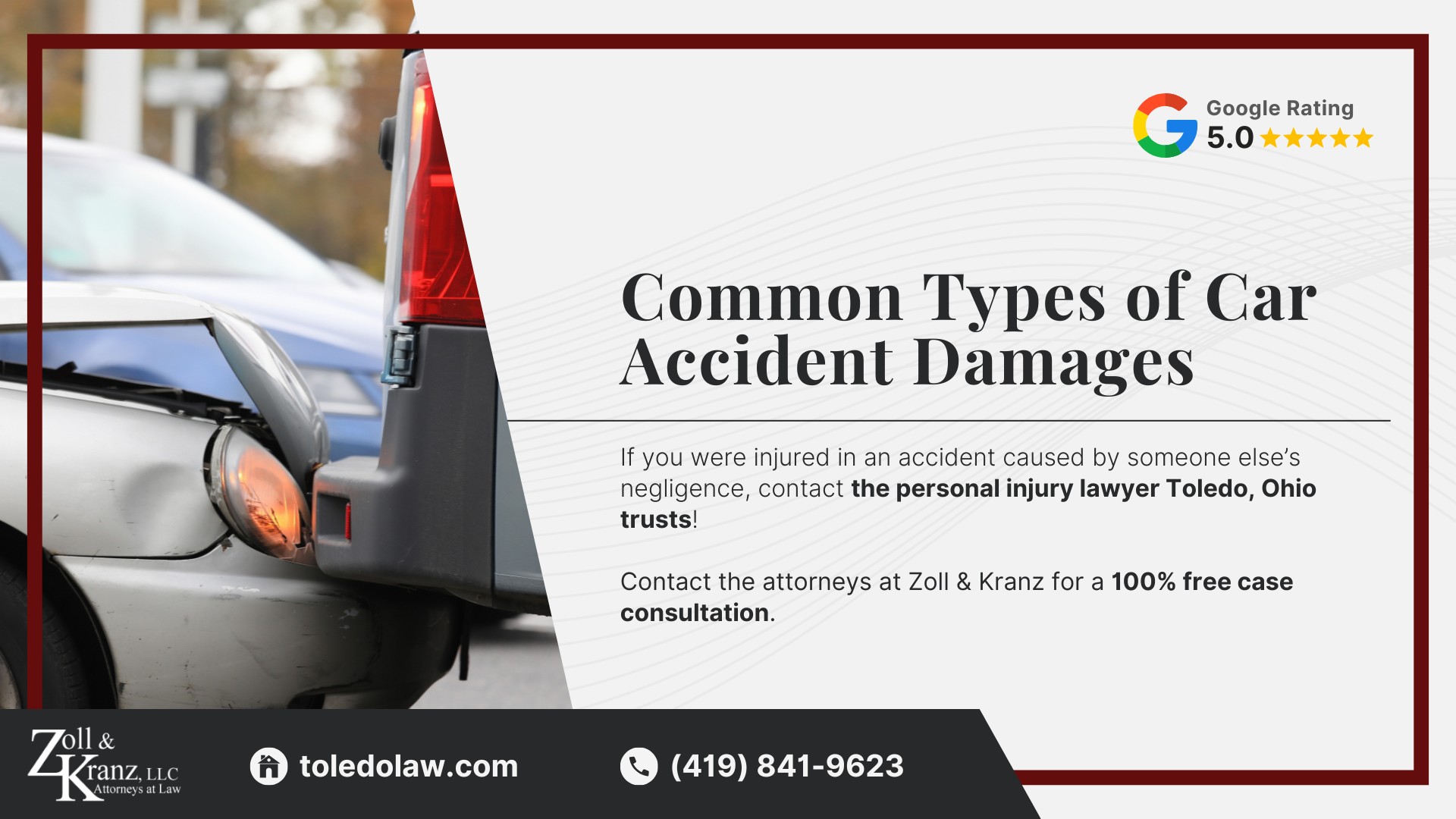
Common Types of Car Accident Damages

Our Experienced Auto Accidents Lawyers Can Help You With Damages

Car accident damages often depend on whether your losses can be proven with clear documentation rather than estimates or assumptions.

A Toledo personal injury attorney can explain what records matter under Ohio law, evaluate how the evidence affects claim value, and outline how fees and case costs typically work before you hire counsel.

Your lawyer can preserve crash reports, photos, video, witness statements, and medical records, then use that proof to identify responsible parties and support a damages claim during settlement negotiations or litigation.

Common Types of Car Accident Damages

Contact Our Car Accidents Lawyers at Zoll & Kranz Today

A serious car accident can create immediate financial pressure, with medical bills, missed work, and uncertainty about what comes next.

In many cases, the real question becomes which car accident damages can be proven and how those losses will be documented for an insurer or a jury.

A Toledo personal injury attorney can review the circumstances, explain your options, and outline how fees and case costs typically work while developing a plan to support damages in car accident claims with records rather than estimates.

Proving auto accident damages usually requires connecting each category of loss to documentation.

Medical records and billing support treatment costs, wage records support income loss, and repair estimates support property-related losses, while other evidence helps show how the crash caused the harm.

A lawyer can also identify all potentially responsible parties and organize the evidence needed to present personal injury damages clearly, including treatment history, restrictions, and the real-world impact of the injuries.

As the claim develops, counsel can manage insurer communications and negotiate using a documented damages picture that includes both financial loss and non-economic harm.

If settlement talks do not produce reasonable terms, the lawyer can file suit and continue building proof through discovery, testimony, and updated medical documentation.

Whether you are evaluating damages personal injury claims or seeking a fair resolution for a serious crash, early documentation and consistent records can strengthen your position from the start.

If you or a loved one was hurt, contact Zoll & Kranz to discuss the facts, the damages for car accident, and what steps can protect your claim.

You can also use the chat feature on this page to request a case evaluation.

Damages in Car Accident Cases

Car accident damages are the losses a person may seek after a car accident or other motor vehicle accident causes injury or financial harm.

A car crash can create immediate expenses and longer-term consequences, and damages are the legal categories used to measure those losses in a car accident claim, personal injury claim, or car accident lawsuit.

In most cases, damages fall into economic and non-economic categories, and in limited situations a court may also consider punitive damages.

Whether a claim resolves through an insurance company settlement or a filed personal injury lawsuit, damages must be supported with evidence and tied to the collision.
Damages are also the framework used to evaluate settlement offers.

Insurers commonly focus on objective records, such as bills and wage documentation, while disputing the severity, duration, or cause of symptoms.

That is why the documentation behind a personal injury case matters as much as the diagnosis itself.

A personal injury attorney can help identify what categories apply, what proof is needed, and how future losses should be supported so the claim is valued on records rather than estimates.

Types of Car Accident Damages

Car accidents can result in significant financial losses for victims, and the law generally divides compensatory damages into economic and non-economic categories.

Economic damages are designed to offset the financial stress caused by a car crash, while non economic damages help compensate for hard-to-value trauma resulting from an auto accident.

In a severe case, damages can also include losses connected to a fatal crash pursued through a wrongful death lawsuit, including funeral-related costs.
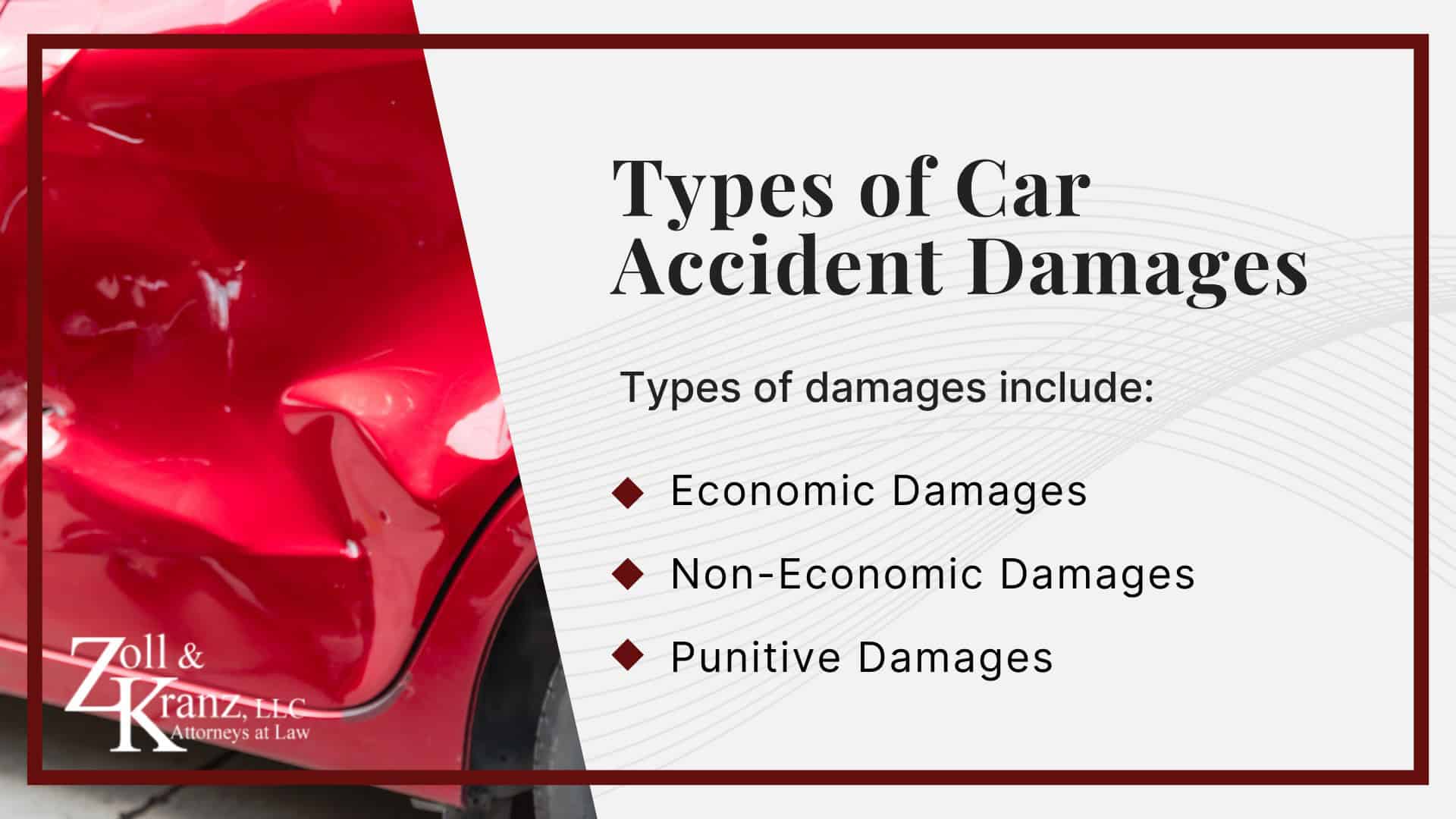
Types of damages include:

  • Economic Damages
  • Non-Economic Damages
  • Punitive Damages

Within these categories, common losses include medical bills, property damage, and lost wages, along with long-term limitations that affect daily function.

The category labels matter because they determine what proof is required and how insurers and courts evaluate the claim.

Economic Damages

Economic damages are intended to compensate the victim for losses that have a specific monetary value.

They are generally easier to calculate because they are based on bills, receipts, and employment records.

The financial cost of economic damages can include direct costs such as medical bills, property damage, and lost wages due to missed work.
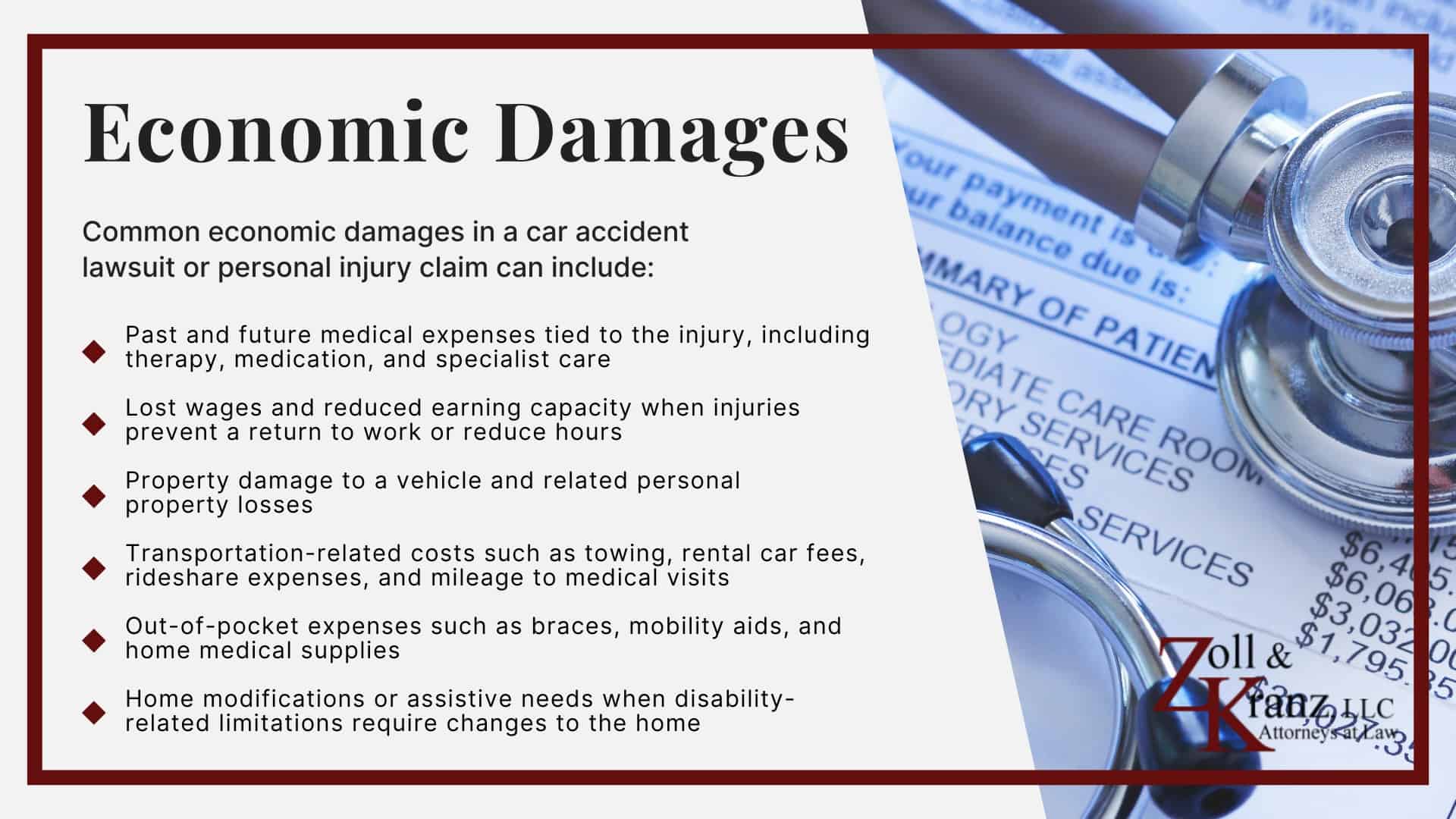
Common economic damages in a car accident lawsuit or personal injury claim can include:

  • Past and future medical expenses tied to the injury, including therapy, medication, and specialist care
  • Lost wages and reduced earning capacity when injuries prevent a return to work or reduce hours
  • Property damage to a vehicle and related personal property losses
  • Transportation-related costs such as towing, rental car fees, rideshare expenses, and mileage to medical visits
  • Out-of-pocket expenses such as braces, mobility aids, and home medical supplies
  • Home modifications or assistive needs when disability-related limitations require changes to the home

Economic damages often become disputed when there are gaps in treatment or incomplete billing records.

Keeping copies of invoices, explanation-of-benefits statements, and employer documentation can help present a clear total that the insurer can verify.

A personal injury lawyer typically packages these records to show what was incurred, why it was necessary, and whether future costs are expected based on medical guidance.

Non-Economic Damages

Non economic damages address the human impact of injuries that do not come with a clear price tag.

They can include compensation for pain and suffering experienced due to a car accident and for hard-to-value trauma that affects daily life.

Non-economic damages can also include emotional distress, loss of enjoyment of life, and loss of consortium, depending on what the law recognizes and what can be supported by the record.

State laws may impose limits on non-economic damages or affect the recognition of certain claims, such as loss of enjoyment of life.

Even when non-economic damages are available, they still need evidence.

Consistent medical documentation, therapy notes, and credible reports of limitations can help show how the injuries affected sleep, mobility, independence, and the ability to participate in normal activities.

A personal injury attorney will often tie these impacts to treatment records and functional restrictions to avoid vague or unsupported descriptions.

Punitive Damages

Punitive damages are not awarded in every personal injury case.

They are a form of compensation that may be available in certain cases where the responsible party acted with gross negligence or intentional misconduct, and they are intended to punish egregious behavior and deter similar conduct in the future.

Judges and juries rarely award punitive damages in routine car accident cases, and they are typically only considered when there is clear and convincing evidence that the at-fault driver’s conduct went beyond ordinary negligence.

In some states, caps may limit the amount of punitive damages that can be awarded.

A common scenario where punitive damages may be pursued is a drunk driving crash or similar reckless conduct.

Even then, punitive damages are separate from compensatory damages and are not guaranteed.

A personal injury attorney can evaluate whether the facts support a punitive claim and whether the evidence meets the required standard.

Long-Term Effects of Car Accidents

A serious auto accident can create damages that extend well beyond the initial medical visit.

Future damages may include ongoing medical expenses and lost wages related to permanent injuries, and the need for future care can become a central issue in a larger personal injury lawsuit.

Long-term effects can be physical, financial, and psychological, and they may change the type and amount of support a person needs over time.

Car accidents can also lead to long-term emotional and psychological effects, including increased stress levels, depression, and post-traumatic stress disorder (PTSD).

Some victims require ongoing mental health support services, such as counseling or support groups, to cope with psychological trauma and restore functioning.

The psychological impact can affect relationships, sleep, and the ability to engage in daily activities, which can contribute to a diminished quality of life.

Non-economic damages are often used to address these impacts, while future economic damages address ongoing treatment costs and work limitations.

Long-term effects may include:

  • Chronic pain and ongoing physical limitations
  • Reduced quality of life and loss of independence
  • Continued medical care, therapy, and future procedures
  • Long-term or permanent work restrictions affecting future income
  • Emotional distress, increased stress levels, depression, or anxiety
  • PTSD symptoms following a serious car crash
  • Relationship strain and reduced participation in daily activities

Collecting Car Accident Damages

To collect car accident damages, you generally must prove the other person was at fault and that their breach of duty caused the crash.

That means showing the other party failed to fulfill their duty of care and that the failure directly caused your injuries or property losses.

You will typically need evidence such as eyewitness testimony, photos from the scene, police reports, medical records, and bills related to your injuries and property damage.

If the insurance company denies your car accident claim or pays only part of it, you may need to file a personal injury claim or car accident lawsuit against the other driver to pursue full recovery.

If you file suit, you generally must include a demand for damages in the initial complaint.

Compensatory damages are divided into economic awards and non-economic awards, and each category should be supported with specific proof.

A personal injury lawyer can negotiate with insurance companies to seek a fair settlement, respond to denial tactics, and build a record that supports each damages category.

If litigation becomes necessary, a car accident lawyer can use discovery tools to obtain records, take depositions, and strengthen proof of fault and damages so the court has a clear basis to award compensation.
The Legal Process of Car Accident Cases

Most car accident cases begin with an immediate report to law enforcement and an insurance claim opened with the relevant carrier.

The legal issue usually centers on whether the at fault party caused the crash by failing to follow the rules of the road and whether that other party owed a duty of care that they party breached through negligent conduct.

Once fault is supported, the next step is proving the full scope of harm, including personal injury damages such as medical expenses, financial losses, and non-economic losses like pain and suffering and emotional distress.

Cases with serious injuries, including spinal cord injuries, often require more documentation and a longer timeline because future care needs and future expenses must be supported with medical records and expert opinions.

In rare situations, a court may award punitive damages when the at-fault driver’s conduct is grossly negligent or intentional, but punitive awards are not typical in routine collisions.

If a crash results in death, a family may need to evaluate a wrongful death suit, which can include claims for funeral expenses and other losses tied to the fatal injury.

In commercial crashes, fault analysis may also involve a business defendant, such as a trucking company, which can raise additional evidence and insurance issues.

Steps To Take After a Car Accident

Taking the right steps early can protect your health and preserve the proof needed to recover damages and pursue a fair settlement.

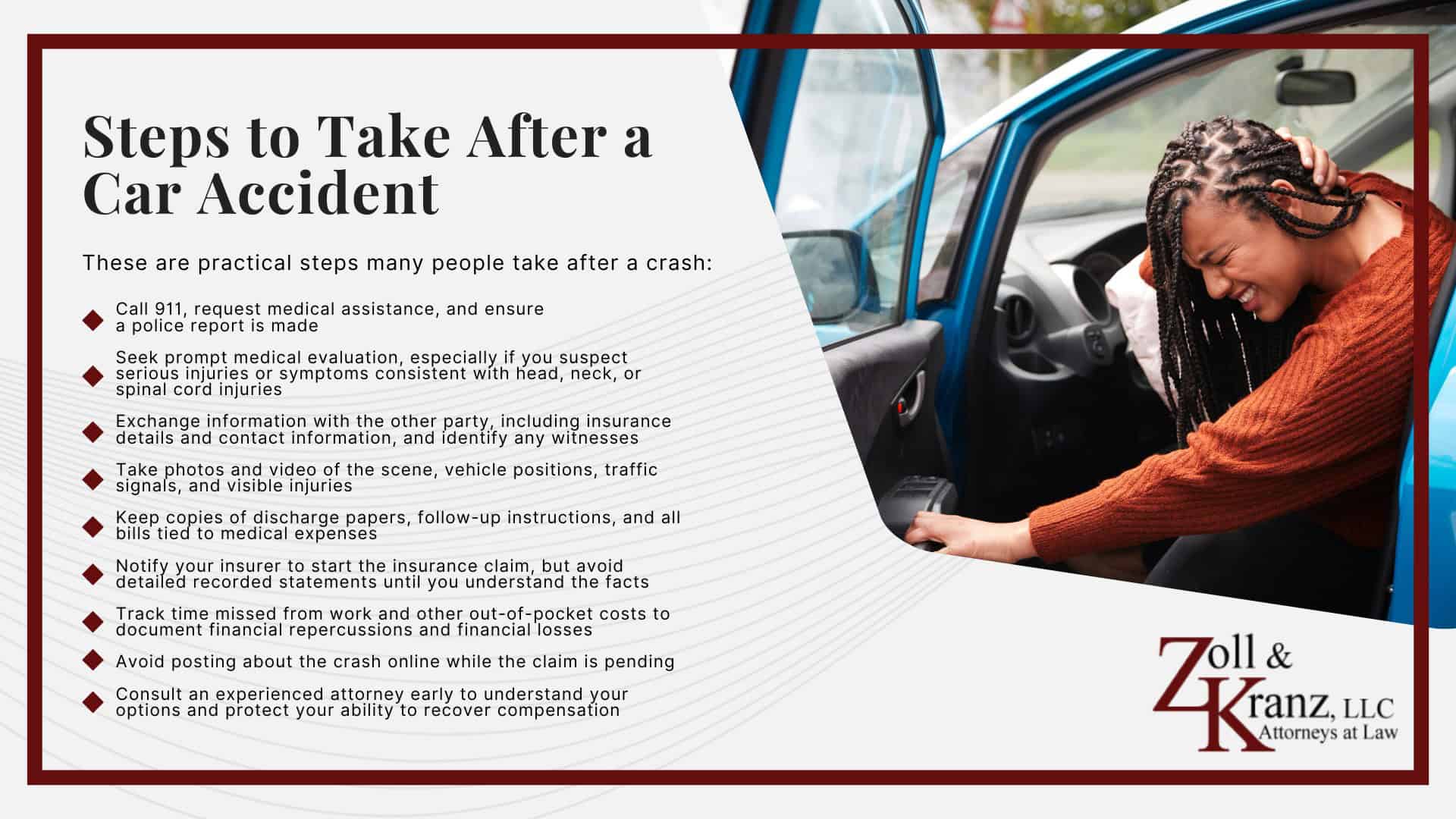
These are practical steps many people take after a crash:

  • Call 911, request medical assistance, and ensure a police report is made
  • Seek prompt medical evaluation, especially if you suspect serious injuries or symptoms consistent with head, neck, or spinal cord injuries
  • Exchange information with the other party, including insurance details and contact information, and identify any witnesses
  • Take photos and video of the scene, vehicle positions, traffic signals, and visible injuries
  • Keep copies of discharge papers, follow-up instructions, and all bills tied to medical expenses
  • Notify your insurer to start the insurance claim, but avoid detailed recorded statements until you understand the facts
  • Track time missed from work and other out-of-pocket costs to document financial repercussions and financial losses
  • Avoid posting about the crash online while the claim is pending
  • Consult an experienced attorney early to understand your options and protect your ability to recover compensation

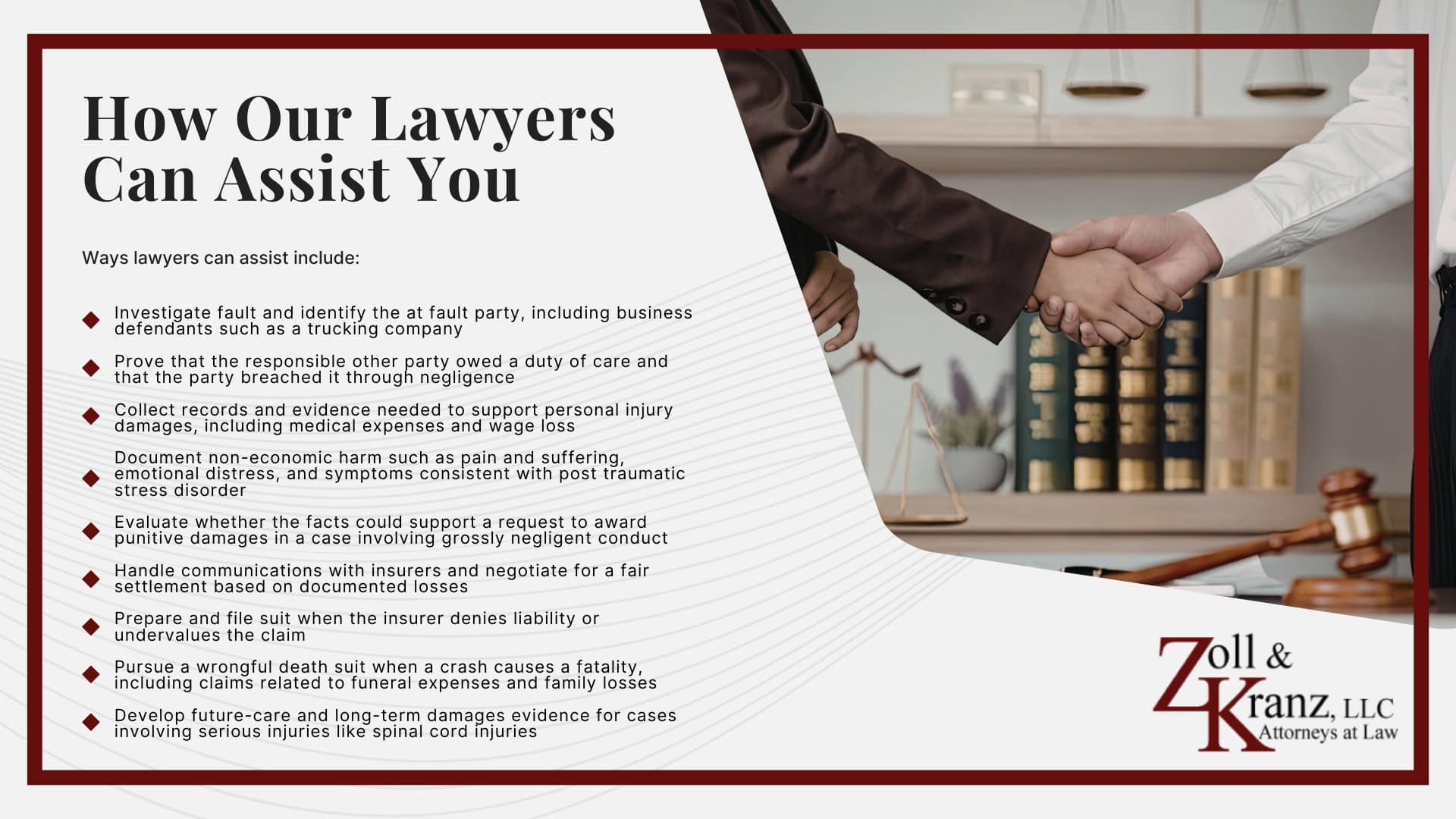
How Our Lawyers Can Assist You

A lawyer’s role is to build a documented case that supports liability and damages and to protect you from avoidable mistakes during the claim process.

Our team can help you pursue compensation for both immediate losses and longer-term harms, including future expenses and non-economic damages.

We also provide a free consultation and can offer a free case evaluation based on the facts and available records.

Ways lawyers can assist include:

  • Investigate fault and identify the at fault party, including business defendants such as a trucking company
  • Prove that the responsible other party owed a duty of care and that the party breached it through negligence
  • Collect records and evidence needed to support personal injury damages, including medical expenses and wage loss
  • Document non-economic harm such as pain and suffering, emotional distress, and symptoms consistent with post traumatic stress disorder
  • Evaluate whether the facts could support a request to award punitive damages in a case involving grossly negligent conduct
  • Handle communications with insurers and negotiate for a fair settlement based on documented losses
  • Prepare and file suit when the insurer denies liability or undervalues the claim
  • Pursue a wrongful death suit when a crash causes a fatality, including claims related to funeral expenses and family losses
  • Develop future-care and long-term damages evidence for cases involving serious injuries like spinal cord injuries

Do You Qualify For a Car Accident Case?

You may qualify for a car accident case if you were injured in an accident caused by another person’s negligence and you can show measurable losses.

In most cases, that means proving the other driver was at fault and identifying the responsible party whose conduct caused the collision.

A claim is typically stronger when it includes clear evidence of how the crash happened and reliable documentation of injuries, medical care, and time missed work.

Some cases involve more than one liable party, and liability can depend on the facts, the roadway rules, and applicable state laws.

In a fatal crash, surviving family members may have legal options through a wrongful death case, and the damages analysis often changes because the losses extend beyond one person’s medical treatment.

If your injury is a serious problem that affects your ability to work, the claim may also involve longer-term wage issues such as reduced earning capacity and limits on future earning capacity.

Ohio Statute of Limitations for Car Accident Claims

Ohio has filing deadlines that control how long you have to bring a lawsuit, and those deadlines apply even if you are still negotiating with an insurer.

In Ohio, many injury claims arising from a car accident must be filed within two years from the date of injury, but the correct deadline can depend on the claim type and the parties involved.

Waiting can also weaken your case even before any deadline passes because vehicles get repaired, video is overwritten, and witnesses are harder to locate.

For that reason, confirming the timeline early helps protect your ability to pursue compensation and preserves options if the insurer refuses to pay fairly.

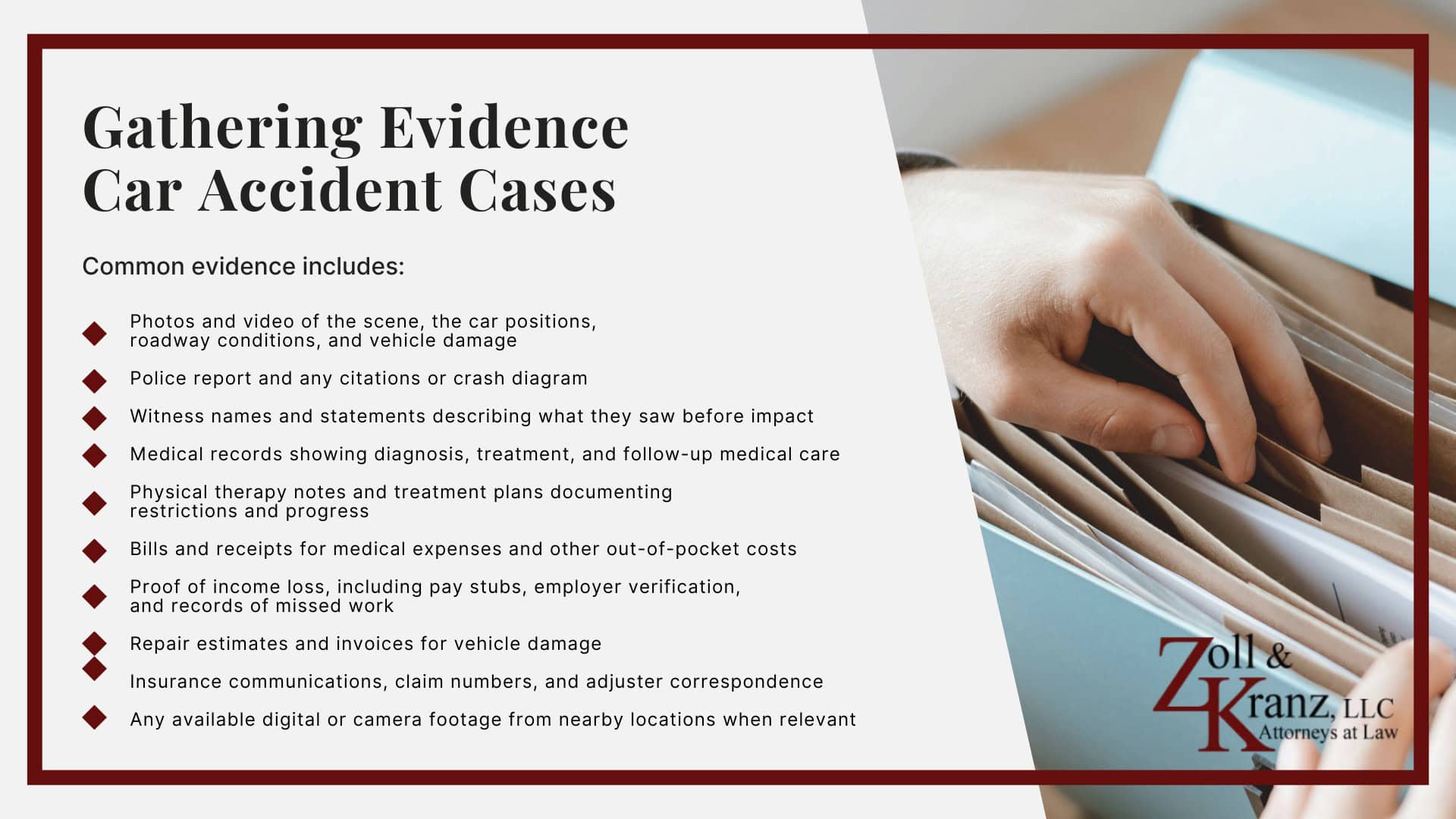
Gathering Evidence Car Accident Cases

Strong cases are built on gathering evidence that shows who caused the crash and what it cost the victim.

Evidence should document the collision, the condition of the vehicle and roadway, and the injury timeline from immediate treatment through follow-up care, including physical therapy when required.

Common evidence includes:

  • Photos and video of the scene, the car positions, roadway conditions, and vehicle damage
  • Police report and any citations or crash diagram
  • Witness names and statements describing what they saw before impact
  • Medical records showing diagnosis, treatment, and follow-up medical care
  • Physical therapy notes and treatment plans documenting restrictions and progress
  • Bills and receipts for medical expenses and other out-of-pocket costs
  • Proof of income loss, including pay stubs, employer verification, and records of missed work
  • Repair estimates and invoices for vehicle damage
  • Insurance communications, claim numbers, and adjuster correspondence
  • Any available digital or camera footage from nearby locations when relevant

Zoll & Kranz: Experienced Car Accident Lawyers That Can Help You Determine Damages

Determining what a case is worth requires more than adding bills.

Zoll & Kranz can evaluate the facts, identify the responsible party, and build a damages record that supports fair compensation based on documentation.

Our team can also explain how damages categories work, including special damages such as medical costs, wage loss, and other financial losses related to the crash, along with non-economic harms such as pain, suffering, and the impact on daily life.

We help clients collect damages by connecting each loss to proof.

That includes organizing medical records, tracking treatment and physical therapy, documenting wage loss, and evaluating whether ongoing impairment supports a reduced earning capacity claim tied to future earning capacity.

In limited cases involving intentional misconduct or extreme conduct, we can also assess whether the facts support an argument to receive punitive damages, although those awards are not typical and depend on the evidence and the law.

If you want to discuss your options, contact our team today so we can review what happened, what evidence is available, and what steps may help you pursue compensation.

Contact Zoll & Kranz today, or use the chatbot on this page to see if you qualify immediately.

Frequently Asked Questions

Published by:
Share
Picture of Michelle L. Kranz
Michelle L. Kranz

Michelle is a founding partner of Zoll & Kranz, located in Toledo, Ohio. Michelle has been a plaintiff’s lawyer for the entirety of her practice – over 32 years. She devotes the majority of her time to complex consolidated litigation and class action including advocating for people injured by medical devices, prescription medications, or corporate negligence.

This article has been written and reviewed for legal accuracy and clarity by the team of writers and attorneys at Zoll & Kranz, LLC and is as accurate as possible. This content should not be taken as legal advice from an attorney. If you would like to learn more about our owner and experienced Ohio injury lawyer, Michelle L. Kranz, you can do so here.

Zoll & Kranz, LLC does everything possible to make sure the information in this article is up to date and accurate. If you need specific legal advice about your case, contact us. This article should not be taken as advice from an attorney.

Other cases we handle in Toledo
All
Auto Accidents
Injury Types
Medical Malpractice
Nursing Home Abuse
Other Accidents & Injuries
You can learn more about other Toledo cases we handle below:
Auto Accident Lawsuit Timeline in Toledo
Bedsores in Toledo Nursing Homes
Collecting Evidence in Toledo Medical Malpractice Cases
Collecting Evidence in Toledo Nursing Home Negligence Cases
Common Car Accident Injuries in Toledo, OH
Common Causes of Nursing Home Negligence in Toledo
Dehydration and Malnutrition in Toledo Nursing Homes
Distracted Driving Accidents in Toledo, OH
Dropped Patients in Toledo Nursing Homes
DUI Accidents in Toledo
Duty of Care Owed by Toledo Nursing Home Facilities
Emotional and Mental Abuse in Toledo Nursing Homes
Evidence in Toledo Auto Accident Cases
Failure to Perform Procedure Malpractice Lawyer in Toledo
Falls in Toledo Nursing Homes
Head-On Collisions in Toledo
Hit-and-Run Accidents in Toledo
How is Fault Determined in a Car Accident?
How To File a Car Crash Lawsuit in Toledo
How To Report Poor Nursing Home Care in Toledo
Inattentive Staff in Toledo Nursing Homes
Infections in Toledo Nursing Homes
Initial Steps To Take in a Toledo Medical Malpractice Case
Interstate Accidents in Toledo
Liability in Toledo Medical Malpractice Claims
Liability in Toledo Nursing Home Negligence Cases
Medication Errors in Toledo Nursing Homes
Neglect in Toledo Nursing Homes
Negligence in Toledo Medical Malpractice Cases
Negligent Hiring or Training in Toledo Nursing Homes
Nursing Home Negligence Wrongful Death Cases in Toledo
Paralysis in Auto Accidents
Patient Rights in Toledo Nursing Homes
Personal Injury Lawyer Toledo, Ohio
Physical Abuse in Toledo Nursing Homes
Process of a Medical Malpractice Case in Toledo
Rear-End Collisions in Toledo, OH
Rental Car Accidents in Toledo
Rollover Accidents in Toledo
Securing a Police Report in Toledo After an Auto Accident
Sexual Abuse in Toledo Nursing Homes
Sideswipe Accidents in Toledo
Toledo Anesthesia Errors Lawyer
Toledo Auto Accident Lawyer
Toledo Bicycle Accident Lawyer
Toledo Burn Injury Lawyer
Toledo Bus Accident Lawyer
Toledo Cancer Misdiagnosis Lawyer
Toledo Car Accident Lawyer
Toledo Catastrophic Injury Lawyer
Toledo Daycare Injury Lawyer
Toledo Delayed Diagnosis Lawyer
Toledo Emergency Room Error Lawyer
Toledo Failure To Diagnose Lawyer
Toledo Insurance Claim Lawyer
Toledo Mass Torts Lawyer
Toledo Medical Malpractice Lawyer
Toledo Medication Error Lawyer
Toledo Misdiagnosis Medical Malpractice Lawyer
Toledo Motorcycle Accident Lawyer
Toledo Nurse Error Lawyer
Toledo Nursing Home Abuse Lawyer
Toledo Nursing Home Negligence Safety and Preventative Measures
Toledo Pedestrian Accident Lawyer
Toledo Spinal Cord Injury Lawyer
Toledo Surgical Error Lawyer
Toledo Toxic Exposure Lawyer
Toledo Traumatic Brain Injury Lawyer
Toledo Truck Accident Lawyer
Toledo Wrongful Death Lawyer
Wrong Site Surgery Malpractice in Toledo
Were you or a loved one injured in Toledo?

A serious injury can have life-altering results.

Don’t settle for less than you deserve, speak with an award-winning personal injury lawyer today.

8 Reviews
5.0
★★★★★
Recovered damages
$35 Million+

Table of Contents

Practice Areas
About Zoll & Kranz, LLC

For over 37 years, Zoll & Kranz has been fighting for clients who have been the victims of the wrongful death of a loved one.

Do you believe you’re entitled to compensation?

Use our Instant Case Evaluator to find out in as little as 60 seconds!

Guides & Resources

Other Toledo Personal Injury Cases

All
Auto Accidents
Injury Types
Medical Malpractice
Nursing Home Abuse
Other Accidents & Injuries
Local Toledo Resources
Education
Emergency Services
Courthouses
Department of Motor Vehicles
Sights to See