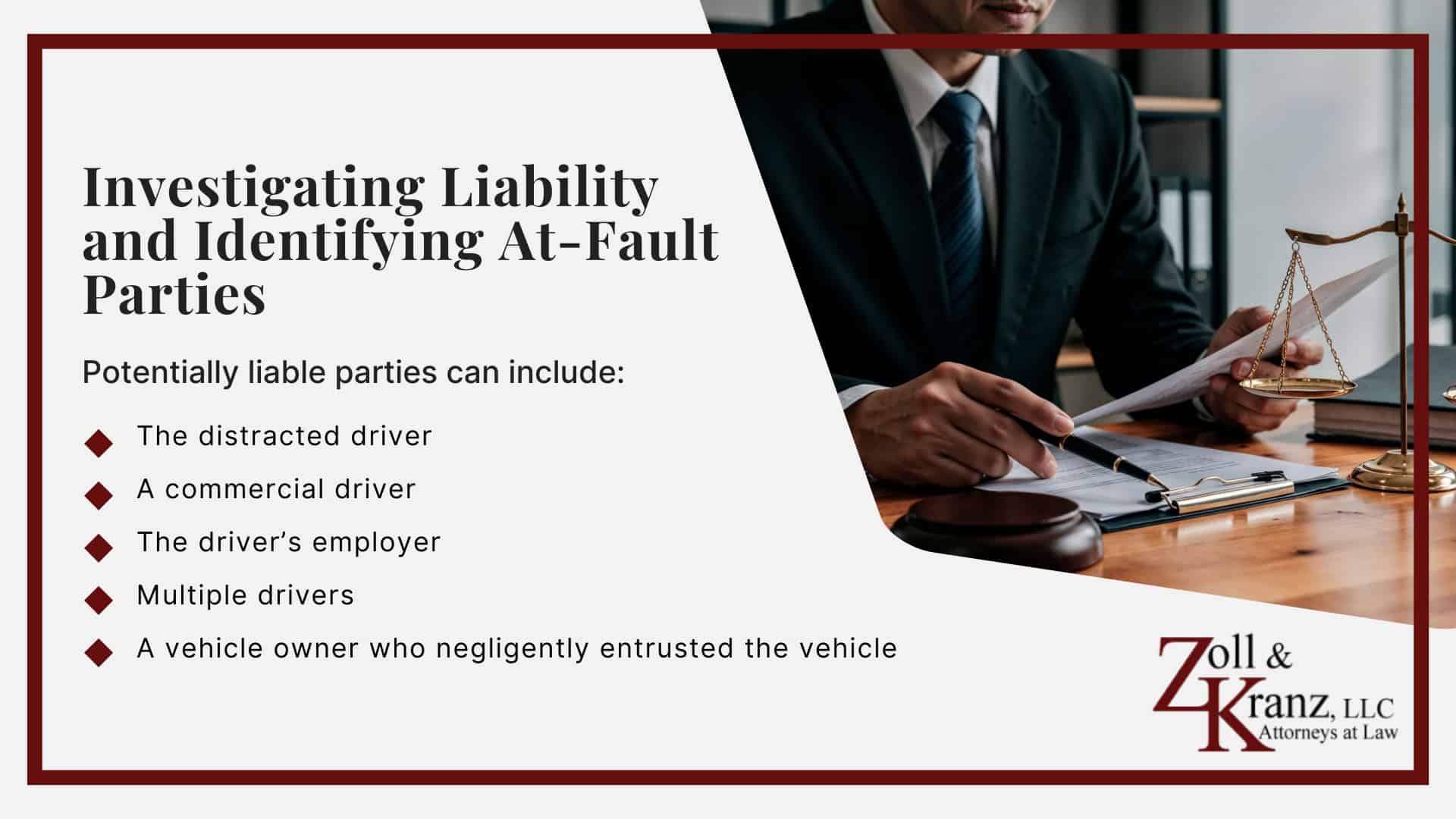
Distracted driving cases often begin like a standard injury claim, but they quickly become evidence driven because driver distractions are frequently denied or minimized once the driver realizes injuries and liability are serious.
The legal process focuses on proving the crash was avoidable and tying the distraction to the seconds before impact, not vague explanations after the fact.

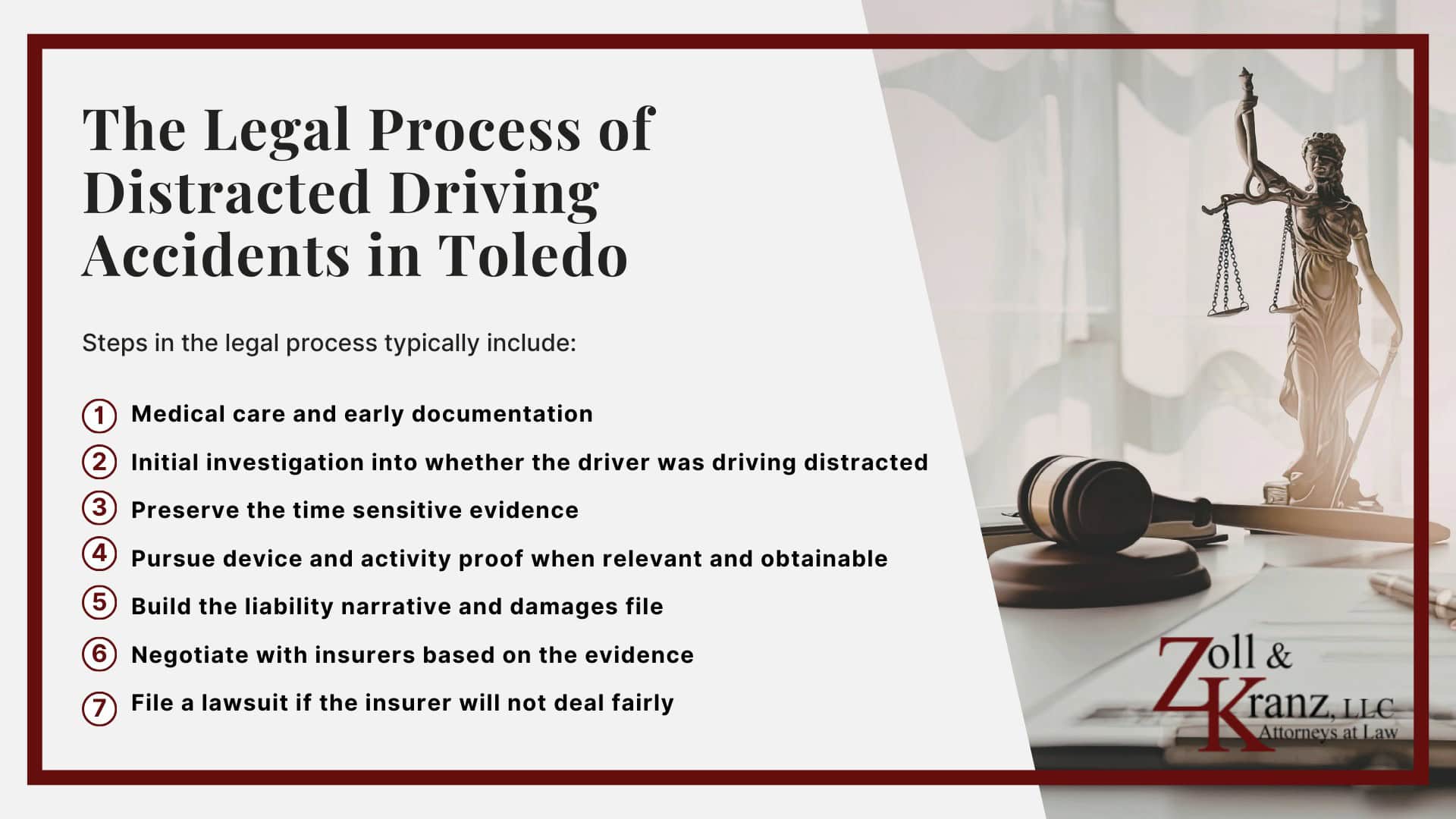
Steps in the legal process typically include:
- Medical care and early documentation: Treatment comes first, then documentation. Early records help show what injuries occurred and create a timeline that insurers cannot rewrite later.
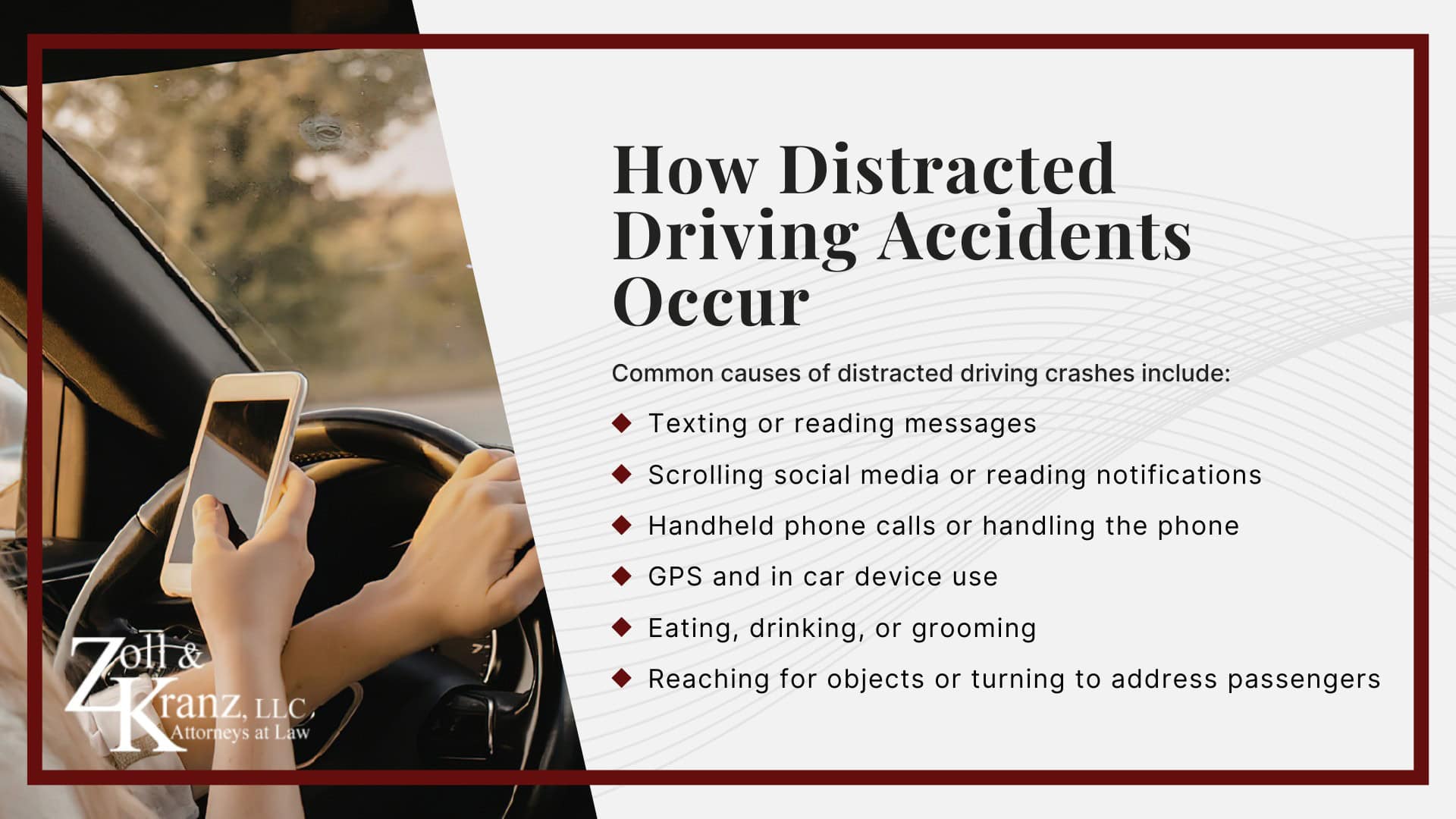
- Initial investigation into whether the driver was driving distracted: The claim turns on what the other driver was doing, texting, scrolling, interacting with a driver electronic device, or engaging in non driving activity such as personal grooming or adjusting air conditioning while traffic demanded full attention. These distracted driving behaviors matter because a few seconds of inattention can erase reaction time and turn a routine drive into a collision.
- Preserve the time sensitive evidence: Your lawyer works to lock down proof before it disappears, including the police report, scene photos, vehicle damage patterns, witness contact information, and any available video that captures lane position, speed, braking, and point of impact.
- Pursue device and activity proof when relevant and obtainable: When the facts support it, the case may involve requests for phone and app activity tied to the crash window. That kind of proof makes it harder to dismiss the collision as “unavoidable” when the timeline shows driving distracted in the moments before impact.
- Build the liability narrative and damages file: The goal is to show what happened, why it happened, and what it cost you. This includes connecting the collision mechanics to the injuries and documenting medical expenses, wage loss, and non economic harms.
- Negotiate with insurers based on the evidence: Many cases resolve through settlement, but the leverage depends on proof. Strong files often show a recognizable pattern where drivers engage in risky driving behaviors, the driver’s mind wanders during an ordinary trip, and that lapse produces deadly consequences for other people on the road.
- File a lawsuit if the insurer will not deal fairly: If the carrier disputes fault or minimizes the claim, litigation can force answers through discovery tools such as depositions, document requests, device related data requests when permitted, and expert review.
Throughout the process, the focus stays consistent: establish the distraction, prove causation, and document the full impact of the crash with evidence that holds up when the other side denies it.
Steps to Take After a Distracted Driving Accidents in Toledo
After a crash, your first priorities are safety and medical care, but the next priority is protecting evidence before it disappears.
Distracted driving accidents often turn on details that fade fast (footage overwrites, witnesses leave, and insurers start shaping the story), so the early steps you take can make a real difference in how a claim unfolds.
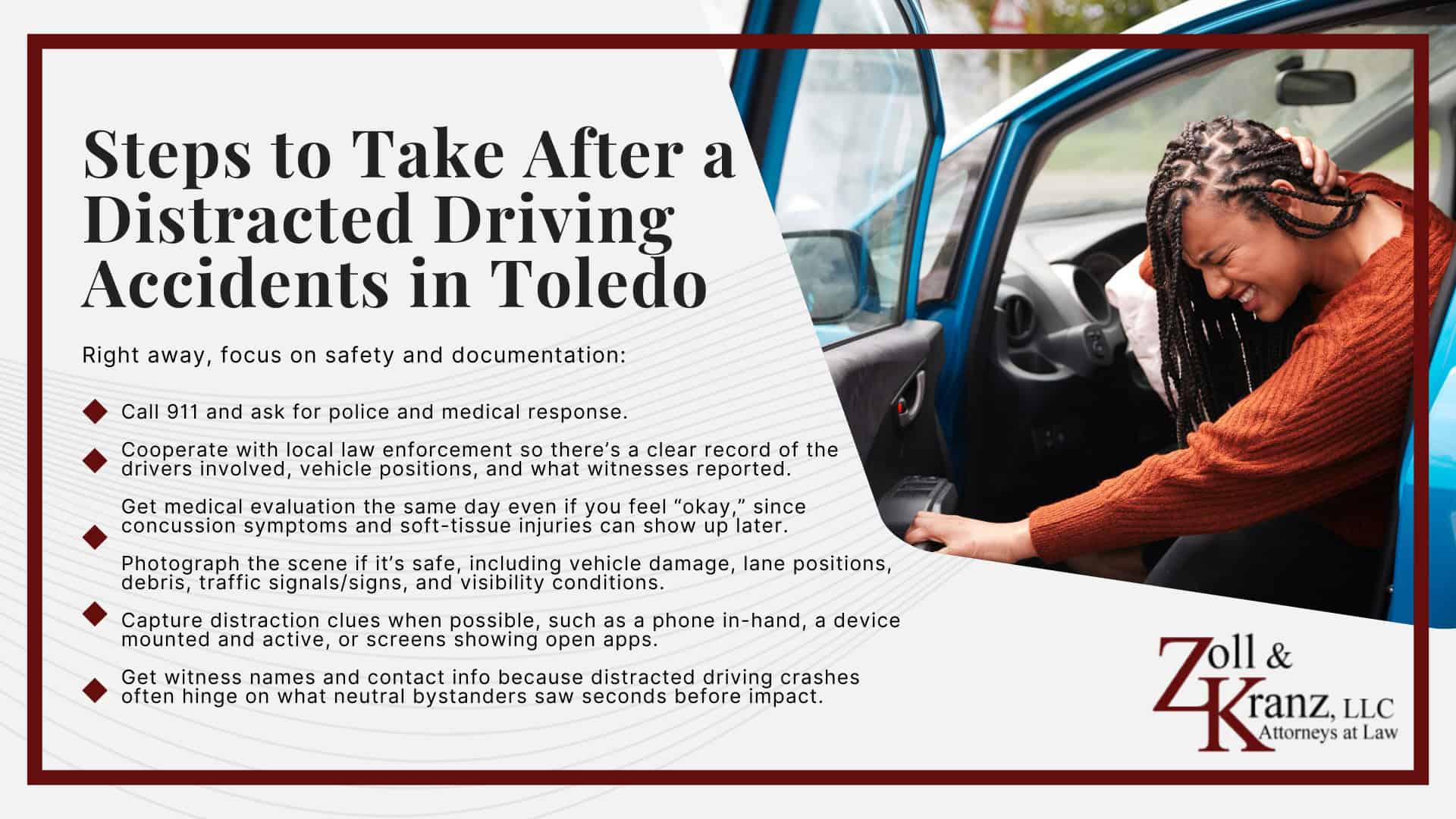
Right away, focus on safety and documentation:
- Call 911 and ask for police and medical response.
- Cooperate with local law enforcement so there’s a clear record of the drivers involved, vehicle positions, and what witnesses reported.
- Get medical evaluation the same day even if you feel “okay,” since concussion symptoms and soft-tissue injuries can show up later.
- Photograph the scene if it’s safe, including vehicle damage, lane positions, debris, traffic signals/signs, and visibility conditions.
- Capture distraction clues when possible, such as a phone in-hand, a device mounted and active, or screens showing open apps.
- Get witness names and contact info because distracted driving crashes often hinge on what neutral bystanders saw seconds before impact.
Then, protect your claim from common insurance traps.
Protecting your claim includes:
- Don’t give a recorded statement to the other driver’s insurer until you’ve gotten legal advice.
- Avoid guessing about fault or apologizing at the scene—those comments can be taken out of context later.
- Tell your attorney early if distraction is suspected, because cell phone and electronic device evidence can be time-sensitive and preservation matters.
Laws for Distracted Driving Accidents in Toledo, OH
Distracted driving cases in Toledo are governed by Ohio law, and the key statute people hear about most is Ohio Revised Code 4511.204, which restricts using an electronic wireless communications device while operating a vehicle, with limited exceptions (including certain hands-free and emergency-related situations).
In practical terms, these rules target the behaviors that most commonly cause preventable crashes—drivers taking their eyes, hands, or mind off the road at the exact moment safe driving requires full attention.
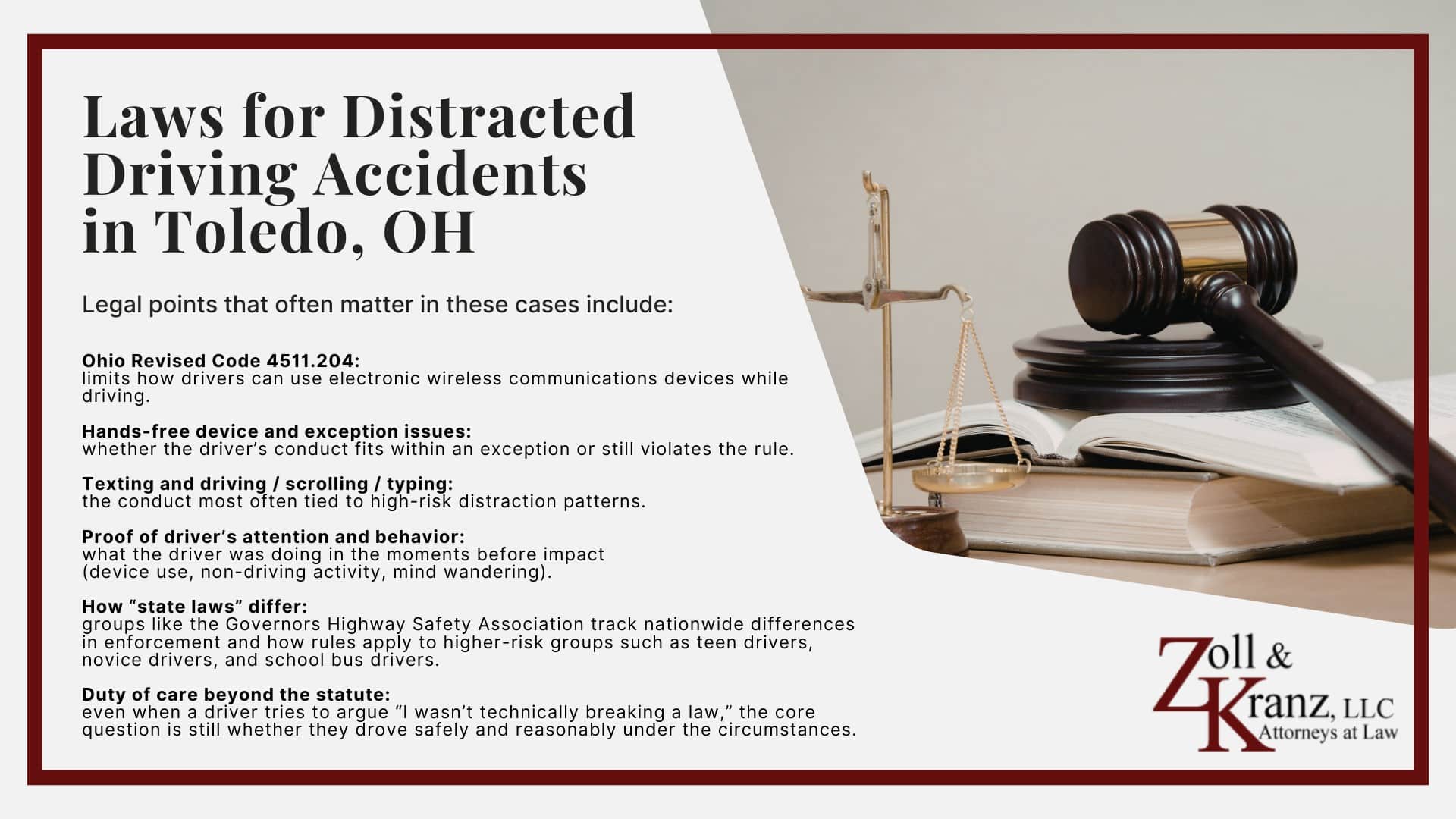
Legal points that often matter in these cases include:
- Ohio Revised Code 4511.204: limits how drivers can use electronic wireless communications devices while driving.
- Hands-free device and exception issues: whether the driver’s conduct fits within an exception or still violates the rule.
- Texting and driving / scrolling / typing: the conduct most often tied to high-risk distraction patterns.
- Proof of driver’s attention and behavior: what the driver was doing in the moments before impact (device use, non-driving activity, mind wandering).
- How “state laws” differ: groups like the Governors Highway Safety Association track nationwide differences in enforcement and how rules apply to higher-risk groups such as teen drivers, novice drivers, and school bus drivers.
- Duty of care beyond the statute: even when a driver tries to argue “I wasn’t technically breaking a law,” the core question is still whether they drove safely and reasonably under the circumstances.
In a Toledo distracted driving case, the real legal question is whether the driver’s preventable distraction caused the collision and whether the available evidence supports liability and full compensation for the harm that followed.
Ohio’s Statute of Limitations for Distracted Driving Accidents Cases
In Ohio, most personal injury claims from motor vehicle crashes (including distracted driving crashes) must generally be filed within two years of the crash date.
That deadline matters because evidence proving phone use or other common distractions can be lost, overwritten, or deleted long before a case reaches court.
Waiting also increases the risk that witnesses forget key details about what they saw the driver doing, especially whether the driver appeared distracted or was using a cell phone.
While there can be limited exceptions in certain situations, it’s risky to assume extra time applies without legal review.
Acting early helps protect your right to pursue compensation and strengthens the proof needed to show distracted driving resulted in the collision.
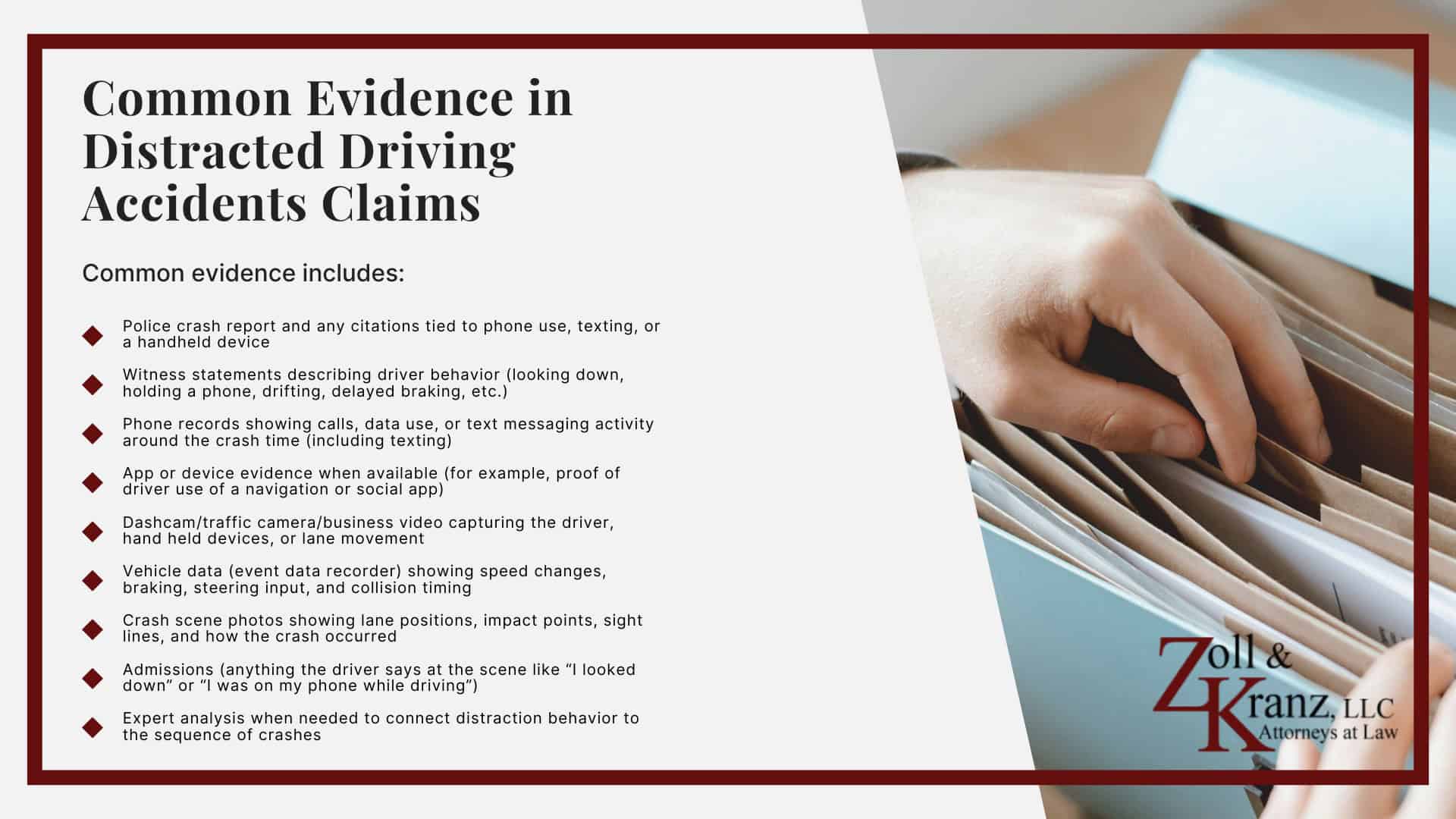
Common Evidence in Distracted Driving Accidents Claims
Distracted driving cases are won with specifics, not assumptions because insurers often argue “there’s no proof” the driver was distracted or that there was only a potential distraction that didn’t affect driving.
Evidence is designed to show what the driver was doing, where the driver’s eyes were, and how the distraction changed the ability to drive safely.
Common evidence includes:
- Police crash report and any citations tied to phone use, texting, or a handheld device
- Witness statements describing driver behavior (looking down, holding a phone, drifting, delayed braking, etc.)
- Phone records showing calls, data use, or text messaging activity around the crash time (including texting)
- App or device evidence when available (for example, proof of driver use of a navigation or social app)
- Dashcam/traffic camera/business video capturing the driver, hand held devices, or lane movement
- Vehicle data (event data recorder) showing speed changes, braking, steering input, and collision timing
- Crash scene photos showing lane positions, impact points, sight lines, and how the crash occurred
- Admissions (anything the driver says at the scene like “I looked down” or “I was on my phone while driving”)
- Expert analysis when needed to connect distraction behavior to the sequence of crashes
Distracted driving comes in many forms (eating, adjusting controls, etc.) but phone while driving remains one of the most litigated because digital records can corroborate what happened.
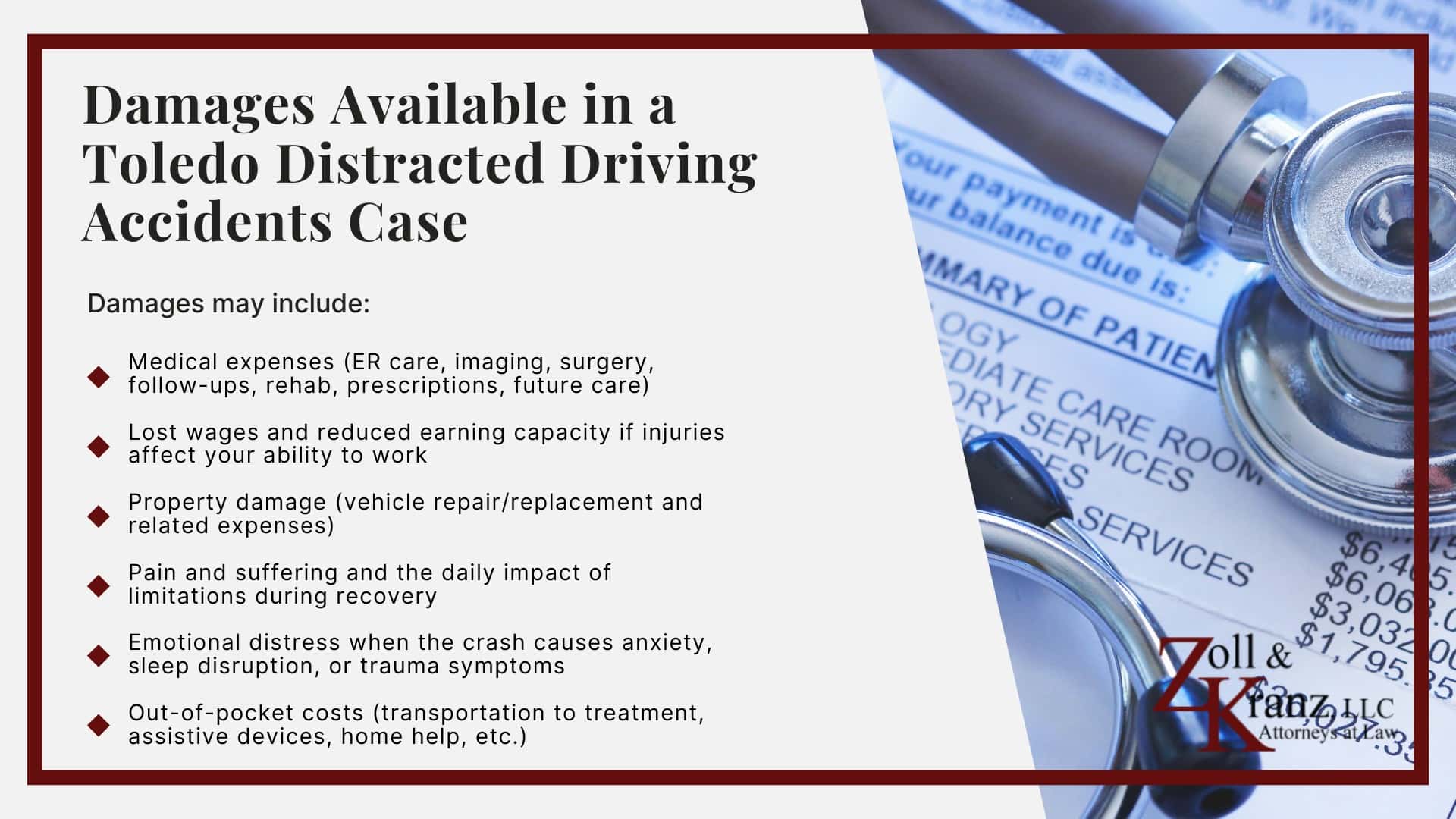
Damages Available in a Toledo Distracted Driving Accidents Case
Damages are meant to reflect the real cost of the crash (not just the first hospital visit), and that matters when distracted driving resulted in injuries that disrupt work, sleep, and daily function.
The goal is to recover losses tied to medical care, time off work, and the lasting impact of being hit by a distracted driver.
Damages may include:
- Medical expenses (ER care, imaging, surgery, follow-ups, rehab, prescriptions, future care)
- Lost wages and reduced earning capacity if injuries affect your ability to work
- Property damage (vehicle repair/replacement and related expenses)
- Pain and suffering and the daily impact of limitations during recovery
- Emotional distress when the crash causes anxiety, sleep disruption, or trauma symptoms
- Out-of-pocket costs (transportation to treatment, assistive devices, home help, etc.)
Even when an insurer tries to minimize the dangers by calling distraction “a momentary lapse,” the evidence can show that moment was enough to cause a near crash to become a serious collision.