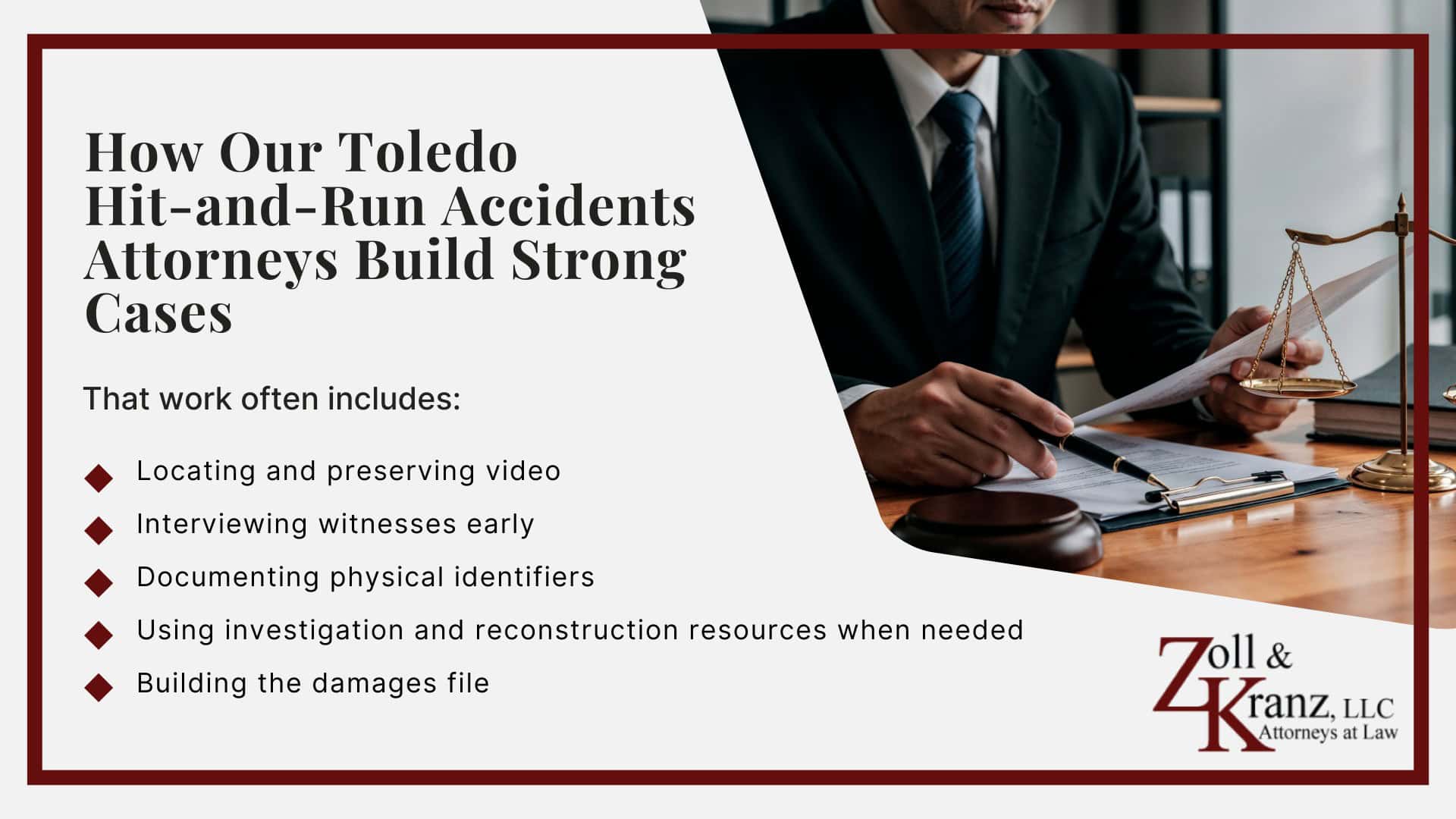
Hit-and-run cases start with two parallel tracks, identifying the fleeing driver if possible and building a car accident claim that can recover compensation even if the driver is never found.
Because the other driver left the scene, proving fault often depends on evidence captured early, before video is overwritten and witnesses scatter.

Steps in the legal process include:
- Call 911, get medical care, and create a report: Treatment comes first, then documentation. A police report helps establish that a hit-and-run occurred and can preserve early details about the fleeing vehicle and the crash scene.
- Lock down the early evidence that proves what happened: Photos of the scene, debris, impact points, and vehicle damage patterns can help show the direction of travel and mechanics of the collision. Witness names and nearby camera locations matter because identification often hinges on small details captured in the first day or two.
- Work with law enforcement while the search is active: Police will attempt to track down the other driver, and the quality of the initial information, descriptions, video leads, witness accounts, can affect whether that effort produces a match.
- Identify the insurance path and file the claim correctly: If the driver is identified, a third-party claim may proceed through that driver’s liability coverage. If the driver is not identified, your own policy may become the primary path, but only if your policy includes uninsured motorist coverage. Ohio law makes uninsured motorist coverage optional, policies may, but are not required to, include UM/UIM coverage.
- Meet the legal proof requirements for an unidentified driver: Ohio’s UM statute treats an unidentified hit-and-run driver as an “uninsured motorist” only if there is independent corroborative evidence proving the injury was caused by the negligence or intentional actions of the unidentified operator. Your testimony alone is not enough unless supported by additional evidence.
- Build damages and push back on insurance resistance: Hit-and-run victims often face extra friction from insurers, including disputes about what happened, what injuries are related, and whether the claim meets policy requirements. A car accident lawyer can preserve time-sensitive proof, tie the evidence to the medical record, and keep the claim consistent while the investigation continues.
- Escalate to a lawsuit if the insurer will not resolve the claim fairly: When liability or coverage is contested, litigation can force evidence through discovery and preserve testimony under oath, while positioning the case for settlement or trial.
This process is built to solve the first problem, identifying the driver, without losing the second, protecting the claim and the ability to recover compensation if the driver is never located.
Laws for Hit-and-Run Accidents in Ohio
Ohio traffic laws impose clear duties on any vehicle involved in a crash, and those duties apply even when a driver wants to leave because the damage looks “minor.”
On a public road or highway, a driver who knows a crash occurred must stop immediately and remain at the scene long enough to provide identifying information to the injured person, the other drivers involved, and any police officer who responds.
If an injured person cannot comprehend or record the required information, Ohio law requires the other operator to notify the nearest police authority with the location of the crash and the operator’s identifying details.
Hit-and-run duties also apply off the roadway.
If a crash happens on public or private property other than a public road or highway, such as a parking lot, the driver must stop and, when requested, provide identifying information and, if available, show a driver’s license.
And if a driver damages real property or personal property attached to real property, Ohio law requires the driver to stop, take reasonable steps to locate and notify the owner or person in charge, provide identifying information, and, upon request and if available, exhibit a driver’s or commercial driver’s license.
Ohio also ties penalties to harm.
Leaving the scene is generally charged as failure to stop after an accident, with escalating felony levels when the crash results in serious physical harm or death.
For victims, these statutes help establish that a hit-and-run occurred, but they do not pay the bills.
The immediate financial burden still falls on the injured person, which is why prompt reporting, thorough documentation, and early medical care matter.
From a claim perspective, you may still need to proceed through car insurance if the fleeing driver is not identified.
That makes it important to follow up with a medical professional quickly, document symptoms and treatment, and preserve proof that supports the claim while the investigation is active.
An experienced attorney can coordinate the civil claim alongside the criminal investigation, preserve time-sensitive evidence, and keep the case organized around proof rather than assumptions.
Ohio’s Statute of Limitations for Hit-and-Run Accidents Cases
In Ohio, most lawsuits for bodily injuries from an accident must be filed within two years under Ohio Revised Code § 2305.10.
Wrongful death claims generally also have a two-year deadline under Ohio Revised Code § 2125.02.
These deadlines can matter even more in hit-and-run cases because gathering evidence takes time, and delays can make it harder to locate the driver, confirm a license plate number, or secure video footage before it is overwritten.
If you’re injured, it’s smart to talk with a car accident attorney early so you don’t lose leverage or lose your right to file entirely.
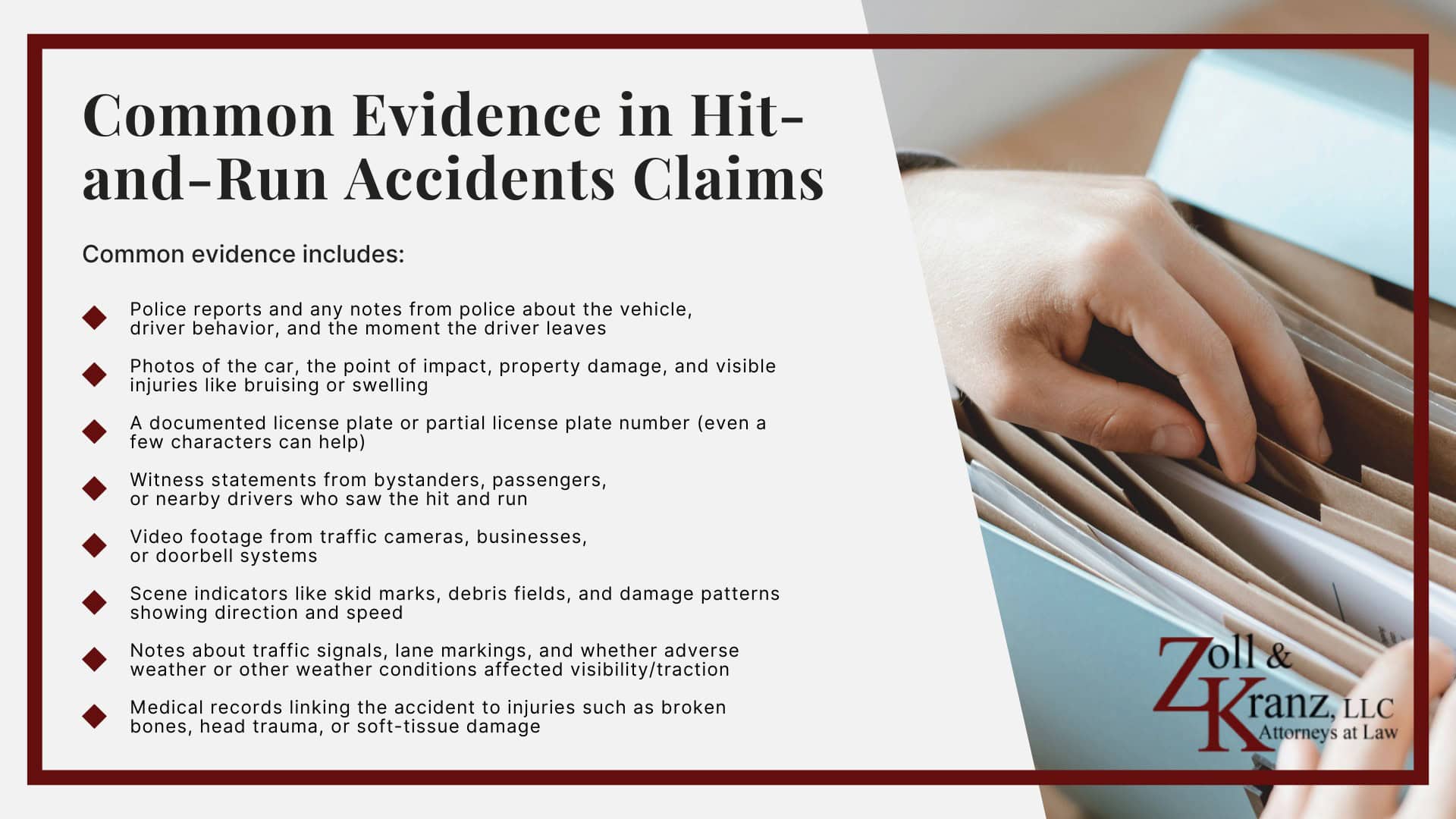
Common Evidence in Hit-and-Run Accidents Claims
Proving what happened often comes down to collecting details from the crash scene and locking them into a clear timeline, especially when the driver disappears.
Common evidence includes:
- Police reports and any notes from police about the vehicle, driver behavior, and the moment the driver leaves
- Photos of the car, the point of impact, property damage, and visible injuries like bruising or swelling
- A documented license plate or partial license plate number (even a few characters can help)
- Witness statements from bystanders, passengers, or nearby drivers who saw the hit and run
- Video footage from traffic cameras, businesses, or doorbell systems
- Scene indicators like skid marks, debris fields, and damage patterns showing direction and speed
- Notes about traffic signals, lane markings, and whether adverse weather or other weather conditions affected visibility/traction
- Medical records linking the accident to injuries such as broken bones, head trauma, or soft-tissue damage
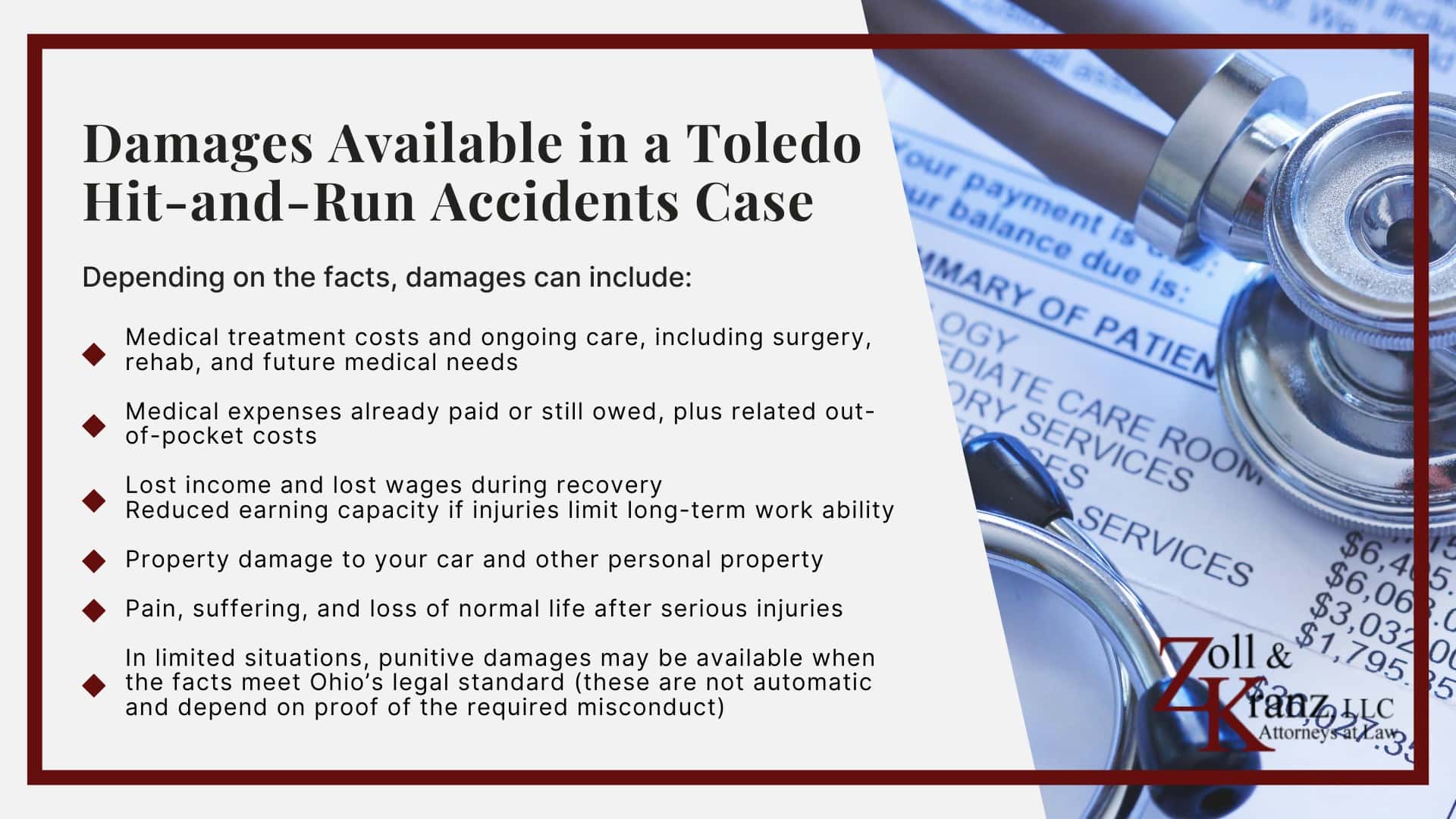
Damages Available in a Toledo Hit-and-Run Accidents Case
The goal is a fair settlement (or trial outcome) that reflects the real impact of the crash, not just the first round of bills.
Depending on the facts, damages can include:
- Medical treatment costs and ongoing care, including surgery, rehab, and future medical needs
- Medical expenses already paid or still owed, plus related out-of-pocket costs
- Lost income and lost wages during recovery
- Reduced earning capacity if injuries limit long-term work ability
- Property damage to your car and other personal property
- Pain, suffering, and loss of normal life after serious injuries
- In limited situations, punitive damages may be available when the facts meet Ohio’s legal standard (these are not automatic and depend on proof of the required misconduct)