After an accident that causes suffered paralysis, many of the “recommended steps” are not realistic for the victim.
A person may be immobilized, sedated, transported by ambulance, or in surgery within hours.
That does not weaken the claim.
It changes who has to act, and family members and lawyers often step in to protect the evidence and the legal record while the injured person focuses on survival and stabilization.

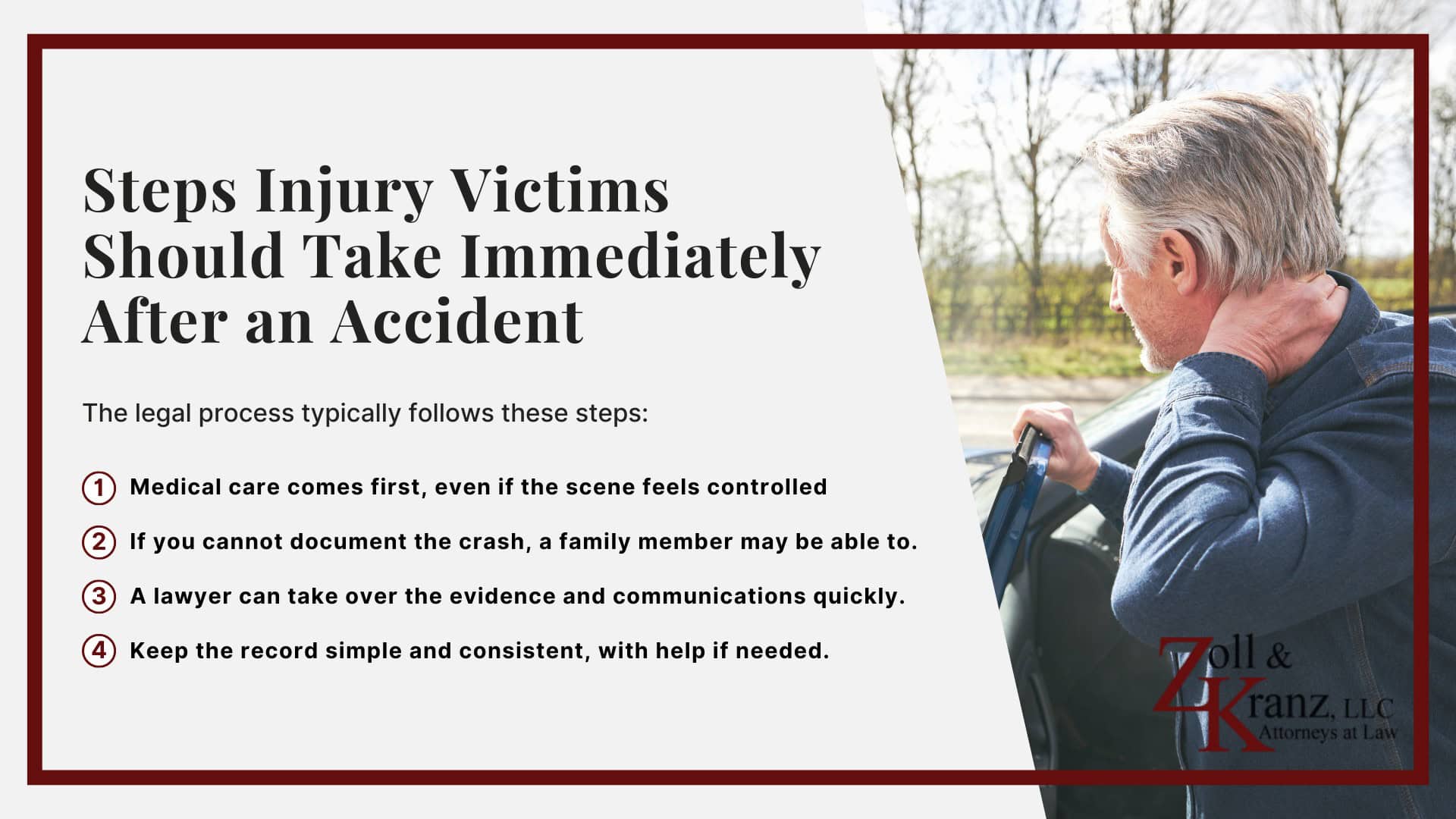
1. Medical care comes first, even if the scene feels controlled
The priority is immediate medical attention, because spinal cord and brain trauma can worsen as swelling increases.
That risk exists even when symptoms seem limited at first, and even temporary paralysis can progress if bleeding, compression, or inflammation develops.
- Call 911 and request emergency services.
- Accept transport if recommended and do not try to “wait it out.”
- Tell medical professionals exactly what you feel, including numbness, weakness, loss of sensation, limb heaviness, or bladder or bowel changes.
- Follow through with imaging, referrals, and specialist care so the medical record captures the injury early.
2. If you cannot document the crash, a family member may be able to.
When paralysis limits mobility, a spouse, parent, or trusted friend can preserve the basics that insurers and defense counsel later fight over.
- Confirm a police report is being made and write down the report or incident number.
- Photograph the injury site and surrounding conditions if it is safe, including vehicle positions, debris, skid marks, lane markings, and any roadway hazards.
- Get witness names and contact information before people leave.
- Save any texts, emails, or messages from the other driver or insurers.
3. A lawyer can take over the evidence and communications quickly.
Paralysis cases often involve pressure from insurers while the victim is hospitalized or in rehabilitation. Early legal help can prevent gaps in the record and stop avoidable mistakes.
- Preserve time sensitive evidence, including video footage, vehicle inspections, and electronic crash data when available.
- Coordinate the collection of crash reports, photos, witness statements, and medical documentation without placing the burden on the injured person.
- Manage insurer contact and reduce the risk of recorded statements, coverage disputes, or early settlement pressure while prognosis is still developing.
4) Keep the record simple and consistent, with help if needed.
Paralysis affects daily tasks, memory, and stamina, and the timeline matters in serious injury litigation. Family members can help maintain a clean paper trail when the victim is not able to do it.
- Save discharge instructions, test results, medication lists, and therapy notes.
- Track symptoms and functional limits in a basic timeline tied to the injury accident.
- Keep copies of bills, receipts, and wage loss documentation connected to missed work.
When paralysis changes what you can physically do after a crash, the right response is not to “catch up later.”
It is to get medical care, then have family members and counsel preserve the proof and protect the claim while recovery takes priority.
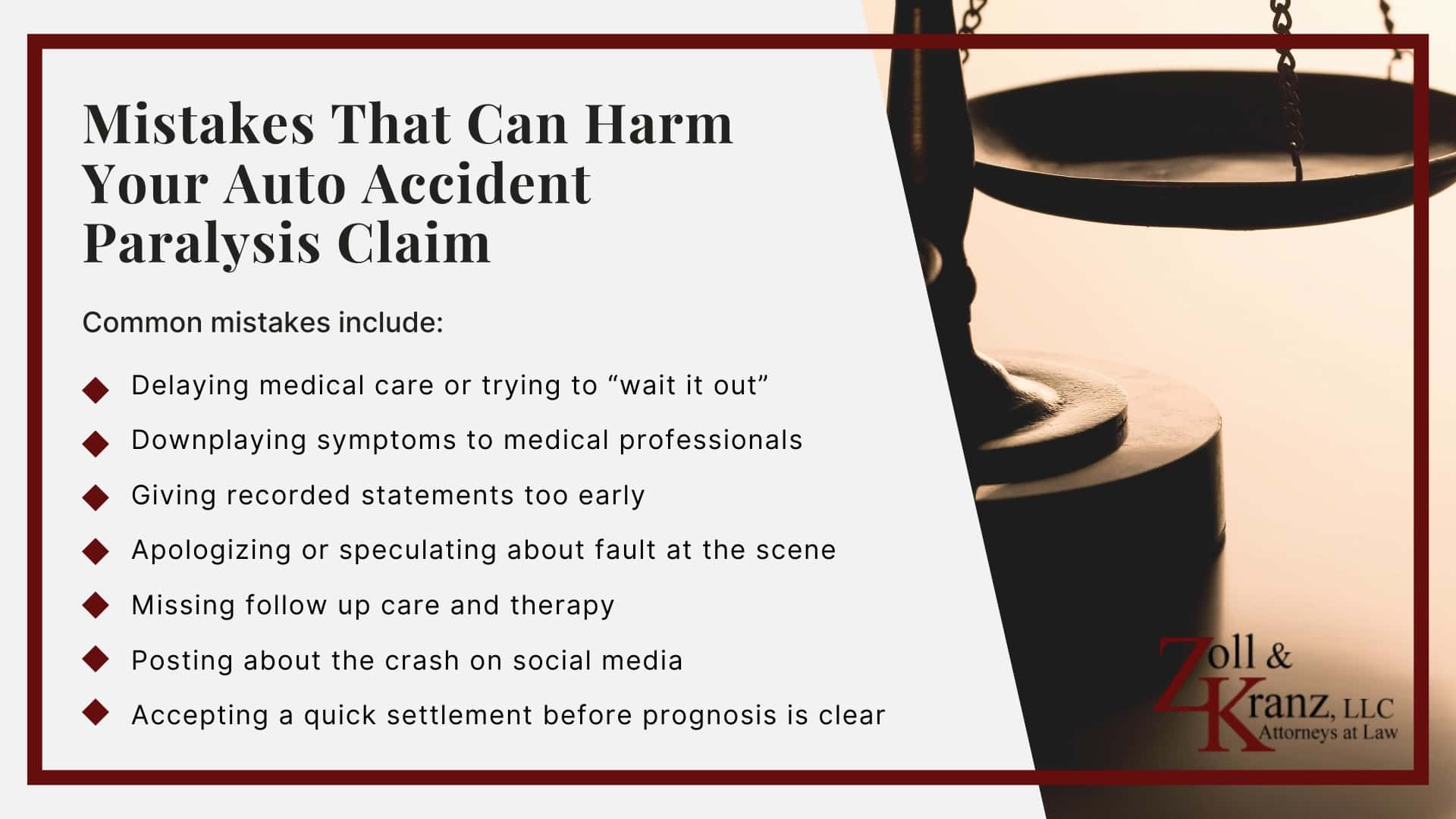
Mistakes That Can Harm Your Auto Accident Paralysis Claim
Paralysis claims are vulnerable to early missteps because insurers look for gaps they can use to dispute causation, minimize damages, or shift fault.
The mistakes below show up repeatedly in cases involving spinal cord or brain trauma, and they can weaken the medical record and the liability narrative even when the crash clearly caused severe trauma.
Common mistakes include:
- Delaying medical care or trying to “wait it out”: Paralysis symptoms can worsen as swelling increases, and gaps in treatment give insurers room to argue the condition was not caused by the crash or was made worse by delay.
- Downplaying symptoms to medical professionals: If weakness, numbness, loss of sensation, or bladder control issues are not documented early, the defense may later claim those problems were not present or are unrelated to the collision.
- Giving recorded statements too early: Early recorded statements often lead to guesswork about speed, lane position, or timing, and insurers use inconsistencies to challenge credibility or shift blame away from the at fault driver.
- Apologizing or speculating about fault at the scene: Offhand comments can be treated as admissions and used to argue you caused or contributed to the crash, even when the facts point elsewhere.
- Missing follow up care and therapy: Skipped appointments, unfinished referrals, and gaps in occupational or physical therapy are commonly framed as proof the injury is not serious, even when the person is still struggling with major limitations.
- Posting about the crash on social media: Photos and short clips can be taken out of context to argue you are not suffering, not limited, or not dealing with emotional impact.
- Accepting a quick settlement before prognosis is clear: Paralysis outcomes can evolve over months, and once a settlement release is signed, the claim usually cannot be reopened if complications develop or a condition that seemed temporary becomes permanent.
How Insurance Companies Handle Auto Accident Paralysis Claims
Insurance companies usually treat paralysis claims as high exposure from the start, which means the adjuster’s first priority is controlling the record that will later support, or undermine, the value of the case.
They often move quickly to secure statements, collect documentation on their terms, and steer the claim toward an early outcome before the long term picture is clear.
Common tactics include requesting broad medical authorizations, pushing for recorded statements, and pressing for early “resolution” while your diagnosis and prognosis are still developing.
In paralysis cases, early notes rarely capture the full scope of impairment, future medical treatment, the need for occupational therapy, or the likelihood of permanent disability, and that uncertainty can be used against you if the claim is closed too soon.
Insurers also look for alternative explanations.
They frequently comb through records for prior neck or back complaints, then argue the loss of motor function was preexisting or unrelated, even when the crash triggered the symptoms.
They may isolate a single chart note, point to a missed appointment, or highlight a short gap in medical treatment to downplay severity, while ignoring the broader medical picture and the reality of recovery after spinal cord or brain trauma.
Damages are another pressure point.
Beyond medical bills and wage loss, insurers often resist paying for non economic harms such as emotional distress, and they may frame a well supported demand as a push for “maximum compensation” to make it sound inflated.
If liability is disputed, the carrier may lean on incomplete accident reports, inconsistent witness statements, or a changing story from the other driver to shift fault onto the injured person and reduce what they pay.
This is where early legal guidance matters.
A lawyer who practice law in serious injury litigation can explain your legal options, protect the evidence and the medical record, and present the claim in a way that is consistent with how causation, liability, and damages are proven in paralysis cases.
Ohio’s Statute of Limitations for Auto Accident Paralysis Cases
Ohio generally gives injured people two years from the date of the crash to file a personal injury lawsuit, and that deadline still applies even when your medical attention, hospitalization, and rehab are consuming your life.
This matters because paralysis cases are proof-heavy and time-sensitive—waiting can cause detailed records to disappear, witnesses to become harder to locate, and crash evidence to be lost.
Early legal action also helps avoid pressure from insurance companies to settle before the long-term picture is clear, especially when doctors are still evaluating treatment options and the risk of complications like blood clots.
The safest approach is to confirm deadlines early so you don’t lose your legal rights while focusing on stabilization and care.
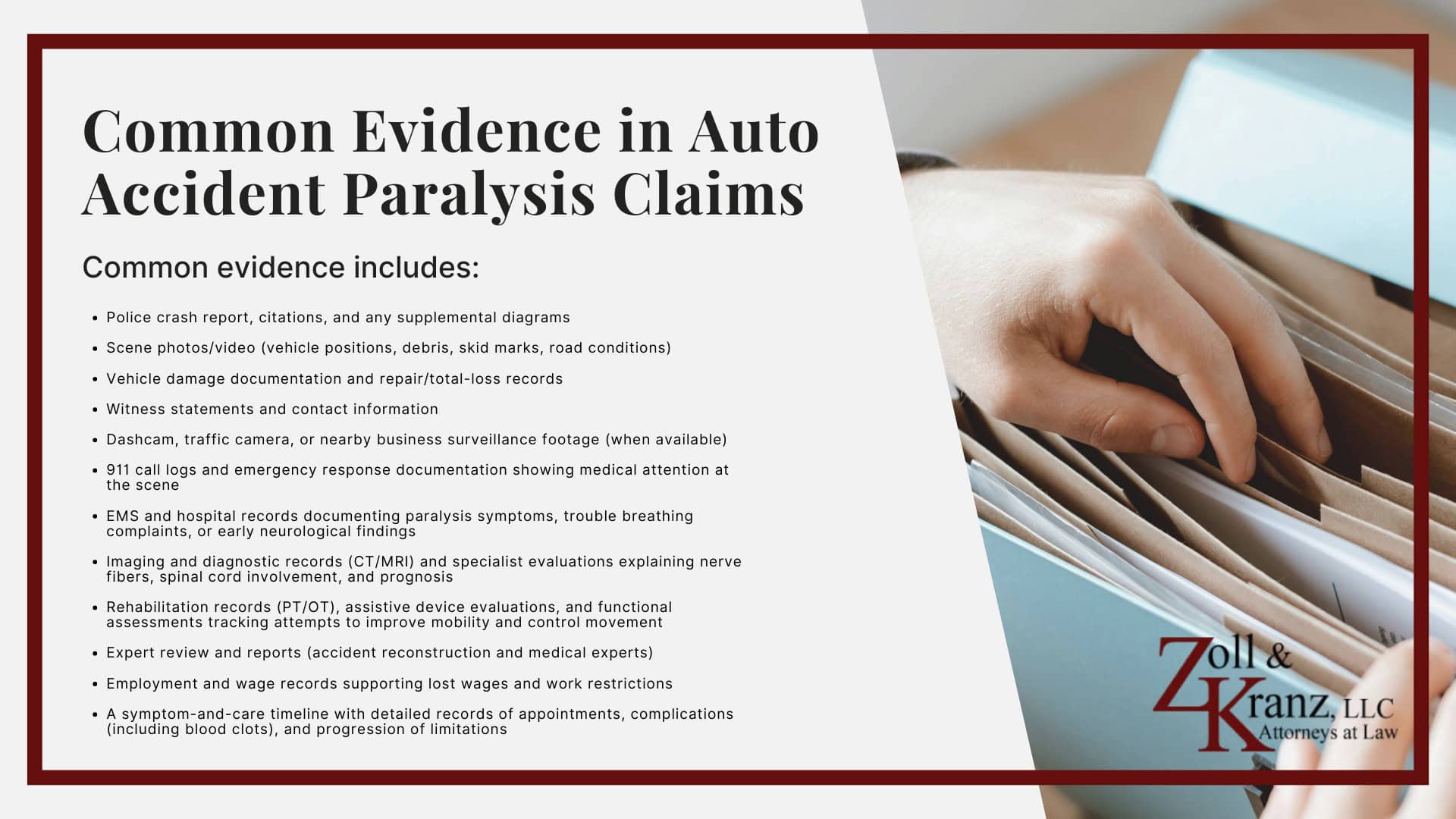
Common Evidence in Auto Accident Paralysis Claims
Auto accident paralysis cases depend on clear proof of how the crash happened and how the injury changed your life and required ongoing care.
Because many injuries evolve over time (especially spinal trauma affecting the nervous system and muscle control), good documentation often comes from both crash evidence and medical evidence, supported by medical experts.
Common evidence includes:
- Police crash report, citations, and any supplemental diagrams
- Scene photos/video (vehicle positions, debris, skid marks, road conditions)
- Vehicle damage documentation and repair/total-loss records
- Witness statements and contact information
- Dashcam, traffic camera, or nearby business surveillance footage (when available)
- 911 call logs and emergency response documentation showing medical attention at the scene
- EMS and hospital records documenting paralysis symptoms, trouble breathing complaints, or early neurological findings
- Imaging and diagnostic records (CT/MRI) and specialist evaluations explaining nerve fibers, spinal cord involvement, and prognosis
- Rehabilitation records (PT/OT), assistive device evaluations, and functional assessments tracking attempts to improve mobility and control movement
- Expert review and reports (accident reconstruction and medical experts)
- Employment and wage records supporting lost wages and work restrictions
- A symptom-and-care timeline with detailed records of appointments, complications (including blood clots), and progression of limitations
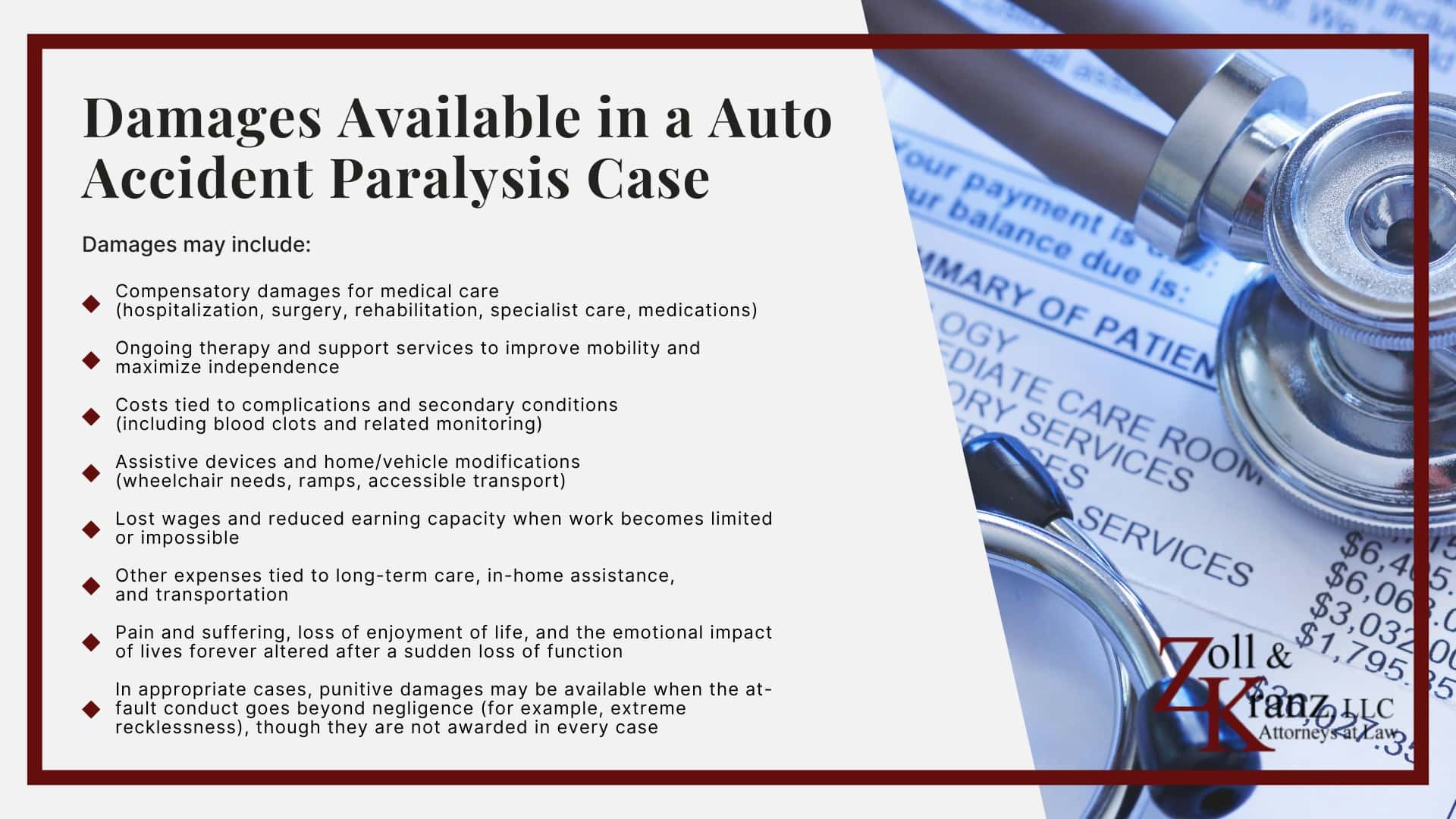
Damages Available in a Auto Accident Paralysis Case
Paralysis is often life altering in a way that affects every part of daily living (mobility, self-care, work, and emotional well being), so damages should reflect what the injury truly changed, not just the first round of bills.
In severe cases, the damages analysis also accounts for the reality that the person’s life may be permanently limited, even when treatment options help improve mobility or restore partial function.
Damages may include:
- Compensatory damages for medical care (hospitalization, surgery, rehabilitation, specialist care, medications)
- Ongoing therapy and support services to improve mobility and maximize independence
- Costs tied to complications and secondary conditions (including blood clots and related monitoring)
- Assistive devices and home/vehicle modifications (wheelchair needs, ramps, accessible transport)
- Lost wages and reduced earning capacity when work becomes limited or impossible
- Other expenses tied to long-term care, in-home assistance, and transportation
- Pain and suffering, loss of enjoyment of life, and the emotional impact of lives forever altered after a sudden loss of function
- In appropriate cases, punitive damages may be available when the at-fault conduct goes beyond negligence (for example, extreme recklessness), though they are not awarded in every case