No fees unless we win.
Get a free consultation
8 Reviews
5.0
★★★★★

Rollover Accidents in Toledo

Our Experienced Rollover Accidents Lawyers Help You Seek Justice and Compensation

Rollover accidents are some of the most dangerous crashes on Toledo roads because a single impact or sudden maneuver can turn into a violent, multi-directional event in seconds.

The force of a rollover can eject occupants, crush the roofline, and cause catastrophic injuries even when seat belts are used.

Zoll & Kranz investigates rollover accidents in Toledo and helps injured people pursue compensation and justice when negligence, unsafe road conditions, or vehicle defects may have contributed to the crash.

Rollover Accidents in Toledo

Contact the Toledo OH Rollover Accidents Lawyers at Zoll & Kranz Today

A rollover accident may start with a sideswipe, a sharp correction, or a turn through an intersection, but the outcome is often severe once a vehicle tips and the roofline and cabin absorb repeated impacts.

National crash data shows rollovers have a higher fatality rate than many other crash types, and NHTSA research has found they contribute to roughly one third of occupant deaths despite representing a small share of crashes.

In a rollover car accident, occupants often suffer head and neck trauma, and traumatic brain injuries are common, especially when a person is unrestrained or partially ejected.

Spinal cord injuries are among the most severe outcomes, including life changing paralysis when the neck or spine is compromised during roof crush, rotation, or ejection forces.

Rollover crashes can also set off a chain reaction on higher speed routes, where other vehicles may strike the overturned car or debris.

In fatal rollover crashes, NHTSA data shows alcohol involvement is frequent, with about half of drivers in fatal rollover crashes registering a measurable BAC in the FARS analysis used in its rollover characteristics report.

The same NHTSA report found that almost three fourths of fatal rollover crashes occurred in rural areas, which helps explain why speed environment and roadway design often matter in these cases.

Even when a rollover seems to happen “out of nowhere,” the evidence often tells a clearer story through skid marks, impact points, and damage patterns, and the long term consequences can include emotional trauma and PTSD after the crash.

A rollover motor vehicle accident can leave victims facing surgery, hospitalization, rehabilitation, and months of limitations that affect work and daily function.

If your car rolled over in Toledo, you deserve answers about why it happened and what it will take to recover financially and physically.

Contact the Toledo car accident lawyers at Zoll & Kranz today.

You can also use the chatbot on this page to see if you qualify for a car accident claim.

Understanding Rollover Accident Claims in Toledo, Ohio

Rollover accidents are medically and legally demanding cases because the forces involved can cause catastrophic injury and long term impairment for vehicle occupants.

A rollover may look like a single moment of lost control, but liability often depends on why the vehicle became unstable in the first place, how the crash sequence started, and whether the rollover risk could have been avoided through safer driving decisions, safer roadway conditions, or a safer vehicle.

Rollover crashes often involve traumatic brain injuries, severe head and neck trauma, spinal cord damage, and fractures sustained when the vehicle tips and the roof structure and cabin absorb repeated impacts.

These cases also require close attention to occupant movement and restraint use.

Interior contact points, roof crush patterns, glass breakage, and belt marks can help explain how occupants moved during the roll sequence and why the injuries occurred the way they did.

Not every rollover follows the same pattern.

Some begin as “tripped” rollovers, where a tire strikes a curb, soft shoulder, guardrail, or another object that initiates the tip.
Others are untripped rollovers, where the vehicle rolls without striking an external object first, often tied to a high speed steering input, an overcorrection, a loss of traction, or vehicle stability characteristics.

That distinction matters because it can change the investigation, the liability theory, and the evidence needed to prove what triggered the roll.

Because rollover crashes can produce severe injuries even at moderate speeds, a strong claim has to show more than that a collision occurred.

It must document what set the rollover in motion and connect the medical harm to that mechanism through records, imaging, and crash evidence.

The personal injury lawyers at Zoll & Kranz build rollover accident claims around clear proof of causation, responsibility, and the full effect the crash has had on your health, work, and daily life.

Common Causes of Rollover Accidents

Rollover crashes usually happen when a vehicle’s momentum shifts suddenly and the tires “trip” or lose stability, causing the vehicle to tip and rotate.

Many rollovers start with driver behavior, but roadway features, vehicle design, and actions by other drivers can also create the conditions for a rollover, including crashes that get recorded as single vehicle crashes even when another driver’s negligence forced an evasive maneuver.
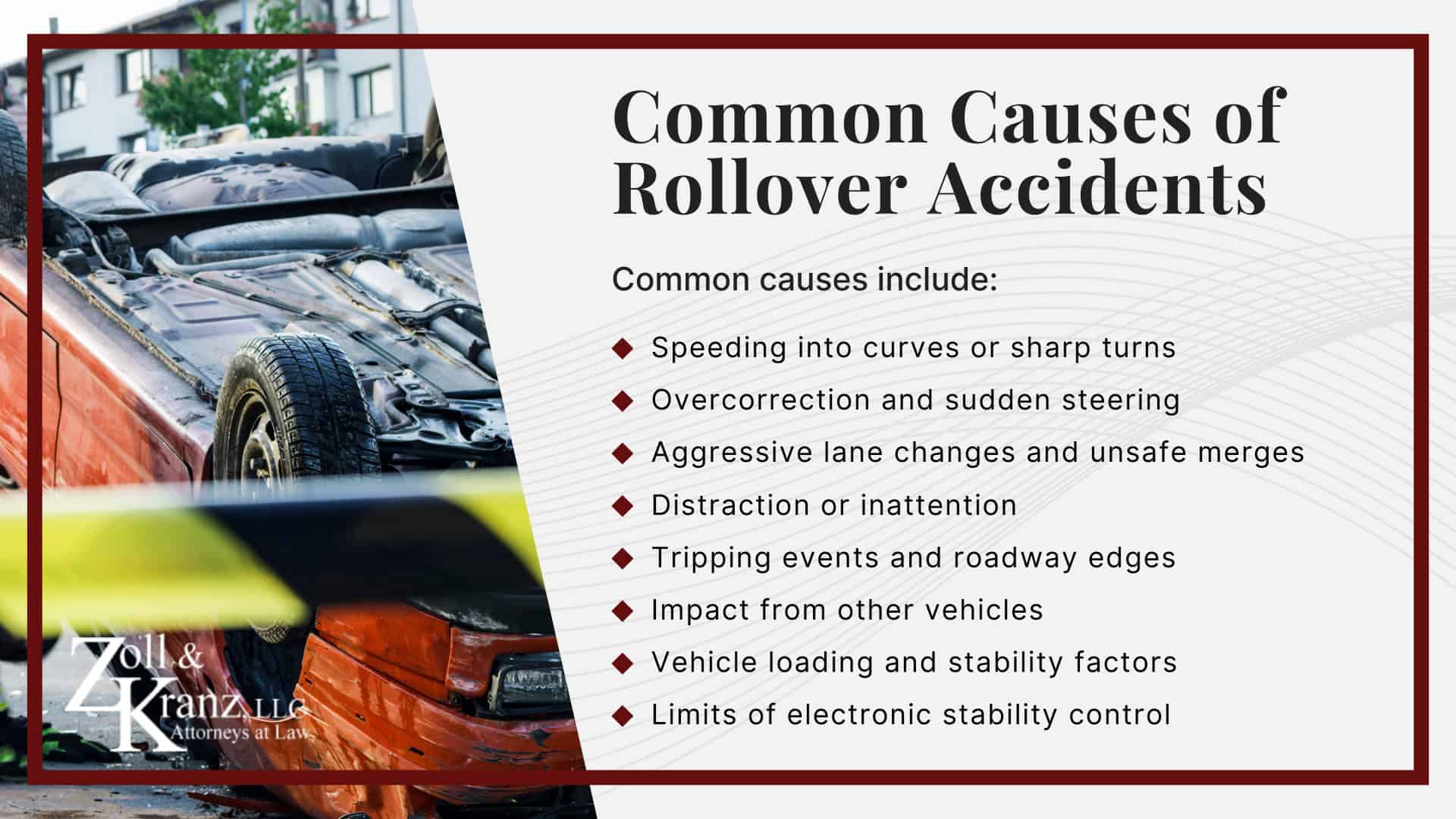
Common causes include:

  • Speeding into curves or sharp turns: Excess speed raises lateral forces and increases the chance a vehicle’s center of gravity moves outside its base of support, especially in passenger cars making abrupt steering inputs.
  • Overcorrection and sudden steering: A quick correction after drifting, swerving to avoid a hazard, or snapping the wheel back into the lane can trigger a loss of traction and a tip, particularly when weight shifts quickly from side to side.
  • Aggressive lane changes and unsafe merges: Rapid lane changes, cutting between vehicles, or late merges near ramps often cause violent steering inputs that can start the rollover sequence.
  • Distraction or inattention: Looking down or reacting late can lead to a sharp, last second maneuver that destabilizes the vehicle, even if the initial trigger seems minor.
  • Tripping events and roadway edges: A curb, soft shoulder, uneven drop off, guardrail contact, or tire digging into dirt can “trip” the vehicle and initiate rotation. Standing water, debris, or uneven pavement can also cause a tire to grab and start the roll.
  • Impact from other vehicles: A sideswipe, rear quarter impact, or angle hit can rotate a vehicle and set up a rollover. Some of these collisions become single vehicle accidents on paper when the at fault driver leaves the scene or the initial contact is not documented, but the crash still began with the actions of other drivers.
  • Vehicle loading and stability factors: Cargo shifts, heavy loads, or mechanical issues affecting stability can make a vehicle more prone to rolling once control is lost.
  • Limits of electronic stability control: Electronic stability control can reduce rollover risk by helping a driver maintain directional control, but it cannot overcome extreme speed, severe roadway hazards, or certain impact dynamics once a vehicle is already tripping or rotating.

Even when police reports classify a wreck as a single vehicle event, the evidence can show a broader chain of causation, including third party negligence, roadway hazards, or an impact that triggered the rollover.
How Our Toledo Car Accident Attorneys Build Strong Cases

Rollover accidents require a fast, evidence driven approach because the scene changes quickly and vehicle condition evidence can disappear once the car is moved, repaired, or salvaged.

If you or a loved one has been involved in a rollover accident, you have the right to seek legal representation with an experienced car accident attorney to pursue financial compensation for the injuries and losses your family has suffered.

That recovery depends on proof, and in most cases it requires showing negligence by another driver or another responsible party.

Our work starts with investigating the circumstances of the crash while the evidence is still available. We secure photos, measurements, and documentation that show where the vehicle first departed its travel path, what it struck, and how the rollover sequence unfolded.

We analyze exterior damage, roof intrusion, interior contact points, and restraint evidence to understand what happened to the occupants during the roll and how the injuries were sustained.

A thorough liability review also looks beyond driver conduct. Legal investigations often evaluate hazardous conditions such as potholes, uneven surfaces, poor shoulder drop offs, and missing or inadequate signage when determining whether roadway factors contributed to the rollover.

When needed, we work with qualified experts to assess crash dynamics and highway safety factors, including speed, rotation, and points of impact, so the case rests on measurable facts rather than assumptions.

We also obtain medical records and treatment timelines that document the seriousness of the harm, including spinal cord injuries, traumatic brain injuries, severe head trauma, and fractures.

Consulting an attorney as soon as possible can make a significant difference in protecting your vehicle accident claim, preserving key evidence, and identifying all accident liability factors.

Car accident victims have a legal right to financial compensation, but the case must be built around clear proof of negligence, causation, and damages.

Investigating Liability and Identifying At-Fault Parties

Liability in rollover accidents can involve more than one cause, even when the crash is initially labeled a single vehicle rollover.

The label does not answer the legal question of who created the risk that led to the rollover, and it does not limit who can be responsible for an injured passenger’s losses.

Potentially liable parties can include:

  • The driver of the vehicle you were riding in: If you were a passenger injured in a single car accident, the driver may be the at fault party if speeding, distraction, impairment, fatigue, or another driving error caused the rollover. Passenger injury claims can be brought against the driver when the evidence supports negligence.
  • Another driver: A rollover may begin when another motorist makes an unsafe merge, cuts in too closely, brakes abruptly, or forces an evasive maneuver that causes a loss of control. Hit and run dynamics also matter, because a crash can be recorded as “single vehicle” even when another driver triggered it and left the scene.
  • A government entity responsible for road design or maintenance: Poor drainage, missing or damaged guardrails, dangerous shoulder drop offs, uneven pavement, potholes, and inadequate signage can contribute to a vehicle tipping or losing stability. These cases require early investigation and strict procedural deadlines.
  • A roadway contractor or work zone operator: Construction zones with improper lane shifts, poor tapering, unclear markings, or debris left in the travel lane can create rollover conditions, especially at higher speeds.
  • A vehicle or parts manufacturer: Mechanical failures, including tire defects, wheel failures, suspension issues, or stability related defects, can increase rollover risk once the vehicle is destabilized. When the evidence points to a defect, preserving the vehicle and component parts becomes critical.
  • A maintenance or repair provider: Improper tire installation, incorrect repairs, or negligent maintenance can contribute to a loss of control and tip sequence, particularly when failures occur at speed.

If evidence shows a third party contributed, another driver, a contractor, a manufacturer, or a public entity, Zoll & Kranz identifies that party early and preserves proof before it disappears.

This matters in the most serious cases, including fatal rollovers, because long term financial stability often depends on locating every responsible party and documenting how each act of negligence contributed to the crash.

Calculating the Full Extent of Your Damages

The damages in rollover accidents often extend far beyond the first hospital bill, especially when the outcome includes serious injuries or permanent impairment.

We document medical expenses and future care needs tied to spinal cord injuries, traumatic brain injuries, broken bones, and other injuries sustained, including rehabilitation, assistive devices, and long-term therapy.

We also calculate lost income and reduced earning capacity when severe injuries limit your ability to return to the same work or maintain full-time employment.

In addition to financial losses, we build a clear record of pain, limitations, and daily-life disruption, because rollover crashes can permanently affect mobility, independence, and quality of life.

When the case involves rollover fatalities, we focus on the losses families face after fatal rollover crashes, including financial support the person would have provided and the lasting impact of the death.

The goal is a damages model that reflects what the crash actually took from you, not a narrow snapshot from the first few weeks after the rollover car accident.

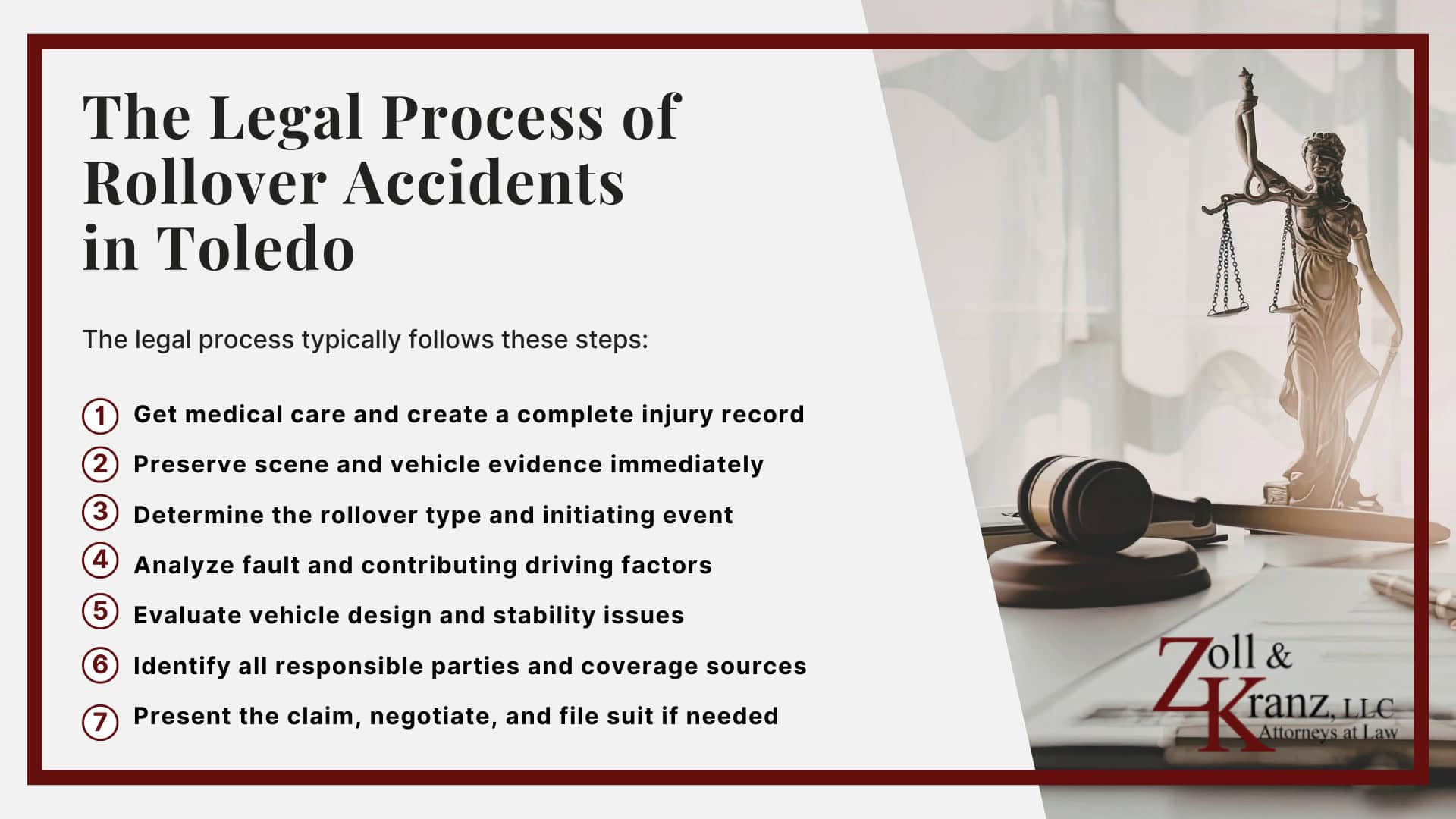
The Legal Process of Rollover Accidents in Toledo

Rollover cases often start with one central issue, why the vehicle lost stability and whether the rollover was preventable.

Because rollovers can involve tripping events, vehicle design, driver conduct, and sometimes impacts from other vehicles, the legal process has to document the entire sequence, not just the final resting position of the car.

The legal process typically follows these steps:

  1. Get medical care and create a complete injury record: Rollover injuries can include brain injuries, neck trauma, and internal injuries that are not obvious at the scene. Early treatment, imaging, and follow up care create the timeline needed to connect the crash to the harm.
  2. Preserve scene and vehicle evidence immediately: Photos, measurements, debris fields, roadway marks, and vehicle damage mapping help show how the vehicle tipped, where it first departed its path, and what it struck during the roll sequence. When available, event data can help clarify speed, steering inputs, and braking before the rollover.
  3. Determine the rollover type and initiating event: Many rollovers begin after a “trip” event, such as a curb, soft shoulder drop off, guardrail contact, or contact with another vehicle, creating a tripped rollover rather than a simple slide. Identifying the initiating event is often the fastest way to clarify liability.
  4. Analyze fault and contributing driving factors: The investigation evaluates driver distraction, driver error, and whether speed exceeded the posted limit or was unsafe for conditions. If the rollover followed a prior collision, the analysis also focuses on whether side impacts or head on collisions caused rotation and tip dynamics.
  5. Evaluate vehicle design and stability issues: Vehicle characteristics can matter, particularly with pickup trucks and other light trucks that have a higher center of gravity than many passenger vehicles. When the facts justify it, the case may also consider tire issues, loading, or stability related defects.
  6. Identify all responsible parties and coverage sources: Rollover crashes are sometimes labeled as single vehicle events, but liability may still involve another driver, a roadway hazard, or another responsible entity. This step matters in the most serious outcomes, including single vehicle rollover fatalities, where the ability to recover damages can depend on identifying every liable party early.
  7. Present the claim, negotiate, and file suit if needed: Once liability and damages are supported by clear proof, the claim is presented to the insurers involved and settlement negotiations begin. If the case is not resolved fairly, the next step is filing a lawsuit and preparing the evidence for trial.

A strong rollover claim ties the crash mechanics to the medical evidence and documents the full costs from day one, so liability and damages rest on proof rather than assumptions.

Steps to Take After a Rollover Accidents in Toledo

After a rollover, your priorities are safety, medical care, and preserving evidence before it disappears.

Rollover crashes carry a serious risk of occupant ejection, so getting checked by a medical professional is critical even if you feel “okay” or don’t see obvious cuts or bruises.

If possible, take photos of the final resting position, tire marks, debris, and anything that suggests a tripped rollover (curb gouges, soft-shoulder tracks, guardrail contact, or roadway defects).

You should also document anything that may explain why the car rolled—driver distraction, unsafe speed for the speed limit, or sudden contact with another vehicle.

Then report the crash to your insurer and start a file with every bill, record, and communication, because medical expenses can add up quickly after a rollover.

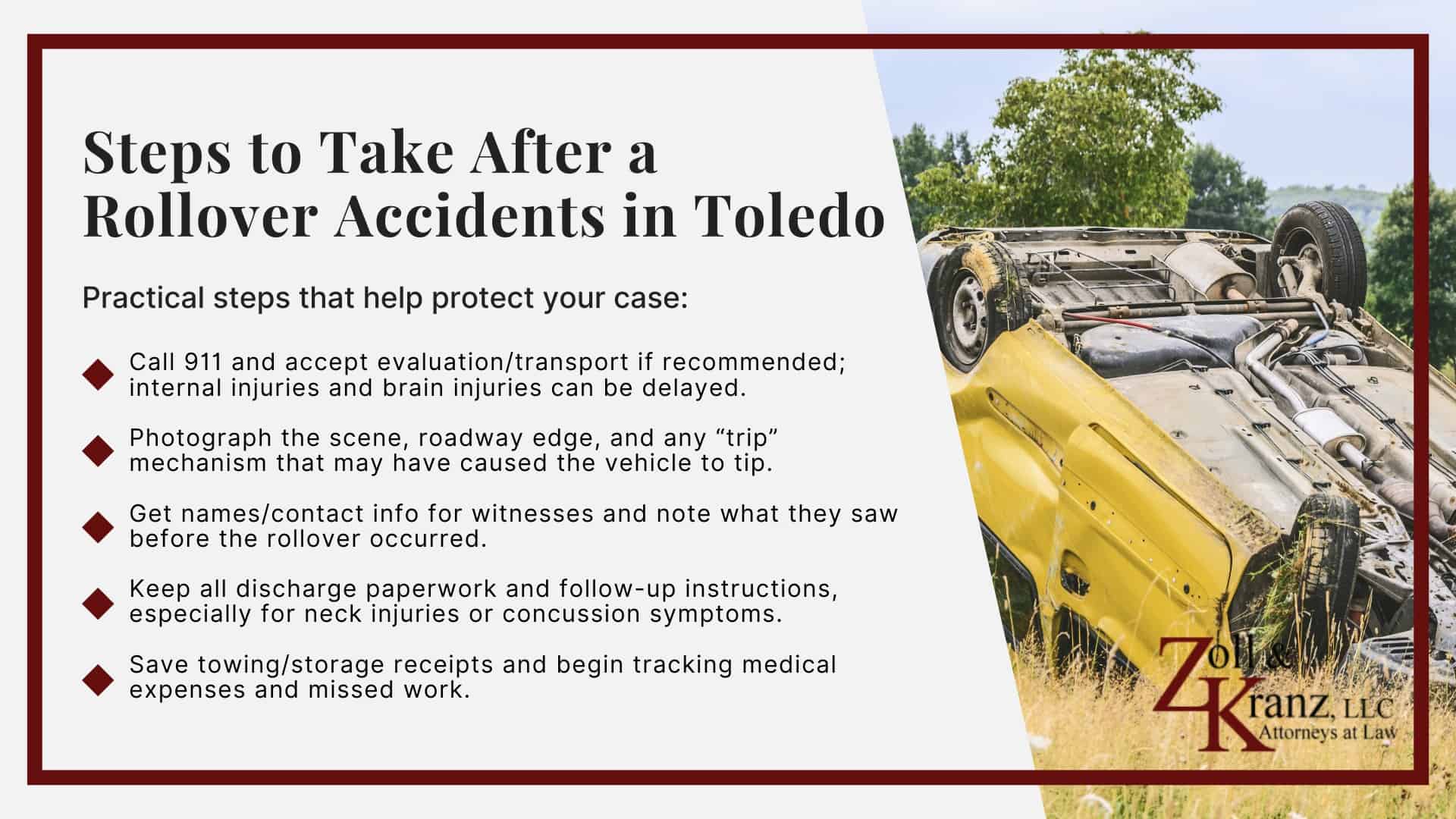
Practical steps that help protect your case:

  • Call 911 and accept evaluation/transport if recommended; internal injuries and brain injuries can be delayed.
  • Photograph the scene, roadway edge, and any “trip” mechanism that may have caused the vehicle to tip.
  • Get names/contact info for witnesses and note what they saw before the rollover occurred.
  • Keep all discharge paperwork and follow-up instructions, especially for neck injuries or concussion symptoms.
  • Save towing/storage receipts and begin tracking medical expenses and missed work.

Ohio’s Statute of Limitations for Rollover Accidents Cases

Ohio law generally gives injury victims two years to file a personal injury lawsuit, including most motor vehicle crash cases.

This deadline comes from Ohio Revised Code § 2305.10(A), which requires actions for bodily injury to be brought within two years after the claim accrues.

That time limit can matter in rollover cases because symptoms do not always show up immediately.

Even if you feel “mostly okay” at first, it is common for serious conditions to be diagnosed later, and the filing deadline can still run while you are in treatment.

For fatal crashes, Ohio’s wrongful death statute also sets a two year filing period in most cases under Ohio Revised Code § 2125.02.

Because rollover cases often involve detailed proof, such as crash reconstruction, vehicle inspection, and scene evidence, getting legal help early can protect evidence and preserve witness testimony while it is still available.

Common Evidence in Rollover Accident Claims

Rollover cases often turn on how the vehicle began rotating and what “tripped” it into a roll.

Most rollovers involve a trip mechanism (like a curb, guardrail, soft shoulder, or uneven terrain) rather than a pure slide, and that detail can shape liability.

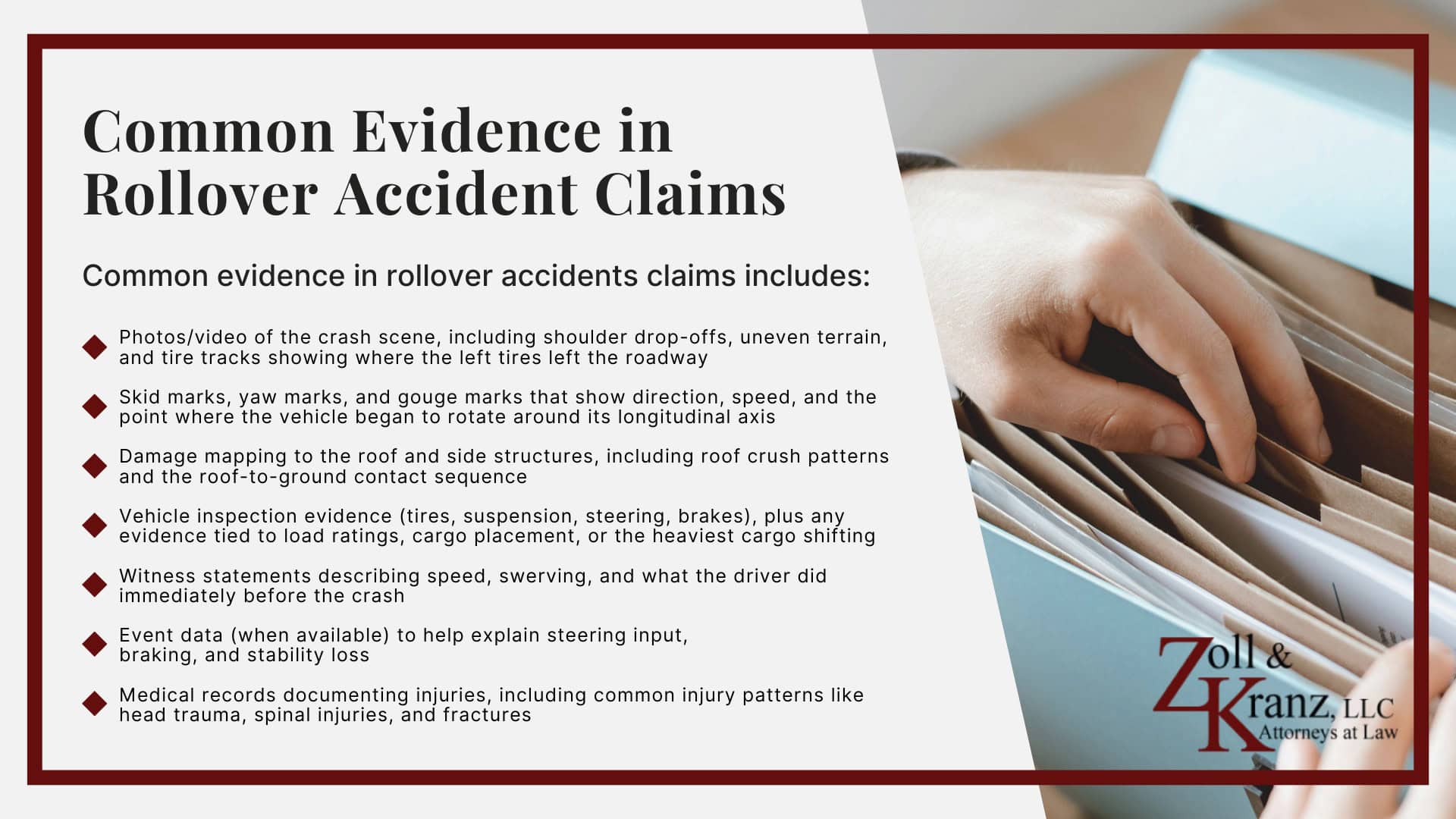
Common evidence in rollover accidents claims includes:

  • Photos/video of the crash scene, including shoulder drop-offs, uneven terrain, and tire tracks showing where the left tires left the roadway
  • Skid marks, yaw marks, and gouge marks that show direction, speed, and the point where the vehicle began to rotate around its longitudinal axis
  • Damage mapping to the roof and side structures, including roof crush patterns and the roof-to-ground contact sequence
  • Vehicle inspection evidence (tires, suspension, steering, brakes), plus any evidence tied to load ratings, cargo placement, or the heaviest cargo shifting
  • Witness statements describing speed, swerving, and what the driver did immediately before the crash
  • Event data (when available) to help explain steering input, braking, and stability loss
  • Medical records documenting injuries, including common injury patterns like head trauma, spinal injuries, and fractures

Damages Available in a Toledo Rollover Accident Cases

A rollover crash can cause violent force injuries that change a person’s life in an instant, and the financial impact often continues long after the initial hospital visit.

Survivors may face extended recovery, ongoing treatment, and lasting limitations that affect work, independence, and daily function.

A strong claim documents not only what you’ve already paid, but what you will likely need in the future—especially when injuries create a high risk of complications or permanent impairment.

If the rollover results in a death, the damages focus on the full scope of loss suffered by the surviving family, including long-term financial support and the personal impact of the loss.

Insurance companies may push for a quick payout, but a fair case focuses on the total cost of the accident, not just the first few bills.

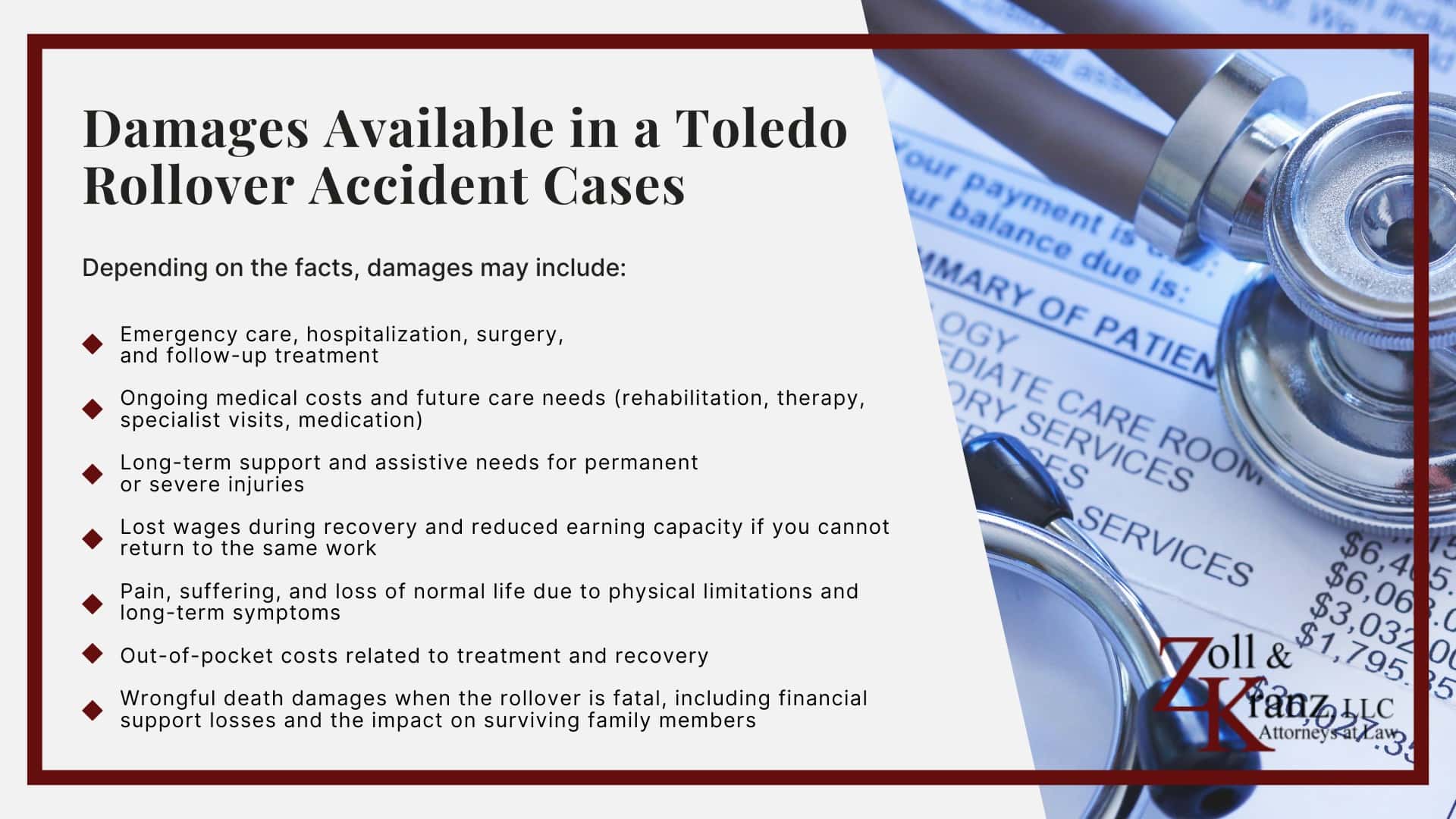
Depending on the facts, damages may include:

  • Emergency care, hospitalization, surgery, and follow-up treatment
  • Ongoing medical costs and future care needs (rehabilitation, therapy, specialist visits, medication)
  • Long-term support and assistive needs for permanent or severe injuries
  • Lost wages during recovery and reduced earning capacity if you cannot return to the same work
  • Pain, suffering, and loss of normal life due to physical limitations and long-term symptoms
  • Out-of-pocket costs related to treatment and recovery
  • Wrongful death damages when the rollover is fatal, including financial support losses and the impact on surviving family members

Contact Zoll & Kranz: Toledo Rollover Accidents Attorneys

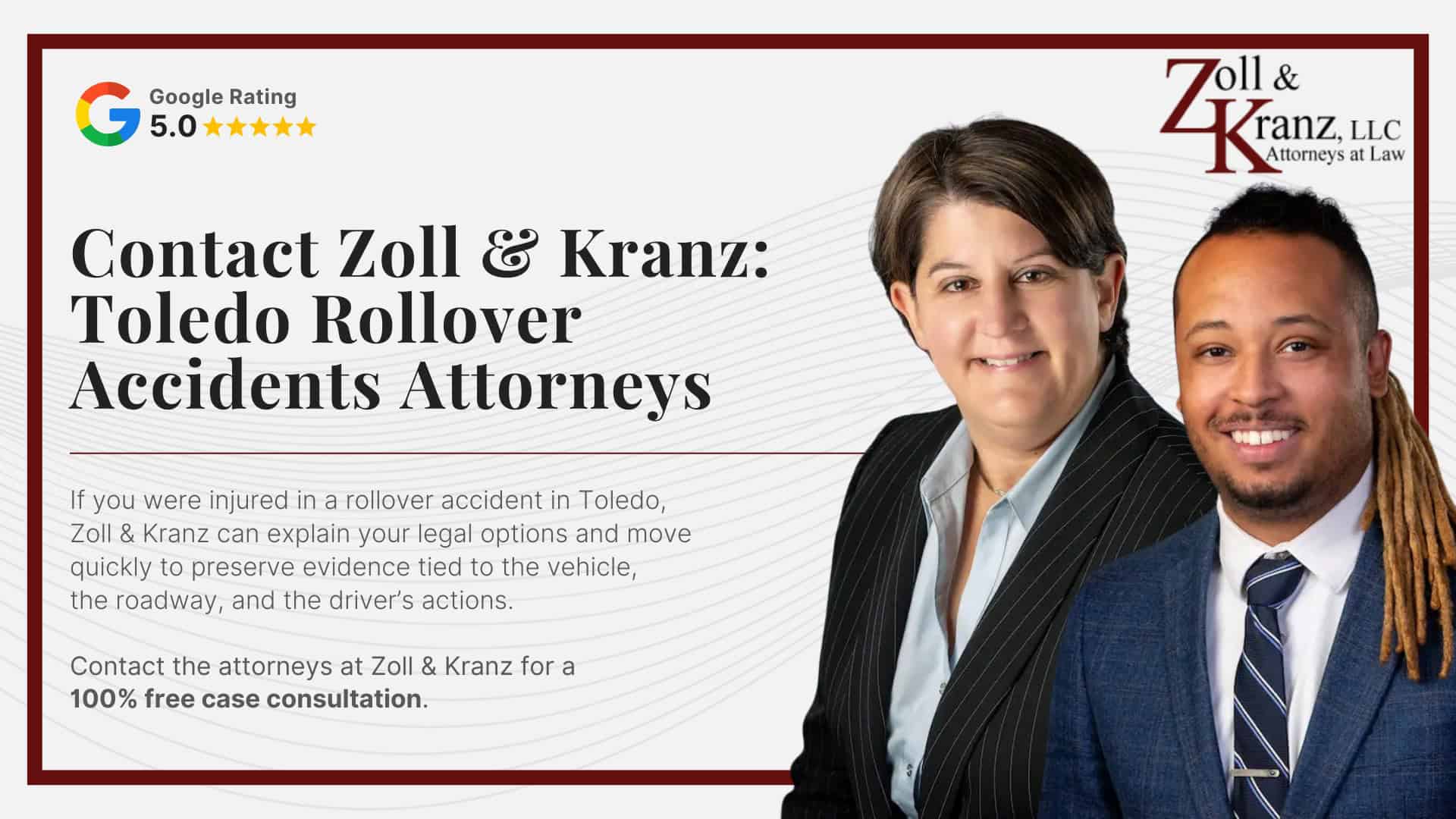
If you were injured in a rollover accident in Toledo, Zoll & Kranz can explain your legal options and move quickly to preserve evidence tied to the vehicle, the roadway, and the driver’s actions.

Our team understands how rollover dynamics, high center of gravity risks, roof damage, and trip mechanisms can shape responsibility and we build cases designed to hold the right parties liable.

Contact Zoll & Kranz today for legal help that prioritizes your recovery and the full value of your claim.

You can also use the chatbot on this page to see if you qualify today.

Frequently Asked Questions

Published by:
Share
Picture of Michelle L. Kranz
Michelle L. Kranz

Michelle is a founding partner of Zoll & Kranz, located in Toledo, Ohio. Michelle has been a plaintiff’s lawyer for the entirety of her practice – over 32 years. She devotes the majority of her time to complex consolidated litigation and class action including advocating for people injured by medical devices, prescription medications, or corporate negligence.

This article has been written and reviewed for legal accuracy and clarity by the team of writers and attorneys at Zoll & Kranz, LLC and is as accurate as possible. This content should not be taken as legal advice from an attorney. If you would like to learn more about our owner and experienced Ohio injury lawyer, Michelle L. Kranz, you can do so here.

Zoll & Kranz, LLC does everything possible to make sure the information in this article is up to date and accurate. If you need specific legal advice about your case, contact us. This article should not be taken as advice from an attorney.

Other cases we handle in Toledo
All
Auto Accidents
Injury Types
Medical Malpractice
Nursing Home Abuse
Other Accidents & Injuries
You can learn more about other Toledo cases we handle below:
Auto Accident Lawsuit Timeline in Toledo
Bedsores in Toledo Nursing Homes
Collecting Evidence in Toledo Medical Malpractice Cases
Collecting Evidence in Toledo Nursing Home Negligence Cases
Common Car Accident Injuries in Toledo, OH
Common Causes of Nursing Home Negligence in Toledo
Common Types of Car Accident Damages
Dehydration and Malnutrition in Toledo Nursing Homes
Distracted Driving Accidents in Toledo, OH
Dropped Patients in Toledo Nursing Homes
DUI Accidents in Toledo
Duty of Care Owed by Toledo Nursing Home Facilities
Emotional and Mental Abuse in Toledo Nursing Homes
Evidence in Toledo Auto Accident Cases
Failure to Perform Procedure Malpractice Lawyer in Toledo
Falls in Toledo Nursing Homes
Head-On Collisions in Toledo
Hit-and-Run Accidents in Toledo
How is Fault Determined in a Car Accident?
How To File a Car Crash Lawsuit in Toledo
How To Report Poor Nursing Home Care in Toledo
Inattentive Staff in Toledo Nursing Homes
Infections in Toledo Nursing Homes
Initial Steps To Take in a Toledo Medical Malpractice Case
Interstate Accidents in Toledo
Liability in Toledo Medical Malpractice Claims
Liability in Toledo Nursing Home Negligence Cases
Medication Errors in Toledo Nursing Homes
Neglect in Toledo Nursing Homes
Negligence in Toledo Medical Malpractice Cases
Negligent Hiring or Training in Toledo Nursing Homes
Nursing Home Negligence Wrongful Death Cases in Toledo
Paralysis in Auto Accidents
Patient Rights in Toledo Nursing Homes
Personal Injury Lawyer Toledo, Ohio
Physical Abuse in Toledo Nursing Homes
Process of a Medical Malpractice Case in Toledo
Rear-End Collisions in Toledo, OH
Rental Car Accidents in Toledo
Securing a Police Report in Toledo After an Auto Accident
Sexual Abuse in Toledo Nursing Homes
Sideswipe Accidents in Toledo
Toledo Anesthesia Errors Lawyer
Toledo Auto Accident Lawyer
Toledo Bicycle Accident Lawyer
Toledo Burn Injury Lawyer
Toledo Bus Accident Lawyer
Toledo Cancer Misdiagnosis Lawyer
Toledo Car Accident Lawyer
Toledo Catastrophic Injury Lawyer
Toledo Daycare Injury Lawyer
Toledo Delayed Diagnosis Lawyer
Toledo Emergency Room Error Lawyer
Toledo Failure To Diagnose Lawyer
Toledo Insurance Claim Lawyer
Toledo Mass Torts Lawyer
Toledo Medical Malpractice Lawyer
Toledo Medication Error Lawyer
Toledo Misdiagnosis Medical Malpractice Lawyer
Toledo Motorcycle Accident Lawyer
Toledo Nurse Error Lawyer
Toledo Nursing Home Abuse Lawyer
Toledo Nursing Home Negligence Safety and Preventative Measures
Toledo Pedestrian Accident Lawyer
Toledo Spinal Cord Injury Lawyer
Toledo Surgical Error Lawyer
Toledo Toxic Exposure Lawyer
Toledo Traumatic Brain Injury Lawyer
Toledo Truck Accident Lawyer
Toledo Wrongful Death Lawyer
Wrong Site Surgery Malpractice in Toledo
Were you or a loved one injured in Toledo?

A serious injury can have life-altering results.

Don’t settle for less than you deserve, speak with an award-winning personal injury lawyer today.

8 Reviews
5.0
★★★★★
Recovered damages
$35 Million+

Table of Contents

Practice Areas
About Zoll & Kranz, LLC

For over 37 years, Zoll & Kranz has been fighting for clients who have been the victims of the wrongful death of a loved one.

Do you believe you’re entitled to compensation?

Use our Instant Case Evaluator to find out in as little as 60 seconds!

Guides & Resources

Other Toledo Personal Injury Cases

All
Auto Accidents
Injury Types
Medical Malpractice
Nursing Home Abuse
Other Accidents & Injuries
Local Toledo Resources
Education
Emergency Services
Courthouses
Department of Motor Vehicles
Sights to See