No fees unless we win.
Get a free consultation
18 Reviews
5.0
★★★★★

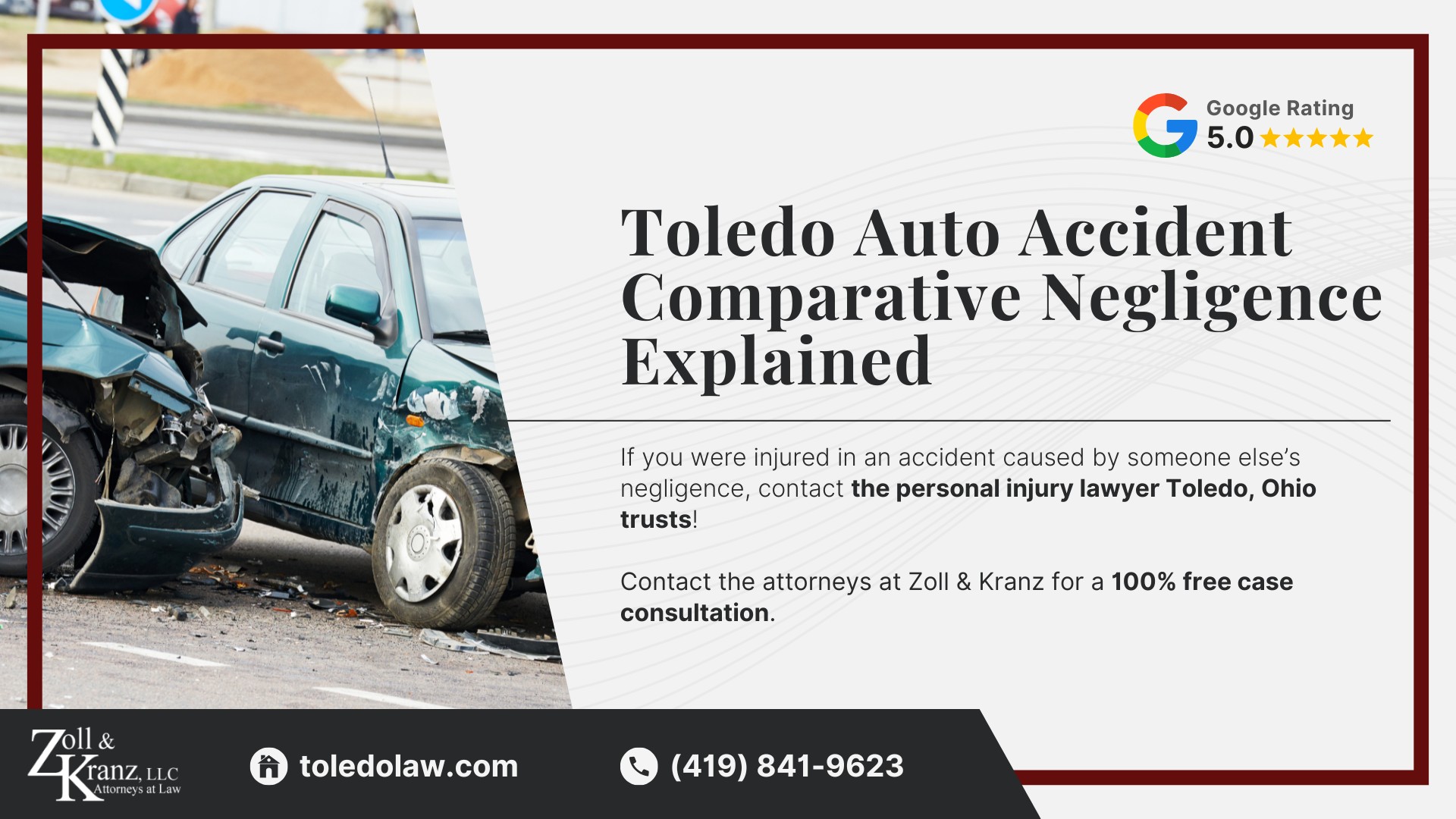
Toledo Auto Accident Comparative Negligence Explained

Comparative Negligence in Toledo Auto Accident Claims

Comparative negligence in Toledo auto accident claims is the rule that assigns each driver a percentage of fault for the crash and reduces the amount the injured driver can recover by that percentage.

In Toledo car accidents, fault is assigned to each driver based on specific driving conduct such as speeding, failure to yield, or improper lane changes.

The percentage assigned to each driver determines liability and the amount the other driver’s insurance company is required to pay on the claim.

Comparative negligence laws determine what percentage of negligence each party contributed to the accident, which affects the compensation awarded to the plaintiff.

An experienced Toledo car accident lawyer at Zoll & Kranz can review how fault was allocated and challenge an assignment that does not reflect what happened.

Toledo Auto Accident Comparative Negligence Explained

Is Fault for the Car Accident Being Shifted Onto You? Talk to a Toledo Auto Accident Lawyer

The insurance company starts evaluating fault within days of the crash, often before the injured driver has finished medical treatment.

The percentage they settle on is built from the police report, the statements taken by the adjuster, and the timing of medical care.

A shift from 30% to 51% on that record changes a partial recovery into no recovery at all under Ohio law.

If you were injured in a Toledo car accident and the insurance company is placing fault on you, Zoll & Kranz can review the evidence and explain whether the fault percentage assigned to you holds up under Ohio law.

Contact Zoll & Kranz today for a free consultation.

Use the chat feature on this page to find out if you qualify for a Toledo car accident claim.

How Ohio Modified Comparative Negligence Works

In a Toledo car accident where more than one driver may have contributed to the crash, Ohio law assigns each driver a share of fault expressed as a percentage and uses that percentage to determine what the injured driver can recover.

Comparative negligence is a legal doctrine used to allocate fault among parties involved in an accident, affecting the damages a plaintiff can recover.

Most U.S. states use some form of comparative negligence, allowing a plaintiff to recover damages even if they were partially at fault for their injuries.

Ohio uses a stricter version called modified comparative negligence, set out in the state’s civil statute.

Ohio follows a modified comparative negligence rule, codified under Ohio Revised Code § 2315.33.

Under Ohio’s modified comparative negligence system, a plaintiff can recover damages only if their fault does not exceed 50%.

The mechanics of assigning that percentage usually begin with the insurance adjuster and continue through a judge or jury if the case goes to court.

For the injured party, that percentage is not just a label in the claim file. It controls whether compensation is reduced, denied, or submitted to a jury for decision.
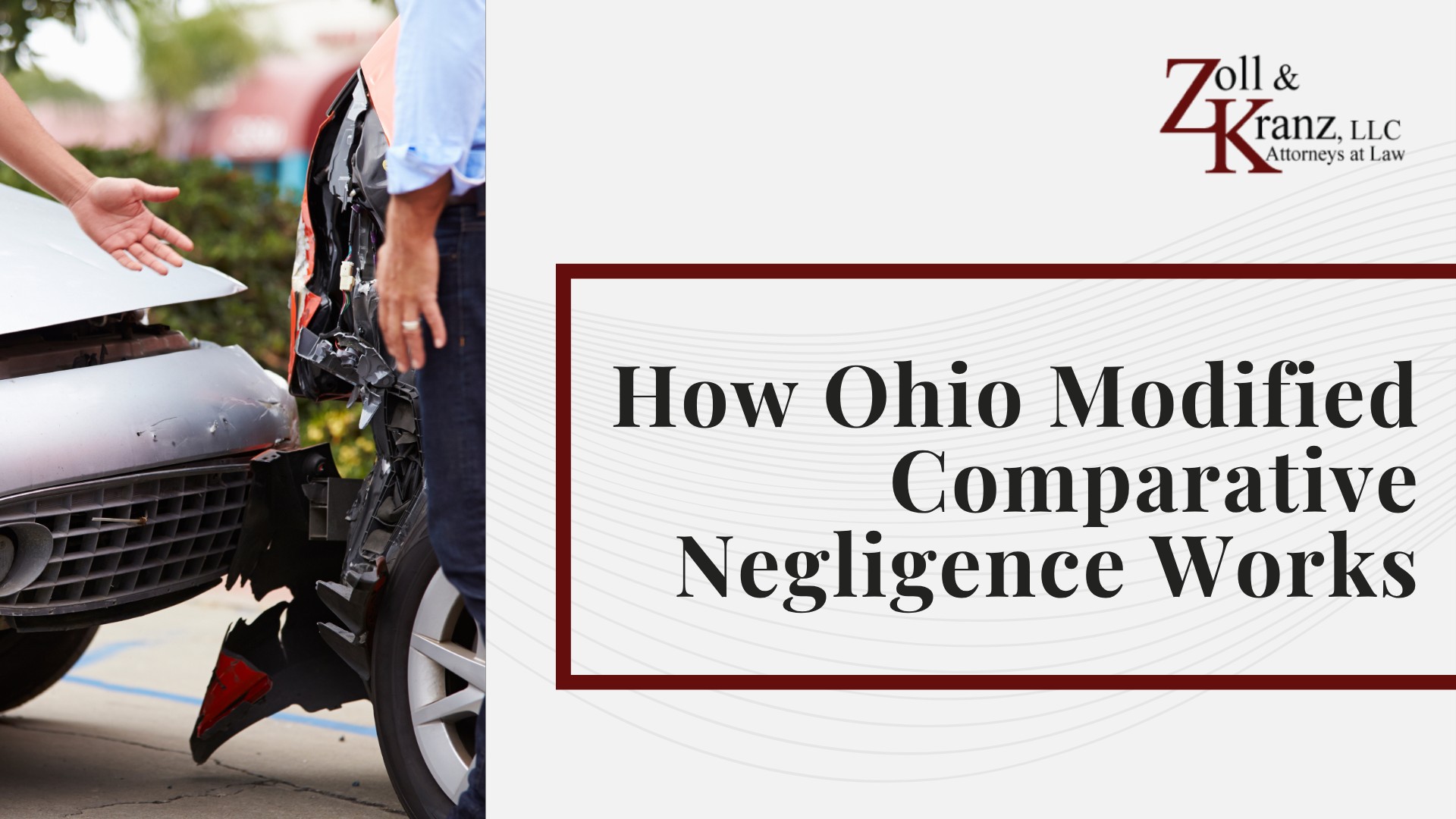
Courts or insurance adjusters assign a percentage of fault to each party involved in a comparative negligence case.

Once the percentage is fixed, it is subtracted from the value of the claim before any payment.

Compensation is typically reduced by the plaintiff’s percentage of fault in a comparative negligence case.

Under Ohio Revised Code § 2315.33, a plaintiff’s recovery shall be diminished proportionately to the percentage of the plaintiff’s contributory fault.
The 51% Bar Rule in Ohio Car Accident Cases

The 51% bar rule is the threshold under Ohio law where comparative fault stops reducing recovery and starts eliminating it entirely.

Under the modified comparative negligence rule, if a plaintiff is found to be 51% or more at fault, they are barred from recovering any damages.

In Ohio, if a plaintiff’s fault is determined to be 51% or more, they are barred from recovering any damages.

A plaintiff found exactly 50% at fault may still recover, while a finding of 51% eliminates recovery entirely.

In Ohio’s modified comparative fault system, if a party’s fault percentage is greater than 50, they likely won’t qualify for compensation.

If a jury determines the plaintiff was 51% or more at fault, they are barred from recovering any damages.

This threshold often becomes the central dispute in a Toledo car accident claim, with insurers focusing on increasing the plaintiff’s fault percentage to eliminate recovery entirely.

A shift of even a single percentage point can change the outcome from a reduced settlement to no recovery at all.

In personal injury lawsuits, that one-point dispute is often supported or challenged through crash evidence, medical records, and testimony about how the collision occurred.

How Fault Is Investigated After a Toledo Car Accident

Before fault percentages are assigned in an Ohio car accident claim, insurance companies, attorneys, and, in some cases, juries evaluate the evidence to determine how the collision occurred.

Comparative negligence decisions are based on specific facts rather than assumptions, and even small details can influence the percentage of fault assigned to each driver.

Because compensation is directly tied to fault allocation, the investigation often becomes one of the most important parts of the claim.

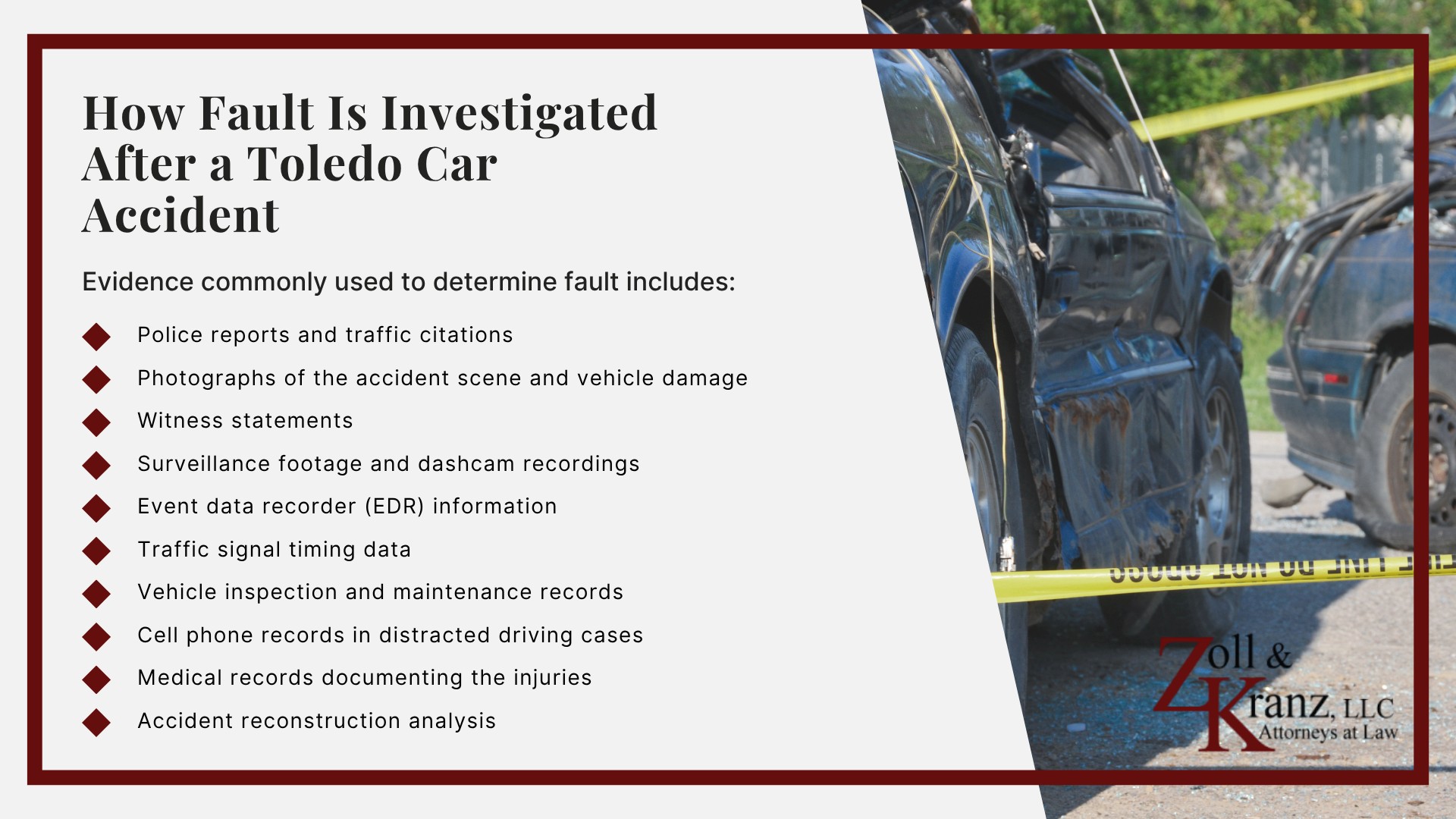
Evidence commonly used to determine fault includes:

  • Police reports and traffic citations
  • Photographs of the accident scene and vehicle damage
  • Witness statements
  • Surveillance footage and dashcam recordings
  • Event data recorder (EDR) information
  • Traffic signal timing data
  • Vehicle inspection and maintenance records
  • Cell phone records in distracted driving cases
  • Medical records documenting the injuries
  • Accident reconstruction analysis

Insurance companies review this evidence to determine whether a driver violated a traffic law, failed to exercise reasonable care, or contributed to the crash in some other way.

When the parties disagree about fault, attorneys may use additional evidence, expert opinions, and accident reconstruction findings to challenge the percentage assigned by the insurer.

If the dispute cannot be resolved through settlement negotiations, a judge or jury may ultimately decide how fault should be allocated under Ohio’s comparative negligence rules.

Calculating Compensation Under Ohio Comparative Negligence

The calculation of compensation under Ohio comparative negligence depends entirely on which side of the 50% threshold the plaintiff falls on, with two distinct outcomes that follow.

A plaintiff at 50% fault or below recovers a reduced amount, while a plaintiff at 51% or higher recovers nothing under the statute. The sections below explain how the math works on each side of that line and how the assigned percentage translates into a final dollar figure.

Recovery When Plaintiff Fault Is 50% or Below

When the plaintiff’s fault is 50% or below, the injured driver can recover compensation, but the full compensation amount is reduced by the assigned percentage.

For example, an injured driver who is found 25% at fault on a $200,000 claim would recover $150,000 after the proportionate reduction.

In a modified comparative negligence system, a plaintiff can recover damages only if their fault does not exceed 50%.

In Ohio, a plaintiff can recover damages only if their fault does not exceed 50%.

If a plaintiff is found partially at fault but less than 51%, their compensation is reduced in proportion to their share of fault.

The reduction applies to the entire claim value, including medical bills, lost wages, lost income, property damage, and proof connecting the plaintiff’s injuries to the crash.

If a plaintiff is found to be 30% at fault for their injuries, and total damages are $300,000, they can recover $210,000 in Ohio.

In a car accident, if you are 20% responsible for speeding, your compensation is reduced by 20%.

In a slip and fall case, if a store is 60% at fault for a wet floor and you are 40% at fault for not paying attention, you recover 60% of the total damages.

Each percentage point assigned to the plaintiff directly removes a portion of the recovery, which is why insurers focus heavily on the assignment of fault during the claims process.

Recovery When Plaintiff Fault Reaches 51%

When the plaintiff’s fault reaches 51% or higher, the rule operates to bar recovery entirely and no compensation is available under Ohio law.

For example, if total damages are $200,000 and the plaintiff is found 50% at fault, the recoverable amount is reduced to $100,000.

At 51%, the same claim produces no compensation.

This is why the difference between 50% and 51% is treated as the decisive issue in many contested Toledo auto accidents, and why insurers work to push the plaintiff’s fault percentage above the line.

The threshold is fixed at the stage where percentages are assigned, either by the insurance adjuster during the claims process or by a court if the case is litigated, and that determination controls whether the claim proceeds to a damages award or is dismissed under Ohio’s comparative negligence rule.

Comparative Negligence Compared to Other State Fault Systems

Ohio’s modified comparative negligence rule is one of three approaches U.S. states use to handle shared fault in personal injury cases.

Plaintiffs can recover damages even if they contributed to their injuries, provided their fault is below a certain threshold, usually 50% or 51%.

The other two systems, pure comparative negligence and contributory negligence, apply in different states and produce different outcomes than what Ohio drivers face.

Pure Comparative Negligence

Pure comparative negligence allows recovery without any fault cutoff, with damages reduced according to the plaintiff’s share of responsibility.

Under the pure comparative negligence rule, the state allows the plaintiff to claim damages for the 1% they are not at fault even when they are 99% at fault.

In a pure comparative negligence system, a plaintiff can recover damages even if they are 99% at fault, with their recovery reduced by their percentage of fault.

In a pure comparative negligence state, if a plaintiff is 30% at fault for an accident with total damages of $100,000, they would recover $70,000.

States that follow pure comparative negligence include California, Florida, and New York.

Ohio does not follow this approach, which is why the 50% threshold matters so much for Toledo car accident claims.

Contributory Negligence

Contributory negligence applies a strict rule that prevents any recovery when the plaintiff shares any responsibility for the accident.

Under contributory negligence, any fault by the plaintiff bars recovery of damages, even if they are only 1% at fault.

Total bar to recovery occurs under contributory negligence if a plaintiff is found even 1% responsible for the incident.

The primary difference between comparative negligence and contributory negligence is how much fault a plaintiff can have before being barred from recovering any compensation.

Pure contributory negligence is still followed in Virginia, Maryland, North Carolina, Alabama, and Washington D.C.

Ohio rejected this approach decades ago in favor of the modified comparative system that now governs Toledo car accident claims.

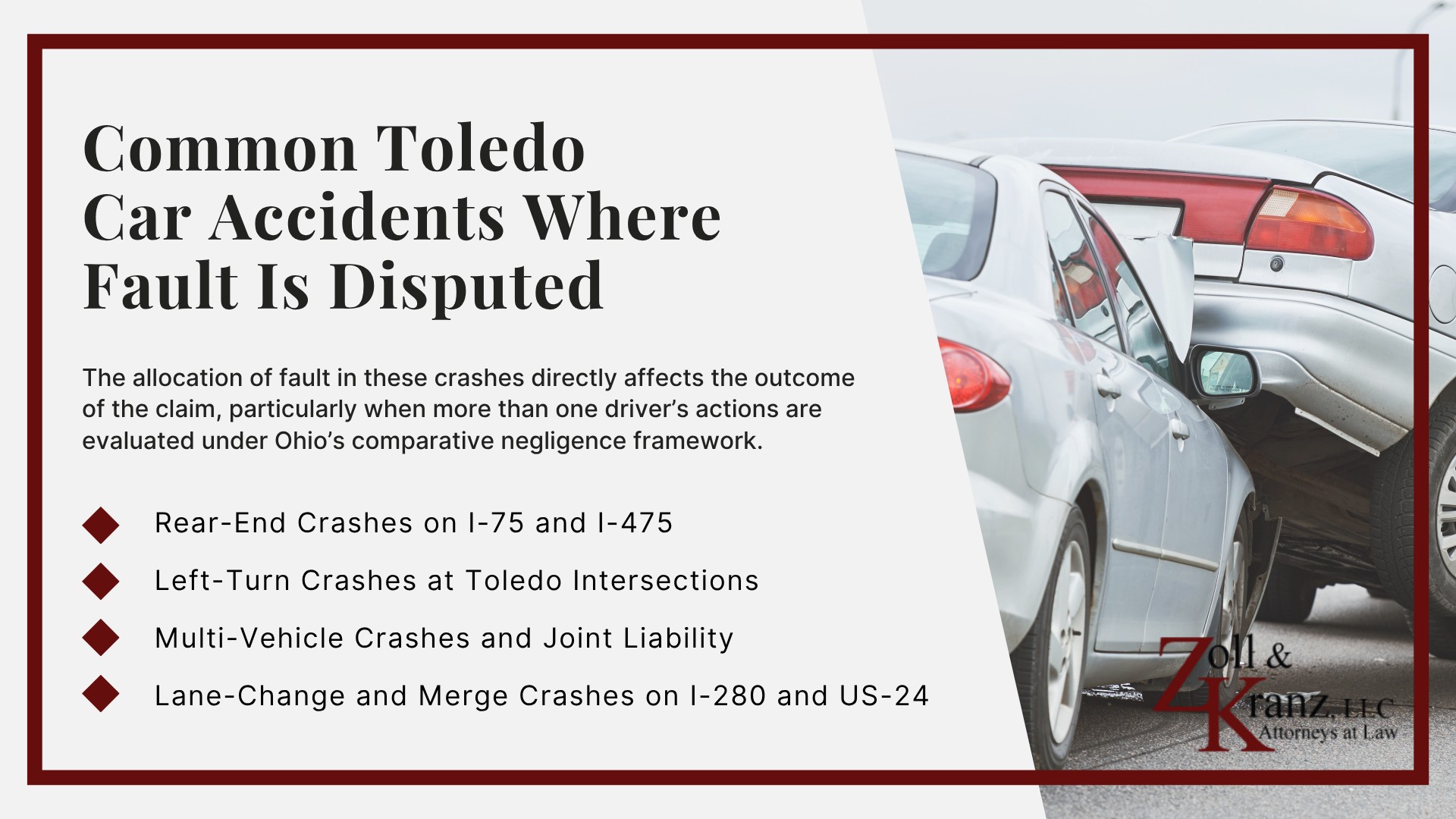
Common Toledo Car Accidents Where Fault Is Disputed

Disputes over comparative fault in Toledo car accidents often arise in crash situations where Ohio traffic laws impose specific duties on each driver, and liability depends on how those duties were performed at the time of the accident.

The allocation of fault in these crashes directly affects the outcome of the claim, particularly when more than one driver’s actions are evaluated under Ohio’s comparative negligence framework.

Rear-End Crashes on I-75 and I-475

Rear-end car crash cases in Ohio are often evaluated under R.C. 4511.21, which requires a driver to maintain an assured clear distance.

This places initial fault on the trailing driver in many accident claims involving rear-end collisions in Toledo.

Insurers frequently attempt to shift liability by arguing that the lead driver created the hazard, including sudden stops without cause or unsafe lane entry.

These arguments are used to increase the plaintiff’s fault percentage in the claim.

In contested cases, fault allocation often turns on objective evidence such as dashcam footage, event data recorder data showing speed and braking, and the physical damage pattern between vehicles.

Left-Turn Crashes at Toledo Intersections

Left-turn accidents in Ohio are governed by R.C. 4511.42, which requires a driver turning left to yield to oncoming traffic that presents an immediate hazard.

This rule places initial liability on the turning driver in many car accidents.

Speeding, running a red light, or entering the intersection during a late signal phase can result in shared negligence and adjustment of the assigned fault percentage.

These disputes often rely on signal timing data, camera footage, and vehicle speed analysis to determine whether the other driver created the hazard.

Multi-Vehicle Crashes and Joint Liability

Multi-vehicle crashes create layered fault allocation issues because each driver’s conduct is evaluated separately within the same accident.

The involvement of multiple parties increases the difficulty of assigning liability across the claim.

Under Ohio Revised Code § 2307.22, a defendant who is 50% or more at fault may be held jointly and severally liable for all economic damages.

This rule means that one defendant can be responsible for the full amount of economic damages, including medical bills and lost wages, regardless of the share assigned to other parties involved.

In a typical chain-reaction crash, one driver may carry the majority of fault, which allows the injured person to recover economic damages even if other parties lack sufficient coverage or ability to pay compensation.

Lane-Change and Merge Crashes on I-280 and US-24

Lane-change and merge accidents in Ohio are evaluated under statutes requiring a driver to remain within a lane and signal before movement.

Fault is assigned based on whether the driver completed the maneuver safely and with proper notice.

These cases frequently involve conflicting accounts between drivers, with disputes focused on blind-spot positioning, failure to signal, and unsafe merging into occupied lanes.

Insurers use these factors to adjust the fault percentage in the claim.

Resolution often depends on EDR data showing steering input and speed at the moment of impact, which helps establish how the maneuver occurred.

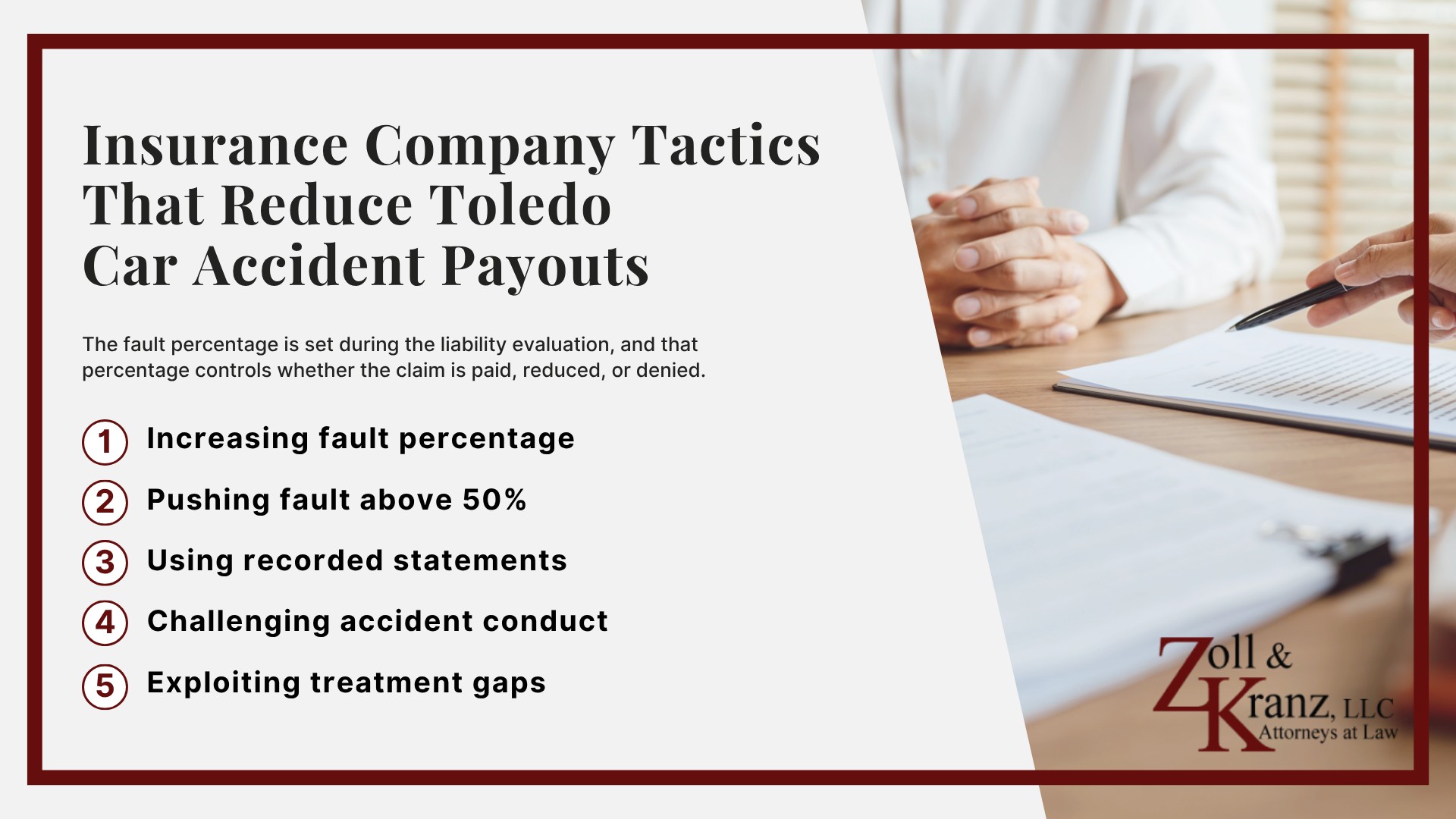
Insurance Company Tactics That Reduce Toledo Car Accident Payouts

Insurance companies and the insurance industry use comparative fault rules in Ohio accident claims to reduce compensation and limit recovery.

The fault percentage is set during the liability evaluation, and that percentage controls whether the claim is paid, reduced, or denied.

  1. Increasing fault percentage: The adjuster assigns percentages by tying fault to specific facts recorded in the file, such as impact location on the vehicles, estimated speed from the report, and whether the driver had the right of way.
  2. Pushing fault above 50%: When the evaluation is close, the adjuster relies on small details already in the record, such as brake timing noted in the report or distance between vehicles, to justify a higher allocation. A minor shift in those facts is used to place the claimant just over the threshold.
  3. Using recorded statements: The statement taken by the insurer is compared directly against the police report and scene findings. If the driver described speed, distance, or sequence differently than what is documented, that difference is written into the liability section as support for a higher fault percentage.
  4. Challenging accident conduct: The file is reviewed for specific driving actions before impact, such as whether a turn signal was used, whether braking occurred in time, or whether the vehicle stayed within its lane. These actions are matched against traffic duties to justify assigning part of the fault to that driver.
  5. Exploiting treatment gaps: Medical records are checked against the accident date. If the driver did not seek medical attention promptly, or treatment stops for a period, the adjuster notes that gap and questions whether the injury described is consistent with the accident timeline.

Evidence That Supports Fault Allocation in an Ohio Car Accident Claim

The evidence used to support fault allocation in an Ohio car accident claim is what determines whether the percentage assigned to the plaintiff holds up or gets shifted during the claims process.

Evidence in Toledo auto accident cases typically includes multiple categories reviewed together, since no single piece of evidence controls the outcome on its own.

Police reports document the scene, list any traffic citations, and record statements from each driver at the time of the crash.

Photographs from the accident scene and vehicle damage images show the direction of impact and the force involved, which helps reconstruct how the crash occurred.

Witness statements from independent witnesses often carry more weight than statements from the drivers themselves, since witness accounts are less affected by the fault dispute.

Event data recorder data captures speed, braking, throttle position, and steering input in the seconds before impact, and this data is often decisive in contested claims.

Records from medical professionals connect the injuries to the crash, document the timing of treatment, and show whether the symptoms are consistent with the type of collision involved.

Each of these categories is reviewed against the assigned fault percentage, and a strong evidence record can shift the percentage closer to the actual cause of the crash.

Speak With a Toledo Car Accident Attorney at Zoll & Kranz

In Toledo car accident claims, the final outcome is determined by how fault is allocated under Ohio’s modified comparative negligence rule.

A shift of even a few percentage points can change the result from meaningful compensation to no financial recovery at all.

That allocation is based on how the evidence is interpreted, including the police report, vehicle damage, and medical records tied to the injury.

Once the fault percentage is established, it governs both liability and the amount that can be recovered in the claim, whether the case resolves through a settlement or proceeds to court.

A Toledo personal injury lawyer at Zoll & Kranz represents Toledo car accident claims involving disputed fault and injury-related compensation.

The firm’s attorneys deal directly with insurance companies, challenge how the fault percentage is assigned, and handle personal injury lawsuits to recover damages through Ohio courts.

When the other driver disputes responsibility or the insurer offers a settlement that does not reflect actual losses, the firm evaluates whether the fault allocation can be challenged on the evidence.

If you or your loved one were in an accident and fault is being placed on you, or the claim does not reflect your losses, Zoll & Kranz can review the file and address how the fault percentage was assigned.

Call (419) 827-3194 to speak with us and schedule a free consultation.

Use the chat feature on this page to find out if you qualify for a Toledo car accident claim.

Frequently Asked Questions

Published by:
Share
Picture of Michelle L. Kranz
Michelle L. Kranz

Michelle is a founding partner of Zoll & Kranz, located in Toledo, Ohio. Michelle has been a plaintiff’s lawyer for the entirety of her practice – over 32 years. She devotes the majority of her time to complex consolidated litigation and class action including advocating for people injured by medical devices, prescription medications, or corporate negligence.

This article has been written and reviewed for legal accuracy and clarity by the team of writers and attorneys at Zoll & Kranz, LLC and is as accurate as possible. This content should not be taken as legal advice from an attorney. If you would like to learn more about our owner and experienced Ohio injury lawyer, Michelle L. Kranz, you can do so here.

Zoll & Kranz, LLC does everything possible to make sure the information in this article is up to date and accurate. If you need specific legal advice about your case, contact us. This article should not be taken as advice from an attorney.

Other cases we handle in Toledo
All
Auto Accidents
Injury Types
Medical Malpractice
Nursing Home Abuse
Other Accidents & Injuries
You can learn more about other Toledo cases we handle below:
Auto Accident Lawsuit Timeline in Toledo
Auto Accident Statute of Limitations in Toledo, OH
Bedsores in Toledo Nursing Homes
Collecting Evidence in Toledo Medical Malpractice Cases
Collecting Evidence in Toledo Nursing Home Negligence Cases
Common Car Accident Injuries in Toledo, OH
Common Causes of Nursing Home Negligence in Toledo
Common Types of Car Accident Damages
Dehydration and Malnutrition in Nursing Homes
Distracted Driving Accidents in Toledo, OH
Dropped Patients in Nursing Homes
DUI Accidents in Toledo
Duty of Care Owed by Nursing Home Facilities in Ohio
Evidence in Toledo Auto Accident Cases
Failure to Perform Procedure Malpractice Lawyer in Toledo
Falls in Toledo Nursing Homes
Head-On Collisions in Toledo
Hit-and-Run Accidents in Toledo
How is Fault Determined in a Car Accident?
How To File a Car Crash Lawsuit in Toledo
How to Report Nursing Home Abuse in Toledo, Ohio
Inattentive Nursing Home Staff: Steps to Take
Infections in Toledo Nursing Homes
Initial Steps To Take in a Toledo Medical Malpractice Case
Interstate Accidents in Toledo
Liability in Toledo Medical Malpractice Claims
Liability in Toledo Nursing Home Negligence Cases
Medication Errors in Toledo Nursing Homes
Mental and Emotional Abuse in Nursing Homes
Neglect in Toledo Nursing Homes
Negligence in Toledo Medical Malpractice Cases
Negligent Hiring or Training in Toledo Nursing Homes
Nursing Home Negligence Wrongful Death Cases in Toledo
Paralysis in Auto Accidents
Patient Rights in Toledo Nursing Homes
Personal Injury Lawyer Toledo, Ohio
Physical Abuse in Toledo Nursing Homes
Process of a Medical Malpractice Case in Toledo
Rear-End Collisions in Toledo, OH
Rental Car Accidents in Toledo
Rollover Accidents in Toledo
Securing a Police Report in Toledo After an Auto Accident
Sexual Abuse in Toledo Nursing Homes
Sideswipe Accidents in Toledo
Toledo Anesthesia Errors Lawyer
Toledo Auto Accident Lawyer
Toledo Bicycle Accident Lawyer
Toledo Burn Injury Lawyer
Toledo Bus Accident Lawyer
Toledo Cancer Misdiagnosis Lawyer
Toledo Car Accident Lawyer
Toledo Catastrophic Injury Lawyer
Toledo Daycare Injury Lawyer
Toledo Delayed Diagnosis Lawyer
Toledo Emergency Room Error Lawyer
Toledo Failure To Diagnose Lawyer
Toledo Insurance Claim Lawyer
Toledo Mass Torts Lawyer
Toledo Medical Malpractice Lawyer
Toledo Medication Error Lawyer
Toledo Misdiagnosis Medical Malpractice Lawyer
Toledo Motorcycle Accident Lawyer
Toledo Nurse Error Lawyer
Toledo Nursing Home Abuse Lawyer
Toledo Nursing Home Negligence Safety and Preventative Measures
Toledo Pedestrian Accident Lawyer
Toledo Spinal Cord Injury Lawyer
Toledo Surgical Error Lawyer
Toledo Toxic Exposure Lawyer
Toledo Traumatic Brain Injury Lawyer
Toledo Truck Accident Lawyer
Toledo Wrongful Death Lawyer
Wrong Site Surgery Malpractice in Toledo
Were you or a loved one injured in Toledo?

A serious injury can have life-altering results.

Don’t settle for less than you deserve, speak with an award-winning personal injury lawyer today.

18 Reviews
5.0
★★★★★
Recovered damages
$108 Million+

Table of Contents

Practice Areas
About Zoll & Kranz, LLC

For over 37 years, Zoll & Kranz has been fighting for clients who have been the victims of the wrongful death of a loved one.

Do you believe you’re entitled to compensation?

Use our Instant Case Evaluator to find out in as little as 60 seconds!

Guides & Resources

Other Toledo Personal Injury Cases

All
Auto Accidents
Injury Types
Medical Malpractice
Nursing Home Abuse
Other Accidents & Injuries
Local Toledo Resources
Education
Emergency Services
Courthouses
Department of Motor Vehicles
Sights to See