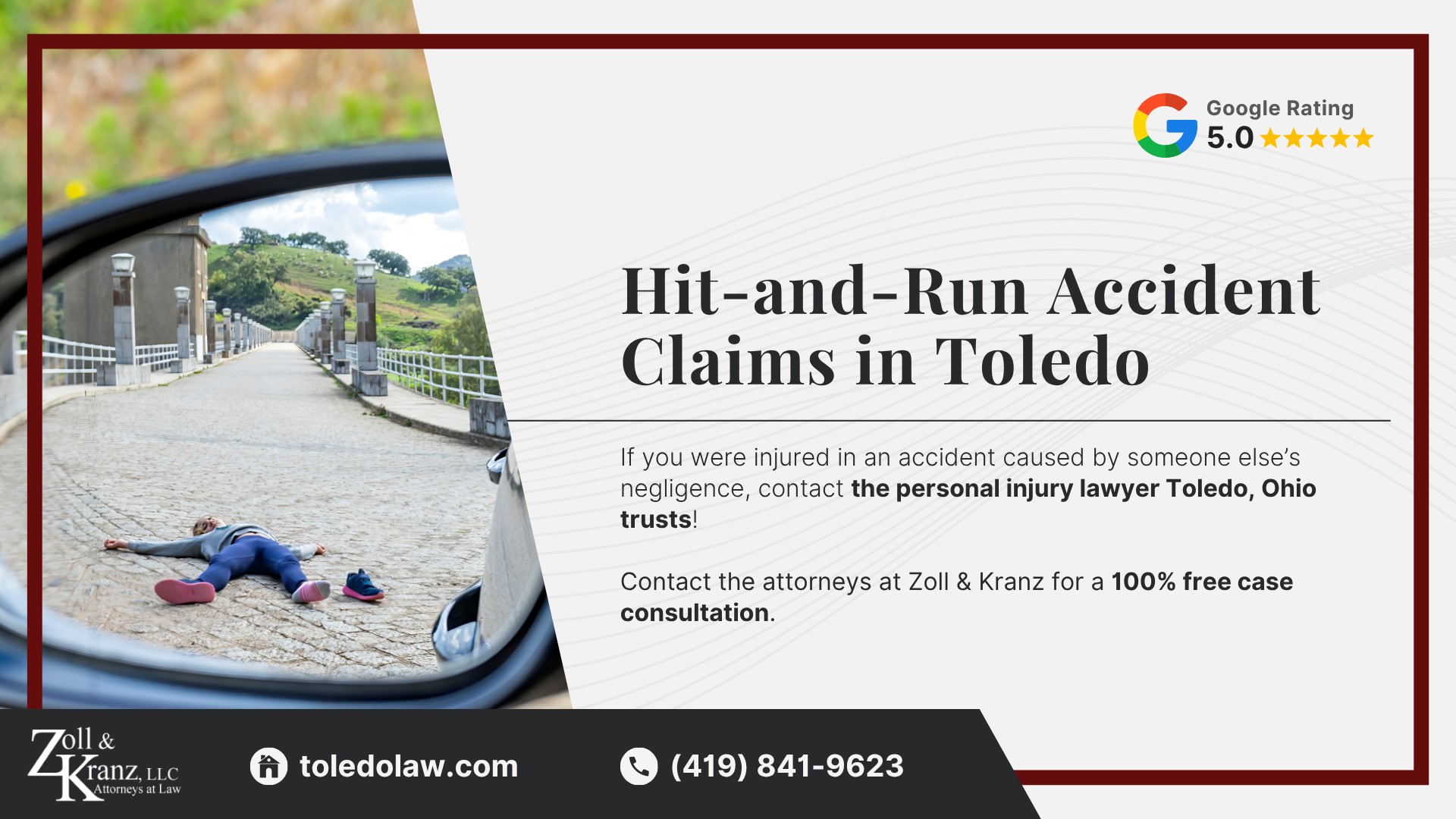
A hit-and-run accident can involve separate criminal and civil issues.
A driver involved in a qualifying accident who leaves without satisfying Ohio’s legal obligations may face criminal charges, while the injured person may pursue a civil claim for medical expenses, lost income, property damage, pain and suffering, and other losses caused by the collision.
The outcome of any hit and run charges does not by itself establish who caused the original accident or determine whether the injured person can recover compensation.
Ohio has three primary hit-skip statutes that apply depending on where the accident occurs and what type of property is damaged:
- Accidents on public roads or highways: Ohio Revised Code Section 4549.02 generally requires a driver who knows they were involved in an accident on a public road or highway to stop at the scene of an accident and remain there while providing the driver’s name and address, the vehicle owner’s information when different, and the vehicle’s registration number. If an injured person cannot comprehend and record the required information, the other driver generally must notify the nearest police authority and remain until a police officer arrives unless removed by qualifying emergency transportation. The statute also addresses collisions with an unoccupied vehicle or unattended vehicle.
- Accidents on other public or private property: Ohio Revised Code Section 4549.021 applies when an accident involving damage or injury occurs on public or private property other than a public road or highway. If the driver does not provide the required identifying information at the scene, the information generally must be reported to the appropriate police department or county sheriff within 24 hours. When an unoccupied or unattended vehicle is struck, the driver generally must securely attach the required information to the vehicle.
- Damage to real property or attached property: Ohio Revised Code Section 4549.03 applies when a vehicle causes damage to real property or personal property attached to real property that is legally upon or adjacent to a public road or highway. The driver must stop and take reasonable steps to locate the property owner or person in charge and provide identifying information. If the owner cannot be located after a reasonable search, the driver generally must report the required information, accident location, and known damage to law enforcement within 24 hours.
Using the wrong statute can lead to an inaccurate explanation of a driver’s legal obligations because the reporting requirements and penalties are not identical in every situation.
A first-degree misdemeanor is the penalty for minor hit-and-run offenses, which can carry up to six months, or 180 days, in jail.
If the accident causes serious physical harm, the offense can become a fifth degree felony or, when the driver knew that serious physical harm resulted, a fourth degree felony.
When an accident results in death, failure to stop can become a third degree felony or, if the driver knew the crash resulted in death, a second degree felony.
A second-degree felony can carry a stated minimum prison term of up to eight years under Ohio sentencing law, with the maximum term determined under the state’s indefinite-sentencing provisions.
Ohio law also permits a conventional fine of up to $15,000 for a second-degree felony.
Sections 4549.02 and 4549.021 also require a class-five driver’s license suspension.
That suspension can range from six months to three years, and the statutes provide that the first six months cannot be suspended by the judge.
The criminal case remains separate from the injured person’s claim for compensation.
A fleeing driver facing serious criminal charges may need a criminal defense attorney, but the victim’s civil case focuses on proving who caused the collision, documenting the resulting physical harm and financial losses, identifying available insurance coverage, and pursuing compensation supported by the evidence.