No fees unless we win.
Get a free consultation
29 Reviews
5.0
★★★★★

Car Accident Injury Claim Process in Ohio

Our Experienced Ohio Car Accident Lawyers Help You Through the Injury Claim Process

The Ohio car accident injury claim process can involve medical treatment, evidence collection, fault disputes, insurance coverage issues, and negotiations over the value of your losses.

Our attorneys can investigate how the crash occurred, obtain the police report, preserve photographs and video, and gather medical and wage records that document the effects of the collision.

We also review the available insurance policies, including liability, uninsured motorist, and underinsured motorist coverage when applicable.

If an insurer disputes fault or refuses to offer reasonable compensation, our law firm can evaluate whether filing a car accident lawsuit is appropriate.

Zoll & Kranz helps injured people pursue claims supported by the evidence while protecting important filing deadlines and legal rights.

Car Accident Injury Claim Process in Ohio

Contact Our Ohio Car Accident Lawyers at Zoll & Kranz Today

A car accident injury claim can involve medical treatment, lost income, vehicle damage, insurance coverage, and disputes over who caused the collision.

Many claims may take roughly 3 to 18 months to resolve, although serious injuries, disputed fault, multiple insurance policies, or litigation can extend the process.

Our attorneys can investigate the crash, preserve evidence, document your injuries and financial losses, and communicate with the insurance companies while the claim is pending.

Every state establishes its own statute of limitations for personal injury lawsuits, with filing periods commonly ranging from one to four years depending on the jurisdiction and type of claim.

In Ohio, Revised Code § 2305.10 generally requires a bodily injury action to be filed within two years after the claim accrues.

For an ordinary Ohio car accident, that period generally begins on the date of the collision, although exceptions can affect the deadline.

Ohio law provides tolling protections in certain circumstances involving minors and people of unsound mind.

Our law firm can evaluate the applicable deadline, identify available insurance coverage, gather the evidence needed to support the claim, and negotiate for compensation based on the documented losses.

If an insurance claim cannot be resolved through negotiation, we can evaluate whether filing a car accident lawsuit is appropriate.

If you or a loved one was injured in an Ohio car accident, contact Zoll & Kranz for a free consultation.

You can also use the chat feature on this page to request an initial review of your car accident injury claim.

What to Do Immediately After an Ohio Car Accident

The first priority after an Ohio car accident is safety.

Stop as close to the accident scene as reasonably possible, call 911 when anyone may be injured, and move away from traffic hazards when it is safe to do so.

Ohio law requires a driver involved in a collision on a public road to stop, remain at the scene, and provide identifying and vehicle information to injured people, other affected motorists, and an officer who responds.
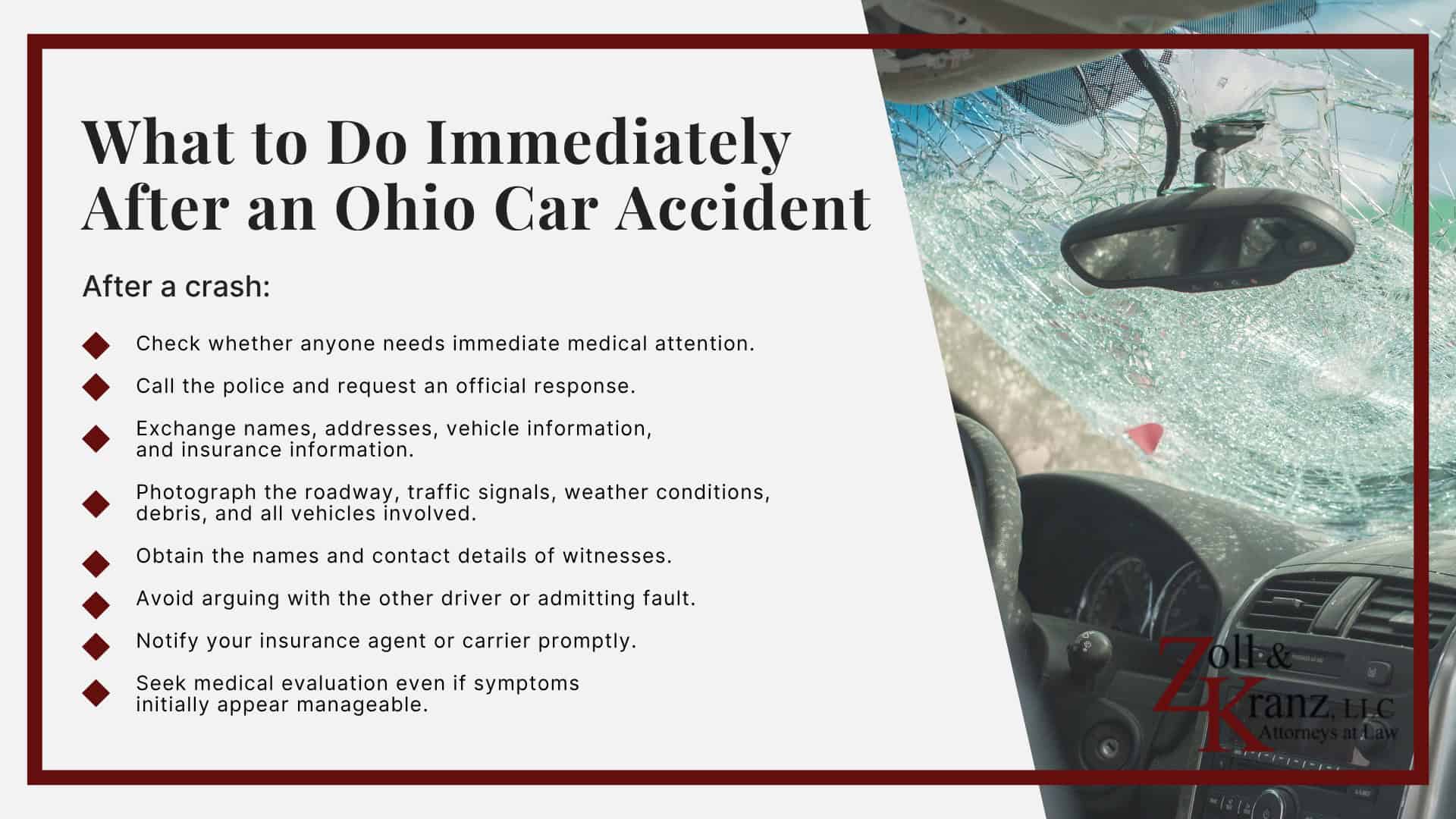
After a crash:

  • Check whether anyone needs immediate medical attention.
  • Call the police and request an official response.
  • Exchange names, addresses, vehicle information, and insurance information.
  • Photograph the roadway, traffic signals, weather conditions, debris, and all vehicles involved.
  • Obtain the names and contact details of witnesses.
  • Avoid arguing with the other driver or admitting fault.
  • Notify your insurance agent or carrier promptly.
  • Seek medical evaluation even if symptoms initially appear manageable.

The initial record can become important if fault is disputed or symptoms develop later.

Photographs, video, the police report, and contemporaneous witness statements may help establish how the accident occurred and which party involved may be legally responsible.

How the Ohio Car Accident Injury Claim Process Begins

The Ohio car accident injury claim process usually begins with medical care, notice to the relevant insurers, and an investigation into fault and damages.

The injured person or attorney may notify the at fault driver’s carrier while also reporting the loss to the injured person’s own car insurance company.

Ohio insurance guidance advises policyholders to report accidents promptly and follow the claim procedures described in the policy.
The early process generally includes:

  • Opening an insurance claim
  • Receiving a claim number
  • Identifying the assigned adjuster
  • Providing basic information about the crash
  • Obtaining the police report
  • Documenting injuries and treatment
  • Securing repair estimates
  • Reviewing all available auto insurance coverage

An injured driver may pursue a third party claim against the other driver’s insurance company.

The person may also have a first party claim under their own policy for collision, medical payments, rental reimbursement, or uninsured and underinsured motorist benefits.

Ohio regulations distinguish a first-party claimant asserting rights under an insurance contract from a third-party claimant seeking payment from another person or entity.

Reporting the Accident and Preserving Evidence

Report the crash to law enforcement when anyone is injured, a vehicle cannot be driven safely, a driver leaves the scene, or there is substantial property damage.

Ohio law requires investigating agencies to forward reports involving a fatality, personal injury, or more than $1,000 in property damage to the Department of Public Safety.

Crash reports submitted by Ohio law-enforcement agencies are also available through the state’s online crash-report search system, although the investigating agency remains an important source for the official record.

Evidence to preserve may include:

  • The police report
  • Scene, injury, and vehicle photographs
  • Dashcam or surveillance recordings
  • Witness names and statements
  • Tow and storage records
  • Estimates for vehicle repairs
  • Receipts for a rental car
  • Text messages or phone records when distracted driving is suspected
  • Vehicle event-data information when relevant
  • Communications with each insurance company
  • Medical and wage-loss documentation

Do not authorize destruction of a totaled vehicle before important evidence has been inspected.

When the crash involves a commercial vehicle, defective component, or several responsible parties, an attorney may send preservation letters covering electronic logs, onboard data, maintenance records, and other evidence.

Seeking Medical Care and Documenting Your Injuries

Prompt medical evaluation protects your health and creates a record of the symptoms reported after the car crash.

Some injuries are immediately apparent, while neck pain, headaches, concussion symptoms, back pain, and other conditions may become more noticeable over the following hours or days.

Tell your medical providers about every symptom and explain that it began or worsened after the collision.

Important documentation may include:

  • Emergency department records
  • Primary-care and specialist notes
  • Diagnostic imaging
  • Physical therapy records
  • Prescriptions and medical equipment
  • Work restrictions
  • Referrals for additional treatment
  • Itemized medical bills
  • Proof of transportation and other treatment-related costs

Follow the recommended care plan and keep copies of your medical records.

Gaps in treatment may make it more difficult to establish the connection between the auto accident and the claimed injuries, although legitimate barriers such as cost, scheduling, or lack of transportation should also be documented.

The source that initially pays the medical expenses may depend on the available health insurance, medical-payments coverage, fault determination, and instructions provided when the claim is opened.

The Ohio Department of Insurance advises consumers to review their coverages and ask the insurer where accident-related medical and hospital bills should be submitted.
What Is the Difference Between a Car Accident Claim and a Lawsuit?

A car accident claim is generally a request for payment made to an insurer outside court.

The claimant submits evidence of fault, injuries, financial losses, and vehicle damage, then participates in an investigation and possible settlement negotiations.

A claim can sometimes be resolved without filing any court documents.

A personal injury lawsuit is a formal court proceeding against the individuals or businesses alleged to be legally responsible.

It begins with a complaint and service of legal process, followed by responses, motions, discovery, depositions, expert review, and potentially trial.

Ohio’s Rules of Civil Procedure govern commencement, service, pleadings, discovery, trials, and judgments in civil cases.

The differences include:

  • An insurance claim is handled primarily between claimants, attorneys, and insurers.
  • A lawsuit places disputed issues before a court.
  • Discovery powers become available after suit is filed.
  • A settlement may occur before or after a lawsuit begins.
  • If trial occurs, a jury or judge rules on the disputed issues.
  • A post-judgment appeals process may follow under separate procedural rules.

Filing a lawsuit does not necessarily mean a case will proceed through trial.

Many personal injury cases settle during litigation after the parties exchange additional evidence.

Determining Fault for an Ohio Car Accident

Fault generally depends on whether a driver or another party failed to use reasonable care and caused the collision.

Evidence may show that the at fault party was speeding, following too closely, distracted, impaired, driving left of center, or violating a traffic-control device.

The other party may dispute fault or argue that several people contributed.

Evidence used to determine fault can include:

  • Statements from drivers and passengers
  • The police report and citations
  • Scene photographs and measurements
  • Video recordings
  • Vehicle damage patterns
  • Event-data recorder information
  • Witness statements
  • Cellphone evidence
  • Reconstruction analysis
  • Applicable traffic laws

The insurance carrier may make its own liability determination, but an adjuster’s conclusion is not a binding court judgment.

When the parties cannot agree, fault may ultimately be determined during a personal injury lawsuit.

Ohio’s Modified Comparative Negligence Rule

Ohio follows comparative negligence, sometimes called modified comparative fault.

An injured party may recover damages when their share of fault is not greater than the combined fault of the other responsible parties.

If the plaintiff is more than 50% at fault, Ohio law bars recovery; if fault is 50% or less, the award is reduced by that percentage.

For example, if an injured driver has $100,000 in damages and is found 20% responsible, the recoverable amount may be reduced to $80,000.

Insurance adjusters may use comparative negligence during claim evaluation, but Ohio regulations require insurers to document its application and disclose that information upon the claimant’s written request.

Ohio is not a no fault state for ordinary automobile liability claims.

Liability coverage generally pays for injuries and property losses caused by a driver who is at fault, which means evidence of negligence remains central to most Ohio claims.

Filing a Claim With the At-Fault Driver’s Insurance Company

To file a claim with the other driver’s insurance company, provide enough information for the carrier to identify its insured and investigate the collision.

This generally includes the crash date and location, the driver’s name, the policy or vehicle information when available, a basic description of the accident, and your contact information.

The carrier may request:

  • The police report
  • Photographs and repair estimates
  • Medical authorizations
  • Medical bills and records
  • Wage-loss verification
  • A recorded statement
  • Information about prior accidents or medical conditions

You should provide accurate information, but you do not have to speculate about speed, distance, injuries, or fault.

A personal injury lawyer can manage communications when broad medical authorizations, recorded statements, or disputed liability create concern.

A third-party carrier does not represent the injured person.

Its obligation is to investigate the claim and protect the interests of its insured and the insurance provider, subject to Ohio’s insurance rules.

Legal representation can help keep the claim focused on relevant evidence and documented damages.

Ohio Auto Insurance Requirements and Available Coverage

Ohio requires owners and operators to maintain insurance or another approved form of financial responsibility.

The statutory minimum liability limits are generally:

  • $25,000 for bodily injury or death to one person
  • $50,000 for bodily injury or death to two or more people in one accident
  • $25,000 for damage to other people’s property

These are minimum limits, not a statement that the coverage will be enough for every loss.

A declarations page identifies the policy’s vehicles, limits, deductibles, and appropriate coverages.

Depending on what was purchased, auto insurance may include:

  • Bodily-injury and property-damage liability coverage
  • Medical-payments coverage
  • Collision coverage
  • Comprehensive coverage
  • Rental-reimbursement coverage
  • Towing and roadside benefits
  • Uninsured motorist coverage
  • Underinsured motorist coverage

When damages exceed the available policy limits, the injured person’s own underinsured coverage or the at-fault person’s personal assets may require review.

The practical ability to collect beyond insurance varies significantly by case.

Liability, Medical Payments, and Collision Coverage

Liability coverage protects an insured when that person is legally responsible for causing injuries or property damage to others.

Bodily-injury liability may address medical costs, wage loss, and other injury damages, while property-damage liability addresses damage caused to another vehicle or property.

Medical-payments coverage, often called MedPay, is optional and may pay covered medical bills for the insured and passengers up to the purchased limit regardless of who caused the crash.

Collision coverage is also optional under Ohio law and generally pays for physical damage to the insured vehicle caused by a collision, subject to policy terms and a deductible.

A lender or leasing company may require collision coverage even though state law does not.

Property-damage disputes may involve:

  • Repair estimates
  • Total-loss valuation
  • Deductibles
  • Towing and storage charges
  • Rental reimbursement
  • Diminished value
  • Replacement-part selection

Consumers may generally choose their own repair shop, subject to any limitation in the policy.

Ohio’s insurance guidance also identifies the right to negotiate with the adjuster, while state claims rules regulate written estimates, repair-shop referrals, and the disclosure of like-kind-and-quality parts.

Review whether an estimate uses original equipment manufacturer parts, aftermarket parts, or qualifying recycled parts.

The right to require a particular part may depend on the policy, repair circumstances, and applicable law, so discuss discrepancies with the adjuster and body shop before authorizing work.

Uninsured and Underinsured Motorist Claims

An uninsured motorist claim may apply when the responsible driver has no bodily-injury liability insurance, the carrier denies coverage, or another situation defined in the policy and Ohio law exists.

Underinsured motorist coverage may apply when the responsible driver has insurance, but those limits are lower than the injured insured’s underinsured limits.

Ohio permits but does not require auto policies to include these coverages.

An uninsured or underinsured claim is usually a first-party claim against the injured person’s own carrier, but the claimant must still prove the elements that would have been required against the negligent motorist.

The driver’s insurance company may investigate fault, causation, damages, and applicable exclusions even though the claimant is its policyholder.

Policy conditions may require:

  • Prompt notice
  • Cooperation with the investigation
  • Proof of the other driver’s insurance status
  • Consent before settling with another carrier
  • Protection of subrogation rights
  • Filing within a contractual period

Ohio law permits UM/UIM policies to include a contractual claim period of at least three years after the accident in specified circumstances.

Because that deadline can differ from the general tort statute of limitations, the actual insurance policy should be reviewed promptly.

How the Insurance Investigation and Claims Process Works

After receiving notice, the car insurance company assigns one or more insurance adjusters to investigate liability, coverage, injuries, and damages.

Ohio rules generally require an insurer to acknowledge receipt of a claim within 15 days.

After receiving properly executed proof of loss, the insurer generally has 21 days to accept or deny the claim or explain why more investigation is needed, followed by written status updates at least every 45 days while the investigation remains open.

The investigation may include:

  1. Confirming that coverage was active.
  2. Interviewing the drivers and witnesses.
  3. Reviewing the police report.
  4. Inspecting the vehicles.
  5. Evaluating photographs and video.
  6. Reviewing medical and wage records.
  7. Determining comparative fault.
  8. Calculating covered losses.
  9. Accepting, denying, or negotiating the claim.

Those timeframes do not require a carrier to settle a disputed personal injury claim within 21 days.

A complicated claim may remain under investigation while treatment continues, expert opinions are developed, or fault disputes are addressed.

If an insurer denies coverage or disputes payment, request the reason and supporting policy provision in writing.

Ohio regulations generally require a denial based on a policy term, condition, or exclusion to identify that provision.

Consumers may also consult their policy’s internal review, arbitration, or appeals process and may submit an insurance complaint to the Ohio Department of Insurance.

Calculating Medical Expenses, Lost Income, and Other Damages

Damages in Ohio personal injury claims are based on the losses caused by the collision.

The calculation should account for what has already occurred and, when supported by medical and financial evidence, future consequences.

Economic damages may include:

  • Emergency and hospital treatment
  • Diagnostic testing
  • Surgery and rehabilitation
  • Past and future medical expenses
  • Prescription costs
  • Past lost wages
  • Reduced future earning capacity
  • Vehicle repairs or replacement
  • Towing and storage
  • Rental-vehicle costs
  • Other out-of-pocket expenses

Noneconomic damages may include:

  • Physical pain
  • Emotional distress
  • Disability or disfigurement
  • Loss of normal activities
  • Reduced quality of life

Negotiating a Car Accident Settlement

Settlement negotiations often begin after fault has been investigated and the claimant’s condition is sufficiently documented.

The injured person or attorney may submit a demand package summarizing liability, medical treatment, wage loss, future needs, property losses, and the effect of the injuries on daily life.

The parties may exchange several offers and counteroffers.

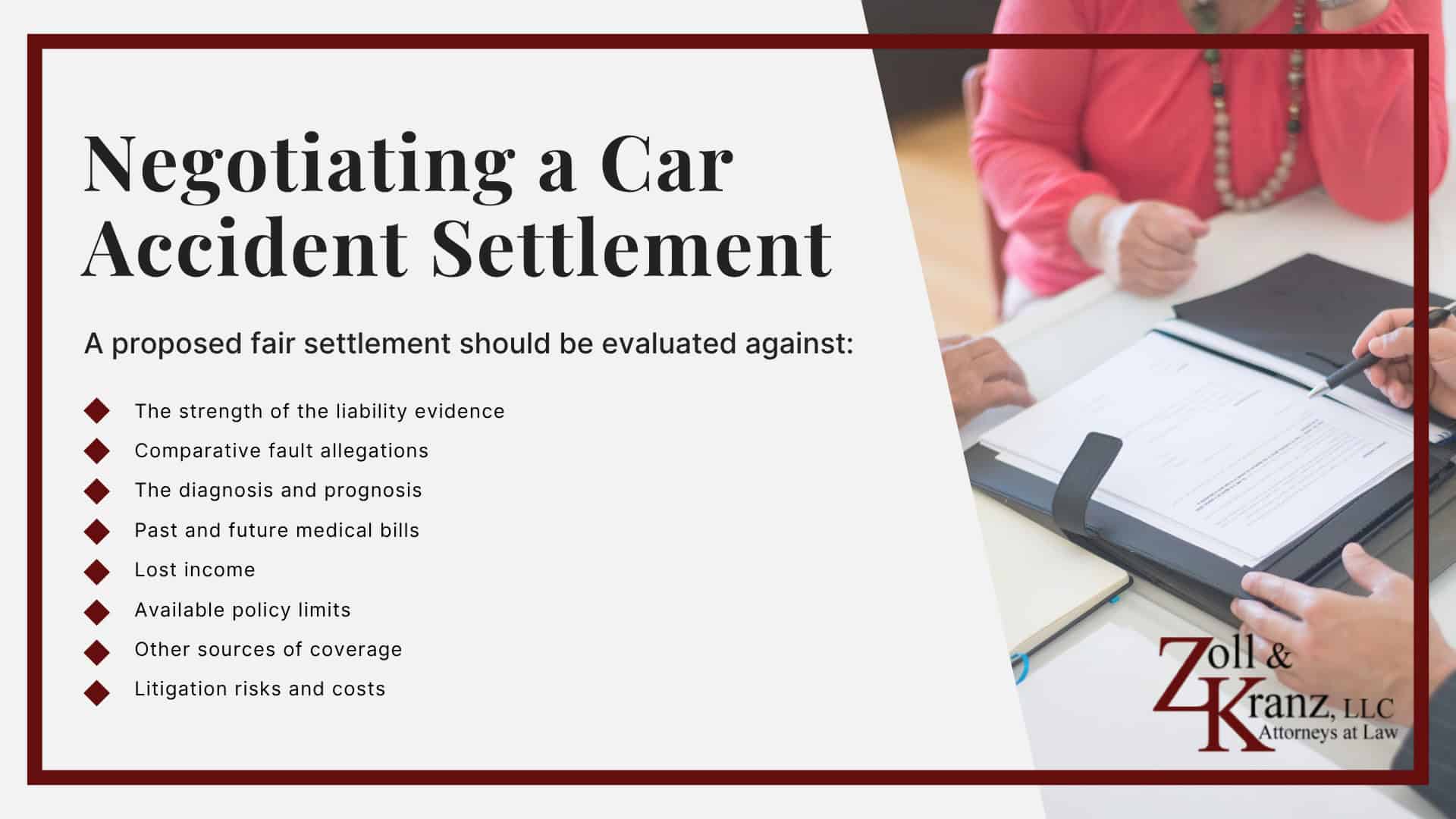
A proposed fair settlement should be evaluated against:

  • The strength of the liability evidence
  • Comparative fault allegations
  • The diagnosis and prognosis
  • Past and future medical bills
  • Lost income
  • Available policy limits
  • Other sources of coverage
  • Litigation risks and costs

Settlement is voluntary.

The claimant may accept, reject, or counter an offer, while the insurer can continue disputing fault or value.

The role of a car accident attorney is to advise the client about evidence, risks, and options, but the final decision belongs to the client.

Should You Accept the Insurance Company’s Settlement Offer?

Do not evaluate an offer based only on current medical bills.

Consider whether you have reached a stable point in treatment, whether future care is expected, and whether work restrictions or symptoms may continue.

Accepting a final bodily-injury settlement usually requires signing a release that ends the claim against the released parties, including losses discovered later.

Before accepting, review:

  • Whether all medical bills have been received
  • Whether health-insurance or benefit liens exist
  • Whether future treatment is anticipated
  • Whether all wage loss has been documented
  • Whether more than one policy applies
  • Whether the offer includes property and injury claims
  • Whether accepting could affect UM/UIM rights

An offer is not necessarily in your best interest merely because it is available quickly.

A personal injury attorney can explain the net recovery after medical liens, case expenses, and attorney fees, while comparing the offer with the evidence and risks.

When an Insurance Claim Becomes a Car Accident Lawsuit

An insurance claim may become a lawsuit when the insurer denies liability, disputes causation, undervalues damages, delays resolution, or refuses to make an acceptable offer.

Filing may also be necessary to protect the claim before the statute of limitations expires.

A lawsuit may be appropriate when:

  • The drivers give conflicting accounts.
  • Several parties share responsibility.
  • The insurer blames the injured person.
  • Serious or permanent injuries are disputed.
  • The available policies are unclear.
  • A commercial or government vehicle is involved.
  • Settlement negotiations reach an impasse.
  • Important evidence can only be obtained through subpoenas and discovery.

A lawsuit may name the at fault driver, an employer, vehicle owner, manufacturer, contractor, or another responsible defendant.

The other insurance company is not always named as a direct defendant because the legal claim is commonly brought against the insured person or business, subject to the facts and governing law.

Steps in an Ohio Car Accident Lawsuit

An Ohio car accident lawsuit follows a structured court process that allows both sides to exchange evidence, question witnesses, present expert opinions, and attempt settlement before the case proceeds to trial.

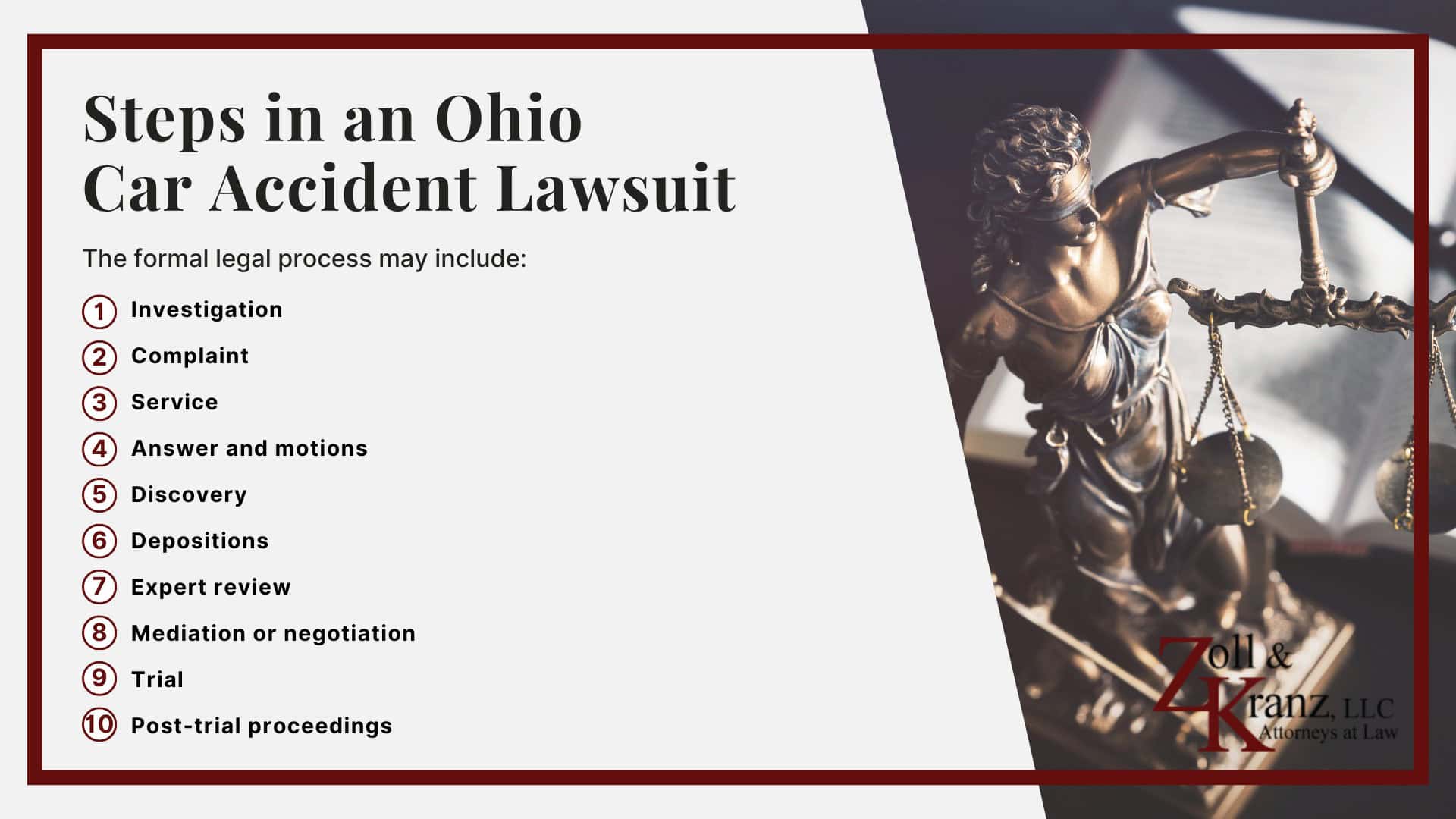
The formal legal process may include:

  1. Investigation: Counsel gathers records, interviews witnesses, and identifies the parties involved.
  2. Complaint: The injured party files allegations and requested relief in the proper court.
  3. Service: The defendants receive the complaint and summons.
  4. Answer and motions: The defendants respond and may challenge some claims.
  5. Discovery: The parties exchange written questions, documents, electronic evidence, and other information.
  6. Depositions: Witnesses and parties provide sworn testimony.
  7. Expert review: Medical, reconstruction, vocational, or economic experts may prepare opinions.
  8. Mediation or negotiation: The parties attempt to resolve the case.
  9. Trial: A jury or judge evaluates the evidence and determines liability and damages.
  10. Post-trial proceedings: Motions or the appeals process may follow.

Ohio’s Rules of Civil Procedure govern pleadings, service, discovery, trials, and judgments.

A small property or money dispute may sometimes be brought in small claims court, which has jurisdiction over qualifying money claims not exceeding $6,000, excluding interest and costs.

Serious bodily-injury cases usually involve damages or legal issues that make the regular civil docket more appropriate.

How Long Does an Ohio Car Accident Claim Take?

There is no single timeline for every car insurance claim.

A property-damage-only claim may resolve relatively quickly, while a claim involving disputed fault, surgery, permanent impairment, multiple policies, or litigation may take substantially longer.

The duration may depend on:

  • How quickly the police report becomes available
  • The number of vehicles and parties
  • Whether witnesses cooperate
  • The length of medical treatment
  • Whether maximum medical improvement is reached
  • Coverage disputes
  • Policy-limit issues
  • Comparative-negligence arguments
  • Expert analysis
  • Court scheduling

Insurers must follow Ohio’s claim-response and status-notification rules, but those rules do not guarantee a final settlement by a specific date when additional investigation is reasonably required.

Resolving a case too early may leave future losses uncompensated.

Waiting without preserving evidence or protecting the filing deadline can also damage the claim.

The appropriate timing depends on the medical picture, evidence, coverage, and approaching deadlines.

Ohio’s Statute of Limitations for Car Accident Injury Claims

Ohio Revised Code Section 2305.10 generally requires an action for bodily injury or injury to personal property to be filed within two years after the claim accrues.

In an ordinary collision case, that is generally measured from the date of the accident.

The deadline may require additional analysis when the crash involves:

  • A minor
  • A person under a statutory disability
  • A government employee or vehicle
  • A defendant who leaves the state
  • Wrongful death
  • Contractual UM/UIM deadlines
  • Claims against several defendants

Opening an insurance claim does not stop the court filing deadline.

Continuing discussions with an insurer also do not necessarily extend it.

Speak with a lawyer well before the apparent deadline so there is time to investigate, identify defendants, and serve the lawsuit properly.

Common Mistakes That Can Harm an Ohio Car Accident Claim

Mistakes made after a crash can weaken an Ohio car accident claim by limiting available evidence, creating questions about the injury, or giving the insurance company grounds to dispute liability and damages.

Common mistakes include:

  • Leaving the accident scene without exchanging information
  • Failing to call the police
  • Delaying medical care
  • Ignoring treatment recommendations
  • Giving speculative or inconsistent statements
  • Posting injury-related content on social media
  • Discarding damaged property or evidence
  • Authorizing vehicle destruction too quickly
  • Signing broad medical authorizations without review
  • Accepting a final offer before future needs are known
  • Missing policy-notice or legal deadlines
  • Assuming the insurer will protect the claimant’s interests

Another mistake is failing to report a loss to your own carrier because you expect the other insurer to pay.

Your own coverage may provide collision, MedPay, rental reimbursement, or UM/UIM benefits.

Ohio guidance advises insured drivers to report accidents promptly and cooperate with legitimate claim-investigation requests.

You may select your own repair shop unless the policy lawfully limits that right.

Ask the insurer and repair facility to explain discrepancies between estimates, required deductibles, and whether the proposed work will restore the vehicle properly.

When to Contact an Ohio Car Accident Lawyer

Contacting an Ohio car accident lawyer early can help preserve evidence, clarify insurance coverage, address disputed fault, and protect your claim before important deadlines expire.

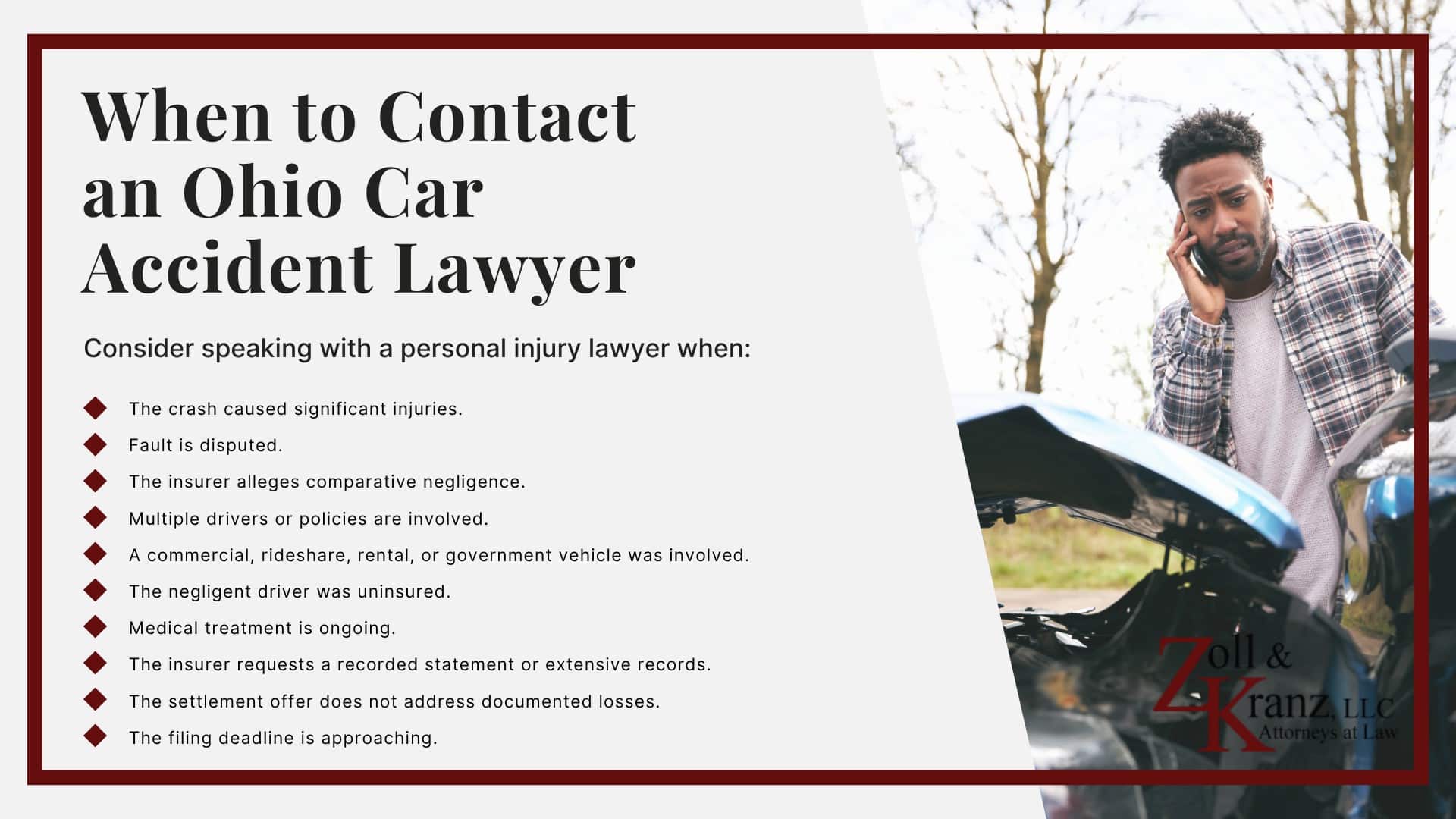
Consider speaking with a personal injury lawyer when:

  • The crash caused significant injuries.
  • Fault is disputed.
  • The insurer alleges comparative negligence.
  • Multiple drivers or policies are involved.
  • A commercial, rideshare, rental, or government vehicle was involved.
  • The negligent driver was uninsured.
  • Medical treatment is ongoing.
  • The insurer requests a recorded statement or extensive records.
  • The settlement offer does not address documented losses.
  • The filing deadline is approaching.

An early consultation may allow counsel to preserve video, electronic vehicle data, witness testimony, and other evidence before it disappears.

A lawyer can also identify whether the case involves a simple negligence claim or broader issues under Ohio personal injury law.

How Zoll & Kranz Can Help With the Claim Process

Zoll & Kranz can investigate the collision, identify the available insurance coverage, and manage communications with the carriers.

Our legal team may obtain the police report, photographs, witness accounts, medical records, wage statements, repair documentation, and policy information needed to support the claim.

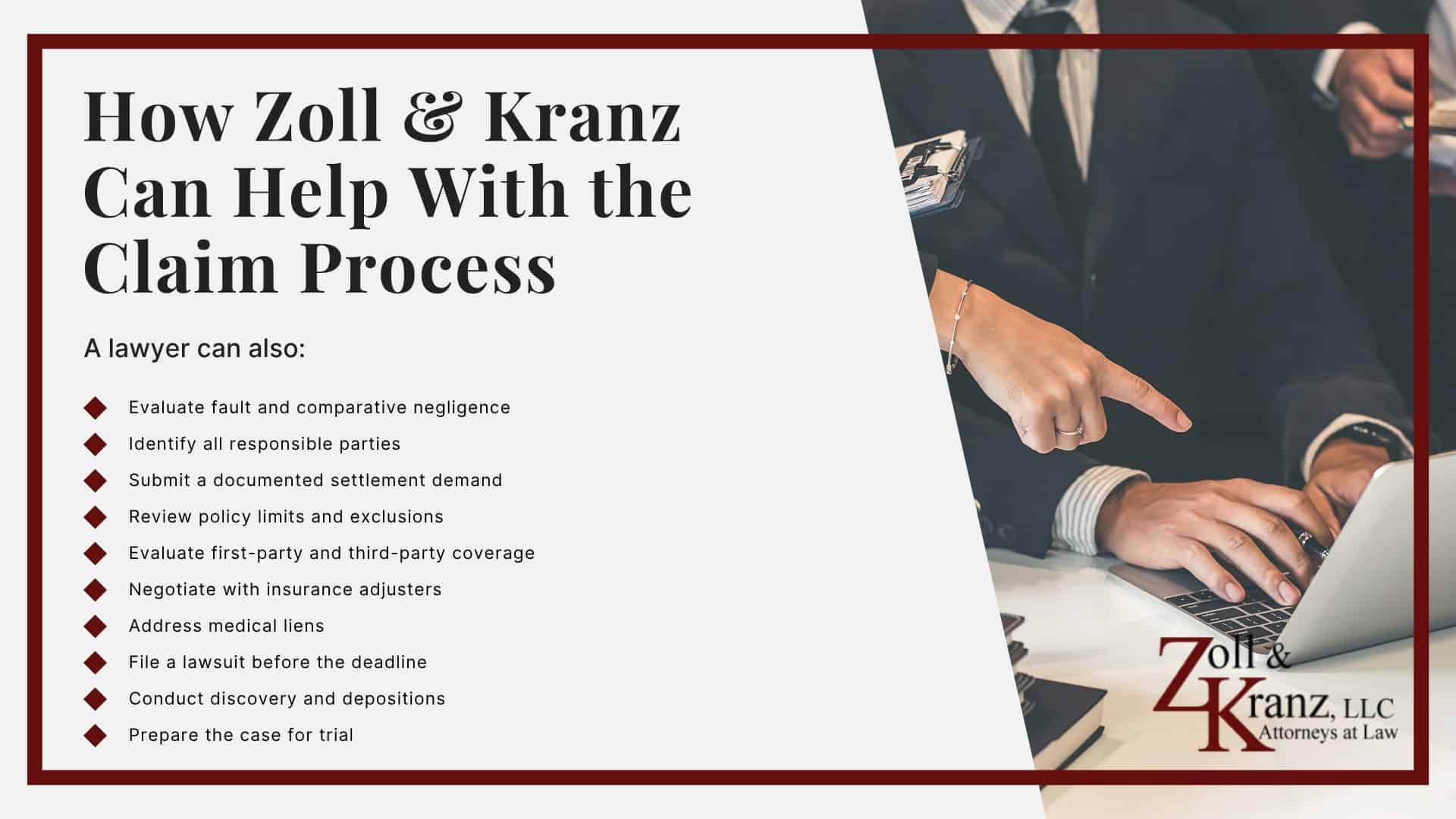
A lawyer can also:

  • Evaluate fault and comparative negligence
  • Identify all responsible parties
  • Submit a documented settlement demand
  • Review policy limits and exclusions
  • Evaluate first-party and third-party coverage
  • Negotiate with insurance adjusters
  • Address medical liens
  • File a lawsuit before the deadline
  • Conduct discovery and depositions
  • Prepare the case for trial

Legal representation cannot guarantee fair compensation, but it can help ensure that the claim is evaluated using complete liability, medical, wage, and insurance evidence.

Zoll & Kranz: Experienced Car Accident Attorneys

A car accident injury claim can become complicated when fault is disputed, medical treatment is ongoing, or several insurance policies may apply.

Our attorneys can investigate the collision, preserve evidence, review available coverage, document medical and financial losses, and negotiate with the insurance companies on your behalf.

We can also evaluate settlement offers against the evidence, address uninsured or underinsured motorist issues, and file a lawsuit when litigation is necessary to protect the claim.

Our law firm handles qualifying personal injury cases on a contingency fee basis, so clients do not pay upfront attorney fees and legal fees are tied to a financial recovery, subject to the written fee agreement.

Contact Zoll & Kranz to speak with an experienced personal injury attorney about your Ohio auto accident.

Schedule a free case evaluation or use the chat feature on this page to request an initial review of your claim.

Frequently Asked Questions

Published by:
Share
Picture of Michelle L. Kranz
Michelle L. Kranz

Michelle is a founding partner of Zoll & Kranz, located in Toledo, Ohio. Michelle has been a plaintiff’s lawyer for the entirety of her practice – over 32 years. She devotes the majority of her time to complex consolidated litigation and class action including advocating for people injured by medical devices, prescription medications, or corporate negligence.

This article has been written and reviewed for legal accuracy and clarity by the team of writers and attorneys at Zoll & Kranz, LLC and is as accurate as possible. This content should not be taken as legal advice from an attorney. If you would like to learn more about our owner and experienced Ohio injury lawyer, Michelle L. Kranz, you can do so here.

Zoll & Kranz, LLC does everything possible to make sure the information in this article is up to date and accurate. If you need specific legal advice about your case, contact us. This article should not be taken as advice from an attorney.

Other cases we handle in Toledo
All
Auto Accidents
Injury Types
Medical Malpractice
Nursing Home Abuse
Other Accidents & Injuries
You can learn more about other Toledo cases we handle below:
Auto Accident Lawsuit Timeline in Toledo
Auto Accident Statute of Limitations in Toledo, OH
Bedsores in Toledo Nursing Homes
Collecting Evidence in Toledo Medical Malpractice Cases
Collecting Evidence in Toledo Nursing Home Negligence Cases
Common Car Accident Injuries in Toledo, OH
Common Causes of Nursing Home Negligence
Common Types of Car Accident Damages
Dehydration and Malnutrition in Nursing Homes
Distracted Driving Accidents in Toledo, OH
Dropped Patients in Nursing Homes
DUI Accidents in Toledo
Duty of Care Owed by Nursing Home Facilities in Ohio
Evidence in Toledo Auto Accident Cases
Failure to Perform Procedure Malpractice Lawyer in Toledo
Head-On Collisions in Toledo
Hit-and-Run Accidents in Toledo
How is Fault Determined in a Car Accident?
How To File a Car Crash Lawsuit in Toledo
How to Report Nursing Home Abuse in Toledo, Ohio
Inattentive Nursing Home Staff: Steps to Take
Infections in Nursing Homes | Can You Sue?
Initial Steps To Take in a Toledo Medical Malpractice Case
Interstate Accidents in Toledo
Liability in Nursing Home Negligence Cases
Liability in Toledo Medical Malpractice Claims
Medication Errors in Nursing Homes
Mental and Emotional Abuse in Nursing Homes
Negligence in Toledo Medical Malpractice Cases
Negligent Hiring in Nursing Homes
Nursing Home Negligence Wrongful Death Cases in Toledo
Paralysis in Auto Accidents
Patient Falls in Nursing Homes
Patient Rights in a Nursing Home
Personal Injury Lawyer Toledo, Ohio
Physical Abuse in Nursing Homes
Process of a Medical Malpractice Case in Toledo
Rear-End Collisions in Toledo, OH
Rental Car Accidents in Toledo
Rollover Accidents in Toledo
Securing a Police Report in Toledo After an Auto Accident
Sexual Abuse in Toledo Nursing Homes
Sideswipe Accidents in Toledo
Steps to Take After an Auto Accident in Toledo, OH
Toledo Anesthesia Errors Lawyer
Toledo Auto Accident Comparative Negligence Explained
Toledo Auto Accident Lawyer
Toledo Bicycle Accident Lawyer
Toledo Burn Injury Lawyer
Toledo Bus Accident Lawyer
Toledo Cancer Misdiagnosis Lawyer
Toledo Car Accident Lawyer
Toledo Catastrophic Injury Lawyer
Toledo Daycare Injury Lawyer
Toledo Delayed Diagnosis Lawyer
Toledo Emergency Room Error Lawyer
Toledo Failure To Diagnose Lawyer
Toledo Insurance Claim Lawyer
Toledo Lyft Accident Lawyer
Toledo Mass Torts Lawyer
Toledo Medical Malpractice Lawyer
Toledo Medication Error Lawyer
Toledo Misdiagnosis Medical Malpractice Lawyer
Toledo Motorcycle Accident Lawyer
Toledo Nurse Error Lawyer
Toledo Nursing Home Abuse Lawyer
Toledo Nursing Home Negligence Safety and Preventative Measures
Toledo Pedestrian Accident Lawyer
Toledo Public Transportation Accident Lawyer
Toledo Rideshare Accident Lawyer
Toledo Spinal Cord Injury Lawyer
Toledo Surgical Error Lawyer
Toledo Toxic Exposure Lawyer
Toledo Traumatic Brain Injury Lawyer
Toledo Truck Accident Lawyer
Toledo Uber Accident Lawyer
Toledo Whiplash Lawyer
Toledo Wrongful Death Lawyer
Types of Neglect in Nursing Homes
Wrong Site Surgery Malpractice in Toledo
Were you or a loved one injured in Toledo?

A serious injury can have life-altering results.

Don’t settle for less than you deserve, speak with an award-winning personal injury lawyer today.

29 Reviews
5.0
★★★★★
Recovered damages
$108 Million+

Table of Contents

Legal Guides
About Zoll & Kranz, LLC

For over 37 years, Zoll & Kranz has been fighting for clients who have been the victims of the wrongful death of a loved one.

Do you believe you’re entitled to compensation?

Use our Instant Case Evaluator to find out in as little as 60 seconds!

Guides & Resources

Other Toledo Personal Injury Cases

All
Auto Accidents
Injury Types
Medical Malpractice
Nursing Home Abuse
Other Accidents & Injuries
Local Toledo Resources
Education
Emergency Services
Courthouses
Department of Motor Vehicles
Sights to See