No fees unless we win.
Get a free consultation
29 Reviews
5.0
★★★★★

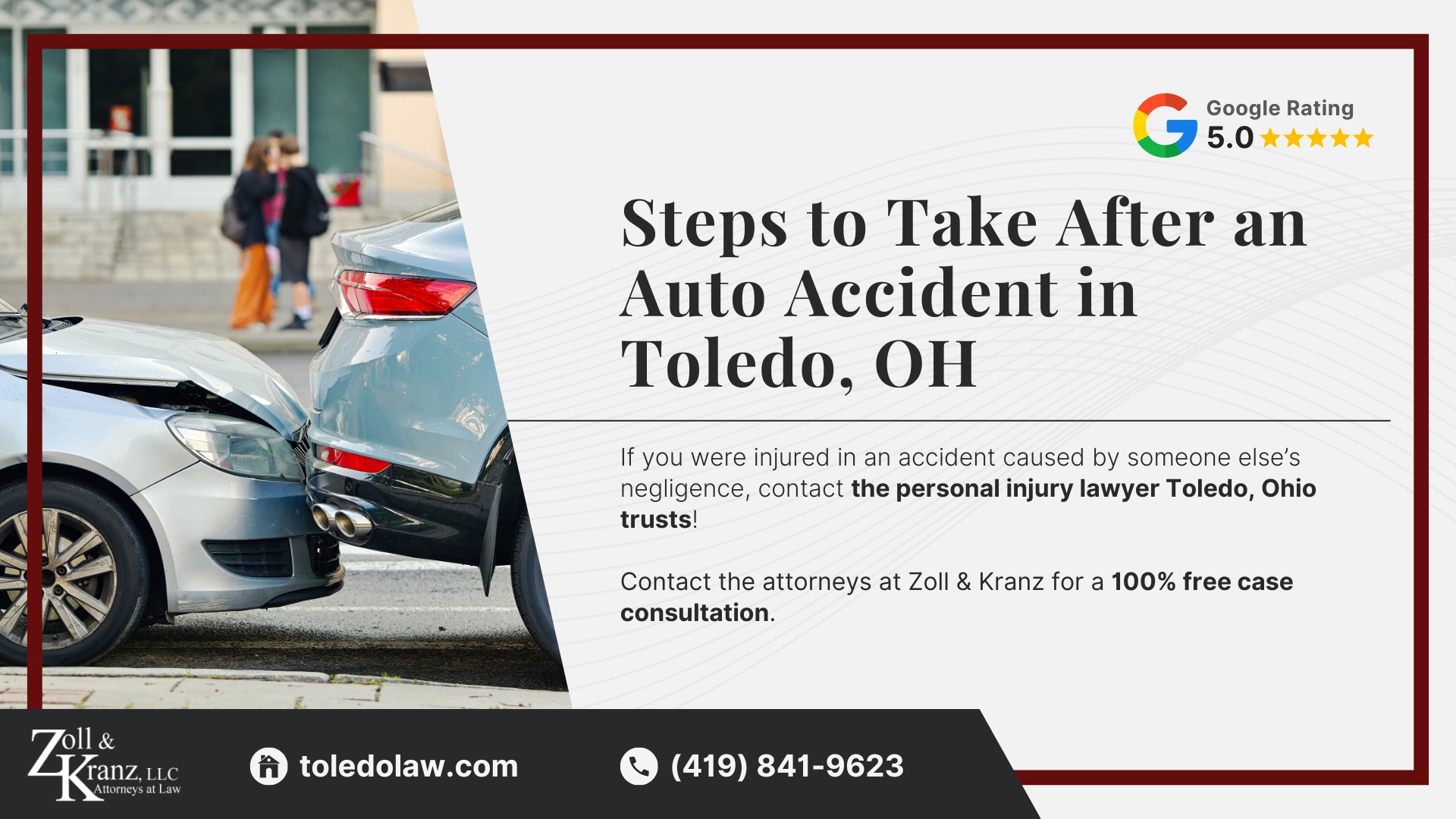
Steps to Take After an Auto Accident in Toledo, OH

Our Experienced Toledo Auto Accident Lawyers Help Protect Your Claim

The steps you take after an auto accident in Toledo can affect your safety, medical care, available evidence, and ability to pursue an injury claim.

When possible, injured drivers should report the crash, seek medical attention, exchange information, photograph the scene, and preserve witness details and other evidence.

Serious injuries may make those steps impossible, especially when a person is transported from the scene by ambulance or requires immediate emergency treatment.

Our attorneys can step in to obtain the police report, preserve photographs and video, gather medical and wage records, and identify potentially responsible parties and available insurance coverage.

Zoll & Kranz helps injured people protect important evidence and pursue compensation supported by the facts of the accident.

Steps to Take After an Auto Accident in Toledo, OH

Contact Our Toledo Auto Accident Lawyers at Zoll & Kranz Today

The hours and days after a Toledo auto accident can affect both your health and the evidence available for a future injury claim.

Seek medical attention even when injuries are not immediately apparent, since symptoms from conditions such as whiplash and concussion can develop hours or days after a collision.

Whiplash symptoms often begin within days of the injury, while other traumatic injuries may also have delayed symptoms.

A prompt medical evaluation can identify injuries requiring treatment and create a record of when symptoms were first reported.

Drivers should also notify their own insurance carrier promptly and follow the reporting requirements stated in the policy.

Ohio insurance rules recognize that notice requirements can be established through policy conditions, so waiting to report a crash can create coverage disputes or other complications.

Reporting requirements differ among states, and some jurisdictions impose separate driver-reporting obligations after crashes involving injuries or substantial property damage.

In Ohio, qualifying traffic crashes investigated by law enforcement are reported to the Department of Public Safety through the state’s crash-reporting system.

Our attorneys can help when serious injuries prevent you from photographing the scene, gathering witness information, communicating with insurers, or preserving other evidence yourself.

We can obtain crash records, locate available video, review insurance coverage, gather medical and wage documentation, and advise you before a recorded statement or final settlement.

If you or a loved one was injured in an auto accident in Toledo, contact Zoll & Kranz today for a free consultation or use the chat feature on this page to request an initial review of your claim.

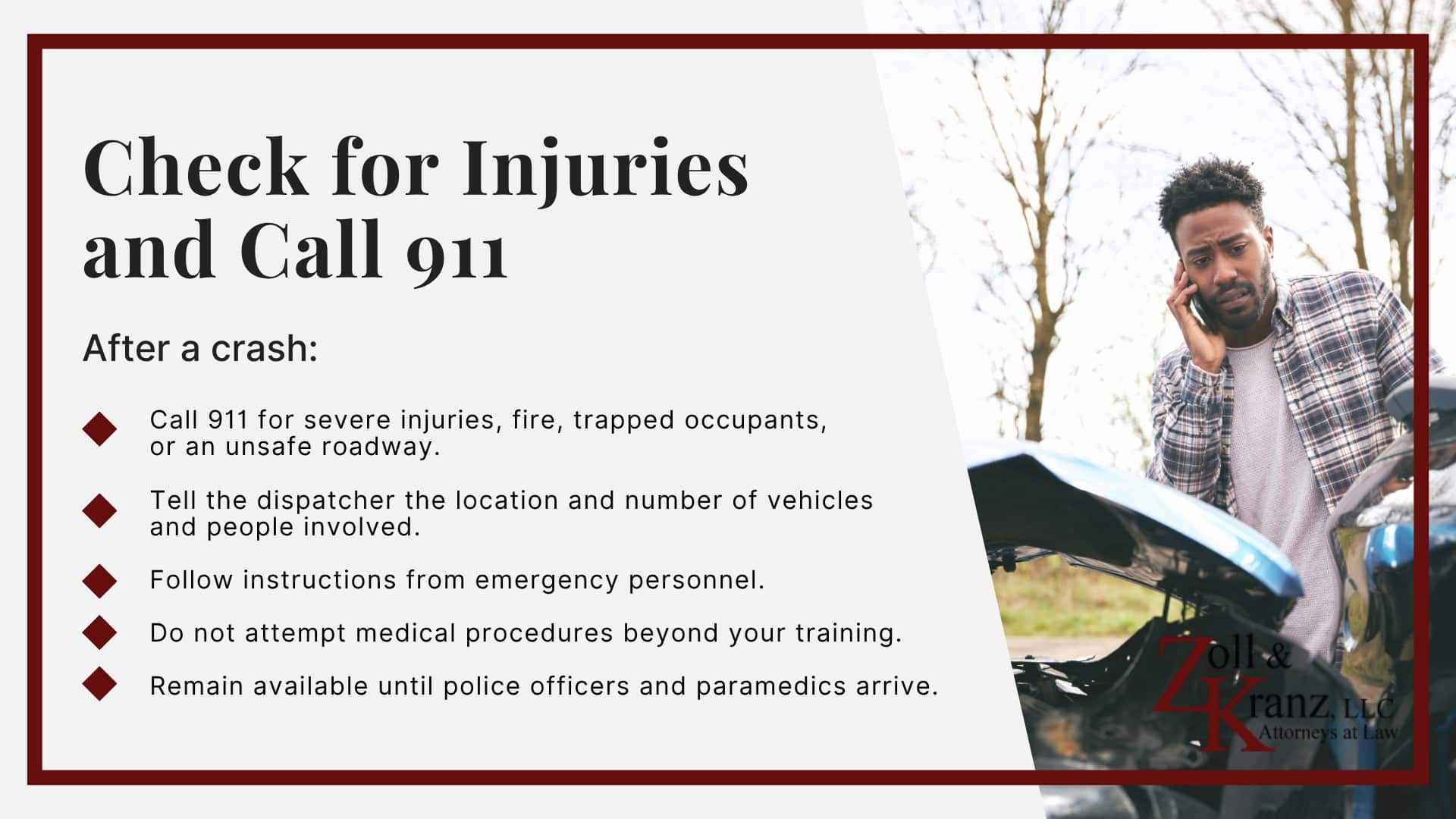
Check for Injuries and Call 911

The first priority after a Toledo car accident is the well being of every driver, pedestrian, and passenger involved.

Stay calm, check yourself and other passengers for visible or suspected injuries, and call the police and emergency medical services when anyone may be hurt.

Do not move an injured person unless remaining in place creates an immediate danger, such as fire, leaking fuel, or approaching traffic.

After a crash:

  • Call 911 for severe injuries, fire, trapped occupants, or an unsafe roadway.
  • Tell the dispatcher the location and number of vehicles and people involved.
  • Follow instructions from emergency personnel.
  • Do not attempt medical procedures beyond your training.
  • Remain available until police officers and paramedics arrive.

Even a minor accident can cause concussions, whiplash, or other soft tissue injuries that are not immediately obvious.

Seek emergency help for significant pain, confusion, weakness, bleeding, difficulty breathing, or loss of consciousness.

Toledo Police directs people to call 911 when an emergency requires units to be dispatched.

Move to Safety Without Leaving the Accident Scene

Ohio law requires a motorist who knows an accident occurred on a public road to stop immediately and remain at the scene of the accident long enough to provide the required identifying and vehicle information.

Failure to stop can be a criminal offense, with more serious penalties when a collision causes serious physical harm or death.

If your car is creating a traffic hazard and can be moved safely, follow instructions from law enforcement or emergency dispatch about where to position it.

Activate the hazard lights, stay away from active traffic lanes, and use road flares only if they are available and can be placed without exposing anyone to additional danger.

Approaching motorists should slow down or change lanes when encountering emergency or disabled vehicles displaying flashing lights.

Do not leave the area simply because the vehicle damage appears limited.

If the vehicle cannot be driven, wait in a protected area for emergency responders or tow trucks unless remaining near the vehicle is unsafe.

Report the Crash to Toledo Police or the Appropriate Agency

Contact Toledo Police when a collision occurs within city limits, particularly when someone is injured, traffic is blocked, a driver leaves the accident scene, or there is substantial property damage.

A crash on an interstate, state highway, or outside Toledo may be handled by the Ohio State Highway Patrol, Lucas County Sheriff’s Office, or another law-enforcement agency with jurisdiction.

Tell dispatchers exactly where the crash occurred and describe any immediate hazards.

When the police arrive, provide truthful information about what you observed without guessing about speed, distance, or fault.

Ask how to obtain the report number and where the final police report will be available.

Toledo Police states that accident reports cannot be filed through its online crime-reporting system and that completed accident reports may be retrieved through the Ohio Department of Public Safety or in person through the department.

A report does not automatically decide legal responsibility, but it may document:

  • The names of the parties involved
  • Vehicle and insurance information
  • Witness identities
  • Road and weather conditions
  • Apparent injuries
  • Traffic citations
  • Statements made at the scene
  • The investigating officer’s observations

Exchange Driver, Vehicle, and Insurance Information

Ohio law requires a driver involved in a public-road collision to remain at the scene and provide the driver’s name and address, the vehicle registration number, and the owner’s information when the driver is not the car owner.

If an injured person cannot understand or record the information, the other operator must notify the nearest police authority and remain until an officer arrives unless the operator is removed by an ambulance or qualifying emergency vehicle.

When possible, exchange information and collect:

  • The other driver’s full name and address
  • Contact details, including current phone numbers
  • The driver’s license and driver’s license number
  • The vehicle make, model, year, and color
  • The license plate and all relevant license plate numbers
  • The registered owner’s name
  • The insurance provider
  • A photograph of the insurance card
  • The policy number
  • Names and telephone numbers for passengers

Use your phone to photograph the documents rather than relying on handwritten notes when possible.

Make sure you obtain license plate information for every vehicle involved, including commercial vehicles, trailers, and rental cars.

Do not photograph documents while standing in moving traffic.

Photograph the Vehicles and Accident Scene

If your condition permits, take pictures and video before vehicles are repaired, towed, or moved.

Images from the scene can help establish the point of impact, travel direction, visibility, roadway layout, and severity of the car crash.

Begin with wide photographs showing the entire area, then capture detailed images.

Take photographs of:

  • Every side of each vehicle
  • The location and extent of vehicle damage
  • Broken glass and debris
  • Skid marks
  • Lane markings and traffic controls
  • Traffic signals and signs
  • Road construction or obstructions
  • Weather, lighting, and pavement conditions
  • Visible injuries
  • Deployed airbags
  • Vehicle identification and license plates

Do not put yourself in danger to collect photographs.

When accident victims are transported for emergency care, family members, passengers, law enforcement, or an attorney may later obtain photographs from witnesses, nearby businesses, highway cameras, or the towing facility.

Gather Witness Information and Other Evidence

Independent witnesses may help explain how the collision occurred when drivers provide conflicting accounts.

Ask witnesses for their names, contact details, phone numbers, and email addresses.

Do not pressure them to give an opinion or argue with them about who caused the crash.

Other evidence may include:

  • Dashcam video
  • Surveillance recordings from nearby businesses or homes
  • Photographs taken by other passengers
  • 911 recordings
  • Body-camera or cruiser-camera footage
  • Vehicle event-data information
  • Towing and storage records
  • Delivery, rideshare, or employment records
  • Cellphone records when distracted driving is suspected

Write down important details while they are fresh, including the sequence of impacts, the direction each vehicle was traveling, and anything the other driver said.

Early efforts to preserve evidence may prevent recordings or electronic data from being erased under routine retention practices.

Toledo Police explains that requests for video, photos, 911 audio, and other records may be made through its public-records process, subject to applicable restrictions and retention rules.

Seek Medical Attention After a Toledo Auto Accident

Obtain prompt medical treatment after a collision, especially when you experience pain, dizziness, nausea, numbness, confusion, weakness, or restricted movement.

Some injuries are immediately visible, while concussions, whiplash, back injuries, and other soft tissue injuries may develop or become more noticeable over time.

Tell medical providers how the accident happened and report every symptom accurately.

Follow discharge instructions, attend scheduled appointments, and comply with reasonable treatment recommendations.

These steps protect your health and create medical documentation connecting the crash to the diagnosis and care provided.

Keep copies of:

  • Emergency-room and hospital records
  • Diagnostic imaging
  • Specialist and therapy notes
  • Prescriptions
  • Medical equipment receipts
  • Work restrictions
  • Itemized medical expenses
  • Transportation costs
  • Future treatment recommendations
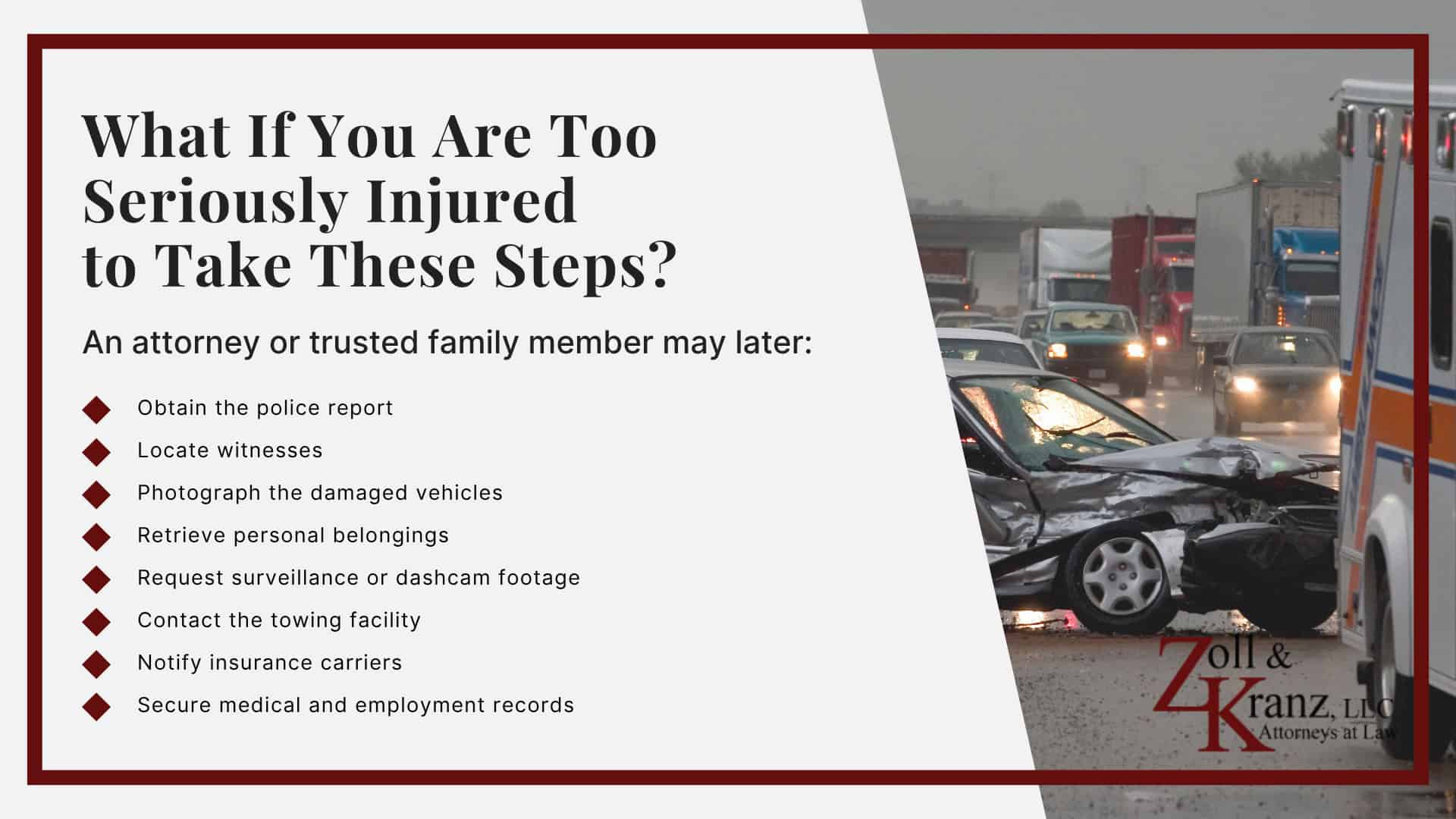
What If You Are Too Seriously Injured to Take These Steps?

People with severe injuries are not expected to remain at the roadside collecting photographs and insurance information instead of receiving emergency care.

If paramedics take you from the scene, focus on your immediate health and let emergency personnel handle the crash site.

An attorney or trusted family member may later:

  • Obtain the police report
  • Locate witnesses
  • Photograph the damaged vehicles
  • Retrieve personal belongings
  • Request surveillance or dashcam footage
  • Contact the towing facility
  • Notify insurance carriers
  • Secure medical and employment records

Being unconscious, hospitalized, or physically unable to follow every item in a step by step guide does not automatically prevent an injury claim.

The available evidence can often be reconstructed through police records, emergency responders, passengers, witnesses, vehicle data, and medical records.

How Family Members and Passengers Can Preserve Evidence

Family members and passengers can assist when the injured driver cannot manage calls, paperwork, or evidence collection.

Their role should be to protect records and communicate basic facts, not to speculate about liability or negotiate a final settlement without authority.

Helpful actions may include:

  • Photographing the vehicle at the tow yard
  • Preserving damaged clothing and personal items
  • Obtaining receipts and bills
  • Recording the names of treating providers
  • Keeping a timeline of symptoms and treatment
  • Saving insurer letters, emails, and claim numbers
  • Collecting employment and wage information
  • Writing down the names of witnesses and officers

Family members should not repair, sell, or dispose of a totaled vehicle before potentially relevant evidence is examined.

They should also avoid posting photographs or details about the injured person on social media, where an insurance company may later review the content.

Notify Your Insurance Company and Review Available Coverage

Report the collision to your own driver’s insurance company promptly and follow the notice requirements in the insurance policy.

Provide the date, time, location, vehicles involved, and basic facts needed to open an insurance claim.

Ask for the claim number and the name and contact information of the assigned adjuster.

Available coverage may include:

  • Bodily-injury liability
  • Property-damage liability
  • Collision coverage
  • Medical-payments coverage
  • Uninsured or underinsured motorist coverage
  • Rental reimbursement
  • Towing and roadside assistance

Ohio liability policies generally carry minimum limits of $25,000 for bodily injury to one person, $50,000 for injury to two or more people, and $25,000 for damage to others’ property.

Higher limits and optional coverages depend on the policy purchased.

You may also open a third-party claim with the other driver’s insurance company, but that carrier does not represent your interests.

Review both policies before assuming the other carrier will cover all medical expenses, repair costs, or losses.

Be Careful When Speaking With Insurance Adjusters

Insurance adjusters may ask for photographs, medical authorizations, prior health information, and a recorded statement.

Provide accurate information, but do not guess, minimize symptoms, or agree with a description of the crash that you do not understand.

Symptoms and treatment needs may change after the initial conversation.

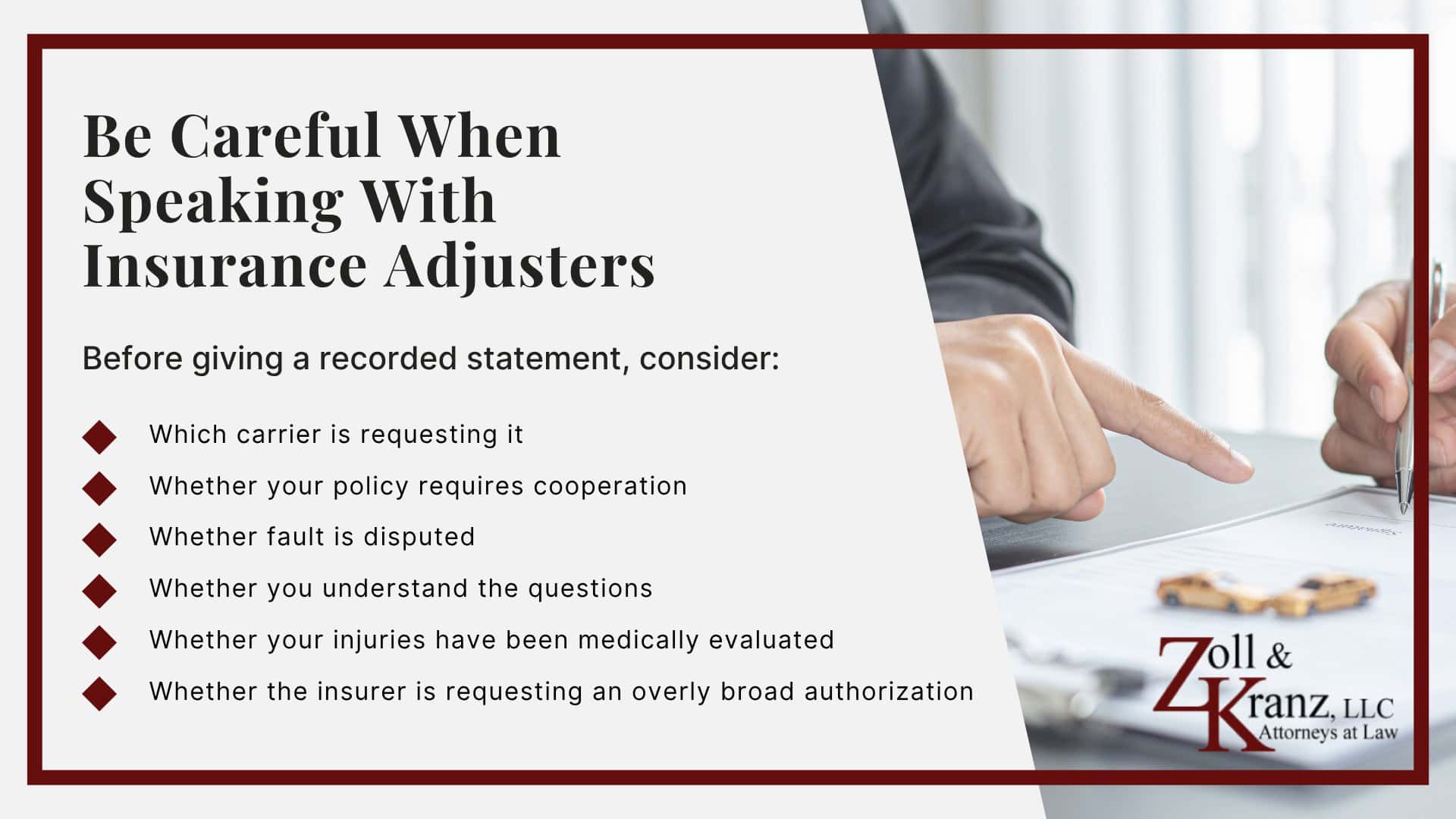
Before giving a recorded statement, consider:

  • Which carrier is requesting it
  • Whether your policy requires cooperation
  • Whether fault is disputed
  • Whether you understand the questions
  • Whether your injuries have been medically evaluated
  • Whether the insurer is requesting an overly broad authorization

Ohio claim rules set standards for how insurers investigate and process property and casualty claims.

They also require insurers to document the use of comparative negligence in settlement evaluation and disclose that information upon written request.

Do not assume the adjuster for the other insurance company is advising you about what is in your best interest.

A lawyer can handle communications while preserving your ability to pursue the car accident claim.

Document Medical Treatment, Lost Wages, and Other Expenses

A personal injury claim requires proof of the losses caused by the crash.

Keep an organized file containing medical records, bills, wage information, repair documents, insurer correspondence, and receipts.

Documentation should show both the immediate costs and any continuing effects.

Potential losses may include:

  • Emergency and hospital care
  • Follow-up appointments
  • Rehabilitation and therapy
  • Medication
  • Past and future medical expenses
  • Lost wages
  • Reduced earning capacity
  • Transportation expenses
  • Home assistance
  • Towing and storage fees
  • Rental-car expenses
  • Property damage
  • Vehicle repair costs

Ask the body shop for written repair estimates and preserve copies of supplemental estimates if additional damage is discovered.

Ohio claim rules address written repair estimates and require insurers to provide a copy of an estimate used as the basis of a proposed automobile property settlement.

What Not to Do After an Auto Accident

Knowing what to avoid is an important part of the steps to take after an auto accident.

Actions taken in the hours or weeks after a crash may affect the available evidence, insurance coverage, and credibility of the claim.

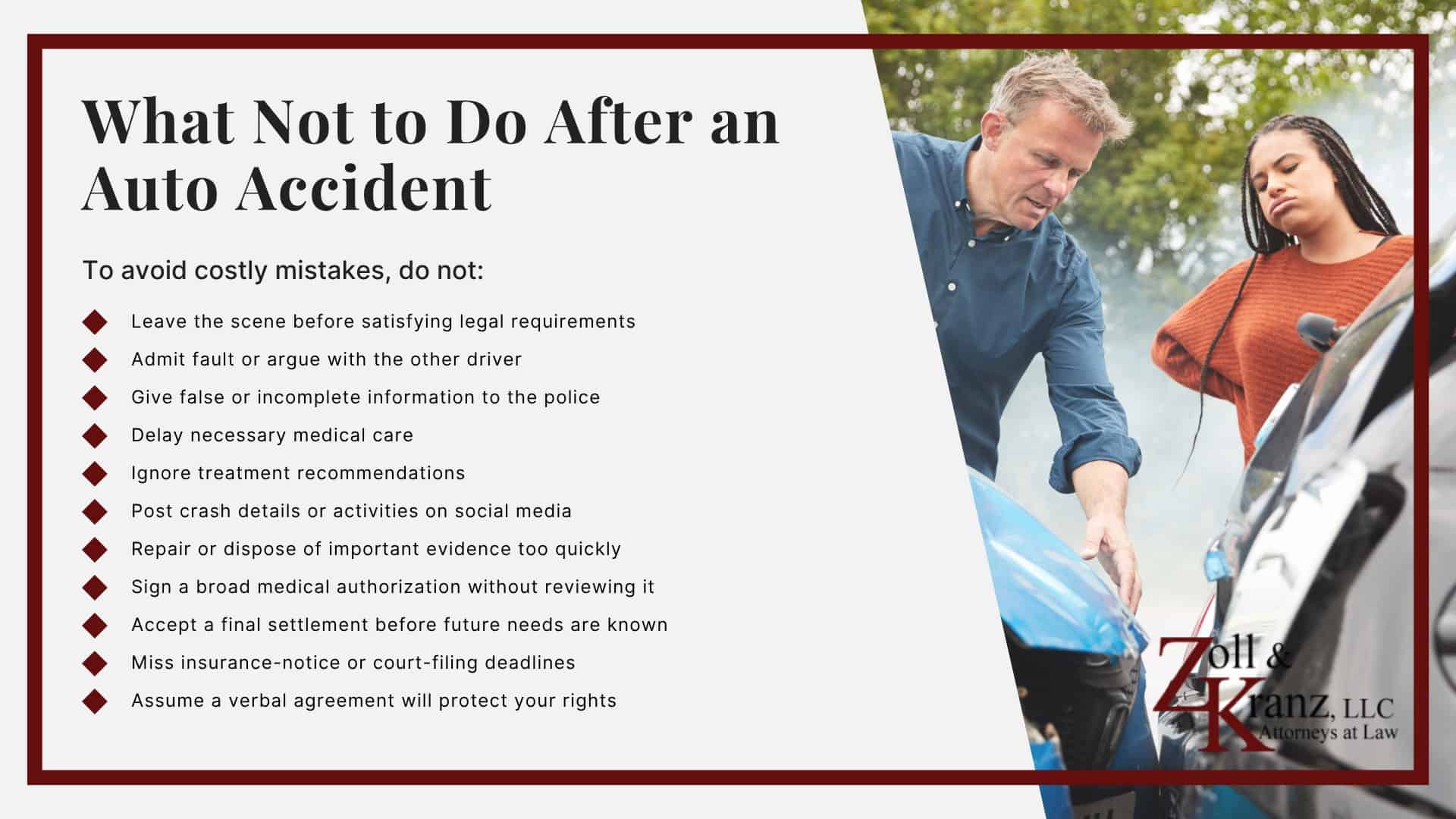
To avoid costly mistakes, do not:

  • Leave the scene before satisfying legal requirements
  • Admit fault or argue with the other driver
  • Give false or incomplete information to the police
  • Delay necessary medical care
  • Ignore treatment recommendations
  • Post crash details or activities on social media
  • Repair or dispose of important evidence too quickly
  • Sign a broad medical authorization without reviewing it
  • Accept a final settlement before future needs are known
  • Miss insurance-notice or court-filing deadlines
  • Assume a verbal agreement will protect your rights

One of the most costly mistakes is accepting payment that requires a release before the full extent of the injuries is documented.

Another is allowing a damaged car to be destroyed when a defective component or disputed impact pattern may matter.

How Fault Is Determined Under Ohio Law

Fault depends on whether a person or business failed to use reasonable care and whether that conduct caused the collision and resulting harm.

The police report, traffic citations, witness statements, photographs, video, vehicle damage, and applicable traffic laws may all be considered.

The officer’s conclusions may be relevant, but an insurer, judge, or jury can reach a different determination based on the complete evidence.

Potentially responsible other parties may include:

  • The other driver
  • A vehicle owner
  • An employer
  • A trucking or delivery company
  • A repair business
  • A vehicle or component manufacturer
  • A roadway contractor
  • A government entity, subject to applicable immunity rules

A car accident claim may involve more than one at-fault party.

An attorney can investigate whether multiple drivers, companies, or insurance policies contributed to the loss.

Ohio’s Modified Comparative Negligence Rule

Ohio follows modified comparative negligence.

An injured plaintiff may recover damages when the plaintiff’s share of fault is not greater than the combined fault assigned to the other responsible people or entities.

The amount awarded is reduced in proportion to the plaintiff’s percentage of responsibility.

For example, a person with $100,000 in proven damages who is found 20% responsible may have the award reduced to $80,000.

A plaintiff who is more than 50% at fault is generally barred from recovering under this rule.

Insurance carriers may raise comparative-fault arguments during negotiations, making scene evidence and witness testimony important.

When an Insurance Claim May Become a Lawsuit

Many cases resolve through insurance negotiations, but a personal injury lawsuit may become necessary when the carrier disputes fault, denies coverage, challenges the connection between the crash and the injuries, or refuses a settlement supported by the evidence.

Filing suit may also be necessary to preserve legal rights before the statute of limitations expires.

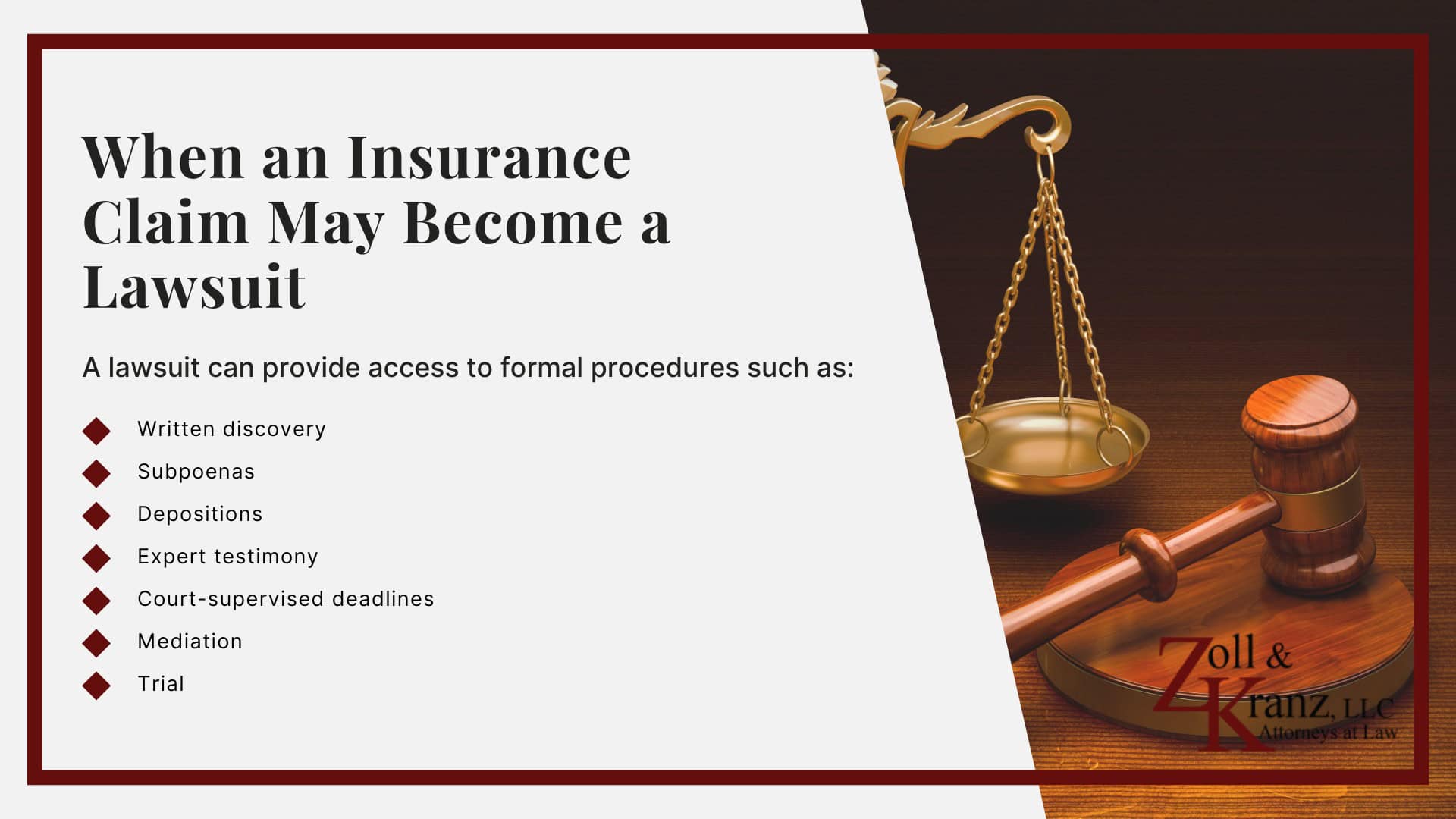
A lawsuit can provide access to formal procedures such as:

  • Written discovery
  • Subpoenas
  • Depositions
  • Expert testimony
  • Court-supervised deadlines
  • Mediation
  • Trial

The lawsuit is usually filed against the people or businesses alleged to be legally responsible, not simply against the insurance company.

Settlement discussions may continue throughout the litigation.

Ohio’s Filing Deadline for Auto Accident Injury Claims

Ohio Revised Code Section 2305.10 generally requires an action for bodily injury or damage to personal property to be filed within two years after the cause of action accrues.

In an ordinary Toledo auto accident case, that period generally begins on the date of the collision.

The deadline may require additional analysis when:

  • The injured person is a minor
  • A government vehicle or employee is involved
  • The defendant leaves Ohio
  • The crash causes a later death
  • Several parties share responsibility
  • An insurance policy imposes a contractual deadline

Opening an insurance claim does not stop the statutory period.

Negotiating with an insurer also does not necessarily extend the deadline, so legal review should occur well before the two-year mark.

When to Contact a Toledo Auto Accident Lawyer

Contacting a lawyer early may help protect physical, electronic, and witness evidence before it disappears.

Legal assistance may be particularly important when the accident caused serious injuries, the drivers disagree about fault, or the available insurance appears insufficient.

Consider contacting an attorney when:

  • You were hospitalized or taken from the scene
  • You could not personally gather evidence
  • Fault is disputed
  • Multiple vehicles or insurance policies are involved
  • A commercial or government vehicle was involved
  • The other driver left the scene
  • The insurer requests extensive records or a recorded statement
  • The settlement offer does not address documented losses
  • A filing deadline is approaching

A lawyer can explain your rights under Ohio personal injury law and determine whether the matter should remain an insurance claim or proceed to litigation.

How a Lawyer Can Help After a Serious Toledo Crash

A Toledo auto accident lawyer can reconstruct what happened even when the injured person could not collect evidence at the scene.

The attorney may obtain the police report, request video, locate witnesses, inspect the vehicles, review insurance policies, and identify all potentially responsible parties.

Legal assistance may include:

  • Preserving the damaged vehicle and electronic data
  • Requesting 911, cruiser, and body-camera records
  • Obtaining medical documentation
  • Calculating lost wages and future losses
  • Reviewing the other driver’s insurance coverage
  • Managing calls from insurance adjusters
  • Negotiating the injury and property claims
  • Filing suit before the deadline
  • Taking depositions and retaining experts
  • Preparing the case for trial

Legal representation does not guarantee a specific result.

It can, however, help organize the evidence and keep the claim focused on documented fault, injuries, and financial losses.

Zoll & Kranz: Get Help After an Auto Accident in Toledo

The aftermath of a serious Toledo auto accident can involve emergency treatment, vehicle damage, missed work, insurance disputes, and important evidence that may disappear quickly.

Our attorneys can investigate the crash, obtain police and medical records, preserve photographs and video, identify witnesses, review available insurance coverage, and document the financial losses caused by the collision.

We can also step in when injuries prevented you from gathering evidence at the scene or communicating with insurance companies on your own.

Our attorneys can investigate the accident, preserve evidence, and pursue compensation supported by the facts.

Zoll & Kranz handles qualifying personal injury cases on a contingency fee basis, meaning attorney fees are tied to a financial recovery rather than charged as an upfront hourly fee.

Contact our law firm for a free consultation if you or a loved one was injured in a Toledo car accident.

You can also use the chat feature on this page to request an initial review of your claim.

Frequently Asked Questions

Published by:
Share
Picture of Michelle L. Kranz
Michelle L. Kranz

Michelle is a founding partner of Zoll & Kranz, located in Toledo, Ohio. Michelle has been a plaintiff’s lawyer for the entirety of her practice – over 32 years. She devotes the majority of her time to complex consolidated litigation and class action including advocating for people injured by medical devices, prescription medications, or corporate negligence.

This article has been written and reviewed for legal accuracy and clarity by the team of writers and attorneys at Zoll & Kranz, LLC and is as accurate as possible. This content should not be taken as legal advice from an attorney. If you would like to learn more about our owner and experienced Ohio injury lawyer, Michelle L. Kranz, you can do so here.

Zoll & Kranz, LLC does everything possible to make sure the information in this article is up to date and accurate. If you need specific legal advice about your case, contact us. This article should not be taken as advice from an attorney.

Other cases we handle in Toledo
All
Auto Accidents
Injury Types
Medical Malpractice
Nursing Home Abuse
Other Accidents & Injuries
You can learn more about other Toledo cases we handle below:
Auto Accident Lawsuit Timeline in Toledo
Auto Accident Statute of Limitations in Toledo, OH
Bedsores in Toledo Nursing Homes
Car Accident Injury Claim Process in Ohio
Collecting Evidence in Toledo Medical Malpractice Cases
Collecting Evidence in Toledo Nursing Home Negligence Cases
Common Car Accident Injuries in Toledo, OH
Common Causes of Nursing Home Negligence
Common Types of Car Accident Damages
Dehydration and Malnutrition in Nursing Homes
Distracted Driving Accidents in Toledo, OH
Dropped Patients in Nursing Homes
DUI Accidents in Toledo
Duty of Care Owed by Nursing Home Facilities in Ohio
Evidence in Toledo Auto Accident Cases
Failure to Perform Procedure Malpractice Lawyer in Toledo
Head-On Collisions in Toledo
Hit-and-Run Accidents in Toledo
How is Fault Determined in a Car Accident?
How To File a Car Crash Lawsuit in Toledo
How to Report Nursing Home Abuse in Toledo, Ohio
Inattentive Nursing Home Staff: Steps to Take
Infections in Nursing Homes | Can You Sue?
Initial Steps To Take in a Toledo Medical Malpractice Case
Interstate Accidents in Toledo
Liability in Nursing Home Negligence Cases
Liability in Toledo Medical Malpractice Claims
Medication Errors in Nursing Homes
Mental and Emotional Abuse in Nursing Homes
Negligence in Toledo Medical Malpractice Cases
Negligent Hiring in Nursing Homes
Nursing Home Negligence Wrongful Death Cases in Toledo
Paralysis in Auto Accidents
Patient Falls in Nursing Homes
Patient Rights in a Nursing Home
Personal Injury Lawyer Toledo, Ohio
Physical Abuse in Nursing Homes
Process of a Medical Malpractice Case in Toledo
Rear-End Collisions in Toledo, OH
Rental Car Accidents in Toledo
Rollover Accidents in Toledo
Securing a Police Report in Toledo After an Auto Accident
Sexual Abuse in Toledo Nursing Homes
Sideswipe Accidents in Toledo
Toledo Anesthesia Errors Lawyer
Toledo Auto Accident Comparative Negligence Explained
Toledo Auto Accident Lawyer
Toledo Bicycle Accident Lawyer
Toledo Burn Injury Lawyer
Toledo Bus Accident Lawyer
Toledo Cancer Misdiagnosis Lawyer
Toledo Car Accident Lawyer
Toledo Catastrophic Injury Lawyer
Toledo Daycare Injury Lawyer
Toledo Delayed Diagnosis Lawyer
Toledo Emergency Room Error Lawyer
Toledo Failure To Diagnose Lawyer
Toledo Insurance Claim Lawyer
Toledo Lyft Accident Lawyer
Toledo Mass Torts Lawyer
Toledo Medical Malpractice Lawyer
Toledo Medication Error Lawyer
Toledo Misdiagnosis Medical Malpractice Lawyer
Toledo Motorcycle Accident Lawyer
Toledo Nurse Error Lawyer
Toledo Nursing Home Abuse Lawyer
Toledo Nursing Home Negligence Safety and Preventative Measures
Toledo Pedestrian Accident Lawyer
Toledo Public Transportation Accident Lawyer
Toledo Rideshare Accident Lawyer
Toledo Spinal Cord Injury Lawyer
Toledo Surgical Error Lawyer
Toledo Toxic Exposure Lawyer
Toledo Traumatic Brain Injury Lawyer
Toledo Truck Accident Lawyer
Toledo Uber Accident Lawyer
Toledo Whiplash Lawyer
Toledo Wrongful Death Lawyer
Types of Neglect in Nursing Homes
Wrong Site Surgery Malpractice in Toledo
Were you or a loved one injured in Toledo?

A serious injury can have life-altering results.

Don’t settle for less than you deserve, speak with an award-winning personal injury lawyer today.

29 Reviews
5.0
★★★★★
Recovered damages
$108 Million+

Table of Contents

Legal Guides
About Zoll & Kranz, LLC

For over 37 years, Zoll & Kranz has been fighting for clients who have been the victims of the wrongful death of a loved one.

Do you believe you’re entitled to compensation?

Use our Instant Case Evaluator to find out in as little as 60 seconds!

Guides & Resources

Other Toledo Personal Injury Cases

All
Auto Accidents
Injury Types
Medical Malpractice
Nursing Home Abuse
Other Accidents & Injuries
Local Toledo Resources
Education
Emergency Services
Courthouses
Department of Motor Vehicles
Sights to See